
Implanted glucose sensor could help diabetics

sensor.jpg

Researchers have developed an implantable sensor that can monitor blood-sugar levels and send the data wirelessly to an external receiver. The team has used the device in pigs for over a year, and is hoping it will work successfully in humans with diabetes.

Diabetics have to routinely measure their blood glucose by pricking their fingers and reading the levels with a small meter, in order to keep the blood sugar in check.

“Four finger sticks per day to measure glucose levels is the current standard of care, but blood glucose can go on significant excursions between sticks,” says David Gough, an author of the study from the University of California in San Diego. “In contrast, the long-term implanted glucose monitor would provide continuous monitoring day and night.” (press release from UC San Diego)

The sensor could aid diabetes patients to adjust the timing and dosage of insulin, as well as minimizing the risk of potentially life-threatening hypoglycaemia—low blood sugar—resulting from too high a dose of insulin or the insulin absorbing too fast. It could also help type-2 diabetes patients to balance their diet and exercise plans.

In the study, published in Science Translational Medicine today (doi:10.1126/scitranslmed.3001148), the team reports inserting the sensors just beneath the skin of two pigs for 222 and 520 days respectively. The device is 1.5 cm thick and has a diameter of 3.4 cm. It works by detecting the amount of oxygen that is consumed in a chemical reaction with glucose, triggered by the enzyme glucose oxidase. The concentration of glucose is proportional to the consumption of oxygen in the reaction.

The authors say that short-term glucose sensors already exist, but they need to be replaced every 3-7 days and haven’t been approved by the Food and Drug Administration as a ”primary standard for glucose measurement”. (Science Translational Medicine, doi:10.1126/scitranslmed.3001148)

The research team has been collaborating with the San-Diego based company GlySens, which Gough started in 1998.

Gough says that he hopes to start the first human trials within a few months.

Image: C. Bickel/Science Translational Medicine © 2010 AAAS
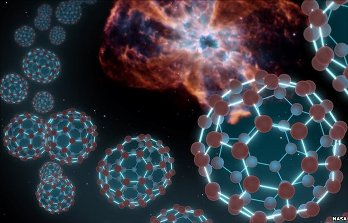
Carbon ‘buckyballs’ found in space for the first time

NASA_new.jpg

Astronomers have serendipitously found soccer-ball shaped carbon molecules in the nebula around a distant, white-dwarf star. The molecules are the largest ones ever found in space, and are part of a third type of carbon—the other two being graphite and diamond.

“We did not plan for this discovery,” said Jan Cami from the University of Western Ontario, London, Canada, who led the team making the discovery using NASA’s orbiting Spitzer infrared telescope. “But when we saw these whopping spectral signatures, we knew immediately that we were looking at one of the most sought-after molecules.” (NASA) The team published their findings in Science.

The molecules resemble the so-called ‘geodesic domes’ built by architect Buckminster Fuller, and are therefore called ‘buckyballs’ .

The buckyball molecule, C60, is about a nanometre across and consists of 60 carbon atoms arranged in a spherical, 3-D structure resembling a soccer ball. The molecule is exceptionally strong, and has chemical properties that scientists have long thought could make it useful in technological applications ranging from medicine to superconductivity and armor development.

The researchers also found the molecule C70, which is made up of 70 carbon atoms and is shaped like a stretched-out sphere. The two types of carbon together are estimated to make up about 3 percent of the carbon around the star, which is located in the planetary nebula Tc-1 in the constellation Ara, about 6,500 light-years away. (Space.com)

The data from the Spitzer infrared spectrometer matches laboratory spectral fingerprints of C60 perfectly.

The carbon buckyball was first discovered in the laboratory in 1985, also by accident, when researchers tried to simulate an ageing, carbon-rich star—in order to understand how carbon chains form in space. One of the scientists, Sir Harry Kroto, was awarded the Nobel prize in 1996 for the discovery.

“The experiments were set up to make those long carbon chains, and then something unexpected came out – these soccer ball type molecules, which just looked weird,” Cami told the BBC. “And now it turns out that those conditions that were deliberately created in a laboratory actually occur in space too – we just had to look in the right place.”

Image: NASA/JPL-Caltech/T. Pyle (SSC). Hubble image copyright NASA,

ESA and K. Noll (STScI)

Moss releases its spores as ‘mushroom clouds’

A type of moss called ‘Sphagnum’ has a peculiar way of launching its spores so that they rise high enough in the air to be dispersed by winds. As the spores are released from the moss’ capsules—only about a centimetre above the ground—they form tiny mushroom clouds, helping them rise at least 10 cm up in the air, a study in Science finds (doi: 10.1126/science.1190179).

Sphagnum moss, covering about 1% of the Earth’s surface, is thought to be able to store more carbon than any other plant, which makes it important in the planet’s carbon cycle. The researchers say that with over 285 species of Sphagnum, “long-distance spore dispersal by wind is critical in maintaining this genus”.(Science Brevia).

In order for the spores to reach the turbulent air layer that disperses them; they have to be released explosively—by a sort of ‘air-gun’ mechanism. In fact, their journey cannot be explained by regular mechanics—so called ‘ballistic trajectories’. The study found that it is instead the generation of turbulent, so-called ‘vortex rings’ that carries the spores to the observed heights, and enables their spread over large distances.

So how does this blast happen? As wet, spherical Sphagnum capsules dehydrate in the sun, the pressure inside them increases and they start to become more cylindrical. At some point, the pressure causes the capsules to burst—a process that only takes a fraction of a second. Since the capsule is cylindrical and pressurized at this critical moment, the spores get launched vertically.

This type of vortex-ring movement is usually not associated with plants, but it is similar to how squid and jellyfish move in water.

The research is based on high-speed videos—up to 100,000 frames per second—of the Sphagnum-spore capsules as they burst. The videos could be used to calculate the trajectories and terminal velocities of the spores.

Video 1: courtesy of Nora Mitchell, Joan Edwards

Video 2: courtesy of Clara Hard, Joan Edwards, Dwight Whitaker

Most massive star ever

<img alt=“cluster_corr.jpg” src=“https://blogs.nature.com/news/thegreatbeyond/cluster_corr.jpg” width=“224” height=“225” /align="right">

Astronomers have discovered the most massive, brightest stars to date. One of them weighs in at about 265 solar masses and is almost a staggering 10 million times more luminous than the Sun. The observation is surprising, since stars are not thought to grow heavier than 150 solar masses—see the 2005 Nature News article about the solar-mass limit.

The discovery was made using ESO’s Very Large Telescope (VLT), examining two star clusters dubbed ’NGC 3603’ and ’RMC 136a’. It is the first time that individual stars in such dense clusters have been resolved. In addition to the VLT, the team used archival data from the Hubble Space Telescope to study the clusters.

The new-found stars are not only more massive and luminous than the Sun—they’re also hotter. In fact, several stars in the clusters have a surface temperature of 40,000 degrees—about seven times hotter than the Sun.

Paul Crowther, from the University of Sheffield, who led the research team of says: ”Owing to the rarities of these monsters, I think it is unlikely that this new record will be broken any time soon”. (press release)

In cluster RMC 136a—located 165,000 light years away in the Large Magellanic Cloud—the team found that four of its 100,000 stars are above the 150 solar-mass limit. One of them, called ’R136a1’, is the most massive and luminous star ever found. Although it currently weighs about 265 solar masses, it is thought to have been as heavy as 320 solar masses at its birth.

Crowther explains that the stars are born heavy and lose weight as they age. “Being a little over a million years old, the most extreme star R136a1 is already ‘middle-aged’ and has undergone an intense weight loss programme, shedding a fifth of its initial mass over that time, or more than fifty solar masses,” he says. (press release)

But understanding how stars can get so massive is unfortunately not easy. There are massive stars known to contain about 150 solar masses, but there is no satisfactory explanation as to how they have become so big. Crowther thinks that the stars were either born big, or result from the merging together of several smaller stars. (press release)

When stars between 8 and 150 solar masses die, they usually go as big supernovae explosions, collapsing into black holes or neutrons stars. However, some researchers believe that stars between 150-300 solar masses could explode without leaving behind a trace, in so-called ’pair-instability’ supernovae. As such a supermassive star ages, its photons would start converting into electrons and positrons (so-called ’pair production), which would decrease the outward pressure on the star. It is this decrease in pressure that would make the giant collapse and finally explode. To read more about ’pair-instability’ supernovae, see the 2009 Nature News article about a giant star explosion.

massive_corr.jpg

Images: ESO/P. Crowther/C.J. Evans

UK may miss out on ‘critical opportunities to build a green economy’

The independent Committee on Climate Change (CCC) has advised the UK government to increase investment in low-carbon technologies in order to boost green, economic growth and to achieve the target of cutting greenhouse gas emissions by 80% by 2050—relative to 1990 levels. The findings were published today in a report to the Government’s Chief Scientific advisor, Sir John Beddington.

Currently, the government funding for research and development of green technologies is about £550m per year. The committee warns that any cutback of this amount would lead to the UK “losing out on ‘critical’ opportunities to build a green economy”. (press release)

The advisors say that if new low-carbon technologies don’t get government support they may end up in a pre-commercial ‘valley of death’ and never find their way to the market. Along with protected funding, they say that clear, long-term objectives from the government are needed in order to boost investor confidence in such technologies.

The UK spends far less on energy research, development and demonstration (RD&D) than many other developed countries as a percentage of the GDP—only about a third of Sweden’s spending, and almost as little as a ninth of Japan’s (report). The CCC says that investing in low-carbon technologies would actually benefit the economy in the long haul.

In fact, at a press launch today, Julia King, the vice-chancellor of Aston University and formerly Director of Advanced Engineering for Rolls Royce, explained that the UK is particularly well-placed to accelerate and drive the development in six technologies: Offshore wind, marine, carbon-capture storage, smart grid & meters, aviation, and electric vehicles.

The report also identifies certain green-technology fields that are in particularly pressing need of increased funding. Such areas are electric cars, offshore wind, marine, and aviation technologies. The CCC says that these technologies should get increased funding promptly after the current financial pressures have eased.

Beddington, who requested a review in October 2009, welcomed today’s report: “Innovation will be enormously important if the UK is to meet its climate change goals, and to do so affordably. We need to develop and deploy the most promising low carbon technologies quickly across all sectors. In times of austerity we must also make sure we invest public money to maximum effect.” (press release)

But one wonders if we’ll ever see these ambitious goals being reached. Last week, the Department for Energy and Climate Change announced that it will make £34m worth of cuts to its low-carbon technology programme (engineer).

In an opinion piece in the Guardian today, Chris Goodall, author of ‘Ten Technologies to Fix Energy and Climate’, who stood in the UK general election in May as a Green Party candidate, said: “Marine energy was not one of the support programmes sliced last week but there is clearly no prospect of any increase in the minimal sums devoted to supporting the industry. The UK had a fighting chance of becoming the world’s major exporter of tidal and wave power equipment but, as with wind power two decades ago, we will lose out to countries with poorer natural resources but greater willingness to invest in hugely expensive R&D.”

Space probe passes asteroid Lutetia

lutitia_done.JPG

The European Space Agency’s (ESA) comet-chasing probe Rosetta has captured the first close-up images of the asteroid Lutetia (ESA, BBC).

“It’s a new world discovered by Rosetta and it will keep scientists busy for years,” said Holger Sierks, the principal investigator on the Osiris camera system (BBC).

At 18:10 CEST on 10 July, the probe—equipped with cameras, spectrometers, magnetic-field experiments and more—passed within 3162 km of Lutetia. The flyby itself was very brief—lasting only about a minute—as Rosetta swept past the asteroid at a speed of 15 km/s. The 400 images that were attained during the fly-by are now being sent back to Earth, with the first pictures arriving over the weekend.

Lutetia is the largest asteroid ever visited by a space probe. The new pictures reveal it has an uneven surface covered by craters, and a stretched-out body that is about 130 km at its longest side. Lutetia is located between Mars and Jupiter, some 454 million km away from Earth.

Although Lutetia was first observed back in 1852 from a balcony in Paris by astronomer and painter Hermann Goldschmidt, it has been something of an enigma to astronomers for many years. Earth-based telescopes have not been able to help determine whether it’s an old, carbon-bearing left-over from the formation of the Solar System (C-type), or if it has a surface containing metals (M-type). Hopefully, the new data from the probe will help shed some light on the problem.

“It is an historic day, Europe once again proving it can do major steps in Solar System exploration. Everything worked like clockwork. It really was picture perfect,” David Southwood, the European Space Agency’s director of science, told the BBC.

Rosetta will now continue its course towards its main destination: the comet Churyumov-Gerasimenko. After orbiting alongside the comet for a few months, it will send a lander to the surface in November 2014.

Image: asteroid Lutetia / ESA

UK government promises to reform libel laws

The UK government will reform the English libel laws, announced the Justice Minister Lord McNally today. The declaration was made at the second reading of a Defamation Bill put forward by Anthony Lester QC, libel lawyer and Liberal Democrat peer. (Telegraph, Guardian)

The government’s announcement came as a surprise to Lester, who said that while listening to the minister he had “wondered if I’m alive at all or whether I’m in heaven, because I never thought to hear a reply of that kind” (Telegraph).

English libel laws have been widely criticized for being ‘unbalanced’, favouring the protection of reputation over the freedom of expression. They are also thought to be unnecessarily complicated, outdated, and costly. (Nature editorial)

Recent libel cases have sparked debate about the laws and resulted in successful campaigns such as “The Libel Reform Campaign” by the organizations Sense about Science, English PEN, and Index on Censorship. One such case was the British Chiropractic Association suing science writer Simon Singh for having said they ‘happily promote bogus treatments’ in a Guardian article. Similarly, cardiologist Peter Wilmhurst was recently accused of libel by the company NMT Medical for criticizing a new heart device called Starflex, designed to close a type of hole in the heart. This raised questions about scientific discourse: Should scientific debate really be settled in the court room? And is it plausible that scientific journals should have to retract or amend papers due to threats of libel, when the papers have already gone through robust peer-review?

Current English libel laws are unique in that they put a great burden of proof on the defendant. When a claimant has proven that the words in question are defamatory, the law presumes in the claimant’s favour, assuming that the words are false. It is then up to the defendant to establish a defence, which can be a cumbersome and costly process. It is often easier to just remove the potentially defamatory content. This fear of libel charges has a ‘chilling effect’, as it can stifle academic debate and freedom of expression. (Defamation Bill explanatory notes)

Another problem with the libel laws is that they don’t recognize the fact that statements can be interpreted differently by different people. A defendant accused of libel has to show that their statement is ‘substantially true’— a so-called ‘fair comment’—which is a difficult case to win.

The media has no specific privilege serving ‘public interest’ under the law. If it did, it could perhaps have helped Simon Singh in justifying his criticism of the BCA—appealing to the public’s right to know. But instead, he had to prove he was making a ‘fair comment’. The whole process took 2 years and cost £200000 pounds. (Guardian)

The internet further complicates the application of libel laws, due to the so-called ‘multiple publication rule’, which means that every time a reader accesses a page it counts as a new publication. Although there is a one-year limitation period for libel actions, that time starts again every time a defamatory text gets downloaded on the internet.

Since foreign publications can be downloaded in the UK, it means that a foreign company can sue for libel here. Foreign companies suing each other in English courts — even when the circulation of the publication has been mostly elsewhere — is called ‘libel tourism’. In fact, the Wilmhurst case is an example of this: Wilmhurst is being sued in London by a US company for something he criticized at a US conference that was posted on a US website.

It is hard to speculate on whether Lester’s bill could have passed if the government hadn’t decided to step in, promising to reform the laws itself. The government plans to publish a bill of proposed reforms early next year, after a consultation over the summer. McNally said it will focus on the freedom of speech, protection of public interest debate, the multiple publication rule, as well as cutting down on libel tourism.

Biology professor arrested in shootings on Alabama campus

A biology professor at the University of Alabama at Huntsville (UAH) has been charged with capital murder in the shooting deaths of three professors during a biology faculty meeting yesterday. Three other people were wounded.

Amy Bishop, who trained at Harvard, has been at UAH since 2003. The New York Times is reporting that she had been denied tenure, appealed the decision, and learned on Friday that she had been denied again.

Killed in the shooting were biology department chair Gopi Podila and professors Maria Ragland Davis and Adriel Johnson. Chris Gunter, former genetics editor for Nature, remembers Podila as “the nicest guy who worked to build [a] biology research community for years”.

The Huntsville Times reports that Bishop had been seen as a rising star at the university who had developed, along with her husband, a mobile cell incubation system. “My colleagues think it will change the face of tissue culture,” she told the paper in 2006. “She was just really passionate about what she was doing, and very energetic,” Stuart Obermann, who used to be on the board of the local BizTech technology incubator, said to the Times yesterday. “I’m really quite shocked.”

The best place for updated news is the Times web site. Nature will also have more on the story in the coming days.

Iran diaspora backs ‘Green Movement’ on eve of key anniversary

More than two dozen Iranian academics and scientists in the diaspora have publicly lent their support to the Iranian opposition – the so-called ‘Green Movement’ – and its de facto leader Mir-Hossein Mousavi, in a statement circulated by email (see signatories and full text below). The move comes on the eve of the 31st anniversary of the Islamic Revolution on 11 February, and expressed the academics’ solidarity with the Iranian people on a day which is expected to witness renewed protests in Iran.

“Notwithstanding the diversity of thought of the millions of Iranians in Diaspora, especially among the tens of thousands of intellectuals, academics and scholars abroad, there has indeed emerged a consensus of unequivocal support for the Green Movement,” reads the statement, adding that they and many of their compatriots inside Iran, “reaffirm their irrevocable commitment to the much anticipated realization of civil and constitutional rights and the enactment of the rule of law, justice and democracy in Iran through non-violent civil disobedience”.

For some of Nature’s past coverage of events in Iran see:

Editorial:

We are all Iranians”, 2 July 2009

News

Iranian academics fear more killings, 19 January 2010

Plagiarism scandal grows in Iran, 9 December 2009

Iran presidential candidate speaks out, 8 July 2009

Iran diaspora responds to protests, 24 June 2009

The full text of the statement, and signatories, is below the fold.

Continue reading

Science scarce in State of the Union

here is looking at you.jpgIn a country reeling from bad economic news and even worse partisan battling in Congress, US President Barack Obama delivered his first State of the Union message last night.

His 71-minute speech to both houses of Congress barely mentioned science. This is par for the course for most US presidents but something of an omission for Obama, who has rhapsodized before about the importance of science and innovation in stimulating economic growth. The few science mentions in the speech included:

– A pledge for “continued investment in advanced biofuels and clean coal technologies”, with a brief plea to Congress to pass “a comprehensive energy and climate bill”.

– A vague reference to “a new generation of safe, clean nuclear power plants”. No nuclear plant has been built in the United States for more than 30 years, and the Obama administration has stripped all funding for the only proposed long-term storage site for nuclear waste in the country, at Yucca Mountain, Nevada.

– Mention of the administration’s outreach to the Muslim world on science and technology initiatives, including sending high-profile science envoys recently to countries such as Egypt and Indonesia.

– A shout-out to the science funding in last year’s economic stimulus package. The question now is how long-term science budgets will fare under Obama. On Monday, he is scheduled to release his proposed budget request for fiscal year 2011 — which could either continue the increases in basic science agencies from last year, or cut them as part of his proposed freeze on discretionary funding.

Image: Obama earlier this month / White House photo