Keep watching the skies!

Posted on behalf of Janet Fang

The $4 million that the United States spends each year searching for near-Earth objects (NEOs) is not enough to meet a congressional mandate, according to a National Research Council (NRC) report released last week. In it the NRC outlined ways to detect more asteroids and comets that are potential threats should they cross into our orbit. wiseasteroid.jpg

Under a 2005 act, NASA must discover 90 percent of these NEOs with diameters of 140 meters or greater by 2020, and in 2008, Congress asked the NRC to figure out the best approach. Last year, an NRC committee concluded it was impossible for NASA to reach that goal.

In their final report from last week, the NRC found that “the administration has not requested and Congress has not appropriated new funds to meet this objective”. The committee laid out two approaches that could allow NASA to achieve this goal shortly after 2020. A combined space-based and ground-based telescopes approach could finish the survey by 2022. If saving money is more important, a ground-based telescope only approach is preferred.

On 12 January, NASA’s recently launched Wide-field Infrared Survey Explorer discovered its first never-before-seen near-Earth asteroid (red dot, right) — about 1 kilometer in diameter (Jet Propulsion Laboratory). An NEO about 10 times wider struck the Yucatan peninsula 65 million years ago, wiping out dinosaurs in one of Earth’s biggest global mass extinctions. Objects this large strike Earth every 100 million years; NEOs in this congressionally mandated survey strike every 30,000 years on average and the damage, though regional, could be devastating (NAS News).

The risk of actually being killed by an NEO impact “is comparable to the risk of being one of the 50 or so people who die on an amusement park ride each year,” Wired says: “The difference is that a major asteroid would kill many people all at once.”

Image: NASA/JPL-Caltech/UCLA

Antarctica 2010: Ice core drilling

After four nights at the West Antarctic Ice Sheet Divide field camp, an LC-130 plane finally landed and brought us back to McMurdo Station, the final stop on the trip before leaving the continent. WAIS Divide gets some of the worst weather in Antarctica — but that’s why it’s the home of one of the most highly anticipated ice-coring projects in the world.

Ice cores trap samples of the atmosphere in small bubbles, offering snapshots of ancient atmospheric conditions to the scientists who dig the ice up and extract the gas. If the ice is thick enough, paleoclimatologists can count the layers back tens of thousands of years to catalog what the climate was like when that ice fell from the sky as snow. Other methods such as comparison with methane records can be used to date the ice, but thicker layers allow for greater temporal resolution and smaller error bars on the final analysis years down the road. And to have thick layers, you need lots of annual snowfall, so that’s why glaciologists drill at WAIS: It gets about half a metre of snow per year (not too shabby for Earth’s driest continent), creating beautiful annual ice layers 22 centimeters thick. freshcoresm.JPG

A look at the science of the WAIS Divide ice coring project will be forthcoming in the print edition of Nature, but in the meantime I thought it would be neat to see how drillers pull up 3.5 kilometers of ice, the last few metres of which are over 100,000 years old. I’ve spent lots of time in the drilling arch over the last few days, and I was fortunate enough to see the ice coring operation in action.

Ice cores like to tease the drillers who pull them up: The Deep Ice Sheet Coring Drill at WAIS grabs ice in 3.3-meter segments (each grabbing is called a “run”), so the closer you get to the bedrock and the further back you go in time, the longer it takes the drill to swim down the hole and reach the next piece. “Swim” really is the operative term: The hole is filled with a drilling fluid to maintain its structural integrity, so the drill is outfitted with a pump that allows it to move quickly down the hole. When the drill comes up, drilling fluid spills out, giving the core a nice fresh sheen.

An automated crane-like system lifts the barrel of the drill to a transfer station, where the core is pushed out of the barrel through a hole to the processing side of the drilling arch. The drilling side remains at whatever temperature it is outside (about -10C to -14C), but the processing side, or “science side,” is cooled to about -27C, and is never allowed to get warmer than -20C, the temperature at which certain gases will begin to leak out of the core. To keep the room cool, four refrigerator units make the science side quite chilly. Suffice it to say that air conditioning in Antarctica has been one of the major surprises of the trip.

Once the core is pushed through to the science side, the core handlers take over. Core handling is, by admission of the people who do it, a rather thankless trade, but all the core handlers are highly qualified scientists doing a very important job. They take a slew of measurements, mark up the core with lines to indicate its proper orientation, and carefully document the condition of the core, including any fractures or breaks the core may have suffered. One of the most important measurements is the precise length of the segment: There is no depth-o-meter to know how far down a core came from, so the handlers measure depth by adding the length of each piece to that of the previous piece and making a cumulative measurement. Certain landmark events like volcanic eruptions (which show up as ash layers in the core) can be used to roughly check the measurements, but scientists are interested in millimetre-scale features of the core, so precise measurements are crucial.

One factor that can make this measurement tricky is the break made by the drill at the end of each run to separate the core from what will become the next segment. Usually these breaks are clean, but sometimes they can be diagonal, making it difficult to say exactly how long a segment of core is. Should you end your measurement when the core ceases to be cylindrical? Or should you extend it to very tip of the ice, even if it’s a thin point? To solve this problem, the core handlers keep the previous segment of core on hand to be butted up against each new segment, and they take the measurement of the two-core combo, which fits together even with diagonal breaks.

Many ice coring projects make a number of scientific measurements on-site, but the remoteness of the WAIS Divide camp and the costs of getting material out there mean handlers can only take the basic measurements mentioned earlier. After that, the ice sits for a few days until it becomes less cloudy, and can be inspected again if anything special comes up. On my visit, we were shown a piece of core from a depth of 1,586m (approximate age: 8,200 years ago) with an ash layer believed to have originated from the eruption of Mt. Takahe, a volcano a few hundred miles from WAIS Divide.lightedcoresm.JPG

After the initial processing stages, the ice can remain on site for quite a while. Last year, drillers were pulling up ice from the “brittle zone,” an area from about 500m in depth to 1,200m, where the ice is known to crack and break into pieces even if handled delicately. Last year’s brittle ice was still on site, “resting” until it could be moved, so this year’s ice will stay on site another year as well (it would be shipped off, but there are only resources to ship one season of ice each year), which gives perspective to the speed of ice-core research. Ken Taylor, the chief scientist at WAIS, told me he doesn’t expect to see publications from the ice pulled up today for another 4-5 years! First, there’s the year of sitting, then another half-year to get to the U.S. National Ice Core Laboratory in Denver, Colorado, and another few months to make it to labs across the world. That’s nearly two years just to get into the hands of scientists, who are suddenly bombarded with a whole drilling season’s worth of ice. If it takes them two years to measure the ice, analyze the data and write up and publish the results (a breakneck pace!), that would be about 4 years from drilling time to publication, and it could certainly take longer.

But it’s worth it to be patient. The work going on here is some of the most important in all of climate science.

Editor’s note: See Chaz’s full story about the WAIS Divide drilling project here.

Antarctica 2010: Ice core drilling

After four nights at the West Antarctic Ice Sheet Divide field camp, an LC-130 plane finally landed and brought us back to McMurdo Station, the final stop on the trip before leaving the continent. WAIS Divide gets some of the worst weather in Antarctica — but that’s why it’s the home of one of the most highly anticipated ice-coring projects in the world.

Ice cores trap samples of the atmosphere in small bubbles, offering snapshots of ancient atmospheric conditions to the scientists who dig the ice up and extract the gas. If the ice is thick enough, paleoclimatologists can count the layers back tens of thousands of years to catalog what the climate was like when that ice fell from the sky as snow. Other methods such as comparison with methane records can be used to date the ice, but thicker layers allow for greater temporal resolution and smaller error bars on the final analysis years down the road. And to have thick layers, you need lots of annual snowfall, so that’s why glaciologists drill at WAIS: It gets about half a metre of snow per year (not too shabby for Earth’s driest continent), creating beautiful annual ice layers 22 centimeters thick. freshcoresm.JPG

A look at the science of the WAIS Divide ice coring project will be forthcoming in the print edition of Nature, but in the meantime I thought it would be neat to see how drillers pull up 3.5 kilometers of ice, the last few metres of which are over 100,000 years old. I’ve spent lots of time in the drilling arch over the last few days, and I was fortunate enough to see the ice coring operation in action.

Ice cores like to tease the drillers who pull them up: The Deep Ice Sheet Coring Drill at WAIS grabs ice in 3.3-meter segments (each grabbing is called a “run”), so the closer you get to the bedrock and the further back you go in time, the longer it takes the drill to swim down the hole and reach the next piece. “Swim” really is the operative term: The hole is filled with a drilling fluid to maintain its structural integrity, so the drill is outfitted with a pump that allows it to move quickly down the hole. When the drill comes up, drilling fluid spills out, giving the core a nice fresh sheen.

An automated crane-like system lifts the barrel of the drill to a transfer station, where the core is pushed out of the barrel through a hole to the processing side of the drilling arch. The drilling side remains at whatever temperature it is outside (about -10C to -14C), but the processing side, or “science side,” is cooled to about -27C, and is never allowed to get warmer than -20C, the temperature at which certain gases will begin to leak out of the core. To keep the room cool, four refrigerator units make the science side quite chilly. Suffice it to say that air conditioning in Antarctica has been one of the major surprises of the trip.

Once the core is pushed through to the science side, the core handlers take over. Core handling is, by admission of the people who do it, a rather thankless trade, but all the core handlers are highly qualified scientists doing a very important job. They take a slew of measurements, mark up the core with lines to indicate its proper orientation, and carefully document the condition of the core, including any fractures or breaks the core may have suffered. One of the most important measurements is the precise length of the segment: There is no depth-o-meter to know how far down a core came from, so the handlers measure depth by adding the length of each piece to that of the previous piece and making a cumulative measurement. Certain landmark events like volcanic eruptions (which show up as ash layers in the core) can be used to roughly check the measurements, but scientists are interested in millimetre-scale features of the core, so precise measurements are crucial.

One factor that can make this measurement tricky is the break made by the drill at the end of each run to separate the core from what will become the next segment. Usually these breaks are clean, but sometimes they can be diagonal, making it difficult to say exactly how long a segment of core is. Should you end your measurement when the core ceases to be cylindrical? Or should you extend it to very tip of the ice, even if it’s a thin point? To solve this problem, the core handlers keep the previous segment of core on hand to be butted up against each new segment, and they take the measurement of the two-core combo, which fits together even with diagonal breaks.

Many ice coring projects make a number of scientific measurements on-site, but the remoteness of the WAIS Divide camp and the costs of getting material out there mean handlers can only take the basic measurements mentioned earlier. After that, the ice sits for a few days until it becomes less cloudy, and can be inspected again if anything special comes up. On my visit, we were shown a piece of core from a depth of 1,586m (approximate age: 8,200 years ago) with an ash layer believed to have originated from the eruption of Mt. Takahe, a volcano a few hundred miles from WAIS Divide.lightedcoresm.JPG

After the initial processing stages, the ice can remain on site for quite a while. Last year, drillers were pulling up ice from the “brittle zone,” an area from about 500m in depth to 1,200m, where the ice is known to crack and break into pieces even if handled delicately. Last year’s brittle ice was still on site, “resting” until it could be moved, so this year’s ice will stay on site another year as well (it would be shipped off, but there are only resources to ship one season of ice each year), which gives perspective to the speed of ice-core research. Ken Taylor, the chief scientist at WAIS, told me he doesn’t expect to see publications from the ice pulled up today for another 4-5 years! First, there’s the year of sitting, then another half-year to get to the U.S. National Ice Core Laboratory in Denver, Colorado, and another few months to make it to labs across the world. That’s nearly two years just to get into the hands of scientists, who are suddenly bombarded with a whole drilling season’s worth of ice. If it takes them two years to measure the ice, analyze the data and write up and publish the results (a breakneck pace!), that would be about 4 years from drilling time to publication, and it could certainly take longer.

But it’s worth it to be patient. The work going on here is some of the most important in all of climate science.

Editor’s note: See Chaz’s full story about the WAIS Divide drilling project here.

Senate upset reshapes US climate battle

brown scott.jpgA Republican state senator who once posed naked in Cosmopolitan magazine last night won the contested Senate seat in Massachusetts. The upset — and for once, the word “stunning” really applies here — stripped the Democrats of their 60-seat caucus and throws up in the air a number of Democratic priorities including health care reform and a cap-and-trade system to regulate greenhouse gas emissions.

Sixty is a magic number in the Senate because it constitutes a ‘supermajority’ that can overcome procedural hurdles that otherwise mean one party can essentially block major legislation. After Ted Kennedy died last year, Massachusetts legislators conveniently reshuffled their laws to permit a Democrat to occupy the seat — and cast the crucial 60th vote — until a special election could be held. That election, held yesterday, saw Democratic candidate Martha Coakley, the state’s attorney general, lose to Scott Brown (pictured right).

Over at ClimateWire, Darren Samuelsohn reports on the ensuing confusion surrounding climate legislation. “A Brown win adds further bricks to the backpack of trying to bring climate change to the floor this year,” one source told him. The House of Representatives passed a climate bill last year, and the Senate was expected to take up its own version this spring. Adding to the confusion are rumours that Alaska senator Lisa Murkowski, citing costs, will soon introduce an amendment that would strip the Environmental Protection Agency of its ability to regulate carbon dioxide as a pollutant. When this might happen — as with all things Senate-related at the moment — is up in the air.

In the near term, the bigger impact will be not on climate legislation but health care reform. Even before the Massachusetts election the Democrats had not gathered 60 votes for a cap-and-trade bill (for a gorey breakdown of the voting likelihood of each senator, see Darren’s analysis here). Through a combination of last-minute wrangling and blatant vote-buying, however, the Democrats had managed to cobble together 60 votes for health care reform.

One thing’s for certain: the eternally grand and insufferably political stage that is the US Senate will continue to amaze, dumbfound, and annoy nearly all Americans.

One minute safer than yesterday

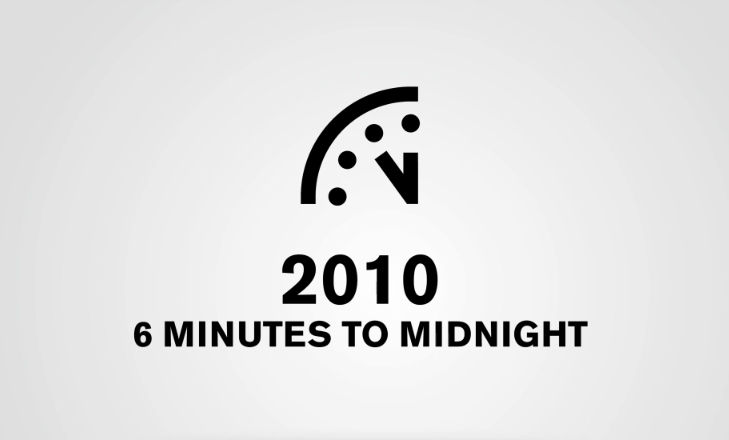
The venerable Bulletin of the Atomic Scientists has deemed the world a bit safer than it was in 2007. The hands of its ‘doomsday clock’ have been inched away from midnight — representing the end of civilization, due to threats such as nuclear war — by a minute. The new time: six minutes to midnight. clock.JPG

The group credits recent efforts by world leaders to shrink the world’s nuclear arsenals, as well as move to restrict greenhouse gas emissions. But the tiny nudge, of only one minute, symbolizes the fact that the world remains in a precarious situation, says Lawrence Krauss of Arizona State University (ABC News).

“For the first time in decades,” Bulletin editors write, “we have an opportunity to free ourselves from the terror of nuclear weapons and to slow drastic changes to our shared global environment. We encourage scientists to continue their engagement with these issues and make their analysis widely known.”

The Bulletin last changed the clock in January 2007, after North Korea conducted its nuclear test. The closest it has ever been to the end of the world is two minutes to midnight, in 1953 after the United States and the Soviet Union both exploded hydrogen bombs.

Earthquake strikes Haiti

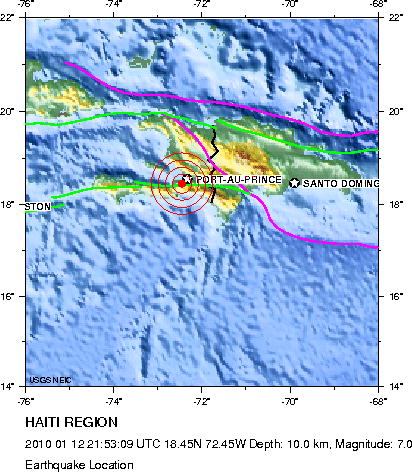
A magnitude-7.0 earthquake, followed by a magnitude-5.9 aftershock, has struck just 15 kilometers from the 3 million people in Port-au-Prince, Haiti. neic_rja6.jpg

A local tsunami watch has gone out covering Haiti, Cuba, the Bahamas and the Dominican Republic, but the greatest threat may be construction practices on the land. Building collapse historically claims the greatest number of lives in such a disaster, particularly in overpopulated areas with shoddy construction. An estimated map of ground shaking from the US Geological Survey is available here; a map of previously known seismic risk is here. A collection of USGS overview material, including historical quakes in the Caribbean, is here.

According to this blogger’s first rough map checking, the quake apparently struck along the Enriquillo fault. For a bit of regional context, this USGS site looks at earthquake risk near Puerto Rico, which experienced a number of quakes on the order of magnitude 7 in the past century.

The Caribbean does not have a dedicated tsunami warning system; alerts in the Caribbean are handled by the Pacific Tsunami Warning Center in Hawaii, other than Puerto Rico and the US Virgin Islands which are handled by the West Coast/Alaska center.

Image: USGS

Antarctica 2010: Pointing a telescope at the ground

Posted on behalf of Chaz Firestone

Say the word “telescope” at the South Pole and you’ll be directed to one of two large dishes at the Martin A. Pomerantz Observatory, each of which searches the sky for cosmic microwave background radiation left over from the Big Bang: The South Pole Telescope and BICEP, the brawny name for Background Imaging of Cosmic Extragalactic Polarization. But there is a third telescope at the Pole, though it doesn’t really look like one. That’s because it’s pointed downward.

IceCube is an astrophysics project at the Pole that looks for traces of neutrinos, invisible particles churned out by nuclear reactions. They can originate from distant supernovae, from our own Sun and even from man-made nuclear reactors, and they are around us all the time, passing through matter with ease. This last property, owing to their lack of charge and tiny mass, makes them notoriously elusive, and neutrino collisions are rare events — so rare, in fact, that you have to go all the way to the South Pole to get the best view of them.hole.JPG

When a neutrino collides with an atom, a byproduct of the collision is a muon, which emits a faint blue light that can be detected by a sensitive enough instrument. Traditionally, neutrino collisions are detected in liquid water, which is used as a medium by labs in Japan and Canada. But one of the insights of IceCube was to realize that neutrino detection would work just as well in ice — and there’s plenty of that in Antarctica.chazdom.JPG

Yesterday, I met with Mark Krasberg, a physicist at the University of Wisconsin who works at IceCube, the largest neutrino detector in the world. IceCube searches for high-energy neutrinos with a more interesting source than our modest Sun: violent astrophysical events like exploding stars and colliding galaxies. Here’s how it works:

With a hot water drill, technicians bore a hole (pictured, above right) 2.4 kilometers deep. In it, they place a string of digital optical modules (DOMs) in the bottom kilometer of the hole. The DOMs (pictured, right) will remain in those holes for tens of thousands of years, and are built to detect that faint blue light from muons in the crystal-clear Antarctic ice. (With that long a shelf life, researchers like to make themselves a part of history by signing their names on the DOMs, which I had the opportunity to do.) After a neutrino collision, the resultant muon travels along the same course as the neutrino that produced it, so astrophysicists can retrace the trajectory of the muon to determine the source of the neutrino, much as a forensics specialist might do ballistics work. Even though only a few neutrinos from cosmogenic events (maybe just two or three!) will collide with an atom of ice each hour in a block 1 cubic kilometer in volume, the equipment at IceCube is sensitive enough to capitalize on the few collisions it observes.

Though the telescope is located just a few hundred meters from the South Pole itself, it actually surveys the northern sky for these violent astrophysical events. As mentioned above, neutrinos can originate from all kinds of sources, but the high-energy neutrinos IceCube is after (reaching energies of a peta electron volt!) have a better chance at passing through the Earth than lower-energy, garden-variety neutrinos. By searching southern ice for neutrinos originating from the north, scientists use the Earth itself as a filter, isolating the neutrinos of interest.

What’s all the trouble for? As Krasberg explained, certain astrophysical events and bodies aren’t easily detectable by traditional optical and radio telescopes. But neutrinos, which can pass through the interstellar medium with even less attenuation than photons, allow astrophysicists the unique opportunity to “see” these cosmogenic events. The end goal, Krasberg said, is to build on work done by IceCube predecessor, the Antarctic Muon And Neutrino Detector Array (AMANDA), to construct a detailed map of (half) the sky’s distant astrophysical bodies.

Antarctica 2010: Pointing a telescope at the ground

Posted on behalf of Chaz Firestone

Say the word “telescope” at the South Pole and you’ll be directed to one of two large dishes at the Martin A. Pomerantz Observatory, each of which searches the sky for cosmic microwave background radiation left over from the Big Bang: The South Pole Telescope and BICEP, the brawny name for Background Imaging of Cosmic Extragalactic Polarization. But there is a third telescope at the Pole, though it doesn’t really look like one. That’s because it’s pointed downward.

IceCube is an astrophysics project at the Pole that looks for traces of neutrinos, invisible particles churned out by nuclear reactions. They can originate from distant supernovae, from our own Sun and even from man-made nuclear reactors, and they are around us all the time, passing through matter with ease. This last property, owing to their lack of charge and tiny mass, makes them notoriously elusive, and neutrino collisions are rare events — so rare, in fact, that you have to go all the way to the South Pole to get the best view of them.hole.JPG

When a neutrino collides with an atom, a byproduct of the collision is a muon, which emits a faint blue light that can be detected by a sensitive enough instrument. Traditionally, neutrino collisions are detected in liquid water, which is used as a medium by labs in Japan and Canada. But one of the insights of IceCube was to realize that neutrino detection would work just as well in ice — and there’s plenty of that in Antarctica.chazdom.JPG

Yesterday, I met with Mark Krasberg, a physicist at the University of Wisconsin who works at IceCube, the largest neutrino detector in the world. IceCube searches for high-energy neutrinos with a more interesting source than our modest Sun: violent astrophysical events like exploding stars and colliding galaxies. Here’s how it works:

With a hot water drill, technicians bore a hole (pictured, above right) 2.4 kilometers deep. In it, they place a string of digital optical modules (DOMs) in the bottom kilometer of the hole. The DOMs (pictured, right) will remain in those holes for tens of thousands of years, and are built to detect that faint blue light from muons in the crystal-clear Antarctic ice. (With that long a shelf life, researchers like to make themselves a part of history by signing their names on the DOMs, which I had the opportunity to do.) After a neutrino collision, the resultant muon travels along the same course as the neutrino that produced it, so astrophysicists can retrace the trajectory of the muon to determine the source of the neutrino, much as a forensics specialist might do ballistics work. Even though only a few neutrinos from cosmogenic events (maybe just two or three!) will collide with an atom of ice each hour in a block 1 cubic kilometer in volume, the equipment at IceCube is sensitive enough to capitalize on the few collisions it observes.

Though the telescope is located just a few hundred meters from the South Pole itself, it actually surveys the northern sky for these violent astrophysical events. As mentioned above, neutrinos can originate from all kinds of sources, but the high-energy neutrinos IceCube is after (reaching energies of a peta electron volt!) have a better chance at passing through the Earth than lower-energy, garden-variety neutrinos. By searching southern ice for neutrinos originating from the north, scientists use the Earth itself as a filter, isolating the neutrinos of interest.

What’s all the trouble for? As Krasberg explained, certain astrophysical events and bodies aren’t easily detectable by traditional optical and radio telescopes. But neutrinos, which can pass through the interstellar medium with even less attenuation than photons, allow astrophysicists the unique opportunity to “see” these cosmogenic events. The end goal, Krasberg said, is to build on work done by IceCube predecessor, the Antarctic Muon And Neutrino Detector Array (AMANDA), to construct a detailed map of (half) the sky’s distant astrophysical bodies.