‘Gecko robot’ walks up walls

The quest to make robots that don’t fall over at the slightest impediment has been making great strides recently.

A team from Simon Fraser University in British Columbia, Canada have combined an adhesive inspired by gecko feet with caterpillar tracks to make a robot that can walk up walls, they describe their robo-gecko-tank in the journal Smart Materials and Structures. According to the team their bot can move from a flat surface to a wall at up to 3.4 centimetres per second.

Of course, what you really want is to see this thing climbing a wall. Ladies and gentlemen: the gecko bot…

You are currently viewing a placeholder content from YouTube. To access the actual content, click the button below. Please note that doing so will share data with third-party providers.

More Information

The paper is available here.

Royal Society frees up journal archive

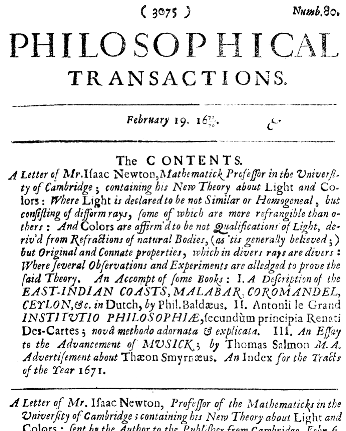
newton.bmpBen Franklin’s account of his electric kite experiment (1752) and Isaac Newton’s first ever paper (1671) are among 69,000 historical scientific papers now freely accessible online, after Britain’s Royal Society opened up its journal archive.

The archive goes all the way back to 1665, when Philosophical Transactions of the Royal Society first appeared – probably the world’s first peer-reviewed scientific journal. It’s now fully searchable, and all papers published more than 70 years ago are free to view. (You’ll still have to pay for the newer ones). The BBC picks out some weird and wonderful papers, including the woman who swallowed a bullet (in 1668), and an experimental canine blood transfusion (1666).

The archive was digitized in 1999 by JSTOR, the US-based archive for academic journals, for a sum in the ‘high five figures in US dollars’. Royal Society commercial director Stuart Taylor says they have been thinking about making part of the archive free for some time. As digitization of print works gets easier and cheaper, “we do not feel it is justifiable to continue charging for access [to out-of-copyright material]”, Taylor said. The Royal Society’s pay-per-view income for the entire archive (including papers after 1941) amounts to less than 0.5% of their total publishing revenues.

In July, programmer Greg Maxwell uploaded nearly 19,000 articles from Philosophical Transactions of the Royal Society, all of them published before 1923, onto the file-sharing website The Pirate Bay (in stated support for computer coder Aaron Swartz, who is still facing a federal indictment for downloading over 4 million articles from JSTOR). The Royal Society’s release today means that the articles Maxwell uploaded are all now free to view. Maxwell’s action did not affect the Society’s decision, says Taylor.

AI pioneer John McCarthy dies

The computer scientist who coined the term ‘artificial intelligence’ and led the field for years has died.

John McCarthy, emeritus professor at Stanford, died on Monday aged 84, the university has announced.

In 1955 he proposed a research conference which is regarded as the first time the term ‘artificial intelligence’ was used in publication, says Stanford. McCarthy continued his work in this area, inventing the LISP programming language and working with various applications of AI, including chess.

Continue reading

If I ruled Yucca Mountain…

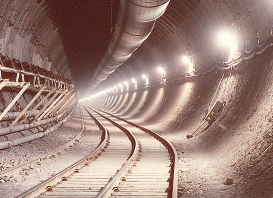
yucca.bmpAttempts in the United States turn a mountain in Nevada into a long-term nuclear dustbin have been on the rocks for a while. So Congressional watchdog the Government Accountability Office has been looking at alternative uses for the site at Yucca Mountain that has so far had several billion dollars lavished on it.

In other words: the US government has a giant hollowed-out mountain that they don’t know what to do with [pictured].

Obama tried to finally kill off the nuclear-waste plans at the site, but doing so has not proven simple (see: Battle of Yucca Mountain rages on). In the meantime, a huge chunk of land is sitting empty. Its most notable feature, the GAO report notes, is “two large tunnels — one about 5 miles [8 kilometres] long and 25 feet [8 metres] in diameter, and another 2 miles long that branches off of the main tunnel”.

Experts gave the GAO 30 possible uses for this space, including strategic petroleum reserve, command centre for unmanned aerial vehicles and secure data storage. Most of the suggestions, though, relate to nuclear activity, such as interim storage of nuclear waste.

In the end the GAO notes, “This report contains no recommendations. [The Department of] Interior generally agreed with our findings, while DOE [Department of Energy], the US Air Force, and NRC [the Nuclear Regulatory Commission] neither agreed nor disagreed."

Continue reading

Updated: Hypersonic test craft ready for its final dive

HTV-2 image 2.jpgPosted on behalf of George Wigmore.

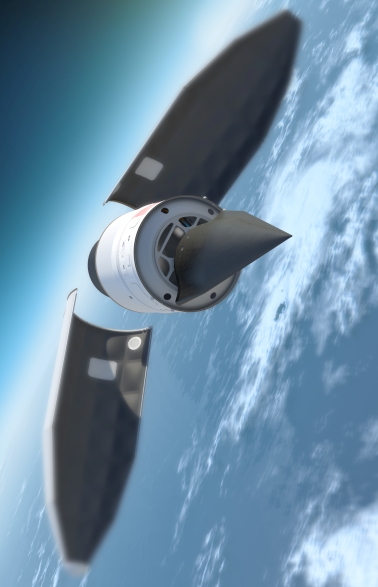
Later today the US Defense Advanced Research Projects Agency (DARPA) will launch its latest hypersonic vehicle, the arrow-shaped Falcon Hypersonic Technology Vehicle 2 (HTV-2), in a bid to develop future hypersonic vehicles that can reach anywhere in the world with an hour.

Blasting off from Vandenberg Air Force Base in California sometime between 7am and 1pm PDT today, the Minotaur IV Lite launch vehicle will orient HTV-2 in the upper atmosphere before releasing it. Capable of reaching speeds in excess of 20,000 kilometres per hour, or Mach 20, as it glides through the earth’s atmosphere, HTV-2 will perform several manoeuvres to test aerodynamic performance, before diving into the Pacific Ocean, 6,500 kilometres from California.

HTV-2’s inaugural flight in April 2010 failed, though it did collect valuable data, mostly by highlighting necessary adjustments. In a statement released by DARPA, HTV-2 program manager, Chris Schulz says, “It’s time to conduct another flight test to validate our assumptions and gain further insight into extremely high Mach regimes that we cannot fully replicate on the ground.”

But how fast is the HTV-2 compared to other aircraft? The record for a manned air-breathing craft is still held by the Lockheed SR-71, which reached speeds of 3,540 kilometres per hour on 28 July 1976. Yet while HTV-2 is closer in speed to a Minuteman intercontinental ballistic missile (ICBM), which can travel at speeds of over 24,000 kilometers per hour, they all pale into insignificance when compared to the Space Shuttle, which reached speeds of 30,000 kilometers per hour during reentry.

As the last remaining prototype, a lot hinges on HTV-2’s mission, especially with no further plans to build another. But any information collected will help improve future hypersonic flight vehicle performance.

UPDATE 11/8/11: Despite much anticipation, yesterday’s launch of HTV-2 was scrapped last minute after poor weather conditions prevented lift-off. Launch has been rescheduled for later this morning, PDT time.

UPDATE 12/8/11: Following its launch on Thursday, Darpa’s latest attempt to fly the fastest aircraft ever built has failed for the second time. Launched from Vandenberg Air Force Base in California at 0745 Pacific Time, the Falcon HTV-2 was successfully released into the atmosphere, but only nine minutes of data was collected before signal was lost. The agency believes that the vehicle crashed into the Pacific Ocean.

Image credit: DARPA

Happy birthday, WWW

the internet.jpgPosted on behalf of George Wigmore.

Tomorrow marks the 20th anniversary of the first website going live at CERN. Born out the dreams of Libertarian hippies in 1970s California, and the anti-authoritarian aspirations of internet-pioneers such as Ted Nelson, who coined the term hypertext, from its early incarnation at CERN, the World Wide Web and the way we send data has changed phenomenally.

The websites we have today with their complicated scripts and banners, bear little resemblance to the first humble website, which was launched by Tim Berners-Lee and colleagues at CERN on the 6 August, 1991.

The web grew out of Berners-Lee’s original 1989 proposal for an information management system which would allow people at different sites to share their ideas and all aspects of a project. In 1990 the idea was accepted, and Berners-Lee’s vision of taking the idea of hypertext, and turning it into a working computer language, HTML, became a reality.

Running on a NeXT computer at CERN, the first web page isn’t much to look at, simply listing information about the WWW project, from the names of collaborators, to information about hypertext, and how to build websites. Looking at it now, it pretty much resembles the half-finished site of a student learning HTML. But this only serves to show how far we’ve come.

Continue reading

Video: Relaxing on a virtual beach

Posted on behalf of Daniel Cressey.

For centuries a stroll in the countryside has been touted as beneficial to health – something modern science has confirmed. But for many people these benefits are out of reach.

Nature Video took a trip recently to the laboratory of Robert Stone in Birmingham. Building on work done for the Ministry of Defence, Stone is building digital recreations of the English countryside to help improve the mental health of people who can’t reach it in reality.

As Stone’s project progresses, the evidence could help optimise exercise for health benefits by teasing out what aspects are important for mental health. And if his virtual worlds can be shown to have similar effects to their real world equivalent, then the relaxation of a countryside stroll could one day be within reach of everyone.

You are currently viewing a placeholder content from YouTube. To access the actual content, click the button below. Please note that doing so will share data with third-party providers.

More Information

Robot water strider skims the surface

72711WaterStriderHIREScreditACS.jpgPosted on behalf of George Wigmore.

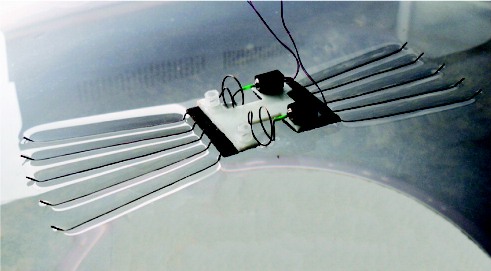
While walking on water may be a dream for humans, it has become a step closer for robots. Qinmin Pan and colleagues at the Harbin Institute of Technology in China have developed a water-walking robot, mimicking the abilities of the water strider, an insect which can effortlessly skim along the surface of the water. The machines could be used to monitor water pollution, and develop surveillance robots.

Tiny hairs on the legs of the water strider enable it form tiny swirling vortices, trapping small pockets of air, and enabling them to skirt across water without drowning.

Taking inspiration from the water strider and advantage of the high surface tension of water, the tiny 15 cm-long robot can stand, turn and walk perfectly fine on water, reaching speeds of up to 15 cm per second. Despite weighing as much as 390 water striders, the robot can stay afloat supported by ten water-repelling legs, propelled by two actuating legs driven by two tiny motors.

While water-walking robots have been developed in the past with the aim of monitoring water supplies, and conducting military spy missions, until now no one has been able to make a robot which is cheap, practical and agile enough to fit the bill. But with the new robot’s ability to support more than twice its body weight, it can be easily equipped with a miniature camera, enabling the machine to succeed where so many have failed in the past.

Image courtesy of American Chemical Society.

China’s venture capital booms

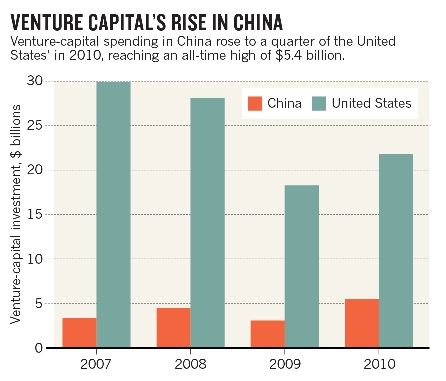
China_venture_cap_Funwatchsmall.jpgAs China’s economy keeps growing, it’s no surprise that venture-capitalists are investing there at a rapid lick. A 20 July report on venture-capital funding in China – from analysts Lux Research – notes activity at an all-time high of $5.4 billion in 2010, an 80% increase on 2009’s $3.1 billion (see chart, and press release [pdf]). And 40% of that sum went into emerging technologies – chemicals, materials, energy and healthcare.

That’s quite a shift from 2007, notes Chris Hartshorn, vice-president of research with Lux Research in Boston, Massachusetts, when just 20% of China’s VC investment fell in these areas (with the rest on more consumer-facing sectors such as retail, telecoms and IT).

Admittedly, $5.4 billion is just a quarter of the $21.8 billion VC funds poured into the United States in 2010. But, after the economic crisis, the United States has only just recovered to 2004 levels (last year’s 19% rise for US VC funds was the first time annual investment had increased since 2007). China is starting to catch up.

Where is the money going? Within the emerging technologies arena that the Lux report analyses, some of the highest interest falls squarely into China’s traditional strengths – composites and advanced materials (28 deals totalling $388 million). That same research theme is evident in another Lux-defined sector, ‘Green building’ ($516 million) where typical investments are made in LED and lighting companies, and in producers of thermal insulation. Energy storage and solar power (together, $255 million) and the pharmaceutical sector ($494 million) rounded off the top areas.

While total investments are shooting up, the size of each deal is getting smaller – because much more VC activity is being focused on the earliest-stage, most risky investments (small firms making what are known as ‘Series A’ funding rounds). “There’s an increasing proportion of activity at the front end of the VC pipeline – meaning a higher proportion of early-stage innovation is being invested in,” notes Hartshorn.

Continue reading

LEGO DNA sculpture unveiled

lego dna.jpgThe X Prize foundation has taken time out from promoting spacefaring, and unveiled what it claims is the largest LEGO DNA sculpture in the world.

“Just as each brick plays an important part in holding the sculpture together, each gene within the human genome helps us understand more about ourselves as humans and how we are all connected,” says artist Nathan Sawaya (press release).

The roughly two metre ‘Building Bricks of Life’ sculpture is on display today at the Saint Louis Science Center on 15 April as part of National DNA Day. Although known mainly for their space exploration funding, the X Prize also sponsors a competition to get 100 human genomes within 10 days or less for $10,000 per genome.

Now if they can make a video showing this sculpture doing transcription (like this example) we’ll be really impressed.

Image: X Prize