Seeking a locum assistant editor for this very journal

We’re looking for a Locum Assistant Editor to join our editorial team for a period of approximately six months.

This position, based in Nature Publishing Group’s New York office, involves working closely with the Chief Editor and other members of the journal team on several aspects of the editorial process, including manuscript evaluation, organizing peer-review and writing for the journal.

Candidates should have expertise in the field of cancer, a broad interest in biomedical science,excellent communication skills, willingness to learn new fields, and the ability to work to tight deadlines with the other members of the team. Applicants will be required to hold a Ph.D. degree. Previous editorial experience would be an advantage, but is not essential.

More details on how to apply can be found here.

NIH emerges with new emergency medicine research hub

When a patient sits clutching his chest in pain in the emergency room, the doctor on call must think with razor-sharp focus to create a treatment plan immediately. The usual clinical suspects, such as heart attack or lung collapse, bear consideration. But anyone in emergency medicine research knows possible culprits vary widely and span the body’s organs. Unfortunately, research in this area has traditionally been spotty and uncoordinated — but perhaps not for much longer, thanks to the formation of a new Office of Emergency Care Research (OECR) unveiled earlier today by the US National Institutes of Health (NIH).

“You can hear the excitement in my voice,” says Jill Baren, an emergency medicine physician-scientist at the University of Pennsylvania Perelman School of Medicine in Philadelphia. “This new office will increase the scope and breadth of emergency medicine research and will allow an amazing amount of coordination.”

The new office will be housed within the NIH’s National Institute of General Medical Sciences with an annual budget of around $400,000, but it will not issue research grants. Instead, the OECR will serve as a clearinghouse for extramural, or off-campus, academic researchers engaged in emergency medicine projects. According to OECR acting director Walter Koroshetz, such coordination is necessary for a field like emergency medicine, which is a facet of almost all of the medical research agency’s institutes and centers. “Research in the emergency setting is on an exponential growth curve because it is such a laboratory for serious health conditions,” says Koroshetz, who also serves as deputy director of the National Institute of Neurological Disorders and Stroke.

For several years now, Baren and Koroshetz have worked together on an NIH-funded project that relies on emergency department data to study acute injuries and illnesses that affect the brain. Following the establishment of the OECR — which came about in part at the recommendation of the US Institute of Medicine, which issued a 2006 report highlighting the shortcomings of emergency medicine care in the country — this project and others will now be under the new office’s umbrella.

Image courtesy of SeanPavonePhoto via Shutterstock

One fish, two fish and 400,000 zebrafish

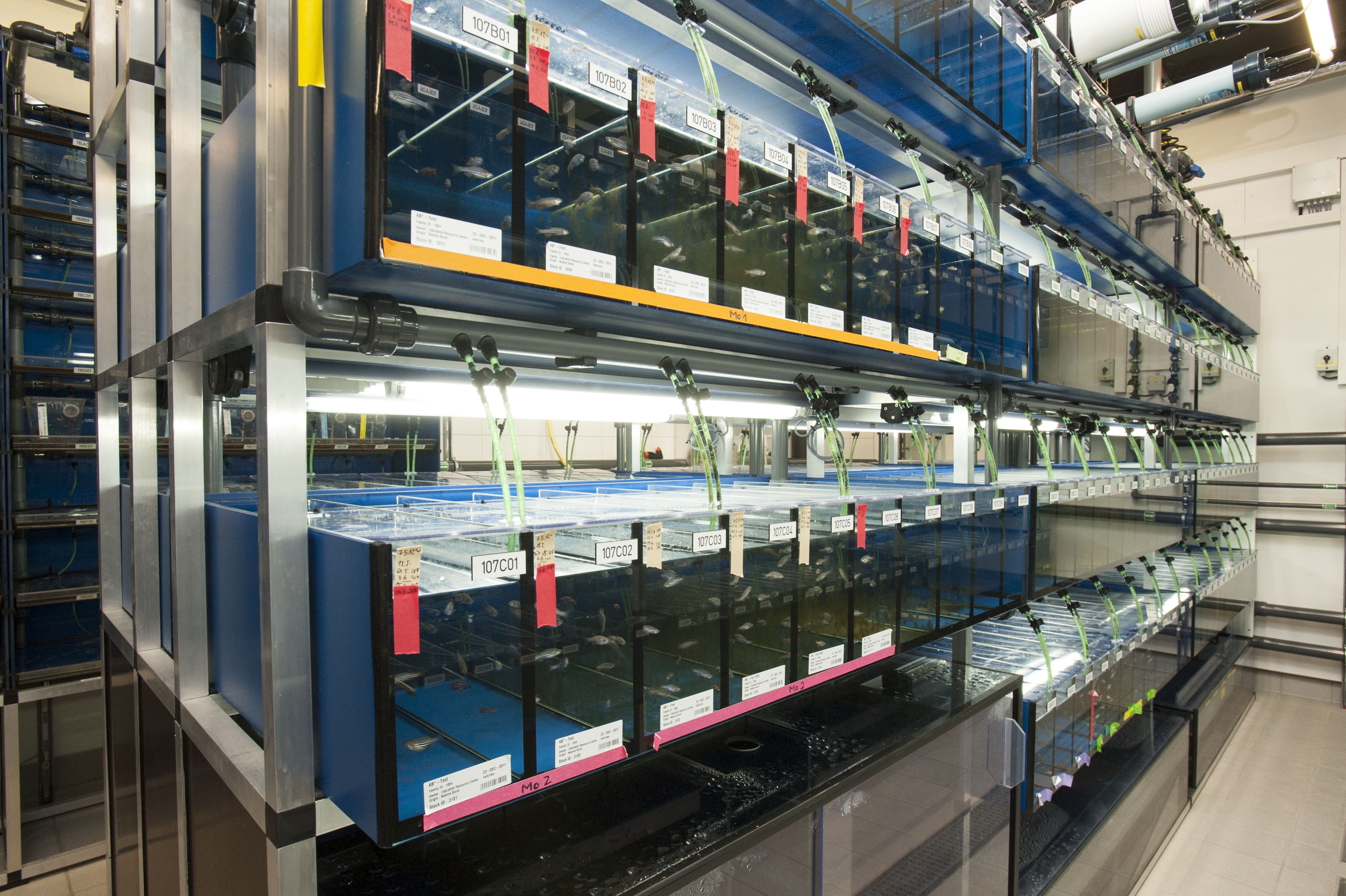
Hundreds of translucent creatures that biomedical researchers rely on for genetic insights settled into new digs today as researchers opened a newly refurbished and expanded animal repository called the European Zebrafish Resource Center. Housed at the Karlsruhe Institute of Technology (KIT) in southwest Germany, the center can maintain 400,000 live fish at maximum capacity in more than 3,000 tanks, and will include lab space for on-site zebrafish in vitro fertilization. Uwe Strähle, a geneticist at KIT, told Nature Medicine by phone after the ribbon-cutting ceremony that European zebrafish researchers eager to preserve their hard-won transgenic and mutant lines may begin submitting eggs to the center. Currently the center houses 300 transgenic lines but Strähle expected the collection to expand to hold thousands of lines in the next five years.

“Some mutant forms of zebrafish cannot be replicated so it is important to preserve those lines for future research,” Strähle explained. And as if capacity wasn’t enough, the center’s equipment might make any zebrafish investigator glassy-eyed with excitement. Located a few floors above the core aquarium room that will hold only frequently requested lines are brand-new PCR machines and freezers capable of storing 80,000 sperm samples in cryopreservation.

But Strähle thinks researchers will benefit most from the center’s screening lab, stocked with—among other neat toys—a single plane illumination microscopy machine that can be used to create 4-D images of the animals, including their traits. He envisions researchers visiting the screening lab to take advantage of the tools available to add or knock out genes and breed zebrafish lines needed for their future research.

In the past, European zebrafish researchers exchanged fish with US labs like the Zebrafish International Resource Center maintained by the University of Oregon, but the costs of sending little fish across the ocean kept going up. Zebrafish research in Europe can now make a big splash on its home turf.

Photo courtesy of Martin Lober, Karlsruhe Institute of Technology


Build a new biosafety lab, but possibly build it smaller, says report

Less than one month after a US National Resource Council (NRC) panel criticized the government for underestimating the risks of a proposed new biosecurity lab, a new ten-person committee issued a second report today advising that construction should go ahead, although possibly on a reduced scale from the original design.

The report comes at the request of the US Department of Homeland Security (DHS), which asked the NRC to weigh the pros and cons of three possible options: build the estimated $1.14 billion  National Bio- and Agro-Defense Facility (NBAF) in Manhattan, Kansas according to the original plans; build a scaled-back version of the facility with a distributed network of smaller affiliated laboratories; or continue using the half-century-old Plum Island Animal Disease Center in New York State.

The NRC committee was not tasked with choosing a best option, but it did come out with strong recommendations. For one thing, it basically nixed the possibility of keeping Plum Island open.

In a news conference this afternoon, committee chair Terry McElwain, director of Washington State University’s animal diagnostic lab in Pullman, described the ageing facility as “very outdated, inefficient,” and even with modifications, it “could not meet maximum level containment standards.”

Yet, even with the recommendation to begin construction on the Kansas facility, the report was mixed on what size and scope the lab should take. “The new lab as planned does meet the nation’s animal research needs, but it has a big drawback: the high cost,” McElwain said.

In this time of fiscal austerity, a scaled-back version of the facility could make a lot of sense, the report noted. And it would still be able to handle most research into emerging pathogens and diseases, although a planned vaccination research program would likely have to be dropped and possibly assigned to another high-level containment lab.

Still, stressed McElwain about the possibility of a smaller NBAF, “I want to make it clear this would not compromise the ability of cutting-edge research.”

Report image courtesy of the National Research Council

Database to help doctors grasp disease risk of duplications the genome

Copy number variations, in which a section of DNA is duplicated or deleted, have been a boon for geneticists hoping to explain the chromosomal causes of everything from autism to schizophrenia to colon cancer. CNVs that are deletions can be helpful in diagnosing a handful of developmental disorders and birth defects such as DiGeorge syndrome, an illness affecting skull formation in which a portion of chromosome 22 is missing. But when doctors find a CNV that is a duplication, they have difficulty knowing exactly which disorder their patient might have as a single duplicated region can cover multiple genes. For example, the clinical significance of rare duplication CNVs of the region including the gene DCLK2, which has been implicated in attention deficit hyperactivity disorder (ADHD), are often missed by lab technicians and physicians.

A new database has begun to change that, allowing doctors to input and access all of the tested mutations within a CNV. The free International Standards for Cytogenomic Arrays (ISCA) database, which currently includes the results of 30,000 CNV tests and is housed at the US National Center for Biotechnology Information in Bethesda, is described in the May issue of Clinical Genetics, and has already drawn more than 800 users. Using the database, “a doctor or lab technician can see all the genes in a CNV,” says geneticist and senior author Christa Martin of Emory University in Atlanta.

What’s more, the database includes a rating system to help physicians estimate how likely genes within an observed CNV are to cause disease. Each CNV is ranked by expert groups on the basis of seven criteria, including the number of mutations reported in people with the CNV, mutational mechanisms and patterns of inheritance. The ratings for CNVs go from 0 (no evidence it causes disease) to 3 (sufficient evidence to predict disease). Surprisingly, “before now, there was not a formal process to rate CNV pathogenicity,” says Martin. “It made analyzing [CNV microarray] data very confusing for doctors. This database begins to fix that problem.”

The ISCA database may become even more important in the future. Preliminary data from a multicenter study presented in February at the Society for Maternal-Fetal Medicine meeting in Dallas indicated that microarray testing detects fetal abnormalities than the current standard karyotype test misses. Helping parents make decisions based on prenatal CNV testing will require the use of a database. “It’s no longer an option for doctors to just avoid CNVs because they’re too complicated to analyze,” says Martin. “Physicians will have to start using the new database tools available to them.”

Photo courtesy of Shutterstock

Top Canadian biomedical prize goes to antibody pioneer

The immunologist who revealed the structure and function of the crucial Fc region of antibodies was one of the researchers recognized today by the Toronto-based Gairdner Foundation for his contributions to biomedicine. Jeffrey Ravetch (pictured), along with six leading scientists in the fields of genetics, neurobiology and infectious diseases, has received one of the prestigious Gairdner awards, which have been called the ‘Canadian Nobels’. The awards come with a hefty C$100,000 ($101,000) cash prize for each winner.

Ravetch, now of Rockefeller University in New York, published a series of trailblazing immunology papers in the late 1980s and early 1990s showing that antibodies in the immune system possess a region called the Fc (or ‘fragment, crystallizable’) region. He found the Fc region is essential for initiating an inflammatory response and also that antibodies have both activating and inhibiting functions, a finding which overturned centuries of dogma about the regulation of the immune system. In subsequent years, he has gone on to show that the Fc region is part of a pathway that suppresses inflammation, publishing a  paper in Nature Medicine in 2000 that demonstrated Fc regions contribute to the effectiveness of tumor-destroying antibodies. “That paper was quite heretical at the time,” says Ravetch. Since then, engineering the Fc region has become a central concern for anyone designing antibodies as therapies for diseases such as breast cancer and lymphoma, and Ravetch’s work may also have applications for improving current antibody-based treatments for autoimmune disorders such as lupus and rheumatoid arthritis.

Such clinical advances are one reason that the Gairdner Foundation chose to honor Ravetch among its 2012 winners. “Dr. Ravetch changed the way we understand how antibodies work, leading to the design of new therapeutic approaches to autoimmunity and cancer,” says John Dirks, president and scientific director of the foundation.

Other International Award winners announced today include Rockefeller University’s Michael Young and his collaborators Jeffrey Hall and Michael Rosbash of Brandeis University, located just outside Boston, for their work on the genetic mechanisms of circadian clocks, and Thomas Jessell of Columbia University in New York for his research into the connections between sensory and motor neurons. Brian Greenwood of the London School of Hygiene and Tropical Medicine locked up the Gairdner Global Health Award for showing that the pneumococcal vaccine and insecticide-treated bed nets both greatly reduce mortality among children in Africa—and for his advocacy efforts to bring such prophylactics to the region.

On 25 October the Gairdner prizes will be formally awarded in Toronto. To read about last year’s winners, click here.

Photo courtesy of Jeffrey Ravetch

TPTB unveil ‘JDRF’, symptomatic of an acronym epidemic IMHO

In a sign of the times, the TPTB at the Juvenile Diabetes Research Foundation today that the organization is abandoning its name and simply adopting the initials JDRF.

True to type—type 1 diabetes, that is—the 41-year-old, New York-based non-profit unveiled its new name, logo and tagline that it says “better reflects the state of type 1 diabetes (T1D) and the organization’s work, which remains committed to curing, treating, and preventing the disease.”

It’s juvenile of me to quibble really about the loss of the old moniker. True, the disease is now known as T1D, not juvenile diabetes. And yes, the disease affects adults just as much as, if not more than, kids. OTOH, if it’s truly no longer a juvenile disease, then why keep the ‘J’ in JDRF? IMHO, the organization should consider changing the name to Type 1 Diabetes Research Foundation. People are savvy enough to learn to use the shorthand T1DRF.

BGI. GAVI. BMJ. PATH. All these biomedically-relevant acronyms used to stand for something. Now, they are just letters evoking a bygone era.

Most people don’t bother spelling out acquired immune deficiency syndrome. But no one refers to AIDS as GRID anymore as scientists now realize that the disease isn’t in fact caused by ‘gay-related immune deficiency’. Similarly, HIV is not called LAV or HTLV-III, as the virus once was once known.

The acronym epidemic has spread too far in biomedicine, from nonprofits to the names of clinical trials themselves (remember the TORPEDO trial?). The cure, BTW, is just a couple of extra keystrokes away.

Our Spoonful gets a more polished look

You probably notice today that the Spoonful of Medicine blog has had some “work done”. But unlike many celebrities of our day, we’re not ashamed to dish on the details of our cosmetic surgery. Thanks to the hard work of our web developers, the blog should be easier to read and navigate. The revamp has also made our blog archive more readily available, so if you’re feeling nostalgic, click on the right to rekindle memories of days when Bush’s stem cell ban reigned supreme (which you’re likely not) or the retreat of swine flu. There’s a spiffy new commenting tool as well, so let us know what you think.

We launched this blog almost five years ago to the date as a place to expand on the news and commentary that you find in Nature Medicine. The journal comes out each month, but here in the Spoonful blog you can get your daily serving of information about drug development and policy changes affecting biomedical research.

From here forward, the Spoonful of Medicine will continue to bring you interviews with leading thinkers in global health and the pharmaceutical industry, such as Seth Berkley (formerly of IAVI, now with GAVI) and the new head of the US National Institutes of Health’s stem cell center, Mahendra Rao. We’ll also continue to dish on business news, in the tradition of earlier stories about the most expensive drug in the world, leadership woes at the California Institute for Regenerative Medicine and how companies are coping with the so-called ‘patent cliff’.

You’ll also find pharmaceutical news off the beaten path on the Spoonful blog, comic-book-style drug reports, reviews of pharmaceutical-themed art exhibits and medicine-inspired musical apps. And, further off the path: movie reviews of films such as Contagion, Extraordinary Measures and We Were Here, a documentary of the AIDS epidemic. You can also find our in-house videos, including a short one about DIY-labs, medical apps for the iPhone, and innovative diagnostic tools for developing-world settings.

If you’re more inclined to teaspoons of news than tablespoons, you can get your fix via Twitter. We’re also on Facebook and Google+. If RSS is more your style, you can subscribe to our feed here. And if you’d rather listen than read, you can subscribe to our monthly podcast via iTunes.

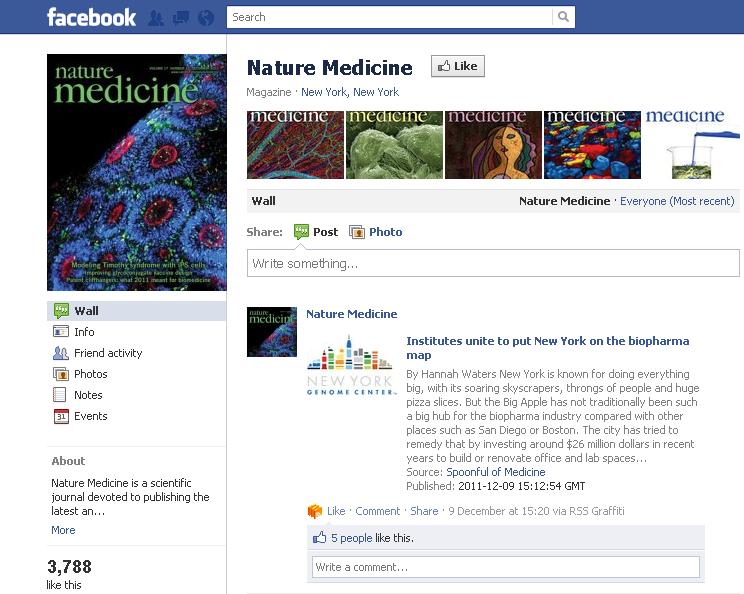
Screenshot of Nature Medicine’s Facebook Page

Many of you reading this blog are scientists, or have some sort of scientific inclination, so don’t be afraid to experiment with how you get your Spoonful of Medicine. Please note, however, that side effects may include an uncontrollable urge to discuss the forecasted market share of biologic drugs at your office holiday party or singing a song about DNA that you can’t get out of your head. Should either of these adverse reactions occur, please consult your doctor.

I heart Facebook: Scientists turn to social networks to study cardiovascular health

heart-facebook.png

Status update: Facebook could be good for your heart.

That’s the hypothesis behind the Social Heart Study, a new social network-based project aimed at understanding how Facebook friendships contribute to cardiovascular health.

The study is the brainchild of University of California–San Francisco epidemiologist Mark Pletcher and University of California–San Diego behavioral geneticist James Fowler. They wanted to find a low-cost way to see if time spent ‘liking’ and ‘poking’ on Facebook has either favorable or adverse effects on people’s hearts. So they decided to go straight to the source. They created a Facebook app and started asking people to share their health data and online activity patterns.

The Social Heart Study went live last week and is still in beta mode. But eventually, the organizers hope to recruit a cohort of more than a million adults who are willing to pour their hearts out (so to speak) for science. All this personal information should form a huge online database for observational and interventional studies into cardiovascular health, and should reveal new online ways to prevent heart disease, the organizers say.

Continue reading

Hollywood goes viral with new Contagion movie

cheever29711.jpgFlu season is approaching, which means it’s almost time to break out the vaccines and hand-sanitizer. But another method of preventative care may be a dose of Warner Brothers’ new thriller Contagion, out this weekend in theaters across North America.

The film begins innocuously enough with the sound of a cough in the darkness. But when the cougher herself, played by Hollywood starlet Gwyneth Paltrow, is dead within the next five minutes, you can’t help but pay close attention to who is coughing on whom and who is touching whom for the rest of the film — and, maybe, for the rest of flu season.

Steven Soderbergh directed Contagion, and, like his Academy Award-winning 2000 film Traffic, the film follows the weaving paths of many people as they try to survive this viral epidemic. Ellis Cheever, deputy director of the US Centers for Disease Control and Prevention played by Laurence Fishburne, coordinates the scientists, media and public as the virus spreads from one major metropolis to another. He sends epidemiologist Erin Mears (Kate Winslet) to Minneapolis — where Paltrow’s character, Beth Emhoff, died after returning from a business trip in China — to try to stop the virus in its tracks. Meanwhile, World Health Organization agent Leonora Orantes (Marion Cotillard) heads to China to trace the virus’s origins at the same time as virologists and epidemiologists (Elliott Gould, Jennifer Ehle, Demetri Martin) work to identify the virus and find a cure back in the US. Rounding out the cast is a muckraking blogger with a penchant for conspiracy theories, Alan Krumwiede (Jude Law), who hocks an herbal remedy to his online readership, and lastly, standing in for the normal guy trying to save his family, is Mitch Emhoff, the husband of Paltrow’s character and played by Matt Damon.

Continue reading