Science as seen on screen – part IV: Nature YouTube Video Vote

The fifth post in our mini-series on science as seen on screen.

Throughout our mini series, we have been considering what makes a great science video. We’ve looked at the history of science on screen, considered how to present science online, and have gathered some top tips on how to make a science video.

Armed with this information, we encourage you to help us in our efforts to judge the best Nature Video. We’ve collated four of our favourites from the Nature Video YouTube channel, selecting them for a variety of reasons, not simply how popular they’ve proved to date.

We invite you to tell us which one deserves the title of Best Nature Video!

And the nominees are…..

Lego Antikythera mechanism:

The Antikythera Mechanism is the oldest known scientific computer. Built in Greece around 100 BCE but lost for 2000 years, it was recovered from a shipwreck in 1901. However, it wasn’t until a century later that its purpose was understood: it’s an astronomical clock that determines the positions of celestial bodies with extraordinary precision. 

In 2010, to celebrate the launch of Digital Science, a new division of Macmillan Publishers that provides technology solutions for researchers, Nature Video and collaborators built a fully-functional replica out of Lego. 


Bat Sense:

This stunning slow motion footage shows how bats use echolocation to find water. We know how bats echolocate to hunt insects, but this is the first study to show how they recognise large, flat objects like ponds. Moreover, by testing young bats that had never encountered a pond or river before, the researchers showed that bats seem to have a built-in ability to recognize these important features of their environment. Read the original research paper here.

The First Britons:

A haul of stone tools unearthed from a beach in England hints that humans were living in northern Europe far earlier than we thought – and in a cold climate. The finding suggests that the first Britons were a hardy bunch, able to thrive in Scandinavian-like conditions.

The Barefoot Professor:

Harvard professor Daniel Lieberman has ditched his trainers and started running barefoot. His research shows that barefoot runners, who tend to land on their fore-foot, generate less impact shock than runners in sports shoes who land heel first. This makes barefoot running comfortable and could minimize running-related injuries. Read more here, and find the original research here.

Please make your vote here….

Create your free online surveys with SurveyMonkey, the world’s leading questionnaire tool.

Votes will close at 5pm on Monday 28th March

Science as seen on screen – part IV: Interview with a film-maker

The fourth post in our mini-series on science as seen on screen.

We have considered how science can be seen on the big screen, on television and online, so we thought it could be useful for all those budding science directors to get some useful tips, and who better to ask than someone in the business.
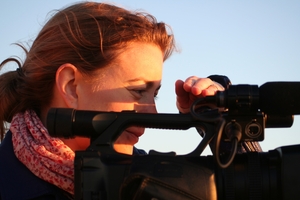
charlotte.JPGCharlotte Stoddart is an online video editor and director. She has been working at Nature for almost 4 years and has directed dozens of science films, including several series about the annual Meeting of Nobel Laureates at Lindau in Germany. Charlotte holds a degree in Natural Sciences from Cambridge, and an MSc in Science Communication from Imperial College.

How do you begin the process of making a science film?

First you need a good idea; for the most part, the films we produce are based on research published in Nature. Our aim is to tell the story of the research in pictures.

From the start, it’s important to think about the audience, the main message of the film, and exactly what you are going to show. We also need to identify the stars of the film.

We work closely with the editors of the paper and the scientists behind the research to find an interesting angle and to make sure the information we have is factually correct.

You have the idea – now what next?

Once we have the idea, the next step is to plan carefully what we want to be seen on the screen. We interview contributors, discussing the film focus in detail, searching for a story to tell; we look for the human angle behind their research. Often we try to dig up interesting, anecdotal stories, those that you wouldn’t read in the journal. We ask the researchers about their lab and the experimental set-up, all the time thinking about what we can film to illustrate the story. We also ask about graphics or animations they may have that could be included in the film.

What things do you need to plan?

Prior to the film shoot, obviously the logistical, practical stuff needs to be planned. We must organise filming dates to fit around our contributors, and in some cases get permission to film on location.

The day before the shoot we check our kit. We make sure we have everything ready, such as the correct lighting equipment, release forms for contributors, spare camera batteries, cable extensions. It’s the little things that count, so we ask ourselves: Does our camera work? Do we have an umbrella in case it rains? Do we have tissues? And have we got enough tapes?

We also write a list of questions to ask our contributors. We use this list as a guide, but we don’t stick to it rigidly; the most interesting answers are often the ones you’re not expecting and you need to be ready to throw away your list and take the interview in another direction.

Planning also varies depending on the film. For instance, for the Lindau series, we spend a long time choosing our contributors. The aim of the Lindau films is to capture on camera a debate between a Nobel laureate and a student, so lots of research goes into finding Laureates and students with overlapping research interests – and also making sure they’ll be able to speak clearly and confidently on camera.

char final.JPG

What are the most important things to take into consideration on a film set?

The filming day is often fun but also long and tiring. Depending on the film, it may just be me on set, in which case I am director, interviewer, and camera/sound man all in one. Being able to multi-task is crucial. At other times there’s a small team of us.

There is an awful lot to think about on a film shoot. First of all, you must listen to background noise in a way you don’t normally. Aeroplanes, for instance, are really noticeable in a film. Indoor air conditioning units are also noisy. You need to be ready to change location or re-record bits if there’s too much background noise. Good quality sound can make or break a film.

Lighting is also important. You have to think about where the natural sunlight is. It’s important that your contributor’s face is lit up and not in shadow. Sometimes we use artificial lighting to achieve this but, where possible, we position them so they’re lit by the natural light coming through a window, for example.

Think about your contributor; it sometimes takes a while for people to warm up and get used to being on camera. As the interviewer, being silently encouraging always helps – lots of eye contact, nods and smiles but no verbal encouragement because usually you don’t want your voice to be recorded. For some it can be an intimidating process; ideally, the contributor will forget the camera is there.

The filming is complete, then what?

The next step is editing the film. Back at the office, first I digitalise the footage, which means transferring it from the camera tapes to the computer. All the video clips must be organised, and all the associated material collected, whether that be pictures, graphics, objects or anything else relevant to the film. I also check we’ve got permission to publish all these materials.

I really enjoy the editing process; working out how to weave the different elements together to tell the story. It’s very creative. I try to find something surprising or particularly emotional to start with – something to draw the viewer into the film.

What else needs to be carried out in the cutting room?

Sometimes we add narration, music and captions to the film. The editing process can take several days. You need to be a bit of a perfectionist; if there’s a glitch in the audio or a bad cut, viewers will probably notice. I like to work early in the morning or at the end of the day when the office is quiet so that I can concentrate.

I try to come up with an overarching theme for the film; something to tie together the text, the music and the story. Music has the ability to alter the mood of a film, so the choice is important. .

After this?

Once I’ve got a rough cut of the film, I show it to my colleagues and also, where appropriate, the editor of the paper. I take on board all the feedback and then go back and make changes accordingly. The last stage is to add Nature branding to the film.

Finally, for those budding science filmmakers, do you have any advice? .

My tips would include a few simple things that can make a film look more professional.

•Make sure you record good audio. If possible, use an external microphone rather than the camera’s built-in mic and use headphones to listen to what you’re recording. Take notice of background noise and if you’re filming outdoors, watch out for the wind.

•Use a tripod. Not everyone has a still hand. Rather than holding the camera and following the action, stay still and shoot the same thing from different angles – then put the shots together to make a sequence. This looks more professional and stops your audience feeling sea-sick (unless you’re deliberately going for a ‘Blair Witch Project’ feel).

•Don’t forget to film the location and your contributor ‘in action’. It’s a common mistake to film plenty of the contributor talking to camera but not enough ‘B-roll’ shots to illustrate what the contributor is talking about. This B-roll is very useful when it comes to editing the film.

•Get close up. When your interviewee gets emotional, zoom in so we can see the emotion in their face. Shoot close-ups of the kit in the lab or the fossils etc. that are the subject of the research.

•Remember, all the viewer sees is what you choose to show them, so don’t be afraid to cut things out in the edit – what they don’t see, they won’t miss!

Science as seen on screen – part III: Video Vault

The third post in our mini-series on science as seen on screen.

Introduction

In the latest installment of our mini-series on Science on Screen, we look at science film and video online, and list some key resources in our video vault.

We’re all aware of how indispensible the Internet has become in the daily working lives of scientists; from the convenience (or distraction!) of email to aligning gene sequences to downloading PDFs of papers. But, in addition to providing useful practical tools for carrying out scientific research, the Internet is also a great forum for sharing scientific-related user-generated content, creating a limitless repository of often lively, entertaining and educational material. Science video, in particular, holds a lot of promise for science education, both within the school system and for the general public. Video content can be both informative and witty, offering the opportunity to demonstrate by visual example and in some cases, also taking advantage of musical effects. Let’s take a look at a selection of the online science video content that we’ve found…

Are textbooks being replaced by videos?

Science films online are a relatively new development and arguably it was the introduction of YouTube in 2005 that really helped their dissemination; there are currently over 33,100 science ‘channels’ on YouTube. But what are these science videos online used for?

Films can also be an invaluable resource in the classroom. The Internet is host to a wide range of educational tools and websites, and many use video to their advantage. SciVee, for instance, has the mantra, ‘making science visible,’ and provides a video sharing website where researchers can upload, view and share science video clips and connect them to scientific literature, posters and slides. The BBC website, hosts video clips specific for school children learning science. It seems it is only a matter of time until viewing science clips online will be an integral part of classroom learning. Teachers are able to use this medium to show dangerous experiments, visualise topics not seen in everyday life and demonstrate hard concepts.

Generally, school learning forums are constantly being changed by technology. We have already seen the replacement of the blackboard with the whizzier electronic interactive whiteboard. Are we entering a new realm where audio visual teaching will eventually replace textbook teaching? As learning gradually becomes more interactive, Kindles may start to replace textbooks, and, with the advent of portable wireless devices such as the iPad, there hasn’t been a better time for online activity to be readily available and easily accessible.

Internet Video Impact

Online science videos have been shown to heighten levels of engagement, allowing students to learn and understand scientific concepts more easily. Research also suggests that an immersive audio and visual medium can contribute to increased interest and motivation for learning. Measuring the educative value of videos on the small screen, however, does have its hurdles. A recent article in Nature Chemistry delves into this difficulty, revealing that measuring the ‘impact’ of such outreach activities is complex. Using their YouTube chemistry channel, The Periodic Table of Videos as an example, they mention some of the obstacles faced:

The most obvious statistic is the number of ‘views’: that is, how many people actually watch each video. However, one ‘view’ cannot distinguish between a high-school teacher showing the video to an entire class or one individual watching the same video numerous times. Moreover, some teachers download the videos, thereby taking them offline and making their use untrackable. Nevertheless, views have some qualitative value because a video with 425,000 views is clearly more popular than one with 7,000 views. YouTube viewing data also come with a crude age/gender profile of the viewers, but just how reliable is it, given that subscribers choose their own age?

Navigating the stream(s)….

One of the lures of the Internet is the ability to jump from one stepping stone of information to another, in a journey directed by our fingertips. To assist in navigating the key resources we’d like to share a scientific video vault. This list is by no means exhaustive, and we encourage those who know of any other great science video resources to make us aware so we can add them too.

The vault

Scientific YouTube channels

MIT YouTube Channel

Nature YouTube Channel

New Scientist YouTube Channel

PTOV YouTube Channel

Science Magazine Channel

Science TV Channel

The Science Channel

Wired Science

YouTube Teachers

Other Websites hosting science videos

Ars Technica Science Videos

British Universities Film & Video Council

Discovery Videos

How Stuff works Science videos

JOVE

Lindau Nobel Laureate Conference Interviews

Guardian Science Videos

Nature Video Archive

New Scientist TV

POPSCI videos

PTOV

Science Daily

Science Hack

Sixty symbols

The New York Times Science Video

Welcome trust film

Lectures Online

Henry Stewart collection

Khan Academy video lectures

Lindau Nobel Laureate Conference Lectures

Science Videos and Lectures

TED Talks

General host to science videos and lectures

5 Min Knowledge

Vega Science Programmes

Science Stage

SciVee

School specific clips

BBC Schools Science Clips

Brain Pop Science

School Tube

Sophia

Teachers TV

Science as seen on screen – part II: Interview with a science presenter

The second post in our mini-series on science as seen on screen.

Introduction

One of the toughest obstacles faced when attempting to explain science for the screen, is how to present it clearly and concisely in new and adventurous ways. So who better to ask about ways to overcome these difficulties than Greg Foot, the BBC’s latest science presenter, recently seen making Big Ben chime 13 times and surfing a tidal wave for his BBC Three show Secrets Of The Universe.

Greg Foot

Having graduated from Cambridge SOTU small low res.PNG University with a first class degree in Natural Sciences, Greg has spent the last five years both in front and behind the camera making science documentaries. He’s made hover boards for the BBC1 children’s science series Whizz Whizz Bang Bang, been the science expert on the BBC2’s quiz series KnowItAlls and challenged rugby star Gavin Henson to take a direct hit from 750,000 Volts of electricity!

Why did you decide to become a science TV presenter? How did you become involved?

When I was at university someone said to me that I would make a great Blue Peter presenter. It had never crossed my mind before, but I thought “Well, why not dream big?!” It seemed the natural route to take – I enjoy communicating science, I love to try to answer those big questions, and I love a challenge. So I went for it!

Over the next three years I wrote tonnes of letters and emails to production companies, filmed and edited dozens of showreels (the first ones are plain embarrassing!) and just kept trying to meet and chat to as many people as possible. Eventually, after a couple of screentests and pilots for other projects (including a spin off of How2!) someone in CBBC got hold of a showreel and I landed my first gig presenting a new series called Whizz Whizz Bang Bang. The whole experience was awesome – among other wacky inventions I got to build an underwater canoe, a robotic horse and a jet powered bed that was driven by The Stig. It was a heck of a learning curve!

I realised that this is what I wanted to do. I wanted to be a science presenter. But the hard work didn’t stop there. It’s definitely not the case that once you’ve had one show you get loads more. I’m still new to all this and its early in my career so it’s always a mission to get the next show. After Whizz Whizz Bang Bang I spent the next four years making countless showreels, was in and out of meetings, and had my name attached to some very cool ideas that never happened. That’s just the nature of the industry. The hard work is worth it though – I got to be part of some really fun shows, so you’ve just got to believe you can do it and keep pushing for that next gig.

What else do you do?

As well as presenting, I am also involved in the production side of things. I’ve worked as a researcher and producer on TV series for the BBC, Channel 5, National Geographic, and many more. I also co-present a podcast called Droppin’ Science that is a new take at doing a science pod that’s more MTV than Material World. Plus, I’m one half of an outfit called Science Junkie (with a mate called Huw James over in Wales) and we present an action packed live show at science festivals and schools all about the science of extreme sports.

How do you begin the preparation for a new programme idea? Are you involved in development meetings and script writing?

In Secrets of the Universe, BBC Three were looking for a way to present science to a new audience. The key to a good TV documentary is to have a good narrative so that’s what we had to sort out first. I was really involved in the development and, to be honest, I wouldn’t want to present something I hadn’t been involved in writing; that way you’re presenting something you’re passionate about. Plus, I reckon the best formula for producing a successful science show is for the director, researchers and presenter to all be on the same level. So everyone was involved in the script writing.

I had regular meetings with the director and researcher to chat through the narrative and to work up some interesting science stunts. They were looking for a new approach to presenting science and this is where they felt my adventurous side tied in well.

Secrets Of The Universe was a great playground to try out this stunt science approach to explaining big principles. I was really fortunate to have an awesome team behind the camera and I got to have the time of my life. The highlights included surfing a tidal wave to explain the concept of gravity, being shot by paintballs as I was dropped out of a tree and having a very fun day exploding cakes, jellies and watermelons!

You never know what the audience is going to think so we all sat there nervously on transmission night. But the flood of tweets and Facebook messages were amazing and I was so chuffed. The highlight was all the teenagers saying they’d been put off by science at school but after watching the show were really excited about it.

What are the most important things to take into consideration on a film set when presenting?

The main thing is to make sure the underlying science is clear and accurate and that can be tricky when you are in the middle of a big energetic stunt. The cogs have got to always be turning in my brain making sure my biggest priority is that the science is comprehensible.

Do you change your style when teaching kids?

A good presenter will always adapt their style to their audience. So, for instance, if your target audience are children you modify your language, and banter accordingly. Your explanations change in complexity.

It is also different presenting a live show from a television programme. The trick with a live show is to get a dialogue going with the audience. When presenting a television programme I try to imagine the camera is a viewer otherwise you’re talking to a inanimate object. I’m in the early stages of my presenting career so I’m still learning every day I go out. I suppose it’s an art form so it will be an ever-developing skill.

Anything else?

Its important to note that a science show may only be an hour long, but months of research go on behind the scenes. Secrets Of The Universe was a small team and a one off documentary, but it still took over six months to research and film! Although I was involved throughout the whole thing it’s the director and researcher that really put in the blood, sweat and tears.

Why not see Greg in action…

Finally for those who want to start a career presenting science? Do you have any advice?

My top tip is to be yourself. If you aren’t yourself, people will see right through you. Also, you must always consider your language when explaining science – its really important to adjust it appropriately for your audience.

If your dream is to be behind the camera, learn as many skills as you can. If you can shoot, edit and write you’ll be onto a winner. If you want to be a presenter it’s useful to know these things too; it really helps to understand production and appreciate how things function behind the scenes.

Finally, my last piece of advice would be to talk passionately about what inspires you, as it is this enthusiasm that helps to encourages others, especially when presenting science.

Science as seen on screen – part I: a brief history

Following on from our posts on science museums, in our latest mini series we will be considering another important scientific learning medium; film and video.

Introduction

The scientific community now has at its disposal multiple ways to turn the wheels of a communication revolution. Film, digitial television, and the Internet are enabling scientists to reach out to people across the world, often providing high quality, factual information for low or no cost, and without geographical limitations. In this post we will explore specifically how television and film are employed to disseminate science.

As we owe the origins of film and television to the scientists and engineers who experimented with technology, it seems only fitting that scientists should utilise these media to help communicate their ideas. Now as technologies for both creating and sharing science films have improved, so has their quality and reach. But where did it all start?

First ever documentary

Film was used to teach science as early as 1903 with the airing of what is widely recognised as the first ever science documentary. Labelled as Cheese Mites, and made by Charles Urban and Francis Martin Duncan, the film was aired at the Alhambra Music Hall in London’s Leicester Square and provided the first glimpse of science on a microscopic level. The film, billed as The Unseen World, also included protoplasm stirring in a sample of Canadian pondweed, as well as short, observational glimpses of other animals, including bees, chameleons, tortoises and toads. It gave an opportunity to those outside the science community to see real science in action.

Take a look at a clip from Cheese Mites in this New Scientist video. Here Tim Boon, curator at the Science Museum, takes a look at some of the earliest science films including the birth of a flower and a juggling fly produced by film-maker Percy Smith

At the time Cheese Mites was aired, the word documentary didn’t exist. It wasn’t until 1926 that, according to popular myth, John Grierson, a Scottish film maker considered the father of British and Canadian documentary film, coined the term to describe a non-fiction film.

The next significant stage for science on screen began in 1922 when a series of nature films produced by British Instructional Films, called Secrets of Nature, was aired. For the following eleven years they produced a total of over 300 nine-minute films. With their beautiful imagery and clever filming techniques, they helped promote a new genre of film, considering the world in a different light. However, these films were not made by professional scientists; they were merely produced by amateur enthusiasts who enjoyed looking at the natural world in new and creative ways. Despite their inexperience, these films set the future stage for the communcation of science in this form.

The public response to these types of films was enthusiastic and, by 1930, the filming of science had become a recognised genre. However, qualified scientists were slow to turn to the cinema to disseminate their knowledge and scientific films aimed at the general public remained relatively uncommon before the Second World War. It wasn’t until the mid-1950s that television began to become a leading medium for science programmes and news items were increasingly explaining the science when relevant. Television soon became the most common medium for science.

New Horizons

Deploying film as a learning tool for science reached new heights in the UK in 1964 with the commissioning of the BBC’s Horizon, which is still running successfully today with a global audience. The first programme was The World of Buckminster Fuller, produced and directed by Ramsay Short, and explored the ideas of inventor Richard Buckminster Fuller. The series proved that television can be a valuable educative tool, not just an entertainment medium. It can be used as an informal science learning landscape, in keeping with the programme’s mission statement:

The aim of Horizon is to provide a platform from which some of the world’s greatest scientists and philosophers can communicate their curiosity, observations and reflections, and infuse into our common knowledge their changing views of the universe.

Things really picked up for science on British television with the commissioning of Channel 4, which began airing in 1982; its aim was to show more factual programmes and in doing so was able to promote science positively. The successful Crucible: Science and Society was one of their ground-breaking science series. The show took advice from some of the world’s greatest scientists, and along with programmes like BBC’s Horizon, helped to pave the way for science on TV today.

Science on TV today

Science can now be found on TV at any time of the day. We have the Discovery Channel, with the more specialised Discovery Science Channel, and the National Geographic Channel, to name a few. These channels often show archive classics, as well as up-to-date material. Most mainstream TV channels have specialist factual departments which commission science programmes, with some long running favourites such as The Sky at Night, which is celebrating its 700th programme this month with a special edition. Horizon is also still going strong, having completed 46 seasons and more than 1000 programmes. There is also a demand for science on screen aimed at the younger generation. Popular interactive children’s science shows, such as Richard Hammond’s Blast Lab, and Brainiac, help to make science accessible as well as entertaining for the young. The Telegraph newspaper recently gave us a breakdown of the top ten classic science programmes. How many do you recognise?

Now the general availability of high definition TV and the more recent advent of 3-D TV improve the audio-visual experience, taking the enjoyment of science on the screen to a new level. Along with film festivals such as The Imagine Science Film Festival held in New York, and Boston’s Science on Screen festival, that help to celebrate the progress of science in the visual media throughout the years, has there ever been a better time to appreciate the wonder of science on our screens?

In the next post we shall consider how science is seen on the internet and look at some of the best websites hosting visual science online.

If you want to read more why not check out Films of Fact by Dr Tim Boon.