
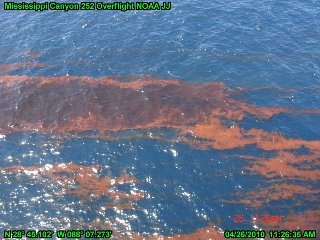
 Oil is leaking from the site of last week’s drilling accident in the Gulf of Mexico far faster than originally thought, according to new estimates.
In an attempt to stop the oil reaching environmentally sensitive areas on land, sections of crude oil were yesterday set on fire for a ‘controlled burn’. A ‘rainbow sheen’ with areas of crude oil now covers an area with a circumference of nearly 1,000 km around the site of the accident.
Worryingly, the National Oceanic and Atmospheric Administration has revised estimates of the amount of oil leaking from the site of the accident that lead to the sinking of the Deepwater Horizon drilling rig. NOAA now thinks that 5,000 barrels of oil are leaking into the ocean every day, compared with an original estimate of 1,000 barrels.
“It’s premature to say this is catastrophic. I will say this is very serious,” said Coast Guard Rear Admiral Mary Landry (AP).
Attempts to use robot submersibles to close the ‘blowout preventer’ valve and halt oil leakage have so far failed.
In addition a large dome is being constructed which NOAA hopes can be placed over the leak site to trap escaping oil so it can be piped to the surface and collected. Another drilling rig should be on site by Friday to start drilling a second oil well that can be used to cut off flow to the leak site, but this could take months.
It is not yet known what caused the Deepwater Horizon to catch fire and sink last week, with the loss of eleven lives.
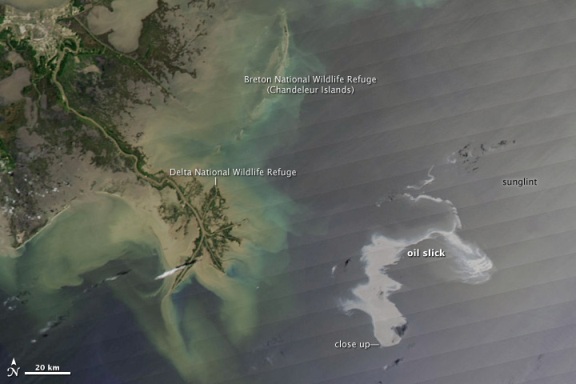
This image, from 25 April, shows the size of the oil slick and its proximity to the important Delta and Breton national wildlife refuges.
Past coverage
Oil spill endangers fragile marshland – 27 April
Deepwater Horizon oil leak still unplugged – 26 April
Race on to contain oil slick after rig accident – 23 April
Image top: NOAA
Image lower: NASA / MODIS Rapid Response Team.