
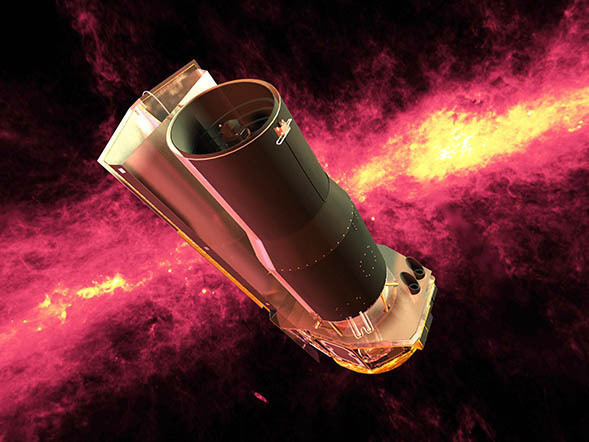
 The results of a ranking of nine ongoing NASA astrophysics missions are in, and the winners are: everyone! For months, astronomers on the missions were worried that a low ranking in the process, called the senior review, would lead to budgetary cuts. But the senior review committee found each of them to be deserving of extended funding, and NASA has apparently been able to find the money to support that recommendation. According to a statement from NASA headquarters, all missions will continue in fiscal years 2013 and 2014. The guest observer programme for the Chandra X-ray Observatory would even be augmented. Only Spitzer (pictured), an infrared telescope, would be phased out earlier than the mission wanted, in 2015.
“This is the strongest suite of programmes that has ever reached an astrophysics senior review,” says senior review chair Joel Bregman, an astronomer at the University of Michigan at Ann Arbor. “Every one of these is highly productive. It’s a surprising situation.”
Unlike previous senior reviews, the committee did not rank the missions overall, from the most scientifically productive to the least. Instead, the committee assigned numerical grades in different categories such as publications per dollar or long-term scientific impact.
There were some mild criticisms of the Hubble Space Telescope, which was competing in the senior review for the first time. The committee said that the mission should be more transparent in explaining its high US$95-million annual operating costs, and that it also should be quicker to reduce them in the years ahead. Nonetheless, NASA is fully funding Hubble, although it will not get an augmentation it asked for. Fermi, a gamma-ray telescope, was also criticized, for not presenting a plan to reduce costs over time. NASA is ordering Fermi to lower its operating costs by 10% each year beginning in 2014.
Bregman says that one of the reasons there were so few consequences this time around was that poor-performing astrophysics missions have already been curtailed. In the 2010 senior review, 11 missions competed against each other. Two years later, five of those missions have either ended or are being phased out. “I’m glad to see it’s not a financial bloodbath, the way it was two years ago,” says Bregman.
Here’s the full NASA statement:
All missions continue operations after the 2012 Senior Review. HST continues at their currently funded levels. Chandra’s Guest Observer budget is increased to account for decreases in FY11. Swift and Kepler mission operations are extended through FY16 with funding for data analysis. Planck will support one year extended operations of the Low Frequency Instrument (LFI). Spitzer’s operations are extended through FY14 with closeout in FY15. U.S. science support of Suzaku is extended to March 2015, to provide one-year overlap with Astro-H. Funding for U.S. support of XMM-Newton is also extended through March 2015. Fermi operations are extended through FY16, with a 10 percent per year reduction starting in FY14. All FY15-FY16 decisions are for planning purposes and will be revisited in the 2014 Senior Review.
Image credit: NASA/JPL-Caltech/R. Hurt (SSC)