
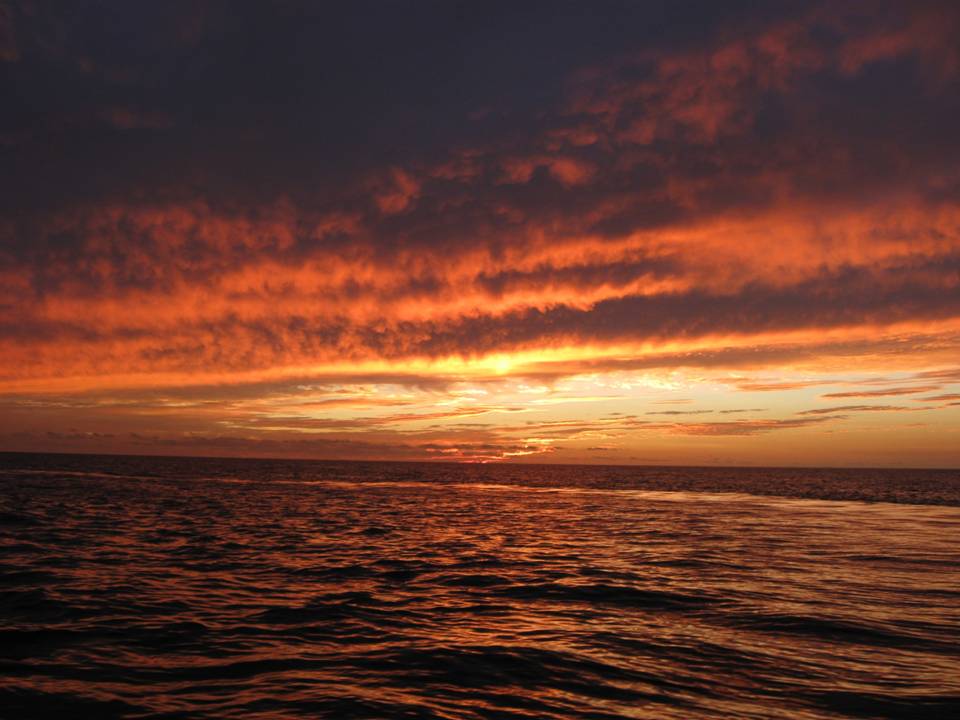
Scientists from the University of Texas and University of Georgia aboard the R/V Cape Hatteras have continued mapping subsurface oil this week, collecting data at eight more stations. Chief scientist Tracy Villareal says that the oil plume they are tracking in the Gulf of Mexico is like the summer cloud banks above the ship, constantly moving, expanding, and contracting.
The ship’s Conductivity Temperature Depth (CTD) device relays real-time data measuring fluorescence, beam attenuation, and oxygen levels. A classic oil signature includes a spike in fluorescence accompanied by an increase in beam attenuation and drop in oxygen (see graph). That’s because hydrocarbon particles absorb a fluorescent beam from instruments mounted on the CTD and reflect back a different frequency; the higher concentration of particles in the plume scatter more light (attenuating the beam); while lower dissolved oxygen indicates bacterial metabolism of oil.
The CTD also collects water samples at various depths, and the scientists use these to conduct tests to back up the real-time data. For example, University of Texas graduate student Ellen Knapke measures the amount of bacteria using a flow cytometer and a dye that stains their DNA. The cytometer reads the resulting pigments, counting the number of bacteria present. Although some question the bacterial activity associated with the spill, and its effects on oxygen, higher numbers of bacteria are generally correlated with a drop in oxygen levels. Knapke’s bacteria counts should correlate to the drops in oxygen shown by the CTD, and she reports that they have, consistently.

Knapke also has observed higher bacterial counts in the plume farther west from the well site. This fits expectations, as this oil is older and bacteria have had more time to feed on it and increase in numbers. The decrease in oxygen caused by this metabolic activity could have long-term consequences at these depths, she adds. While controversy rages about just how much oil remains in the Gulf, and where, the data have convinced Knapke and her colleagues that the oil is certainly not gone from the region. Several research cruises in addition to this one have identified the deep plume moving steadily west from the well, its direction and shape influenced by the topography of the sea bottom, currents, and the passage of time.
While the plume is constantly changing, data from this cruise show that it remains at a pretty stable depth of about 1,200 meters. Once the oil became entrained in a particular water layer, Villareal says that it would take some kind of disturbance for it to leave that layer.

Around sunset on Monday we passed the Deepwater Horizon site, a cluster of rigs and ships on the hazy horizon. We took measurements along a transect until the data confirm that we’ve reached the southern edge of the plume, near the edge of a drop-off on the floor of the Gulf. We then headed toward stations that will define its northern edge. Whenever there is greater distance between stations, those on board kill time by finishing up loose ends in the lab, crunching data on laptops, watching Lonesome Dove on DVD, or grabbing a few hours of sleep to catch up on those lost in the past few hectic days.
The process of lowering the CTD, firing the collection bottles at various depths on ascent, collecting water for various tests, and performing those that can be done in the ship’s lab takes several hours. This sometimes keeps the scientists up well past midnight. In the blur of collections, I’m drafted to record oxygen content and pH readings from a series of glass bottles. It’s a bit like being back in college labs, only the music is a bit different, and this ship-board lab literally rocks.
Posted on behalf of Melissa Gaskill
photo credits: Melissa Gaskill (sunset at sea, deploying the CTD)
graphic: Tracy Villareal