
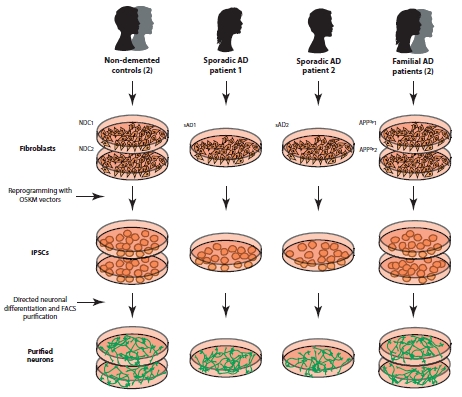
Israel et al. Supp Fig1: Experimental design.
Alzheimer’s disease (AD) is a devastating neurodegenerative disease that could become an even more massive public health problem than it already is, if current projections hold. Some predict that by 2050, 1 in 85 individuals will be affected by the disease. Currently, there is no cure, but there are neurotransmitter-enhancement-based strategies to slow down the cognitive deficits [the loss of cholinergic neurons is implicated in some of the memory problems associated with AD so therefore, pharmacological enhancement of brain acetylcholine concentration can partially alleviate some memory-based symptoms.] However, as with many neurodegenerative diseases, these stop-gap treatments only work for so long, until the cells responding to neurotransmitter supplementation treatments die off completely. Therefore, diverse strategies designed to cure or at least slow down AD are imperative.
While a number of AD transgenic mouse models have been created, based on the various mutations identified in patients, the trouble is that these models still utilize the cross-species approach of studying “diseased” mouse neurons expressing mutated human genes. And perhaps an even bigger problem with many mouse models, genetically-inherited forms of AD represent only ~0.1% of cases, with the remainder being “sporadic” (although there are genetic risk factors influencing the emergence of sporadic AD.)
In a new paper, online today from Nature, Lawrence Goldstein and colleagues go right to the source and purify skin fibroblasts from AD patients with the intent to turn them into neurons for study. The authors took skin cells from 2 patients with familial AD (the genetically-inherited version), 2 patients with sporadic AD and 2 control patients. These cells were reprogrammed into induced pluripotent stem cells (iPSCs) and subsequently directed to form neurons. Neurons were purified to around 90% with cell sorting techniques, were allowed to mature and then were tested to determine whether the resulting cultures presented signs of neuronal maturity (for example, making synaptic contacts and exhibiting mature electrophysiological signatures.) Once satisfied with these critical assessments, the authors moved towards documenting abnormalities in the diseased cells, such as noting the expression of pathophysiological markers like amyloid-β(1–40), phospho-tau(Thr 231) and active glycogen synthase kinase-3β (aGSK-3β), while also observing disruptions in specific organelles. One aspect that particularly makes these culture models attractive is the ability to easily manipulate the cells pharmacologically, with the authors demonstrating that treatment of diseased neurons with β-secretase inhibitors reduced the levels of some pathophysiological markers. In short, despite only living in a dish for a few weeks, these iPSC lines could still recapitulate disease phenotypes that take decades to develop. And perhaps most importantly, these results represented one of the first possible models for sporadic AD (remember, this version of the disease makes up 99.9% of cases!!)
Of course, as with any newish technology or strong conclusion, there were bumps along the way during review. Reading through the final paragraphs of the paper, you’ll notice this warning from the authors:
One point of caution is that it is possible that the cultures of purified neurons that we generated and studied may not have been fully mature, as they lacked repetitive action potentials and had limited spontaneous activity. Although some types of mature neurons also have these properties, it is conceivable that the phenotypes we observed might be modified by duration of in vitro culture. In this context, while there is debate about when Alzheimer’s disease phenotypes initiate, evidence exists that Alzheimer’s disease-like pathology can occur in Down’s syndrome fetuses as early as 28 weeks of gestation24
This is a welcome point of disclosure and caution that reflects some of the concerns regarding the maturity of the neurons raised during the review process. While this is an important point, delaying publication by 4-8 more weeks while the authors explored a vast set of new experiments using a variety of different neuronal ages seemed excessive, given all of the experiments they had already completed in this study. Thus, words of caution and a conservative tone were in order. This brings us to a broader issue at Nature, and likely one at various other journals everywhere, concerning the means by which the “bar” is set for experimental evidence. In most well-established, mature fields, the editorial criteria for techniques and comprehensive experimentation is extremely high. In short, the experiments better not be short. However, in a new field using emerging techniques, it is not always a rock-solid requirement to conduct a full comprehensive analysis. Several strong lines of evidence converging on the main point are often enough. We must remember that everyone in a new field is “feeling their way” with experiment and thus, major advances can come in the form of baby steps, ones that could help many others progress with their studies. With this in mind, delaying publication and communication not only makes little sense, but seems detrimental to the progression of the field. As editors, we must walk the fine line of demanding the best that can be currently provided (within reason,) while avoiding any stark editorial positions that could potentially stifle a field or delay the communication of the latest results.
Applying these ideas here, human patient-derived iPSCs were first introduced back in 2008, with cell lines derived from ALS and SMA patients. In those publications, although neurons were produced, only in the Svendsen paper were the neurons crudely tested for their ability to make synapses. This was conducted by staining the cultures for synaptic markers, like the synaptic vesicle-associated protein synapsin. Although synapsin clustering isn’t a definitive marker for functional synapses, this paper was nonetheless more about deriving neurons from patients, period. Not necessarily what could be done with them. Fast-forward 3 years later and now the authors in the current study were not only conducting staining for synaptic markers, but were also completing electrophysiological characterizations to examine spontaneous activity and the derived neurons’ ability to fire repetitive action potentials. Although this publication, it could be argued, is also more about the potential for using iPSCs in the study of sporadic AD, the patient-derived iPSC field is growing and maturing, with more characterization and more complicated experiments being required, as other aspects (like cell reprogramming) become more routine. Therefore, the bar is rising, and with the publication of this paper, has risen again. The field has already changed from “Look at these cells, aren’t they cool!” to “Look at what we can DO with these cells, aren’t they cool!”
[For additional coverage see this Nature News story, including a podcast with lead author Larry Goldstein.]
 Israel, M., Yuan, S., Bardy, C., Reyna, S., Mu, Y., Herrera, C., Hefferan, M., Van Gorp, S., Nazor, K., Boscolo, F., Carson, C., Laurent, L., Marsala, M., Gage, F., Remes, A., Koo, E., & Goldstein, L. (2012). Probing sporadic and familial Alzheimer’s disease using induced pluripotent stem cells Nature DOI: 10.1038/nature10821