Five ways science communication can help you

Naturejobs journalism competition winner Rachel Harris explains how engaging others in science has benefitted her in the lab

For the past four years I’ve been working in science communication (SciComm), and academia. I’m now mid-way through my PhD — I’m studying on Alzheimer’s disease and I know I would be finding research a lot tougher if I were not involved with science communication.

RH_BNF2016_original-smaller

Rachel Harris doing some SciComm at Bristol Neuroscience Festival this year

Continue reading

Discovery of distinct peptides in brains of Alzheimer’s patients could help diagnosis

Alzheimer’s patients with different medical histories might possess distinct variants of amyloid beta fibrils—the basic component of the plaque-like deposits found in the brains of people with the disorder—according to study of two affected individuals published online today in the journal Cell. The findings hint at the existence of Alzheimer’s disease subcategories, and suggest a potential path forward to improving the diagnostic specificity of this devastating illness.

It’s thought by some scientists that the overproduction of amyloid beta peptides, or perhaps the failure to clear this peptide, can cause an accumulation of these molecules and the formation of fibrils in the brain, possibility leading to inflammation and neurotoxic effects.

Previous studies demonstrated that amyloid beta fibrils cultured in a test tube can present different molecular structures and can retain these structures when grown from short fibril fragments. To determine if different structures of these peptide chains are also present in human brains, the study’s researchers gently extracted amyloid fibrils from postmortem brain tissue taken from two Alzheimer’s patients who had different medical histories. One of the individuals received an Alzheimer’s diagnosis while still alive. The other was had initially been diagnosed with another form of dementia, but an autopsy that revealed the hallmark amyloid plaques in his her brain that indicated Alzheimer’s.

The researchers then used the extracted amyloid beta fibrils to seed the growth of isotopically-labeled amyloid samples in sufficient quantity for analysis. A close inspection of the peptides revealed that the fibrils grown from one patient seemed to have a periodic twist in their structure that was absent from those grown from the other patient’s sample, which grew fibrils with a constant diameter of 7 nanometers. Importantly, each of the patients possessed a single type of structure that did not overlap with that found in the other.

Continue reading

Patients help bring the study of Alzheimer’s to the dish

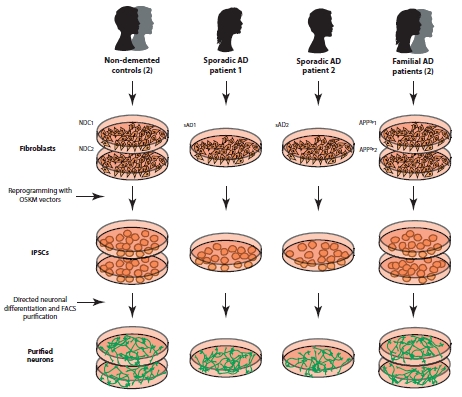
Israel et al. Supp Fig1: Experimental design.

Alzheimer’s disease (AD) is a devastating neurodegenerative disease that could become an even more massive public health problem than it already is, if current projections hold. Some predict that by 2050, 1 in 85 individuals will be affected by the disease. Currently, there is no cure, but there are neurotransmitter-enhancement-based strategies to slow down the cognitive deficits [the loss of cholinergic neurons is implicated in some of the memory problems associated with AD so therefore, pharmacological enhancement of brain acetylcholine concentration can partially alleviate some memory-based symptoms.] However, as with many neurodegenerative diseases, these stop-gap treatments only work for so long, until the cells responding to neurotransmitter supplementation treatments die off completely. Therefore, diverse strategies designed to cure or at least slow down AD are imperative.

While a number of AD transgenic mouse models have been created, based on the various mutations identified in patients, the trouble is that these models still utilize the cross-species approach of studying “diseased” mouse neurons expressing mutated human genes. And perhaps an even bigger problem with many mouse models, genetically-inherited forms of AD represent only ~0.1% of cases, with the remainder being “sporadic” (although there are genetic risk factors influencing the emergence of sporadic AD.)

Continue reading