Antibodypedia on Facebook

This has been cross-posted from the Stepwise Blog.

Those readers who are avid, or even obsessive, followers of Nature’s various blogs will know that NPG is collaborating with a website called Antibodypedia since December of 2011. Well, last week we passed a significant milestone with the listing of its half-millionth antibody. And this week we are launching a Facebook page.

Antibodypedia attempts to pull together information about the performance of publicly available antibodies so that researchers can make informed decisions about which will work best in their experiments before they buy them. The data we aggregate are things like links to research papers in which the antibodies have been used, technical data from the antibody suppliers, and the results of experiments performed by independent scientists.

Antibodypedia is a great resource as it is, but the aggregation and presentation of information already available, albeit in diverse places, is only half of the story. We want it to also be a place where researchers can share their experiences with specific antibodies and discuss the problems that arise with immuno-based cell biology techniques.

We already have a mechanism in place for researchers to submit experiments showing the performance of antibodies, and an advisory board to help us peer-review those experiments to ensure their usefulness; it is a form of micro-publication. Now we are taking a further step in engaging with the research community with our Facebook page.

Why Facebook?

Well, it would have been perfectly possible to incorporate a message board, discussion forums and the other functionalities of a community site into Antibodypedia but the plain fact is the vast majority of researchers are already members of a global social networking site, so why ask them to join another one? Instead we are making things easy and carving out a small corner of Facebook for all things antibody(pedia). We will of course be posting a lot ourselves on the page—news, highlighting of research papers, running polls etc.— but we also hope that antibody-using researchers will start their own discussions, share their experiences and try to solve each other’s problems.

The page launches today so please come, take a look and ‘like’ us. Then come back regularly over the next few weeks to follow our posts, take part in the polls and, of course, leave a comment or two.
The first few months of Antibodypedia

This is a guest blog post from Victoria Newman, the Antibodypedia curator.

Late last December I wrote a blog post for Stepwise announcing the launch of the new NPG resource Antibodypedia | nature (www.antibodypedia.com), an open-access platform to search for antibody data and commentary. I’ll talk more about what we’re trying to do below; however, as a quick status update, since our launch we’ve been steadily adding antibodies and making improvements here and there and have had lots of positive feedback from users. Most impressively, since the New Year we’ve been accessed from 136 countries, with repeat visitors from 113 countries in the last four weeks. Yay for open-access! But we know there is always room for change and we value your comments. Send us your feedback or, if you’re planning on attending the FASEB Experimental Biology (ASBMB) meeting next week in San Diego, stop by the NPG booth and let me know what you think in person: I’ll be there from 12-3 on the afternoon of Monday the 23rd.

So what does Antibodypedia do? We think of it as a microjournal, publishing bite-sized bits of data rather than full-length manuscripts. The data are specific to assays involving antibodies, since we believe that there’s huge scope for improvement with regard to their annotation—the process of buying them can be intensely chaotic, sometimes with very little information available to suggest that one reagent works better than another in the experiment you’re trying to plan. Our aim is to provide data from the antibody user community (including published references citing reagents) and antibody vendors or distributors to give users as well-rounded as possible a grasp of how a product works for different techniques. Because we feel strongly that your data (the control experiments in your lab notebook that may make it into supplementary data or may never see the light of day again) are the best way to convince other users that reagents do or don’t work, we’ve arranged to assign a DOI to each data submission so they can be cited onward. They don’t have to look lovely, especially if you think they’re evidence that something isn’t working, but we feel that they should be made public to help you troubleshoot your blank western blot. So send us your data—help users to answer the eternal question ‘Did I forget to induce my cultures again?’.

Advanced Search on Antibodypedia

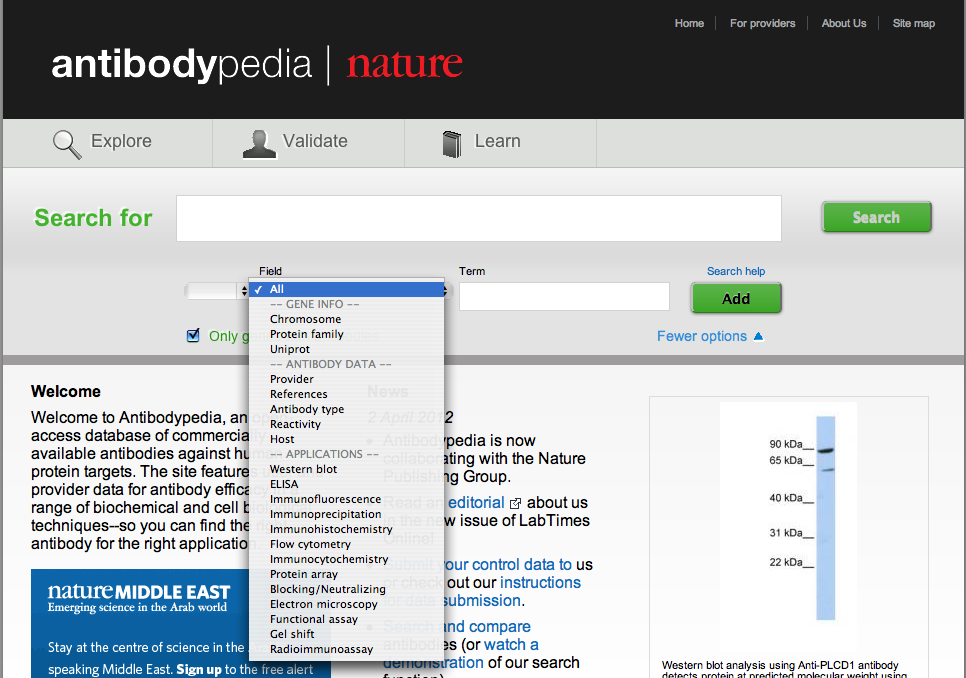
Advanced Search

Because we want to provide researchers with the capacity to identify antibodies proven to work in specific techniques, Antibodypedia is structured slightly differently from many of the antibody search engines you might find out there: its organization is gene-centric, so each antibody directed against a single protein target can be retrieved by a search for that antigen. ‘Advanced search’ lets you find antibodies that are recommended or validated for one or more types of experiment, sold by a particular provider, and linked to reference citations, among other things. The ‘Advanced search’ menu is always undergoing development, so please let us know if it’s missing something you’d find useful.


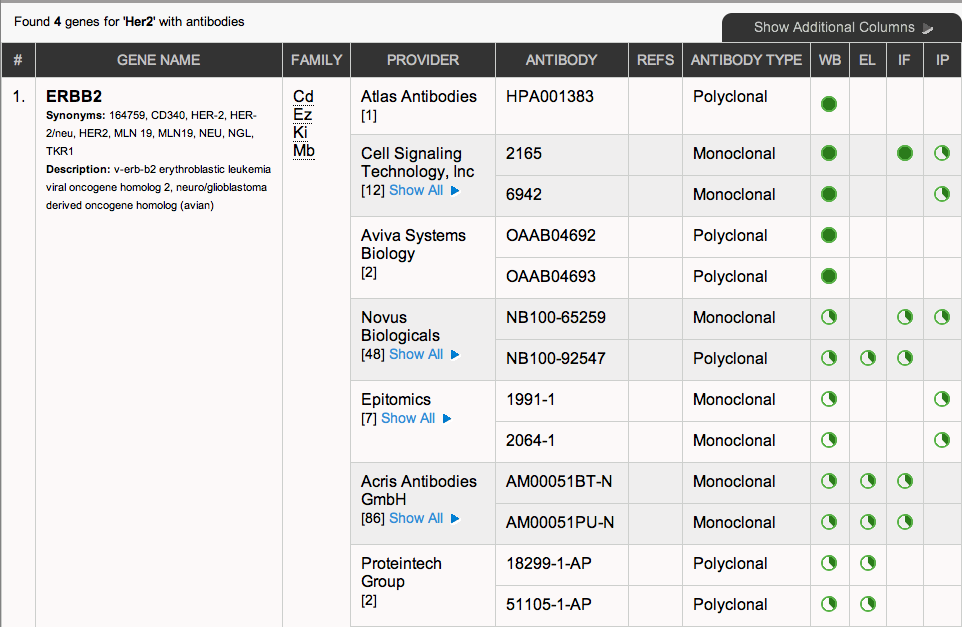
After you’ve defined and run your search, your results will be displayed as a table, with each row representing a single antibody.

Search Results

Search Results

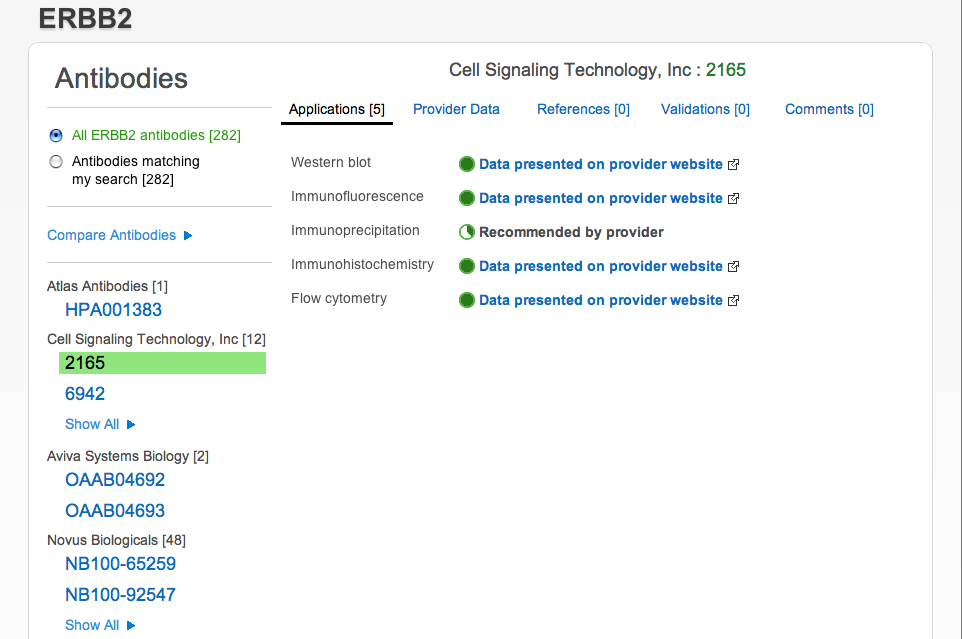
Clicking on a reagent will take you to antibody pages, which host or link to both user- and provider-sourced data as well as protocols and published references using those reagents.

Antibody Details

Antibody Details

You can also choose some of the antibodies retrieved by your search for side-by-side comparison to decide more easily which one(s) you’d like to test. Our antibody pages link directly out to vendor pages as well so you can find pricing and ordering information.

We think Antibodypedia will simplify selecting an antibody for a particular experiment by making quality control data both accessible to bench scientists and easy to interpret. But in order to maximize our utility, we need your help. Tell us which antibody providers you’d like to see listed in Antibodypedia so we can contact them and which techniques you use that aren’t currently searchable so we can start gathering data for them. And most importantly: submit to us so that we can populate antibody entries with your results! Remember that we’re not asking for publication-quality images, just something that can be interpreted as positive or negative proof that something’s working along with some notes on how you set up your experiment. Help us create an efficient means to search for good antibodies so you and your colleagues can plan your assays with less waste of time and money.