Antibodies found in Peruvians suggest natural resistance to rabies in local vampire bats

While attempting to better understand the exposure of rural Latin American communities to diseases harbored by bats, epidemiologists at the US Centers for Disease Control and Prevention (CDC) have stumbled upon an intriguing finding: eight people living in two tiny Peruvian villages appear to have developed antibodies against the rabies virus found in local vampire bats without any prior vaccination or treatment for the infection. This population study, the first of its kind, may provide clues to better understand how incremental exposure to rabies could lead to better vaccines or monoclonal antibody drugs.
“We think that these people were lightly bitten during the night, but were not exposed to enough of the virus to develop a full infection,” explains co-author Sergio Recuenoco, an epidemiologist at the CDC in Atlanta who published the findings today in the American Journal of Tropical Medicine and Hygiene.

The study suggests that humans are exposed to and develop antibodies against the virus without developing disease. Whether this reflects inadequate exposure or successful immune clearance of virus remains unclear, explains Ashley Banyard, a virologist at the UK Animal Health and Veterinary Laboratories Agency in Surrey, England, adding, “Personally, I believe this paper to be of great significance to the scientific community.”

The CDC initiated its survey on human exposure to bats only four years ago, prompted by new evidence at the time that these flying mammals are reservoirs of serious pathogens such as the Ebola, Nipah and Corona viruses. But unlike those viruses, virtually every known rabies infection in humans—except for a rare handful of isolated cases—has led to death. The disease causes brain inflammation, leading to a horrible end characterized by hallucinations and convulsions. Right now the only option for people infected with rabies is an expensive and painful course of therapy that can cost up to $1,000 and require five vaccine injections and an additional shot of antibodies against the virus. The World Health Organization estimates that around 55,000 people die each year from rabies, and some evidence suggests that number may climb.

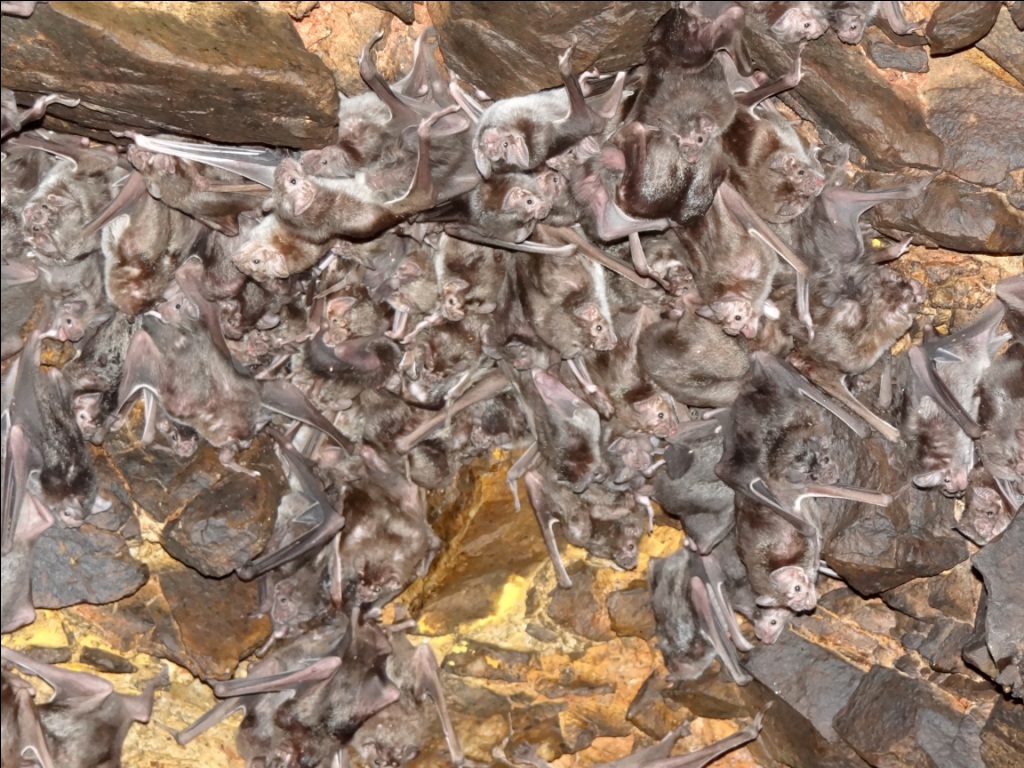
Vampire bats, which can harbor rabies, generally dine on the blood of cows and pigs. But the nocturnal creatures will bite humans if their primary food sources are unavailable. And in communities like Truenococha and Santa Marta, the two Peruvian villages in the CDC study, humans are a tasty alternative during periods when farmers have sold off their livestock.

Knowing that the Peruvians had contact with local vampire bats, CDC scientists closely examined the blood samples of the eight residents. They found a mixture of neutralizing and non-binding antibodies against rabies, leading them to deduce that the individuals had overcome exposure to the virus. As Brett Petersen, another author on the study and fellow a CDC epidemiologist, notes, better understanding these people’s immune responses could ultimately help scientists in overcoming rabies.

“A greater understanding of the process by which the people developed antibodies in this setting may help inform improved vaccine development or identify new targets for treatment,” he says.

Image courtesy of Daniel Streicker
The first few months of Antibodypedia

This is a guest blog post from Victoria Newman, the Antibodypedia curator.

Late last December I wrote a blog post for Stepwise announcing the launch of the new NPG resource Antibodypedia | nature (www.antibodypedia.com), an open-access platform to search for antibody data and commentary. I’ll talk more about what we’re trying to do below; however, as a quick status update, since our launch we’ve been steadily adding antibodies and making improvements here and there and have had lots of positive feedback from users. Most impressively, since the New Year we’ve been accessed from 136 countries, with repeat visitors from 113 countries in the last four weeks. Yay for open-access! But we know there is always room for change and we value your comments. Send us your feedback or, if you’re planning on attending the FASEB Experimental Biology (ASBMB) meeting next week in San Diego, stop by the NPG booth and let me know what you think in person: I’ll be there from 12-3 on the afternoon of Monday the 23rd.

So what does Antibodypedia do? We think of it as a microjournal, publishing bite-sized bits of data rather than full-length manuscripts. The data are specific to assays involving antibodies, since we believe that there’s huge scope for improvement with regard to their annotation—the process of buying them can be intensely chaotic, sometimes with very little information available to suggest that one reagent works better than another in the experiment you’re trying to plan. Our aim is to provide data from the antibody user community (including published references citing reagents) and antibody vendors or distributors to give users as well-rounded as possible a grasp of how a product works for different techniques. Because we feel strongly that your data (the control experiments in your lab notebook that may make it into supplementary data or may never see the light of day again) are the best way to convince other users that reagents do or don’t work, we’ve arranged to assign a DOI to each data submission so they can be cited onward. They don’t have to look lovely, especially if you think they’re evidence that something isn’t working, but we feel that they should be made public to help you troubleshoot your blank western blot. So send us your data—help users to answer the eternal question ‘Did I forget to induce my cultures again?’.

Advanced Search on Antibodypedia

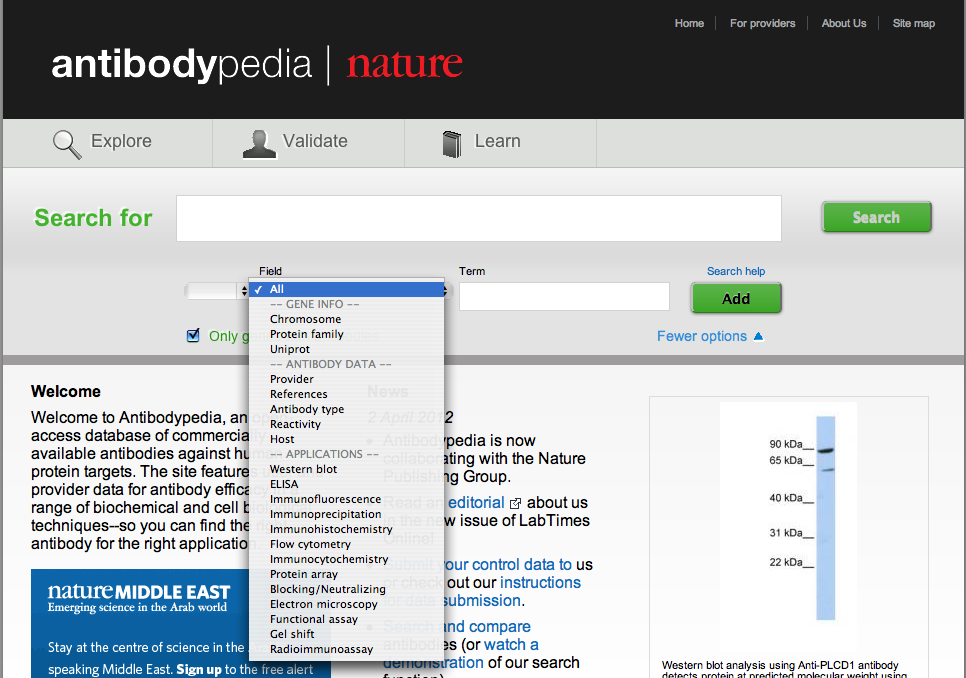
Advanced Search

Because we want to provide researchers with the capacity to identify antibodies proven to work in specific techniques, Antibodypedia is structured slightly differently from many of the antibody search engines you might find out there: its organization is gene-centric, so each antibody directed against a single protein target can be retrieved by a search for that antigen. ‘Advanced search’ lets you find antibodies that are recommended or validated for one or more types of experiment, sold by a particular provider, and linked to reference citations, among other things. The ‘Advanced search’ menu is always undergoing development, so please let us know if it’s missing something you’d find useful.


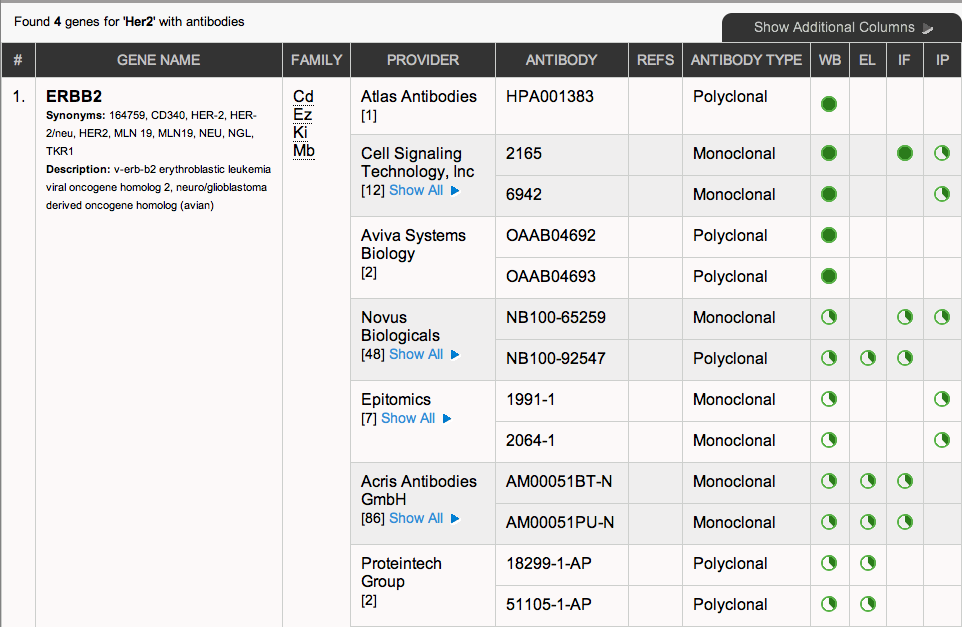
After you’ve defined and run your search, your results will be displayed as a table, with each row representing a single antibody.

Search Results

Search Results

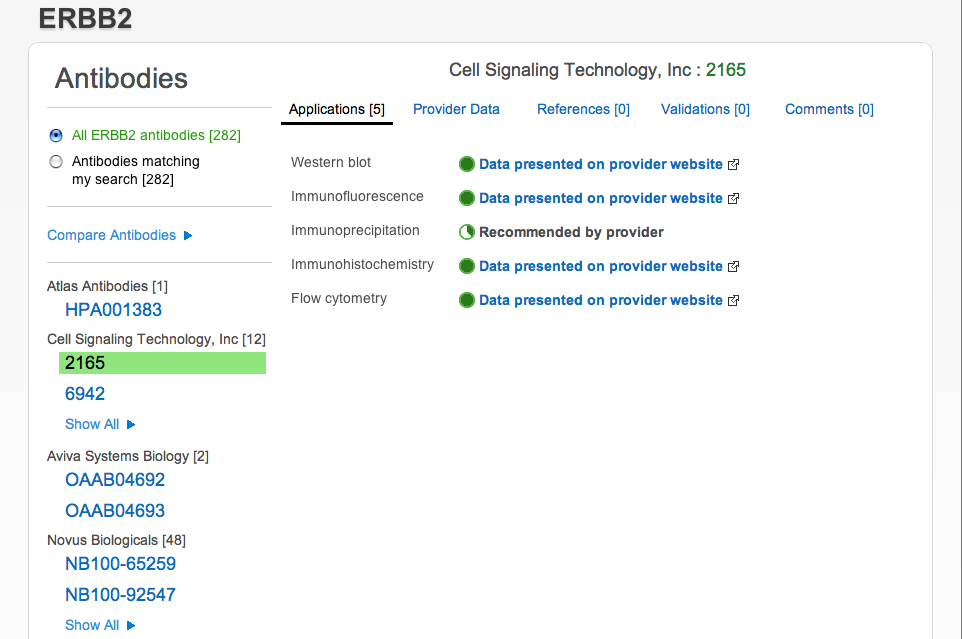
Clicking on a reagent will take you to antibody pages, which host or link to both user- and provider-sourced data as well as protocols and published references using those reagents.

Antibody Details

Antibody Details

You can also choose some of the antibodies retrieved by your search for side-by-side comparison to decide more easily which one(s) you’d like to test. Our antibody pages link directly out to vendor pages as well so you can find pricing and ordering information.

We think Antibodypedia will simplify selecting an antibody for a particular experiment by making quality control data both accessible to bench scientists and easy to interpret. But in order to maximize our utility, we need your help. Tell us which antibody providers you’d like to see listed in Antibodypedia so we can contact them and which techniques you use that aren’t currently searchable so we can start gathering data for them. And most importantly: submit to us so that we can populate antibody entries with your results! Remember that we’re not asking for publication-quality images, just something that can be interpreted as positive or negative proof that something’s working along with some notes on how you set up your experiment. Help us create an efficient means to search for good antibodies so you and your colleagues can plan your assays with less waste of time and money.