After the fall, Curiosity plans its first move

The post-mortem of the Curiosity rover’s picture-perfect landing is nearly complete. After catching the rover in the act of falling, the HiRISE camera on the Mars Reconnaissance Orbiter (MRO) has, in its latest pass overhead, spotted the rover and all of its accoutrements in a sort of family portrait, shown here. “It looks like a crime scene,” said HiRISE scientist Sarah Milkovich in a press briefing at the Jet Propulsion Laboratory (JPL) in Pasadena, California, on Tuesday.

What’s next? As I describe in the magazine this week, Curiosity’s ultimate destination is Aeolis Mons, (informally dubbed Mount Sharp), to the southeast — but that is many months, if not a year, away. It might be tempting to go look at the wreckage of the sky crane, which is directly behind the rover. Some have even speculated that the very first image returned, from the rear hazard cameras, caught a puff of dust caused by the sky crane crashing. It would be an amazing coincidence of time and orientation. “I don’t think we can rule it out,” said mission manager Mike Watkins. But the rover team is unlikely to drive to that wreckage, partly because scientists with finicky geochemical instruments want to keep their distance from the confounding effects of 140 leftover kilograms of hydrazine propellant that may have polluted that terrain. So where will the rover drive?  Continue reading

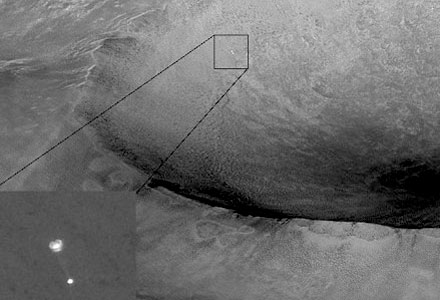
Mars orbiter catches Curiosity by the tail

Curiosity has been caught in the act. Just a minute before landing, the HiRise camera aboard the Mars Reconnaissance Orbiter did what everyone was hoping for, and repeated the amazing feat of four years ago, when it snapped a picture of the parachute of the Phoenix lander. Alfred McEwen, principal investigator for the HiRise camera, had estimated that there was only a 60% chance of getting this image, which leaked on Twitter. The snap of Curiosity’s parachute is expected to be 5 times richer than the one for Phoenix, both because MRO was closer and Curiosity’s parachute was bigger.

Over the past few days, people here at the Jet Propulsion Laboratory in Pasadena, California have been fixated by an XBox video game that allows users to pilot in the rover themselves. And last night, it was the rich simulations of the landing sequence that held everyone’s attention. But it’s images like this, lonely and frail and beautiful, that get me. This is the real thing.

More details to come after the 9 am PDT press briefing.


Curiosity aims for a smooth runway

{credit}NASA/JPL{/credit}

I’ve been focusing a lot on the probabilistic assessment that Curiosity has a 98.3% chance of landing successfully (if its hardware works). About 1% of that risk is in the parachute, which is why scientists working the Mars Reconnaissance Orbiter are so keen to catch Curiosity during its descent. But what about the remaining 0.7% terrain-hazard risk?

This risk is the combination of boulders and slopes that could threaten to tip the rover, and craters and mesas with walls too steep for Curiosity to escape. According to Devin Kipp, an engineer on the entry, descent and landing (EDL) team at the Jet Propulsion Laboratory in Pasadena, California, slopes greater than 20% give the rover trouble. “Above that and it gets shaky,” he says.

Allen Chen, the EDL operations lead, was kind enough to share the above image, which shows the areas (in red) that contribute to the 0.7% risk associated with terrain hazards. You can see that the ellipse was purposefully positioned between the steep walls of Gale crater in the upper left corner, and, in the lower right, the steep slopes of Mount Sharp (oops, I mean Aeolis Mons).

But look carefully within the ellipse and, halfway between the centre and the western edge, you can see an angry red pimple: an unnamed 250-metre-wide crater with walls that would probably trap the rover. It’s a hole-in-one that Curiosity certainly wants to avoid. After the jump is a map that shows how that crater’s walls can slope as much as 25 degrees. Chen says that it’s possible that the rover could escape through a slightly less steep section of the crater’s southern wall, but it’s a predicament he doesn’t want to deal with.

So why didn’t the team move the landing ellipse to the north a little, where the landing terrain is all blue? That certainly was considered, Chen says. But there are trade-offs. The team would have eliminated a tiny amount of dangerous terrain, but then the rover would have much further from the base of Aeolis Mons — where the most important mission science awaits.

Continue reading

Mars orbiter plans for a Curiosity close-up

{credit}NASA/JPL/Univ. Arizona{/credit}

Remember this picture? NASA is quietly planning to have an even better one of the Curiosity landing — perhaps even in colour — by Monday morning.

This snap, taken on 25 May 2008, is the parachute of the Mars Phoenix lander caught in the act 3 minutes before landing by the HiRISE camera on the Mars Reconnaissance Orbiter (MRO). Not only did the MRO give NASA a stunning image for the public, but it also provided crucial engineering information about one of the riskiest aspects of any Mars landing: whether the parachute opened completely.

And NASA is trying again. The MRO will slew into position and take a snap of Curiosity’s parachutes 60 seconds before landing, just before the rover is released from the back shell. It could even be possible to discern the heat shield on the ground. “We get one shot,” says Alfred McEwen, principal investigator of HiRISE (High Resolution Imaging Science Experiment) at the University of Arizona in Tucson.

This time, the chance of catching Curiosity on camera is only 60%, says McEwen. With Phoenix, there was about an 80% chance. The difference is because of the relative paths of the spacecraft. For the Phoenix landing, HiRISE’s long and narrow field of view was closely aligned with the path of the lander. For the Curiosity landing, the MRO will be much closer and looking almost directly down at Curiosity. But the paths are nearly perpendicular, which means that HiRISE’s field of view — a narrow north–south track about 6 kilometres wide on the ground — might not contain Curiosity, which will be barreling east along its 20-kilometre-long landing ellipse (see map after the jump).

There is a silver lining, however. Not only will the MRO be closer, but Curiosity’s parachute is about twice the size of Phoenix’s. In the Phoenix snap, the parachutes were just 10 pixels across. McEwen says that Curiosity’s parachutes could cover 50 pixels, making for a black-and-white image as detailed as 35 centimetres per pixel. And McEwen estimates that there’s a 20% chance Curiosity will fall along the central swath of HiRISE’s field of view, where there are colour detectors. “If we’re really, really lucky we’ll catch it in our colour strip,” he says.

McEwen expects to get the data back to Earth by 1 a.m. Pacific daylight time on 6 August. His team will spend a frantic few hours trying to spot Curiosity and process the image before delivering it to the Jet Propulsion Laboratory (JPL) in Pasadena, California, by 3 a.m. So forget the fish-eyed, fuzzy thumbnails that Curiosity’s hazcams are supposed to return first. By the time of the 9-a.m. press briefing on Monday morning, the JPL could have a beautiful surprise waiting for the public: a memento (hopefully not mori) of the most complicated landing ever attempted in the Solar System.

Continue reading

Eyes on Curiosity’s descent

This is just way cool. NASA has created a visualization application, ‘Eyes on the Solar System‘, that allows you to use your home computer to see where all of its spacecraft are in the Solar System. Not only that, but programmers have created a module within the software to follow the Curiosity mission as the rover approaches Mars. You can follow the entry, descent and landing in real time, and you can also take the driver’s seat to fast-forward (and backward) in time. Doug Ellison, the content lead for the application at the Jet Propulsion Laboratory in Pasadena, California, says that everything is modelled as precisely as possible — even the trajectories for the ballast weights that are shed as the spacecraft descends. Here’s a shot of Curiosity against the backdrop of the mysterious Mount Sharp, just after it is released from the parachute and back shell.

{credit}NASA/JPL-Caltech{/credit}

Mars rover on track for 5 August landing

{credit}Eric Hand{/credit}

It’s so far so good for Curiosity, the car-sized rover that at 10:24 p.m. PDT on Sunday is expected to slam into the atmosphere of Mars en route to landing at the bottom of Gale Crater. Mission scientists are monitoring a dust storm that’s roiling in the southern hemisphere, but it is unlikely to linger around long enough to affect the spacecraft’s descent. “It’s very, very quiet in my office, which is good,” says Peter Theisinger, project manager for the mission at the Jet Propulsion Laboratory (JPL) in Pasadena, California.

At a media briefing on Thursday, mission engineers at the JPL said that after the latest corrective manoeuvre, the spacecraft hauling the rover is offset by just under a kilometre from its intended entry point into the atmosphere. That’s well within the tens of kilometres of offset that can be cleaned up during the guided entry phase of its descent, the first stage of the ‘7 minutes of terror‘ for the spacecraft, says Adam Steltzner, who is leading the entry, descent and landing phase. He says that the team may decide not to perform a final corrective manoeuvre on Friday. Steltzner is pictured at right describing the final stage of the descent, when the sky crane releases the rover from bridle cords. “I promise you it’s the least crazy of the methods that we could use,” he says. “We’ve become quite fond of it.”