Ancient regulatory logic

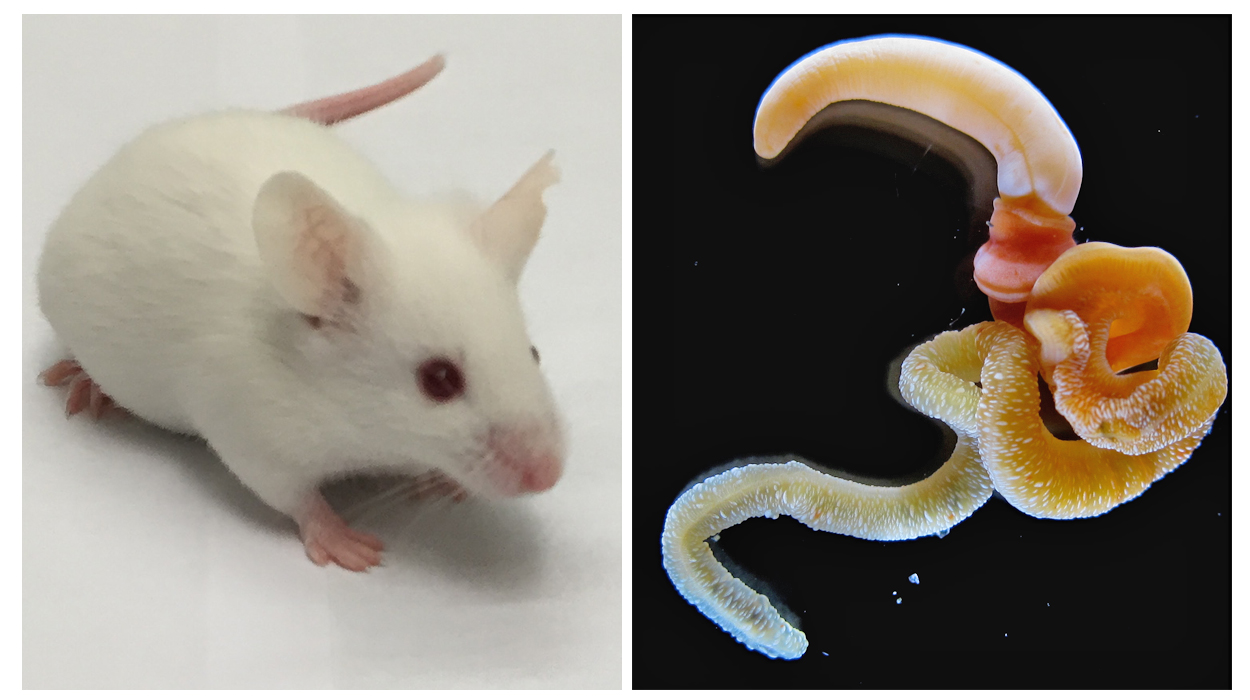
Yao et al. found that certain brain enhancers were functionally conserved between mice (left) and acorn worm (right), despite very limited sequence conservation.

Yao et al. found that certain brain enhancers were functionally conserved between mice (left) and acorn worm (right), despite very limited sequence conservation. {credit}Douglas Epstein{/credit}

A study published this week in Nature Genetics shows that enhancers can be conserved across very long evolutionary distances, even without extensive sequence conservation. Continue reading

Enhancing our knowledge of regulatory evolution

Stark

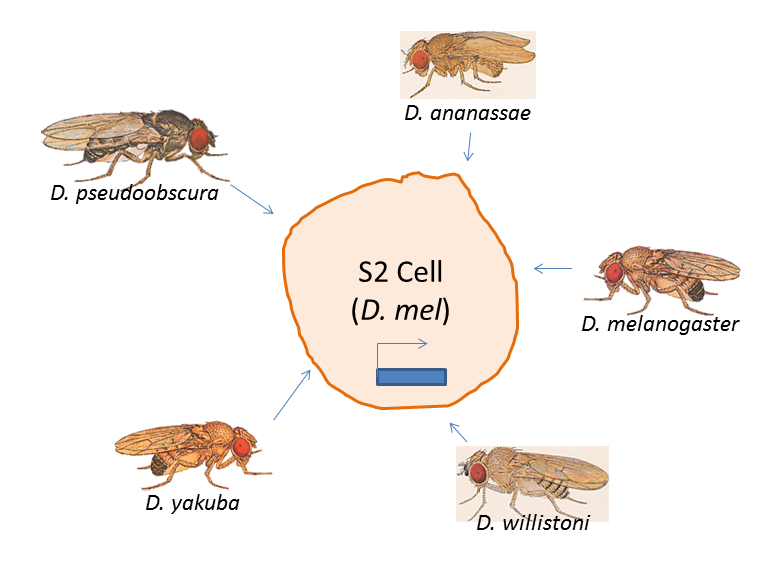
Fly illustrations from The University of Texas Publication No. 4313: April 1, 1943 and The University of Texas Publication No. 4445: December 1, 1944

A paper published online this week in Nature Genetics mapped the enhancer regions of 5 fruit fly species to better understand the evolution of regulatory DNA. 

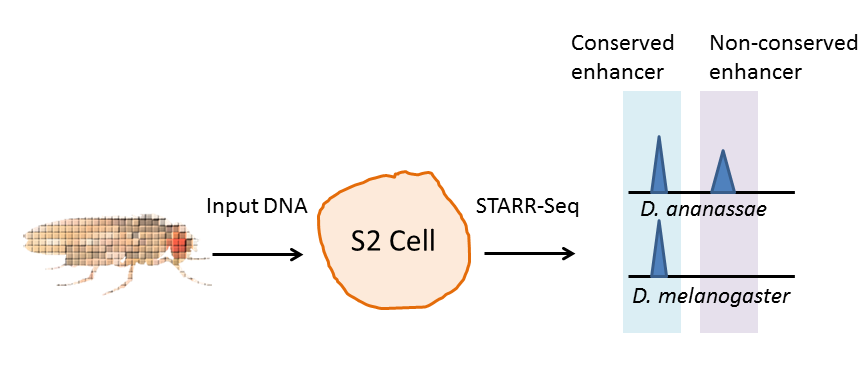
Alexander Stark and colleagues used a recently-developed method, called STARR-Seq, to find which Drosophila melanogaster enhancer elements were still functional in the different fly species. Basically, you chop up your input DNA, put the fragments into a vector with an open reading frame preceding it (so your input DNA can act as an enhancer, if it so chooses) and then toss it into some cultured cells.

In this case, the cells used were Drosophila melanogaster S2 cells. Keeping the cell line constant ensured that any differences seen in the expression levels of the ORFs + enhancers would be due to cis changes and not trans ones (like different transcription factors).

After expressing the constructs in S2 cells, you sequence the transcripts and compare them to the input and to the genomic sequence of the reference species, D. melanogaster. Interestingly, the authors found a pretty high proportion of enhancer elements are conserved between species. Between D. melanogaster and it’s closest relative used in the study, D. yakuba (only 11 million years diverged), 58% of the D. melanogaster elements were conserved. Between the most distant relatives (D. mel and D. willistoni), 34% were conserved. Now, they may just look like flies to you and me, but those two species are about as distantly related as you and I are from lizards.

Another key finding was that even over relatively short evolutionary time, hundreds of new enhancers can appear, right out of the blue. DNA sequences that had previously done nothing (or at least, done something completely different) were transformed into working enhancers. Between D. mel and D. yakD. mel gained 525 enhancers, while its yellower relative gained 472.
STARR

As for losses, the authors estimated that every 10 million years, about 4% of enhancers lose their activity. This rate of gain and loss of enhancer elements is probably faster than was previously thought. The authors speculate that the rates are likely to be much higher in mammals. Another example of why regulatory DNA is so important to the evolution of gene expression and function.

New non-coding RNAs keep stem cells stemmy

Human embryonic stem cells. Image adapted from Russo E (2005) Follow the Money—The Politics of Embryonic Stem Cell Research. PLoS Biol 3(7): e234. doi:10.1371/journal.pbio.0030234

Human embryonic stem cells. Image adapted from Russo E (2005) Follow the Money—The Politics of Embryonic Stem Cell Research. PLoS Biol 3(7): e234. doi:10.1371/journal.pbio.0030234{credit}Nissim Benvenisty{/credit}

Stem cells are increasingly being used to develop new disease treatments and to understand the basic biology of a number of diseases. However, one of the questions that still needs to be answered regarding stem cells is how they manage to stay in a pluripotent state, instead of differentiating into other cell types. Understanding how pluripotency is maintained has important implications for the optimization of stem cell-based therapies and to the understanding of disease states such as cancer than involve an aberrant undifferentiated state.

Earlier this week in Nature Genetics, Piero Carninci, Alistair Forrest and colleagues (including the FANTOM consortium) reported the identification of a new class of non-coding RNAs that appear to be important for maintaining pluripotency. They name these new RNAs “Non-annotated stem transcripts (NASTs),” since they previously had no known or predicted function. In fact, nearly none of them had even been identified as transcripts before this analysis.

The authors found that NASTs tend to be transcribed from long-terminal repeat (LTR) retrotransposon families, suggesting an important role for this particular “junk DNA”.  To figure out what they actually did in the cell, the group knocked down specific NASTs in mouse stem cells carrying a reporter for nanog (a marker of the pluripotent state). Basically, if the NAST in question is important for maintaining pluripotency, knocking it down should reduce the reporter expression (in this case, they’d glow less green under UV light). They tested 77 NASTs, 25 of which affected the expression of the nanog reporter. They confirmed that these NASTs affected pluripotency by also checking the expression of other marker genes.

In a press release, Dr. Carninci had this to say about the study:

“Our work has just begun to unravel the scale of unexpected functions carried out by retrotransposons and their derived transcripts in stem cell biology. We were extremely surprised to learn from our data that what was once considered genetic ‘junk’, namely ancient retroviruses that were thought to just parasite the genome, are in reality symbiotic elements that work closely with other genes to maintain iPS and ES cells in their undifferentiated state. This is quite different from the image given by textbooks that these genomic elements are junk.” 

As we delve deeper and deeper into our genome, we continue to find unique functions for “junk DNA”, which we’ve known isn’t actually junk for some time. Studies such as this one, that integrate data from a variety of sources and add functional data to test in silico predictions, will surely yield more exciting discoveries about our genomes.


Follow me on Twitter @Brooke_LaFlamme