What’s behind an fMRI signal?

In this month’s editorial we discuss the importance of gaining a deeper understanding of the signals underlying fMRI technology.

Despite the increased interest in this technology and the huge investments, we know very little about the underlying biology that produces these signals. This lack of understanding limits the type of information that can be obtained from this methodology and its utility to help us understand how our brains work.

We discuss new technological developments that might help address this question, including a research article by Dr. Helmchen and colleagues in this issue.

Dialogs between neuroimagers and cellular neurobiologists are critical to solve this question, as has been discussed before and funding institutions should give a higher priority to projects focused on gaining a deeper understanding of these complex signals.

Using the NIH RePORTER database we performed a search based on the following terms: ‘functional magnetic resonance imaging’ and ‘brain imaging’. We restricted the search to active projects starting on 1 January 2010 and we screened through the list of projects to remove those that were related to MRI but not fMRI. We then added up the total cost of all projects in the curated list. The number that we present in the piece is approximate and has not been scrutinized in detail. This way, we came up with the approximate amount of money that the US National Institute of Health has spent over different time periods in the last years. 

An exponential increase in scientific publications based on fMRI research has also been observed over the last years.

We’re curious to hear what you think of this!
Call and response

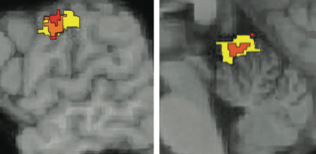
From Ramsden et al. addendum

The (highly abbreviated) life story of a paper appearing in Nature often goes something like this: ideas are birthed and experiments envisioned. Pilot experiments are run, yielding beautiful preliminary data. Replication and controls are then gathered over the course of months, if not years of hard labor. The paper is written, submitted, and reviewed. A few (two is typical) rounds of review and revision later, it is published (with highly variable degrees of reviewer and editorial unanimity). But this is by no means the end, rather, just a milestone in the evaluation process by the community.  In journals, post-publication evaluation has traditionally occurred in the form of peer-reviewed follow-up papers or formal commentary. This may change someday as alternative forms of scientific publishing are explored, but for today we’ll talk about a formal addendum we’re publishing on a 2011 paper by Cathy Price and colleagues and invite you to add to the discussion.

Continue reading

Telepathy? I think not

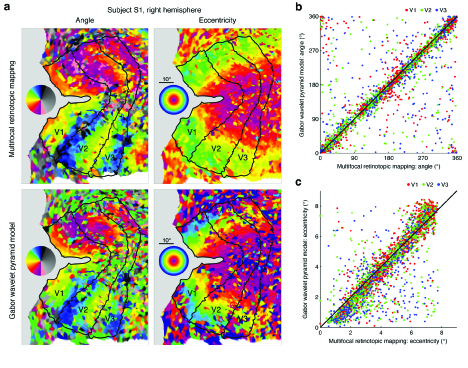
From Supp Fig 10 of Kay et al.

There is just something about neural decoding that captures the imagination. Scientists “reading out brain activity” to infer what someone was seeing or doing sounds like the stuff of science fiction. But in practice, with the right dataset and right computer algorithm, it can be done – providing the question you are trying to query the brain is simple enough. But no matter how simple the question, with every paper comes an orgy of stories in the mainstream press about how scientists can eavesdrop on your thoughts or even engage in electronic telepathy. Thereby infuriating scientists and science journalists in droves, sometimes detracting from some very cool work.

Today I’m going back a few years to a paper that typifies this effect, a study from Jack Gallant‘s lab about a model for decoding natural images from fMRI activity in early visual cortex.

Continue reading