
{credit}Nik Spencer/Nature{/credit}
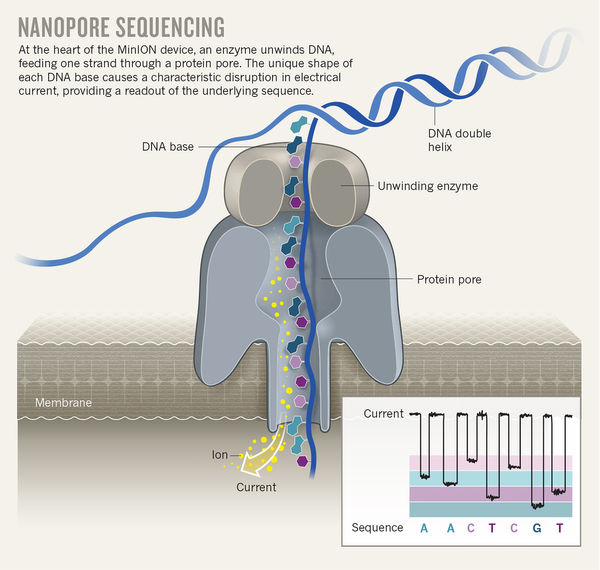
For this week’s Technology Feature, Michael Eisenstein wrote about the technology, applications, and challenges of nanopore DNA sequencing. In brief, the technology involves threading intact pieces of DNA through a tiny aperture in a membrane or other barrier, through which a current flows. As each base passes, it disrupts that current in a characteristic way, allowing specialized software to determine the sequence.
The technology has multiple benefits: it’s relatively inexpensive and compact, and produces exceptionally long reads. But the resulting error rate is also higher than some other technologies. What that means is, informatics tools designed to handle short-read data can often stumble when confronted with nanopore sequences. But a growing collection of dedicated long-read tools is rapidly filling in the gap. I asked a few nanopore veterans to help me compile a list.
Real-time data analysis
MinoTour — https://minotour.nottingham.ac.uk/
Basecallers
Albacore — https://nanoporetech.com
Chiron — https://github.com/haotianteng/chiron
Scrappie — https://github.com/nanoporetech/scrappie
(Ryan R. Wick, Louise Judd, and Kathryn Holt at the University of Melbourne, Australia, recently performed a comprehensive comparison of nanopore basecallers. You can read their analysis here.)
Data Extraction
poRe — https://sourceforge.net/projects/rpore/
Poretools — https://github.com/arq5x/poretools
QC/Trimming
Porechop — https://github.com/rrwick/Porechop
NanoOK — https://documentation.tgac.ac.uk/display/NANOOK/
Picopore — https://github.com/scottgigante/picopore
Sequence Alignment
GraphMap — https://github.com/isovic/graphmap
LAST — https://last.cbrc.jp/
MarginAlign — https://github.com/benedictpaten/marginAlign
MiniMap2 — https://github.com/lh3/minimap2
Variant Detection (SNPs and SVs)
Nanopolish — https://github.com/jts/nanopolish
NanoSV — https://github.com/mroosmalen/nanosv
Sniffles — https://github.com/fritzsedlazeck/Sniffles/wiki
Long-read Assembly
Canu — https://github.com/marbl/canu
MECAT — https://github.com/xiaochuanle/MECAT
Miniasm — https://github.com/lh3/miniasm
Hybrid (Short + Long-read) Assembly
MaSuRCA — https://www.genome.umd.edu/masurca.html
SPAdes — https://bioinf.spbau.ru/spades
Unicycler — https://github.com/rrwick/Unicycler
Assembly Polishing
Racon — https://github.com/isovic/racon
Nanopolish — https://github.com/jts/nanopolish
Methylation Detection
Nanopolish — https://github.com/jts/nanopolish
Nanoraw — https://nanoraw.readthedocs.io/
SignalAlign — https://github.com/ArtRand/signalAlign
Putting it all together…
For a sense of how some of these pieces fit together and integrate with other (non-nanopore-specific) tools, check out Nicholas Loman’s pipeline for viral consensus genome sequence analysis, published in May in Nature Protocols. See also PoreCamp, a “training bootcamp” for the MinION, and a recent review in Genome Biology.
h/t Miten Jain, Nicholas Loman, Benedict Paten, Adam Phillippy, Keith Robison, Mick Watson
Jeffrey Perkel is Technology Editor, Nature
Suggested posts
Jupyter powers bioinformatics, again