
 European astronomers today announced the discovery of more than 50 new exoplanets — and are now confident enough to predict that half of all Sun-like stars should have at least one planet.
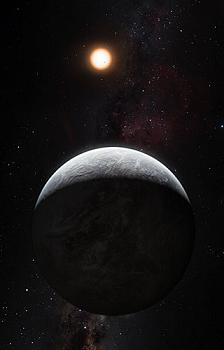
Included in the raft of discoveries is one that sits in the habitable zone (artist’s rendition pictured). This exoplanet, called HD 85512 b, is 3.6 times the mass of Earth, and orbits its star at a quarter of the distance Earth does the Sun, around the orbit of Mercury. Since the star is smaller than the Sun — and about 1,000 degrees cooler — the planet orbits at a distance where liquid water can exist. The same European team two years ago confirmed the existence of a first habitable-zone exoplanet, but that planet, Gliese 581 d, is 5.6 times the mass of Earth.
Lisa Kaltenegger of the Max Planck Institute for Astronomy in Heidelberg, Germany, cautions that a lot of assumptions would have to hold for the planets to be habitable. It is not known whether the new planet, HD 85512 b, is rocky or not. Kaltenegger says it will also be important to build telescopes capable of discerning whether atmospheres in exoplanets like HD 85512 b have chemical constituents such as methane, oxygen and water. “We have great targets now,” she says.
The discoveries were made using an instrument called HARPS on a 3.6-metre telescope at La Silla Observatory in Chile, run by the European Southern Observatory. The announcement was timed to coincide with presentations at an exoplanet conference going on in Wyoming.
It’s the latest salvo in a competition between ground-based teams like HARPS, and the NASA space telescope Kepler. Using rival methods, astronomers are pushing ever closer to the goal of discovering another Earth. NASA announced in February that the Kepler mission has five near-Earth-sized habitable-zone planet candidates that it is trying to confirm. The team is planning a press conference for Thursday.