Timely inhibition

Image: Tamily Weissman

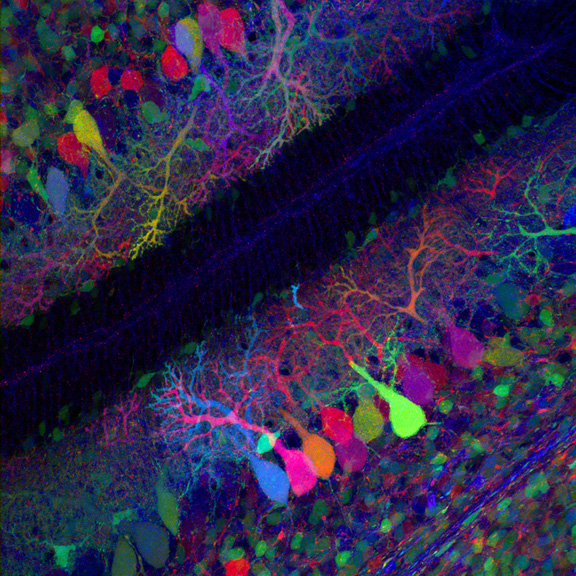
This week’s paper is by Abigail Person and Indira Raman and is about information transmission between two cell populations in the cerebellum – purkinje cells in the cortex and their targets in the deep nuclei. Purkinje cells are justifiably famous for their spectacular anatomy  which enables integration of thousands of inputs. This paper, however, is about their output and how these exclusively GABAergic cells control the activity of downstream neurons. Conventional wisdom holds that there should be a straightforward inverse relationship between the firing rate of the two populations, but this has not always been observed. Person and Raman present a new solution based on spike timing – when purkinje cells spike asynchronously, their targets are inhibited (as expected), but when they spike synchronously, nuclear neurons can spike during the gaps in inhibition and end up time locking their activity to their inputs.

This is an intriguing proposal for how information is transmitted in the cerebellum that could have implications for how this brain structure controls movement, but it’s just the first step. The proposal is built from in vitro experiments, deduction, and some supporting in vivo data, but several crucial unknowns have to be resolved before we’ll know whether it’s relevant to actual behavior. There was plenty of spirited discussion during the review process about the strength of some of the authors’ assumptions. There were deeply divided views on whether the authors had made sufficiently strong a case for how the cerebellum IS operating, as opposed to just proposing how it COULD be. We had to decide whether to publish a paper that everyone agreed was interesting, but one that contained some pieces of indirect evidence and some good (but by no means universally agreed-upon) assumptions.

Continue reading

Light dissection of reward

Image courtesy of Jeremiah Cohen

Out online in Nature today: a paper from Naoshige Uchida and colleagues about cell-type specific reward and punishment signals in the ventral tegmental area (VTA) of mice. The VTA is a midbrain region heavily implicated in reward and addiction, and its outputs are thought to provide reward-related signals to other brain areas. One subpopulation of cells with the VTA, the dopaminergic neurons, have been the topic of intense study for their potential computational role in reward learning. Over a decade ago Wolfram Schultz and colleagues found that in monkeys, dopaminergic neurons fired for unexpected rewards, but were also suppressed if expected rewards were not received. Schultz and colleagues proposed that the neurons were representing the difference between expected and actual outcome, and also noted that such reward prediction error has been theoretically posited to drive reinforcement learning. Although reward prediction is by no means the only proposed role for dopamine, the idea that dopaminergic neurons carry reward signals has figured prominently into theories of VTA function and what goes wrong in disease.

But only around half of VTA neurons are dopaminergic; GABAergic neurons, which make inhibitory projections onto dopaminergic neurons, make up a big chunk of the remainder.  In the current paper, Uchida and colleagues asked how the two populations encode learned rewards and punishments. They recorded from VTA neurons in mice learning to associate odors with rewards and punishments and sorted the neurons post-hoc by their firing properties. Some neurons had brief phasic responses to rewards and reward-predicting cues. Others had sustained increases in firing during the delay between cues and rewards, and yet others sustained decreases. The authors then used optogenetic stimulation to establish dopaminergic or GABAergic identity in a subset of the cells. Dopaminergic neurons all belonged to the first class of cells with phasic reward and reward-predicting responses, and GABAergic neurons the second class with tonic increases. Most but not all dopaminergic neurons were inhibited by aversive stimuli,  most GABAergic neurons were excited. Continue reading