Fear of the Light

fear-of-the-light**PLEASE SEE UPDATES BELOW**

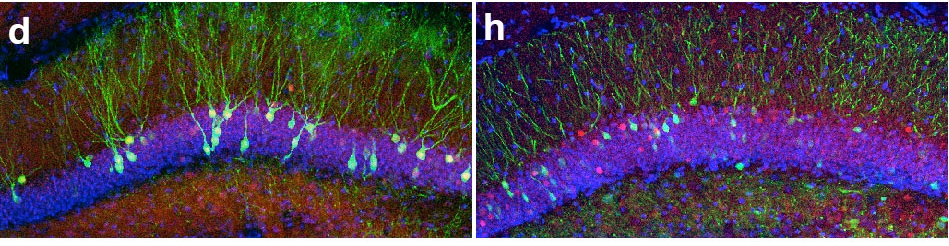
It is commonly believed that distinct mini-networks of neurons, firing together, may be the means by which memories and other conceptual encoding requirements are handled in the brain. However, it is only recently that we have had the tools available to directly test the sufficiency of such a mechanism. Today, a new study in Nature from the lab of Susumu Tonegawa documents the ability to use light as a means to activate distinct subsets of neurons responsible for the encoding of fear memories.

Continue reading

Parietal decision sequences – and more of mice and monkeys

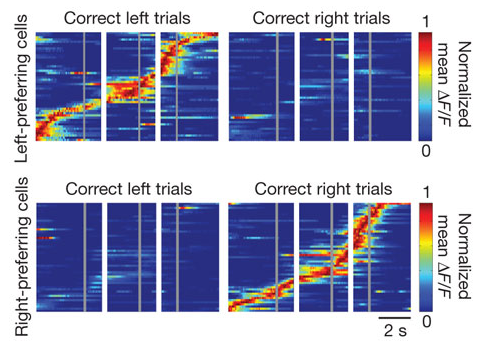
From Figure 2 of Harvey et al

Back in the 1990’s, one of the most intense battlegrounds in systems neuroscience was in monkey posterior parietal cortex. Labs competed to claim what a little strip of cortex called lateral intraparietal area (LIP) really does – decision, movement planning, attention, reward, or all of the above – mostly using single cell recording in behaving monkey. The experiments were (and still are) tough: standard operating procedure requires a well-trained monkey who will perform hundreds if not thousands of trials a day and then isolating neurons one at a time to find ones that respond during some interesting part of the trial. And then lots and lots of repetition so that you can average over many neurons. All things considered, it’s remarkable how much the field has been able to learn with this toolbox.

Fast forward to present day, there’s a new kid on the block. As I discussed a few weeks ago, rodent behavior and physiology is booming. People are taking on questions previously studied mainly in primates and are taking full advantage of the recent storm of new techniques. This is typified by today’s paper by Chris Harvey, Philip Coen, and David Tank, which goes back to the question – what does posterior parietal cortex do during a decision task?  They imaged populations of neurons while mice used visual cues to navigate a virtual maze. Just like in primates, individual neurons were selective for different choices that the mouse made. But unlike in primate parietal cortex, where neurons tend to have sustained responses leading up to the time of decision, individual neurons responded transiently in different portions of the trial. So as a population, different choices were represented by distinct sequences of neuronal activity. This kind of sequential firing has been seen in other parts of the rodent brain such as hippocampus, but not in posterior parietal cortex.  Continue reading

The Fine Architecture of Learning and Joint Publication

(image courtesy of Svoboda lab, https://openwiki.janelia.org/wiki/display/SvobodaLab/Research)

You warily walk into a dark compartment, wondering if there is food inside. Suddenly there is a loud tone and you feel an uncomfortable surge of electricity through your feet. This goes without saying, but it won’t take long before you will learn to be afraid of that tone. However, over time, you hear the tone without the shock, and slowly (foolishly??) accept that the previous connection may no longer hold.

Or perhaps you are extremely motivated to work for food, given that in your home area, nutrition has been sparse and hard to come by. You see millet seeds seemingly just within the reach of your fore-limb. Though not a typical movement for you, you reach for it. In another instance, you find a different type of food that is difficult to handle. However, it is nourishment nonetheless, so you will learn the required motor skills.

SPOILER ALERT: In each of the above cases, you were a mouse the whole time (I know!) But this is a neuroscience blog, not M.Night Shyamalan’s IMDB page, so perhaps we should focus on what was taking place in the brain as each scenario played out. In both of the cases above, learning was occurring, with new information stored away within the appropriate neural connections of particular brain areas. These situations are on display in a pair of new(ish) papers out in Nature, exploring the structural substrates of such learning and identifying patterns underlying the observed structural changes as learning occurred. Continue reading