Dark-energy camera snaps first pictures

The Dark Energy Camera, mounted on the Blanco telescope in Chile.{credit}Dark Energy Survey Collaboration.{/credit}

Posted on behalf of Nicky Guttridge.

A dark-energy camera led by Fermilab, based near Batavia, Illinois, and the Dark Energy Survey collaboration has achieved first light, researchers announced yesterday. The 570-megapixel instrument, based in Chile, snapped its first images of galaxies and star clusters on 12 September. It is designed to hunt for signs of dark energy and will survey the skies in a bid to explain why our Universe is expanding at an ever-increasing rate (see ‘Cameras to focus on dark energy‘).

The images posted below are part of the camera’s initial testing, which will continue until December, when the Dark Energy Survey begins. This survey will measure distortions of light owing to gravitational lensing across large expanses of sky. From this, astronomers hope to map the distribution of dark matter throughout the Universe. It is thought that dark energy will leave imprints on this mesh of dark matter, meaning we can work out more about where and what it actually is.

This image focuses on the Fornax cluster, some 60 million light years from Earth. The galaxies in the image seem to cluster together in the upper-right portion of the image, where the centre of the cluster is located. The particularly prominent spiral structure in the lower section is NGC 1365.{credit}Dark Energy Survey Collaboration{/credit}


NGC 1365 is a barred spiral galaxy around 60 million light years from Earth, located in the Fornax galactic cluster. {credit}Dark Energy Survey Collaboration{/credit}

This image, composed of stitched-together sections of sky, shows the globular star cluster 47 Tucanae. It is located approximately 17,000 light years from Earth.{credit}Dark Energy Survey Collaboration{/credit}

Highest recorded temperature record overturned

Death Valley: hot enough for you?{credit}Courtesy of peterp via Flickr under Creative Commons{/credit}

Posted on behalf of Michele Catanzaro.

The world’s highest temperature ever recorded has fallen from 58 °C (136.4 °F) to 56.7 °C (134 °F), after a World Meteorological Organization (WMO) assessment, published on 13 September, showed that the previous record was a mistake. As a consequence, the hottest spot ever measured has moved from Libya, where it has been believed for the past 90 years to be, to Death Valley in California.

The long-lasting mistake is due to an incorrect measurement performed on 13 September 1922 by an inexperienced member of the Italian military in El Azizia, approximately 40 kilometres south–southwest of Tripoli, according to the study. A WMO committee found that the military used a problematic instrument (a Bellani-Six thermometer) in non-standard conditions (on asphalt instead of on sand). As a result, the record does not match the temperatures observed at the same time in nearby locations, and successively at the same site.

The record for the next-hottest spot is held by a measurement performed at Greenland Ranch in Death Valley on 10 July 1913. “Available evidence supports the validity of this measure,” says Randall Cerveny, WMO rapporteur of weather and climate extremes, and head of the committee that examined Libya’s evidence. “However, there are undoubtedly places with hotter temperatures: here we are comparing only places where standardized measurements have been done,” he points out.

A 2010 blog post by meteorology writer Christopher Burt raising doubts about the 1922 measurement first brought the issue to Cerveny’s attention. Cerveny formed an international commission that included two representatives from Italy (Libya’s colonizer in 1922) and one from Libya to examine the evidence. They concluded that the 1922 measurement was an error.

Giant nature reserve to be built with earth dug up from under London

The rebuilt wetlands will form Europe's largest coastal wildlife reserve.{credit}The RSPB{/credit}

Posted on behalf of Nicky Guttridge.

Construction has begun on a new nature reserve in the Thames Estuary, east of London, a project that will create the largest human-made coastal reserve in Europe. The venture is headed by the Royal Society for the Protection of Birds (RSPB) with help from Crossrail, a huge rail project in London, and will put 4.5 million tonnes of earth excavated from rail tunnels being dug under the city to good use.

Crossrail will displace some 6 million tonnes of earth. The majority of this will be repurposed to build-up Wallasea Island, situated in the Thames Estuary, Essex. The island is now about two metres below sea level and is used as low-lying farmland, but the earth supplied by Crossrail will help to raise the site and create a 670-hectare expanse of mudflats, wetlands and marshes. This aims to attract and house tens of thousands of migratory and rare birds, amongst other wildlife such as otters, herring and saltwater plants. The reserve is expected to be completed in 2020.

Officially launched today by the UK Environment Secretary Owen Paterson, the reserve forms part of a government plan to recreate 3,600 hectares of habitat by 2015 — an attempt to tackle the losses of land caused by coastal flooding and climate change. The RSPB warns that much coastal habitat has been lost over the past 400 years, and that a further 1,000 hectares could be lost in the next decade, owing rising sea levels. This would threaten the habitats of many bird species and marine life.

“The primary purpose of the reserve is to provide habitat for wildlife, rather than for scientific research,” says Nik Shelton of the RSPB. “But there will be regular surveys to monitor progress.”

Drilling ship Chikyu returns deepest seabed core samples yet

Posted on behalf of Nicky Guttridge.

Japanese deep-sea drilling vessel Chikyu has bored into the sea bed and recovered rocks from more than 2.11 kilometres beneath the sea floor, the Japan Agency for Marine-Earth Science and Technology announced on 6 September. Although oil wells frequently reach deeper, this is the first scientific expedition to retrieve core samples from such depths.

This tops the previous record, set by US research ship JOIDES Resolution at the Costa Rica Rift, by mere centimetres. The ship will continue to drill deeper into the sea bed during the remaining 3 weeks of the expedition.

Chikyu is part of the Integrated Ocean Drilling Program (IODP), an international programme of research that uses ship-mounted equipment to drill down into the sea. It aims to access and sample regions beyond Earth’s crust, such as the deep seisomogenic and biosphere zones. Chikyu is drilling off the coast of Japan in the fault zone responsible for the 2011 Tohoku earthquake, collecting samples in order to study the region’s geological history. By examining deeply buried formations of rock and coal, the Chikyu team also hope to learn more about deep-sea hydrocarbons and microbial activity.

Chikyu first broke records in April of this year for deep-sea drilling when it reached 7.7 kilometres below the ocean surface. This represents a hole in the crust 860 metres deep, as the measurement includes the 6.9 kilometres of water sitting atop the sea floor. This exceeded the previous record depth of 7.05 kilometres, set in the Mariana Trench in 1978 by US vessel Glomar Challenger.

The expedition hit a setback when the Tohoku fault sprang to life in March 2011, causing a magnitude-9.0 earthquake and subsequent tsunami. Chikyu was docked on Japanese waters during the tsunami — filled with schoolchildren on a field trip. Nobody was hurt, but the ship scraped the sea floor and suffered damage that required several months to fix.

The tale of the tail: measuring dinosaurs is tough when bones are missing

{credit}Photo courtesy of debaird™ via Flickr under Creative Commons{/credit}

Posted on behalf of Ed Yong.

Travel down the body of a dinosaur, and our knowledge of its anatomy tails away past its hips. As Dave Hone from University College Dublin has discovered, the vast majority of dinosaur skeletons, even many that have been deemed ‘complete’, are missing parts of their tails.

These lost bones are important because tails are included in estimates of dinosaur length, which are often quoted, and sometimes used to estimate mass. “A fairly simple question of ‘How long in total was this dinosaur?’ could be really quite tricky to answer for a very good number of species,” says Hone, writing in his Guardian blog. If tails are telling tall tales, other important measures could be inaccurate.

Hone did a painstaking search for complete tails among the scientific literature, more than a dozen museums, photos and his colleagues’ memories. His search came up largely empty. Even many of the best-preserved fossils, which have feathers and skin imprints, have only partial tails.

“Despite having thousands of dinosaur fossils, including a good few hundred that could broadly be considered complete, we’ve got barely two dozen complete tails,” he says. His results are published this week in the Journal of Vertebrate Paleontology. Continue reading

Nile University students start sit-in at Zewail City campus

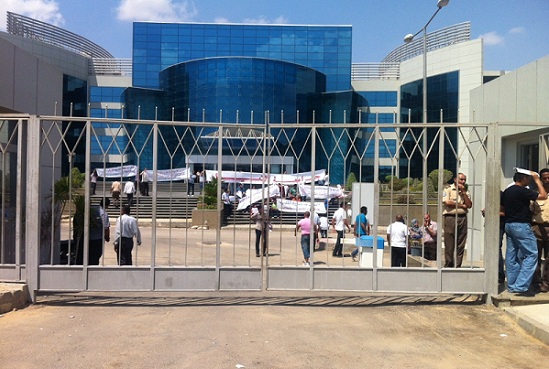
Nile University students start a sit-in in front of the main building until their demands are met.{credit}Mohamed Abdel-Mottaleb{/credit}

Cross-posted from Nature Middle East’s House of Wisdom blog on behalf of Mohammed Yahia.

In an escalation of the row between Nile University and Zewail City of Science and Technology in Egypt over a disputed campus (see ‘Universities clash by the Nile‘), more than 50 students from Nile University today forced their way into the Zewail City campus to protest the “loss of their campus”.

The Nile University students have been holding peaceful protests daily at the gates of the disputed campus on the outskirts of Cairo. Today, however, they managed to force their way through the gates and overcome the security at the gate. Initial reports claimed the students broke the gate and attacked security and workers. However, these were later refuted by both sides.

“I am standing by the gates now and they are fine. I don’t see any damage at all. There were no injuries whatsoever, this is all exaggerations,” says Mohamed Abdel-Mottaleb, director of the Nanotechnology Research Center at Nile University, who went to the campus after hearing what happened. “The undergraduates and some research assistants decided yesterday – and I only knew this today after the events that happened in the morning – to force their way into the campus. Now they are standing protesting peaceful on the stairs in front of the university.”

In a press statement that the students released, they said they are “protesting for their right to use their campus to prepare for the new academic year which starts next month.”

The students are continuing their protest, holding up signs and chanting against Ahmed Zewail, a chemistry Nobel laureate and the founder of Zewail City. They say they are fed up with all the talks between officials to find a solution to the deadlock which have failed so far. Continue reading

Curiouser and curiouser: Curiosity beams back high-resolution zooms of Mars

{credit}NASA/JPL-Caltech/MSSS{/credit}

Cross-posted from Scientific American.

Like an adventurer of old, NASA’s Curiosity rover is using its spyglass to scope out some as-yet unexplored environs.

The image above comes from Curiosity’s 100-millimeter telephoto camera, which, according to NASA, has about three times the resolving power of any previous landscape camera deployed on the Red Planet.

The literally otherworldly landscape has been colorized both for visual appeal and to highlight geologic differences in the soil types. “It’s probably a little bit more pastel and pinker than it would be to your eye,” geologist Mike Malin said during a 27 August press briefing. His company, Malin Space Science Systems, built four of the cameras for the rover mission, including the Mars Descent Imager that documented Curiosity’s landing in high-res color.

For scale, Malin noted that the black dot in the center of the white square (blown up in detail, below right) is a boulder with roughly the same dimensions of the car-size Curiosity itself. The boulder is about 10 kilometers away at the base of Mount Sharp, the eventual destination for the rover and the planned focus of its exploration.

Jailed Iranian physicist loses appeal against 10-year sentence

Omid Kokabee has been imprisoned in Iran since February 2011.{credit}Omid Kokabee{/credit}

Posted on behalf of Michele Catanzaro.

Tehran’s court of appeal confirmed last week the 10-year sentence imposed on Omid Kokabee, a physics PhD student who has been in prison in Iran since February 2011.

Kokabee is an Iranian student affiliated with the Institute of Photonic Sciences in Spain and the University of Texas at Austin. In February 2011 he was arrested while leaving Tehran after a visit to his family and accused of communicating with a hostile government and illegal earnings. In May he was sentenced to 10 years in prison.

Kokabee has denied all charges. His lawyer, Saeed Khalili, says that he has not been allowed to discuss the case with his client, and the appeal court’s response to his 10-page submission consisted of just a few sentences. Several scientific organizations have written open letters and launched petitions asking for a fair trial for Kokabee or asserting his innocence.

However, the decision of branch 36 of Tehran’s appeal court means that the file is closed as far as the Iranian courts are concerned, according to Arash Alaei, a doctor who was jailed in Iran until 2011. “We believe that Kokabee is innocent, so we will do all we can to use other legal methods to prove his innocence,” says Khalili.

While waiting for the appeal to be heard, several scientific organizations joined those expressing support for Kokabee. These include the American Society of Photobiology, the Spanish Thematic Cooperative Network PRISMA and the University of Oslo, but the University of Texas and the Institute of Photonic Sciences, where Kokabee was working, have not issued official support documents. Friends and colleagues of Kokabee have also set up an online campaign open to the public called We are all Omid.

Greater oversight but no sanctions for Italian AIDS contrarian

Marco Ruggiero{credit}Courtesy of M. Ruggiero{/credit}

Posted on behalf of Zoë Corbyn.

An Italian university’s inquiry into the teaching activities of an academic who assisted on a course that denies the causal link between HIV and AIDS, and supervised students with dissertations on the same topic, has concluded with no disciplinary sanctions. But molecular biologist Marco Ruggiero’s teaching activities will be more closely supervised in the future, and some of his work has been referred to the Italian medical board.

The outcome of the University of Florence investigation into the “teaching behaviour and responsibility” of Ruggiero, previously reported by Nature (see ‘Inquiry launched over AIDS contrarian’s teaching‘), was announced last week.

The inquiry followed a letter of complaint to the institution’s rector by an Italian campaign group called the HIV Forum, which represents people infected with HIV and others concerned about the disease.

It found no “elements of responsibility such as to require adoption of disciplinary measures”. However, the topics of the undergraduate dissertations he supervises are to undergo “deeper and detailed checks” to ensure their compatibility with the bachelor in biological sciences course. Ruggiero will also need to confirm his teaching programme — which he is understood to be now reviewing — with the head of the degree course, and he has been warned not to publish inaccurate online news damaging the image and the reputation of the university.

The Ordine dei Medici — the Italian medical board — has also been informed of Ruggiero’s alleged clinical experiments involving an enriched probiotic yoghurt as a potential cure for HIV, for which there is no proven evidence. The authority is responsible for licensing and registration of physicians and for hearing complaints about professional conduct. Continue reading

National security trumps indigenous rights on development projects in Brazil

Posted on behalf of Claudio Angelo.

A regulation passed earlier this month by the Brazilian government is stirring anger among indigenous people and environmentalists, as it allows dams, roads and military bases to be built in indigenous territories without consent if the projects are considered to be relevant to “national security”.

The act follows an already controversial pruning of seven federal protected areas in the Amazon to accommodate hydropower plants passed by Congress in June, just before the Rio+20 environmental summit. Most of the parks targeted for shrinkage are in the Tapajós river basin, a wilderness area of “extreme relevance” for biodiversity.

The new regulation, issued on 17 July by Attorney General Luis Adams, targets the Amazon, where 13% of the forest is now delimited as indigenous territory. In 2007 a study showed that these areas are more effective than national parks in stopping deforestation and the ensuing CO2 emissions. However, some of them “stand in the way” of planned infrastructure, such as the Belo Monte megadam on the Xingu River. Construction is opposed by tribes who claim that the development threatens their traditional way of life, and that the consultation process was unfair.

The regulation allows government to skip consultation altogether, leaving decisions in the hands of the 12-member National Security Council. It also freezes any expansion of indigenous lands. Adams told Nature that the measure only aims to ensure “legal stability”.

But according to Raul do Valle, a lawyer with indigenous-rights organization Instituto Socioambiental, the act violates both the country’s constitution and international treaties signed by Brazil, such as the 169th Convention of the International Labor Organization, which warrants prior informed consent of Indians regarding any intervention on their lands. “The act is authoritarian,” he says.

The move has been unpopular even within the government. The National Indian Foundation publicly criticized it, causing Adams to suspend application until September.