Skip to primary content
Skip to secondary content

nature.com blogs

nature.com blogs

Main menu

  • Home
  • Nature Blogs
    • On your wavelength
    • Spoonful of Medicine
    • Free association
    • Action Potential
    • Methagora
    • Indigenus
    • House of Wisdom
    • TradeSecrets
    • Stepwise
    • Soapbox Science
    • Nature Jobs
    • Plant Life
    • The ScepticalChymist
    • Scientific Data
    • A view From the Bridge
    • Nature Future Conditional

Category Archives: Ethical / Social

Ethical / Social

Post navigation

← Older posts
Newer posts →

GM Animals in the US

Posted on 29 Apr 2013 by Luiz Antonio Barreto de Castro
Reply
long road

AquaBounty’s GM salmon has had a long road to approval.

An opinion piece in the NY Times earlier this month questioned the extremely long time that the FDA is taking to approve GM animals. The article considered the 17 years that have passed since AquaBounty applied for approval for its GM salmon from FDA (this process has not yet been concluded), and suggested that the FDA should ensure other promising genetically modified animals don’t meet the same end. The article pointed out that every application needs to be painstakingly evaluated, and not every modified animal should be approved, but it also pointed out that in cases like AquaBounty’s product, where all the available evidence indicates that the animals are safe, political calculations or unfounded fears should not keep these products off the market. If that happens, we’ll be closing the door on innovations that could help us face the public health and environmental threats of the future, saving countless animals, the article said — and perhaps ourselves.

Unfortunately this isn’t the only example. To date only one GM product resulting from the gene expression in animals has been approved by the agency: Atryn, produced by GTC Therapeutics of Boston, (now rEVO Biotherapeutics), an antithrombin protein effective to prevent thromboembolitic events.

It’s been 40 years since Herbert Boyer expressed an insulin gene in Escherichia coli and marked the onset of this technology. This happened 20 years after Watson and Crick discovered the genetic code. Genetic engineering has progressed to a point that today one can express any gene in any organism from bacteria to animals. Complex genes, structurally speaking, require complex models for their expression, and as such, bacteria will not adequately serve for the genes that require other systems (such as Chinese Hamster Ovary cells), plant and animal gene expression.

GM plants have progressed tremendously since the first ones were taken to the market in 1996. In 2011, 16.7 million farmers in 29 countries planted 160 million hectares, a sustained increase of 8% annually since 1996.

The growth there is impressive, but what has happened to GM animals? They struggle for approval at FDA, and this has forced scientists in the US to look for collaborators in other countries. James Murray and Elizabeth Maga from University of California at Davis are working with Brazilian scientists to obtain approval for GM caprines (goats) that express Lysozime and Lactoferrin in their milk for the prevention of infant diarrhea – an affliction that kills 2 million children every year. Their effort for approval at FDA is four years old and barely moving.

Surprisingly, UC-Davis twice tried to obtain funds from the Gates Foundation, but were not successful. Instead, they came to Brazil and obtained funds from the Ministry of Science and Technology, when I was a R&D Secretary at that Ministry. Diarrhea claims the lives of thousands of children annually in Brazil’s Semi-Arid region.

Lysozime and Lactoferrin are proteins found in humans. Let’s hope it’s possible for Brazil to approve these products before the FDA, because these kids cannot wait forever. This raises a question: will AquaBounty be capable of transferring its technology to other countries, such as Brazil? It seems unlikely, as the company will have waited at least 17 years for product revenue, and thus, funds will be scarce.

Luiz Antonio Barreto de Castro

Posted in Ethical / Social, Regulatory | Leave a reply

Yamanaka Inspiration and Teamwork

Posted on 05 Nov 2012 by Samuel JK Abraham
Reply

I met some of my old pals and colleagues at the Angiogenesis Meeting this March in Chennai, India, and several topics came up one evening as we sat in a restaurant overlooking the Bay of Bengal. One was the recent financial crunch, especially the research fund cuts all over the world. Our discussion prompted one of my colleagues to suggest we do something like Dr. Yamanaka did: run a marathon to raise funds for research. That thought revived our interest in music, and a song I had composed a long time ago came back up. We named ourselves Angre & Nut – “An” from the angiogenesis meeting, and “Gre & Nut” from the first and last three letters of the resort Green Coconut in which the meeting was held.

In the following days, beside our journal club and weekly review meetings, we gave final shape to the song, composed to pay a tribute to the city of Chennai, where our lab in India is located. We launched the song in October, through a public charity trust, and it’s downloadable for about US$1. Though we did not raise millions, we were surprised to see people willing to donate for research funding. As a side benefit, though, I observed that our team had less inhibition and better communication in our project discussions and weekly meetings after the launch.

Our extra-curricular activities have made the team work better than it did before, and the activities were inspired by Prof. Shinya Yamanaka and his marathon-run to Nobel. I would strongly recommend that Principal Investigators try bringing out the hidden talents of your colleagues, as it can yield only better understanding and communication among all. It can also help gather research funds, as we experienced!

Samuel JK Abraham 

Posted in Ethical / Social | Leave a reply

Trust Me I Am a Spin Doctor

Posted on 26 Oct 2012 by Chris Hillier
Reply

By the time you read this the US presidential race may well be over and the incumbent will be looking back on a campaign well fought. For me, a lasting memory will be the three presidential debates. The first and last were relatively gentle affairs with no particularly memorable moments. The second,  however, was a blistering encounter with punch and counter-punches, narrowly won by President Obama.  It hinged, at least to me, on an error on Governor Romney’s part, in which he insisted that the President had not made a statement that he actually had. The effect of such a small part of a very wide-ranging debate was a classic example of the importance of words and how they are used. In the hands of skilled protagonists, they are deadly tools, weapons of mass humiliation. Mitt Romney was able to easily win the first debate by spinning the economic data and various polls and statistics to suit his own political agenda.  In the second, President Obama was armed to the teeth with his own statistical summaries and brandished them with aplomb.

From the perspective of a non-US citizen these debates are interesting for a number of reasons, but for the purposes of this blog I wanted to focus on one aspect – the “spin.” Clearly, spin, or as the Oxford English Dictionary would say, “the presentation of information in a particular way; a slant, especially a favorable one,” is ever-present in almost every political race worldwide. However, the public perception of spin is generally negative, since it implies putting a gloss on a fact that it doesn’t deserve. Moreover, the term “spin-doctor” is often given to the most clever strategic political advisors able to control information. These are often bracketed with the worst side of politics and suffer derision as representing a kind of moral corruption.

In the world of science, this kind of phenomenon is a problem. Science is objective, evidence-based, pure. Science would be sullied – polluted even – if it were to be contaminated by spin. Yet, one of the major outputs of the biosciences (drugs) is probably the most hyped product available anywhere. Every time I hear an advertisement for this or that drug, especially those that I am most familiar with, I cringe at the long list of “Tell your doctor if you experience……….” that accompany them. Tell your doctor if you experience spin perhaps should be one of these.

The truth is similar to something said by Karl Popper, one of the fathers of scientific logic:

“It might do us good to remember from time to time that, while differing widely in the various little bits we know, in our infinite ignorance we are all equal.”

As far as our knowledge of how any particular drug works, I am consistently amazed that we know very little about even our best known drugs. Is anyone else intrigued by the stream of new aspirin studies that appear almost monthly? Indeed, if Popper were addressing this issue, he might have said:

“It might do us good to remember from time to time that, while we know various little bits about the drugs we use, what we don’t know is still staggering.”

Too much? I don’t think so. One particular reason for our lack of insight into the characteristics of our pharmacopeia might be the huge over-reliance on animal data during the drug discovery process. Last year, I was one of 17 authors, including Sir Ian Wilmut, on a letter printed in the UK medical publication The Lancet that called on the UK government to invest in an objective assessment of the technologies now available for safety testing. Technologies that relied on molecular, cellular and even tissue screens instead. However, this issue, like many others, is not science but a political issue and so like all political issues vulnerable to spin.

Perhaps, at the level of the entrepreneur, attempting to build credentials for his or her new biotechnology product, the attraction to use spin is even more powerful than at the level of the corporate giant. What if the new entrepreneur is a academic wishing to commercialize his or her own innovation? Have our universities suddenly, over the last five years, improved their research exponentially, or is their ability to produce press reports at a much more “mature” level? Is it disrespectful to suggest that spin has spun its way into our establishments of learning?

In a recent post on Scientific American’s Science Sushi Blog, PhD student Christie Wilcox discusses this very point and actually reports a French study that suggests 47% of medical press releases contained spin. What was fascinating was that if the original scientific study didn’t contain spin, then only 17% of the press releases did. This suggests that the major component of spin is coming directly from the scientists. The university press officer needs good press, the entrepreneur needs good press, and the scientists need good press. Who then suffers? Caveat emptor seems appropriate here. Clearly, the entrepreneur will be thoroughly screened by investors and other stakeholders who will carry out due diligence to protect themselves from financial risk. Is there an equivalent on-campus? Who is responsible for protecting universities from the reputation risk associated with questionable spin?

Just like our two political giants slugging it out in a series of highly public presidential debates, our own constituency of academic scientists, biotech entrepreneurs and funding stakeholders are in a constant battle to win ground. How much they rely on spin I guess depends on how much actual real good news they have to tell. Perhaps it might be best to leave the last word to Karl Popper:

“Those who promise us paradise on earth never produced anything but a hell.”

Chris Hillier


Posted in Entrepreneurship, Ethical / Social | Leave a reply

Genes are Flowing

Posted on 06 Sep 2012 by Luiz Antonio Barreto de Castro
Reply

The strategy adopted before the commercial release of genetically modified organisms in the United States, and in many other countries, requires that risk assessment and risk management programs are done on a case-by-case basis.

There has been a continuous release of GM plants since 1986. Hundreds of GM varieties are cultivated today in millions of hectares in a number of countries. It has never been assumed that genes would not flow as they normally do – from GM to non-target populations, such as non-GM-cultivated species and wild relatives. Genes are certainly flowing from GM corn, cotton and canola, to the non-GM cultivated varieties of these species, and to the wild relatives in the case of canola and cotton.

Recently, Yang, et al, verified that GM genes flow from to rice wild relatives. But the researchers concluded that the rapid spread of insect-resistance transgenes in weedy population in commercial GE crop fields may be not likely to happen.

In Brazil, we’ve dealt with gene flow from wild rice to cultivated rice for decades. It is quite a problem to find areas that are red rice free, so that rice seed can be produced without being contaminated with red rice. The methodology exercised by the Yang group is too limited to make a long-term statement. It is often questioned whether small plots are sufficient to accurately predict how GM plants will behave in large-scale commercial fields. This of course is hardly possible; reliable methodologies are needed to work with large-scale monitoring of GM plants.

Continue reading →

Posted in Ethical / Social | Leave a reply

Agbio in Africa: a train that is finally rolling

Posted on 29 Aug 2012 by Ed Rybicki
Reply

It took an interesting temporal juxtaposition of articles in two very different media – the Cape Times newspaper business section, and an editorial in New Scientist – to set me off, but once I’d started, there was no stopping.

The theme?  The uptake of advanced biotechnology in Africa, and in particular, of genetically modified (GM) crops.

I have been interested in this field ever since I became practically involved back in 1990, with the birth of our fledgling GM crop programme at the University of  Cape Town.  It has been with some degree of enlightened self-interest, therefore, that I have followed the application of GM technology in Africa and abroad – and one of my sources has in recent years been the excellent and regular reports on the global status of commercialized biotechnology and GM crops by The International Service for the Acquisition of Agri-biotech Applications (ISAAA), such as the latest one available here.  It has been very interesting to watch the steep rise in cultivated area under GM crops over the years, in countries like Argentina, South Africa and now Brazil: in fact, there was an almost 100-fold increase in area from 1996 to 2011, from 1.7 million to 160 million hectares.  As the brief reports, this makes

“…biotech crops the fastest adopted crop technology in the history of modern agriculture.”

The interesting thing is that of the top ten growers of GM crops, no fewer than seven – excluding China– are developing nations.  While the USA leads the pack, the next three slots are filled by Brazil, Argentina and India. Paraguay, Pakistan, South Africa and Uruguay bring up the rear, with another eight developing countries in the next ten.  Thus, it is not the First World that is growing the most; it is the countries with the populations that are: the brief makes the point that more than half the world’s population live in the 29 countries growing GM.

However, while Latin American countries are very well represented among the leaders – 9 of the top 20 producers are in South or Central America – Africa has just two:  South Africa, at 9, and the surprise entry Burkina Faso, at 15.  Egypt pegs in at 24th with less than 50,000 ha of crops, which is less than a sixth of Burkina Faso’s total.

The world’s top GM crops are maize, cotton and soybeans, and Africa grows a considerable amount of the natural versions of all of these: according to the FAO information site, South Africa is 8th in maize production, with Nigeria at 10th, followed by Tanzania, Ethiopia, Kenya and Malawi in the top 20; Burkina Faso and Nigeria are bracketed at 13 and 14th for cotton with Egypt 16th; South Africa is 12th and Nigeria 15th for soybean production.

However, again South and Central America do better: Argentina is 10th for cotton production; Brazil, Argentina and Mexico occupy positions 3-5 for maize production; Brazil and Argentina are 2nd and 3rd with Paraguay 6th and Bolivia 9th for soybean production.

There is far more arable land in Africa than in South America – total land areas of 30 million and 18 million km2 respectively, with 1.946 million vs. 1.046 million km2 cultivated – and populations per km2 are not much different at a low 34 and 22 respectively, so why is productivity so much lower?  Why, then, is uptake of GM also so slow in the continent that could probably benefit the most?

The answer to the first question is mired in a toxic mix of chronic under-development as a result of colonial pasts, past and present politics, and grinding poverty, and is not mine to give.

The answer to the second, however, is more simple: it is mainly due to a mix of political and economic and regulatory inertia, and innate cautiousness about solutions that people are being fostered on them from outside – and in particular, from countries that are not seen to be applying them at home.  A knock-on from the last is that anti-GM activists from especially European countries have exported their campaigns, lock stock and barrel, into the developing world – where politicians have taken notice, and have become even more cautious as a result.  Thus it is, that while the major proportion of both maize and cotton grown in South Africa is GM, and this share is increasing, other southern and central African countries like Zambia have even been reluctant to accept milled GM maize as food aid, let alone to plant it.

Mrs. Pauline Ruiru, on her farm near Githungiri, central Kenya, standing behind an MSV-infected plant.{credit}Ed Rybicki{/credit}

Kenya has bucked this trend, however: in 2011 they became Africa’s 4th member of the GM crop club, with publication of regulations governing the cultivation of GM crops in open fields for research and commercial purposes by the National Biosafety Authority.  ISAAA has long had offices in Kenya; there is also a home-grown NGO in the shape of Africa Harvest, which has been very active in advocacy for GM plantings since 2002: their mission is

“…to promote the use of advanced science and technology products to improve agricultural productivity among Africa’s farmers, and free Africans from poverty, hunger and malnutrition.”

Neighbouring Ugandahas also been contemplating legislation that will regulate – and allow – GM plantings.  Crops under consideration are bananas, maize, cotton and cassava: in particular, Uganda is interested in cassava engineered to be resistant to cassava brown streak virus, which is a serious and emerging problem in the country, for which no natural resistance genes are known.  There was also recently news about a successful Bill & Melinda Gates Foundation-funded GM banana nutritional enhancement programme. This was an Australian-led initiative that heavily involved local researchers, and has led to the “golden banana,” or banana which is highly enriched in vitamin A and iron, and will hopefully also be engineered to be nematode-resistant.

There is a common thread running through all but possibly one of Africa’s GM adopters – and that is that local scientists have been involved in developing products everywhere except maybe Burkina Faso, and that the countries involved have put legislation and regulations in place to deal sensibly with GM issues.  This is very similar to the case of Brazil, which was aired in this forum in March a year ago, in a blog titled “Brazil Feeds The World.”  Luiz Antonio Barreto de Castro wrote then that:

“…why did it take so long to see biotech crops released inBrazil? We had a biosafety law in operation since 1995, but literally lost 10 years disputing the judiciary in Brazil, which took sides and made political decisions against science and scientists.

After 2005 everything changed. A new biosafety law stimulated the combination of tropical genetics and biotech so much that Brazil is second only to the US in biotech crop production. We have few plants entirely engineered in Brazil, but Brazilian corporations take advantage of our breeders’ expertise and release the best crops for all Brazilian biomes.”

He finishes with:

“There is work to do, but Brazil can make the gene revolution work in the same direction as the green revolution did decades ago, by the hands of Norman Borlaug with more powerful science tools available.”

This is an excellent sentiment, and one that surely applies for other developing nations, too.  There are important lessons for Africa here: first, once the legislation is in place, and regulations enforced, it is possible to apply imported GM technology under your own conditions and under your control.  Second, development of your own biotechnology research community can result in products specific for your country, which owe nothing except in original concepts to the outside world.  An important object example here is the engineering via specific siRNA expression of GM green beans resistant to the Bean golden mosaic geminivirus that was discovered in, and is endemic in, Brazil.

Indeed, my group has similarly attempted to produce a home-grown solution to Africa’s worst viral disease affecting its premier food crop: for some 22 years now, and with only local money, we have been working towards engineering resistance to Maize streak virus, with lab-scale success coming in 2007.  This work may yet fail at the field-trial hurdle; however, what we have done is to lay a foundation of routine maize transformation and regeneration for us and others to make other products – such as plants resistant to fungi, bacteria, and drought, as also mentioned by Luis in his blog.

There has been an increasing tide of positive media commentary recently on the potential of GM crops to improve living standards and help in poverty alleviation in Africa– and good example was this article on the Voice of America web site.  While it is a long and well-reasoned article, one comment from ISAAA Kenya’s Director, Margaret Karembu, struck me forcefully as epitomising the problem:

“Everybody else wants to make decisions for Africa without letting Africans make decisions.”

Which is why Africans don’t want to adopt the technology.

And what were the two articles I’d read that sparked writing this blog?  The first – which was rescued from having been used to clean windows after I frantically phoned home, having forgotten to put it in my work bag – was “Agricultural Technology Grows Food for Africa”, by Ayanda Mdluli in the AgriScope column of our local Cape Times.  While Ayanda is, I think, unnecessarily gloomy about the potential of GM seed growing to negatively impact small farmers, he also has this to say:

“The aim of various ongoing projects in Africa by biotechnologists is to curb vitamin deficiencies and address the gruelling challenge of food security, which will take some time to correct due to infrastructure impediments and policy issues.

Whether we like it or not, the use of biotechnology in agriculture is here to stay, the question is how it will be used by its advocates in their crusade towards creating a productive agricultural industry in Africa that could rival the likes of Brazil and even the US.

Sub-Saharan Africa is destined to be one of the key areas of food production, and with more technological advancements at the centre of the food security agenda, biotechnology may serve as the tool that eradicates the poverty datum line for Africans.”

I could not agree more – which is why I was enthused to write this piece.  And as I was about to start, I saw the second of my inspirations in the shape of this editorial in New Scientist on Golden Rice.  The editors make the point that the opposition to the Golden Rice project – which has no links to Big Agriculture, and has at its heart the prevention of vitamin-deficiency-caused blindness – is essentially dogmatic, and wrong.  Moreover, in the light of evidence that eating just 100 – 150 gm of the rice can provide 60% of the recommended daily intake of vitamin A, the opposition may just be in danger of getting run over in a rush to adopt it.

Which is entirely as it should be, and would be an excellent vindication of an excellent and humanitarian project, long past due time.  And while we’re about it, let’s grow it in Africa!

Ed Rybicki

Posted in Business development, Ethical / Social, Regional Initiatives | Leave a reply

How biotech can help create jobs

Posted on 21 Aug 2012 by Samuel JK Abraham
Reply

The number of graduate students opting to take graduate courses in basic sciences such as microbiology, biotechnology and other specialties has been in decline, meaning several educational institutions in India have closed. There are many possible reasons, but a lack of adequate job openings for the graduates, or general, global funding cuts for research in niche areas are a few worth mentioning.

On the other hand, the increase in automation and usage of robots has slowly eroded the larger job market. Examples here are Taiwanese manufacturers considering employing robots in assembly lines for producing electronic devices, or Japanese homes for the elderly using  robots to help entertain and assist the retirees.

But there are a few areas in which humans cannot be made redundant. One is in the field of personalized medicine. Whether it’s engineering of tooth tissue or culturing specific cells to help Graft-versus-host-disease, or a step-wise procedure of cadaver-donor derived scaffold based artificial organ, careful human hands are required. Automation happens only when large quantities of a product are produced. Personalized medicine is the exact opposite of that – each product is individualized, and thus cannot be done on a huge conveyer belt. In this way, the biotechnology of personalized medicine could help produce jobs.

Samuel JK Abraham

Posted in Ethical / Social | Leave a reply

BIO: Optimism Abounds

Posted on 21 Jun 2012 by Michael Francisco
Reply

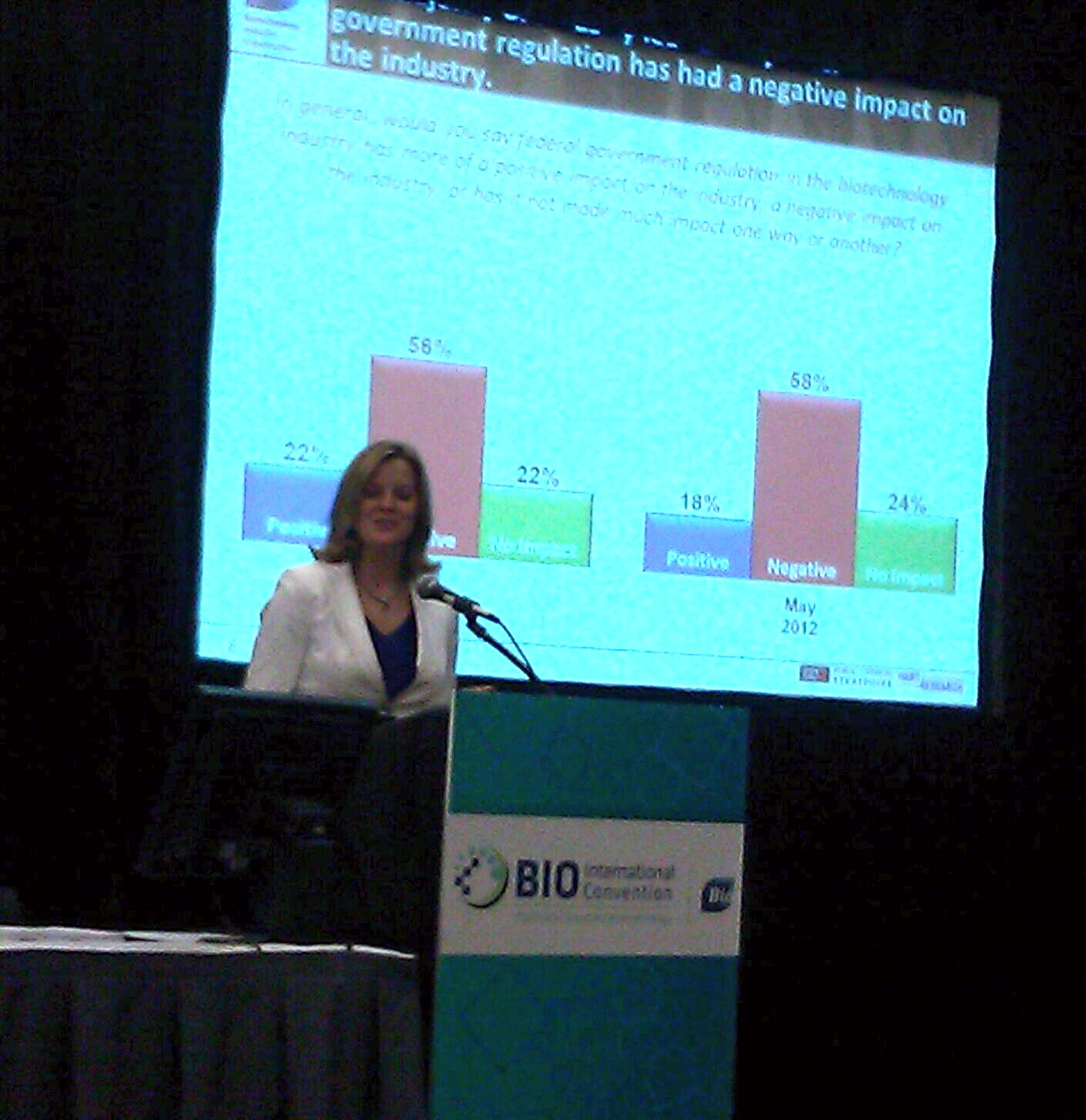
At a press conference Tuesday morning, BIO announced the results of three surveys that showed a continuing optimism about the state of the biotech industry, from industry leaders, US voters and BIO 2012 attendees. Geoff Garin of Hart Research Associates summarized the outlook among industry leaders: 63% are still optimistic about biotech’s future prospects, compared with 79% when the same question was asked in April 2007. Leaders cited the difficulty in attracting private financing as well as the lack of tax incentives from government as their main challenges. As might be suspected, convention attendees were even more optimistic about the state of their industry, with finding cures for chronic diseases such as cancer, Alzheimer’s Parkinson’s, HIV/AIDS and diabetes, and improving the economy being the most important drivers.

A telephone poll of 800 registered US voters yielded more surprising results. Even if the average American was not familiar with the industry, just a brief description of what biotech companies do caused a massive boost in favorability, from 44% to 83%. A majority (56%) of voters supports government help for the industry, either through streamlining regulations, enacting tax incentives to encourage private investment, or direct investment in biotech companies. Surprisingly, given the country’s economic climate, this viewpoint held across party lines with Democrats, Republicans and Independents voicing support for increased government support for the industry. Voters ranked finding cures for diseases just behind jobs and the economy in terms of importance. Other aspects of biotech, such as biofuels, agriculture and pollution were seen as only slightly less important, according to co-presenter Alex Bratty of Public Opinion Strategies (pictured above).

All in all, the numbers were heartening and should give those of us who work in biotech a morale boost. Said Garin, the average person right now is thinking, “How do we get out of this mess?” and at such times, one of the groups people look to for answers are scientists.  With already a solid record of achievement behind us and public support on our side, here’s hoping for more answers in the future.

A complete summary of study findings can be found here.

Michael Francisco

Posted in Ethical / Social | Leave a reply

Are Green Vaccines Appropriate for Africa?

Posted on 11 Jun 2012 by Ed Rybicki
Reply

I have mentioned several times here, and elsewhere, that my lab works on expressing vaccine-relevant viral proteins in plants – and that I think this is a highly appropriate technology for the purpose.

For all the good it will do, I have even nailed my colours to the mast, with a recent declaration in BMC Biotechnology that we have “…set up a platform for plant-based influenza virus vaccine production in South Africa.”

Why do I think so highly of the potential of Green Vaccines?

I have explained this in some considerable depth in a couple of reviews of recent vintage (see here); suffice it to say that the technology lends itself very well to “orphan” or “niche” vaccines, because of what is in effect infinite scalability of production.  It is also very well suited for manufacture of “rapid response” vaccines, such as those directed against pandemic influenza and bioterror agents: indeed, no less an agency than the US Defense Advanced Research Projects Agency (DARPA) launched in 2005 an Accelerated Manufacturing of Pharmaceuticals (AMP) programme that included an investigation of the suitability of plants as a manufacturing platform for the purpose.  In 2009, as a response to the H1N1 “swine flu” virus pandemic, they initiated the “Blue Angel” effort, which is

“…an accelerated and integrated effort to deliver effective interventions for pandemic influenza”

part of which has involved funding several companies to demonstrate a capability to use plants to produce 100 million doses of influenza vaccine a month.  This work is now significantly advanced, with several manufacturing plants having been built, and at least one company having achieved all its targets so far.  Thus, it appears as though the promise of biopharming could be about to be realised, finally – and with the help of the US government, no less.

Why are products so slow in coming, then?  While there are a number of reasons for this, possibly the most important are sheer inertia on behalf of established vaccine producers, who have huge amounts invested in conventional manufacturing processes; high monetary barriers to entry into especially the human products market, because of clinical trial costs; and perceptions of a difficult regulatory process, especially for products intended for use in humans.  Indeed, a 2012 Jordan Report on Accelerated Development of Vaccines makes no mention whatever of plant-made products in its 186 pages of expert review, which possibly sums up the opinion of the vaccine research mainstream. Continue reading →

Posted in Ethical / Social, Regional Initiatives, Regulatory | Leave a reply

New Bioentrepreneur article

Posted on 21 May 2012 by Bioentrepreneur
Reply

We’ve just published a new article on the Bioentrepreneur site, available in both HTML and PDF formats.  Titled From Academic Solos to Industrial Symphonies, the article looks at ways in which academics must change in order to fit into the social structure of industrial research.  It was written by a trio of authors, one of which, Emily Walsh, has written for Bioentrepreneur before. It’s an angle we haven’t really covered in BioE, and it’s an enjoyable read (or so says us).

Posted in Entrepreneurship, Ethical / Social | Leave a reply

Israel Antibody Forum

Posted on 17 Apr 2012 by Bernard Dichek
Reply

Now that the Israel monoclonal antibody forum exists, the reasons for founding it seem as obvious as do the reasons why it has become a success. The forum was the initiative of Tehila Ben-Moshe,  CEO of cCam Biotherapeutics,  who thought that  companies with MAb-based technologies like hers, especially start-ups, could benefit from one another by pooling information. She didn’t know how  many MAb companies were within driving distance, as there is no official breakdown of the local biotech industry according to technological platforms.

She also thought that scientists at some of the larger and veteran biopharma companies like Teva Pharmaceuticals and Curetech that were developing MAb-based products might be interested in sharing information and getting together with younger colleagues.

So about a half year ago, she spread the word that a MAb networking meeting would take place, and more than 20 people showed up, representing about a dozen companies. It turned out that those present, many new to the industry, had a lot to talk about. What lab processes could be out-sourced? Who were the best suppliers?

The forum now meets about once a month and usually features a guest speaker.  At a recent meeting, for instance, Patrick Haddad, visiting from France, presented  a new  joint CMO bioproduction platform, called MAbLaunch, a partnership between France’s LFB Biomanufacturing Group and Sanofi. Haddad combined his commercial presentation with a talk about the production of GMP cellular banks and their characterization, along with guidelines about the establishment and control of cell banks.

Israel MAb forum members include:

  • cCam Biotherapeutics , the developer of  CM-10,  a drug for metastatic melanoma

CM-10 derives from research suggesting that tumor cells leverage the CEACAM1 gene in order to evade detection and attack by the body’s immune system. cCam’s technology disrupts communication between the tumor cells and CEACAM1, enabling the immune system’s battery of NK and T cells to destroy the tumor cells.  Unlike Yervoy, a recently launched and highly-touted drug for metastatic melanoma, CM-10 is tumor-site-specific and  does not lead to a general activation of the immune system and ensuing adverse side effects

  • Fusimab, an early-stage company able to produce full length bi-specific antibodies (BsMAbs), comprising synthetic proteins designed to bind to two different types of antigens.

As bi-specific antibodies do not occur in nature, for drug developers to be able to produce them in sufficient quantity, purity and speed for clinical trials, producing them has until now posed a serious challenge. But Fusimab has developed a method that enables production of full length MAbs and antibody toxin fusion proteins in bacteria that may offer a significantly quicker route to drug discovery and manufacturing

  • Immune Pharmaceuticals, a developer of ‘nanoMAbs’ – antibodies that are conjugated to nanoparticles.

The company has licensed a technology that enables the coupling of monoclonal antibodies with nanoparticles containing thousands of cytotoxic molecules. “This new technology allows us to deliver a higher payload of cytotoxics to the target,” explains CEO Daniel Teper. “Nothing is lost on the way. The nanoparticle opens only when it is inside the cell and because you have multiple antibodies the overall internalization to the cell is more efficient.”

Bernard Dichek

Posted in Entrepreneurship, Ethical / Social | Leave a reply

Post navigation

← Older posts
Newer posts →
  • Home
  • Nature Blogs
    • On your wavelength
    • Spoonful of Medicine
    • Free association
    • Action Potential
    • Methagora
    • Indigenus
    • House of Wisdom
    • TradeSecrets
    • Stepwise
    • Soapbox Science
    • Nature Jobs
    • Plant Life
    • The ScepticalChymist
    • Scientific Data
    • A view From the Bridge
    • Nature Future Conditional
  • Your privacy choices/Manage cookies
  • Terms & conditions
  • Privacy policy
Springer Nature

© 2026 Springer Nature