Spain hit by two earthquakes

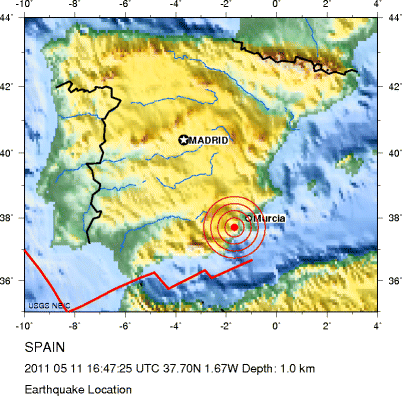
spain 5.1.gifSpain was hit by two earthquakes in quick succession yesterday. Several people were reported to have died after a 5.1 magnitude quake hit the Murcia region just before 7.00pm local time, less than two hours after a 4.5 quake in the same area.

Thousands of people spent the night outside after several buildings collapsed in towns near the epicentres.

The southeastern region of Spain where the earthquake occurred is very seismically active, as it sits near the boundary of the Eurasian and African plates (see map), notes the US Geological Survey (USGS).

“The epicenter of the 11 May earthquake is situated near a major fault, the Alhama de Murcia fault,” says the USGS. “However, significant field work in the epicentral region of the earthquake will be necessary to confidently determine if the earthquake occurred on a segment of the Alhama de Murcia fault or on a nearby fault.”

Image: location map for the second quake / USGS

Japan to shut down ‘dangerous’ Hamaoka nuclear reactors

Japan is to shut down a nuclear power station branded the world’s most dangerous, despite fears that the closure could affect local industry.

The Hamaoka plant in Omaezaki, south-west of Tokyo, sits near a major fault line and concern about the plant has spiked in the wake of the Fukushima disaster. Japan’s prime minister Naoto Kan last week said there was an 87% chance of an 8.0 quake in the area in the next 30 years, and requested that owners Chubu Electric shut down reactors at the site.

Today the company said it would stop the operation of reactors 4 and 5 at Hamaoka. Reactor 3 was already closed and operation will not be resumed, it added. Reactors 1 and 2 were already shut down.

Restarting the reactors will wait at least until the company has built additional defences against natural disaster, including a sea wall.

Continue reading

Earthquake triggering, and why we don’t know where the next big one will strike

Cross posted from Scientific American’s blog. By Christie Rowe

As I came through airport security in Connecticut, upon presentation of my California driver’s license, the TSA officer asked me, “Aren’t you folks worried about how that big Japan quake is going to hit you next?” I was glad to be able to tell him that we’re not any more worried than we were before, and that a writer had just made that up. I didn’t ask him where he got that idea, but on my mind already was Simon Winchester’s column in Newsweek magazine on March 13. The article was wrong, and that fact has gotten a lot of traction in the blogosphere—and in real newspapers, if a distinction still exists.

RoweEQfig.jpg

The Newsweek article argues that the relatively small but very damaging Christchurch, New Zealand earthquake of February 22, 2011, the very large Chilean earthquake of Feburary 27, 2010 and the recent great earthquake in Japan constitute “triggering events” around the Pacific Plate, stating, “That leaves just one corner unaffected—the northeast. And the fault line in the northeast of the Pacific Plate is the San Andreas Fault, underpinning the city of San Francisco.” After this geographical error, Mr. Winchester states that the stresses around the San Andreas have built to “barely tolerable levels” and that a triggering event is required to set off a great quake.

Mr. Winchester, a well-known author of several popular science books on geological topics, is much better versed in the history of geological events, and much of the science around them, than most people. However, his piece in Newsweek contains wrong information, baseless predictions and an ominous tone that is more fear-mongering than warning. We had a bit of correspondence about my objections, which wonks can read on my Facebook page. In that correspondence and a follow-up column in the Daily Beast, Mr. Winchester defends his earthquake prediction and implies that earthquake scientists are either hiding something or just plain stupid for not sharing his views.

I’m not saying Mr. Winchester is wrong about the great risk to San Francisco from the San Andreas Fault, on the contrary; I fully agree. And I appreciate the intention to grab the moment after the tragedy in Japan to point out the risks while public and media are showing so much interest in earthquakes. However, some of Mr. Winchester’s “facts” are wrong, and logic is deeply flawed.

Read the rest of this entry at Scientific American.

Figure courtesy of Chuck Ammon.

Helping hand for scientist-refugees

Research facilities have been destroyed by the recent earthquakes and tsunami in Japan, and fear over radiation has brought work to halt at a far greater number of laboratories throughout the Tokyo area. The setback for science will be great, and many in Japan are wondering whether they will ever get their careers back on track. For scientists who are forced to close their labs or who chose to evacuate, there might be hope. Researchers living outside of Japan are trying to think of ways to help scientist-refugees.

University College Dublin’s Suzi Jarvis, who was a scientist in Japan for 8 years including a staff position at the Nanotechnology Research Institute in Tsukuba, wrote me to suggest that foreign universities, including her own, offer some kind of “emergency sabbaticals”:

“Most (especially biology) labs can’t operate when electricity is not stable also many labs have damaged equipment that will not be replaced for the foreseeable future. I would like my university to help by bringing people here for ‘emergency sabbaticals’. We have space and some accommodation but no salaries. Surely it’s in the interests of the Japanese Government to have its researchers doing something productive somewhere or will they really stop salaries? People with young families would be a priority for the university. We are also thinking about students and what we can do to help. I think many foreign universities should be able to offer some help. Obviously the immediate concern is the humanitarian crisis but beyond that Japan is a technically advanced nation and it can’t just divert all its workforce into reconstruction.”

Philipp Selenko, a biophysicist at FMP Berlin, is likewise trying to organize a German relief effort for Japanese scientists:

“I could imagine that if the situation gets worse (especially with a complete meltdown looming) that quite a number of students and scientists will not be able to pursue their ‘professions’ (let alone their everyday lives) as usual. I know that a lot of research labs in Germany would be able and willing to have people over, house them and enable them to continue their studies or scientific projects in some sort of orderly manner … even if that is only for a short period of time. If such an effort were properly coordinated, I think we could communicate a very strong statement of collegiality and exploit existing scientific networks for a greater good. Now is the time to act, even if it just means calling up Japanese colleagues asking them about their well being, inviting them to Germany for seminars or offering them or their students the possibility of research stays.”

Selenko is setting up a website, www.nipponsciencesupport.net, though no text exists yet, to coordinate efforts with German research institutions, major funding bodies, German universities and the Ministry of Science. “We are working day and night,” he says.