Microbes in charge of mopping up the Gulf

Posted on behalf of Amanda Mascarelli

bug small.jpg

The latest in the flurry of hazy messages surrounding the fate of oil in the Gulf of Mexico is published this week in Science. A team led by researchers from the Lawrence Berkeley National Laboratory in Berkeley, California, has identified a group of oil-devouring microbes that appear to be dominant players in slurping up the enormous oily plume that, upon last report, was drifting deep underwater in the Gulf.

According to the new study, these workhorses of the order Oceanospirillales have ballooned out in large numbers and appear to be degrading oil at a steady clip without causing significant drops in oxygen – which is good news for other marine organisms. They also performed lab experiments and found that these native Gulf hydrocarbon degraders are capable of gobbling up copious quantities of oil, prompting the researchers to conclude that the microbes could play a major role in cleaning up the Gulf.

On the face of it, the new report, based on measurements taken at sea between 25 May and 2 June, doesn’t line up neatly with last week’s study in Science, which found that microbes were not breaking the oil down quickly and that the plumes could hang around for quite some time. Both studies are a snapshot in time, since they are based on two- and three-month-old samples, and researchers suspect that the plumes have changed significantly since then.

But actually, Richard Camilli, an oceanographer at the Woods Hole Oceanographic Institute and lead author of last week’s Science study, says that the two studies are not contradictory.

Given that researchers don’t yet agree on how much oil is still lost at sea or how long it might be there, there are still some very basic questions to answer. Researchers are flocking to sea to determine the exact whereabouts of the plume, how long the oil might stick around, what elaborate biochemical processes are at play, and how the organisms living in and around the oily soup will fare.

Image courtesy of Science/AAAS

Deepwater Horizon: ‘residual’ vs ‘remaining’

More scientists have come forward to criticize a US government report on the fate of the oil leaked into the Gulf of Mexico during the recent Deepwater Horizon debacle.

Earlier this month the National Oceanic and Atmospheric Administration stated that only 26% of the 4.9 million barrels that spewed from the BP well was “residual” in the Gulf. A number of scientists interviewed by Nature (see: Upbeat oil report questioned) and Science questioned the positive spin put on this report .

Now researchers from the respected Georgia Sea Grant programme have joined the fray. In their report they say that up to 79% of the oil from the spill remains.

“One major misconception is that oil that has dissolved into water is gone and, therefore, harmless,” says Charles Hopkinson, director of Georgia Sea Grant a researcher at thee University of Georgia Franklin College of Arts and Sciences (press release).

“The oil is still out there, and it will likely take years to completely degrade.”

At issue is the fate and danger of this distributed oil (a point also raised previously on this blog).

The NOAA report takes oil dispersed by chemicals or natural processes out of the ‘residual’ category, whereas the Georgia team leaves it in their ‘oil remaining’ category. Also, while NOAA puts evaporated and dissolved oil in one category, the Georgia report puts dissolved but not evaporated oil in the ‘remaining’ amount. The new report then tries to estimate how much of this distributed oil has has actually been completely degraded.

Another difference in the new report is a slightly lower overall amount of oil released. The Georgia team says 4.1 million barrels were actually released into the Gulf, as 800,000 were piped directly from the leaking wellhead to the surface. While this might seem a good thing, the smaller starting number means that higher percentage of oil remains in the system with this method of calculating (so maybe the top pie below should strictly speaking be bigger than the other pies, in the interests of graphical cohesion).

oil pie small.JPG

Deepwater Horizon: static kill seems to have worked

deepwater static kill two.jpgAfter all the endless doom, gloom and oiled pelicans, it’s nice to have a new entry in our (very) occasional series ‘good news from the Gulf of Mexico’.
First up: BP’s ‘static kill’ of the leaking well appears to have worked. This means the pressure of the heavy mud pumped into the well is successfully holding in the oil.

However the National Incident Commander, Admiral Thad Allen, said yesterday that the relief wells currently being drilled remain the ultimate solution.

“The static kill will increase the probability that the relief well will work. But the whole thing will not be done until the relief well is completed. The static kill is not the end all be all,” he said.

“… And there should be no ambiguity about that. I’m the National Incident Commander, and that’s the way this will end … with the relief wells being drilled, and the annulus and the casing being filled with mud, and cement being poured.”

In other news, the New York Times has apparently been given a new report due out later today from the National Oceanic and Atmospheric Administration. This report, says the paper, makes the staggering claim that “three-quarters of the oil from the Deepwater Horizon leak has already evaporated, dispersed, been captured or otherwise eliminated – and that much of the rest is so diluted that it does not seem to pose much additional risk of harm”.

The next sentence clarifies that most oil is either “light sheen” at the surface or dispersed below the surface. Whether huge amounts of dispersed oil in the ecosystem can really be said to not pose “much additional risk” is a controversial point. It’s probably better dispersed than as a huge slick of crude, but it is hardly business as usual for the sea.

In related news, the Guardian notes today that “the Obama administration is facing internal dissent from its scientists for approving the use of huge quantities of chemical dispersants to tackle the oil spill in the Gulf of Mexico”.

Image: a crewman from Coast Guard cutter Decisive observes the drilling rig undertaking the static kill / photograph by US Coast Guard Petty Officer 1st Class Adam Eggers.

After punting on climate, Senate punts on energy and oil spills

US Senate Democrats acknowledged they don’t have the votes to pass a scaled-back energy bill Tuesday afternoon, a week and a half after acknowledging they don’t have the votes to pass a climate bill.

The new plan, says Democratic Leader Harry Reid of Nevada, is to rethink things over the August recess and then see about a September vote. Whether or not an extra month will help is anybody’s guess. This is an election year, and it would appear that lawmakers are in full electioneering mode, which makes even small compromises difficult.

In theory, Democrats control 59 of 100 seats in the Senate. That is by normal democratic standards a sizable majority, but this is the upper house of the US Congress. Even if Democrats stuck together – which they seldom do on energy and climate issues – they would still be one vote short of the 60 needed to overcome the infamous filibuster and do virtually anything, including reform filibuster rules and make it harder for minority parties to block votes.

Deepwater Horizon: it’s worse than you thought (again) – part 2

deepwater static kill.jpg

The official estimate of the amount of oil that leaked into the Gulf of Mexico before BP managed to cap its ‘MC252’ well has again been revised upwards. The resulting new figure makes the incident the worst accidental spill in history.

US scientists now think that at the start of the disaster 62,000 barrels of oil a day were escaping the well, which began leaking after the explosion and sinking of the Deepwater Horizon drilling rig. Although this fell to 53,000 barrels per day by the time the well was capped on 15 July, a total of 4.9 million barrels probably escaped the well (press release).

Initially it was claimed that a mere 1,000 barrels per day were escaping (the history of the endlessly increasing estimates is contained in the original ‘it’s worse than you thought (again)’ blog post).

Of the 4.9 million barrels that leaked, some 800,000 were captured by BP, meaning ‘only’ 4.1 million barrels actually ended up polluting the Gulf. This is still more than the previous largest ever accidental spill – the Ixtoc 1 disaster, which released around 3.5 million barrels in the 1970s. Deliberate spilling during the first Gulf War is thought to have resulted in about 5 million barrels of spillage.

In other news, BP is still preparing for the ‘static kill’ of the well. This will involve attempting to permanently seal the well by forcing heavy mud downwards to drive back oil into the reservoir and allow the whole thing to be sealed off with cement. This is similar to the ‘top kill’ attempted earlier, except that the well is no longer flowing – hence ‘static’ (BP briefing).

If the static kill is successful a decision will have to be made as to whether to continue with the relief wells, which were previously thought to be the final answer to the leak.

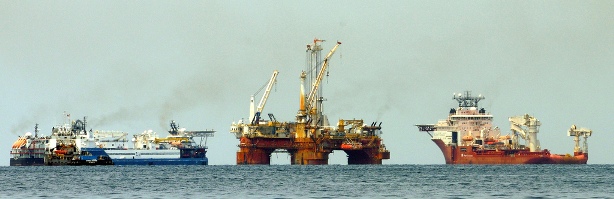
Image: Q4000 vessel (shown centre) undertaking preparations for the ‘static kill’ / US Coast Guard photograph by Petty Officer 1st Class Adam Eggers.

Senate to take up modest energy bill; oil-spill research included

In addition to a host of provisions tied to the Deepwater Horizon disaster in the Gulf of Mexico, a pared-down energy bill expected to hit the Senate this week would bolster oil-spill research and set up a monitoring programme for the Gulf of Mexico. Similar legislation passed the House of Representatives last week.

The bill also contains a range of energy measures, including tax breaks to convert heavy vehicles to natural gas and rebates to encourage home improvements that boost energy efficiency. Other provisions require the Energy Department to develop a plan to promote electric vehicles and contract with the National Academy of Sciences on a related study.

But the bill is most notable for what it does not include. In addition to setting aside language on global warming, Senate Democratic Leader Harry Reid of Nevada left out a requirement that electric utilities boost renewable electricity production that many saw as a potential fall-back measure. The goal is apparently to jettison controversial language in an effort to get something out the door before senators leave town for the August recess next week.

Once the debate begins, Senators will go about their business with amendments that could target just about anything, from renewable energy to climate to clean coal. And one feature of the rules governing this bicameral legislature is that the majority party can always include provisions that were passed by the House in the final legislation – even if those provisions were never approved by the Senate. And since the House passed climate legislation last year, that technically means that this modest bill might yet roar.

Most consider climate legislation an extreme long-shot this year, but the White House pointedly raised this possibility on Wednesday. Lawmakers would still need to broker some kind of a compromise that can garner 60 out of 100 votes in the Senate, but if they succeed that language could be inserted into the process when the House and Senate go to negotiate the differences between their bills this fall.

And as long as we are talking long shots, there is always the post-election Christmas-Eve Hail-Mary pass in which a lame-duck Congress attempts to push through massive legislation just hours before many of its members are kicked out of office. Highly controversial, to be sure, but there are those who think the Democrats might be willing to do it if they take a serious hit during the November elections. And as Steven Cohen, executive director of Columbia University’s Earth Institute, points out in the Huffington Post, it’s been done before.

Gulf storm subsides as BP prepare to ditch Hayward

BP’s share price jumped an excited 5% on Monday to reach its highest closing price since early June, as investors looked forward to ushering out chief executive Tony Hayward.

The company insisted no final decision had been made on changes to management before a board meeting on Monday evening, with second-quarter financial results due out on Tuesday. But Hayward’s place at the top table is widely expected to be filled by an American: Robert Dudley, the director of BP’s oil-response unit. As for Hayward himself, he will reportedly be nominated for a place on the board of TNK-BP – the company’s Russian joint venture (Wall Street Journal, BBC).

The Wall Street Journal’s blog notes that dumping a CEO doesn’t generally help a company boost its stock in the long run.

With the announcement of Hayward’s departure imminent, tropical storm Bonnie – which caused BP to evacuate most of its ships on Friday – has thankfully dissipated, meaning that work on permanently plugging the spill with relief wells can resume (BP press release).

Tropical Storm Bonnie scuppers Deepwater well kill

Ships dealing with the aftermath of the disastrous Deepwater Horizon oil spill are fleeing the accident site today in the face of a ferocious storm.

Although BP is currently still monitoring the capped site of the MC252 well, efforts to drill relief wells that will finally shut it down have been suspended after forecasters predicted that Tropical Storm Bonnie would track into the Gulf of Mexico. According to the National Hurricane Center, the storm already has sustained winds of 65 km per hour and can be expected to worsen.

“Due to the risk that Tropical Storm Bonnie poses to the safety of the nearly 2,000 people responding to the BP oil spill at the well site, many of the vessels and rigs will be preparing to move out of harm’s way beginning tonight,” said Admiral Thad Allen, the National Incident Commander, yesterday.

“Some of the vessels may be able to remain on site, but we will err on the side of safety. While these actions may delay the effort to kill the well for several days, the safety of the individuals at the well site is our highest concern.”

Aside from the suspension of response work, a storm in the Gulf could have a number of potential impacts on the oil that has already leaked from the seabed. The storm could increase the mixing of oil and water, which would encourage the breakdown of the oil by natural processes.

In addition, a storm could either drive oil towards the shore or away from the shore, depending on which side of the slick it passed. For example, if a storm passed to the east, the wind – which blows counter-clockwise – would push oil out to sea.

At the moment the predictions for Bonnie have it heading more or less directly towards the leak site.

bonnie wind speed.gif

Image: National Hurricane Centre

Deepwater Horizon: cap test extended

BP has been given another 24 hours to test the sealing cap in place on its disastrous Gulf of Mexico oil well.

The National Incident Commander, Admiral Thad Allen, extended the test despite concerns regarding the monitoring systems in place and indications oil may be leaking from somewhere. A seep has been observed near the now-sealed well and there are also indications of methane over the well, says Allen.

Allen said yesterday that the pressure readings from the cap were lower than expected, possibly indicating that oil was leaking out somewhere. If necessary the valves in the cap can be opened, allowing oil to be piped to the surface for collection.

“This test will only continue if they [BP] continue to meet their obligations to rigorously monitor for any signs that this test could worsen the overall situation,” he said today. “At any moment, we have the ability to return to the safe containment of the oil on the surface until the time the relief well is completed and the well is permanently killed.”

BP says the relief wells currently be drilled to permanently shut down the leaking well will likely be ready in the first half of August.

Deepwater Horizon: leak stopped!

deepwater cap.jpgLet’s just let BP say this in their own words: “Currently the well remains shut-in with no oil flowing into the Gulf.”

That’s right, after 88 days and probably over 3 million barrels of oil spewed into the Gulf of Mexico, the leak begun by the explosion and sinking of the Deepwater Horizon drilling rig may finally be under control.

BP appears to have successfully attached and engaged a ‘sealing cap’ atop the broken blowout preventer, stopping the oil flow. The company is now monitoring the pressure build up in the well to check if oil is escaping anywhere, and will reopen the valves and let oil flow to its collection ship after a test period. After this – if the test is deemed a success – the well could be shut off. (The BBC has a nice graphic explaining the details, and Admiral Thad Allen’s recent press conference also lays this out.)

The relief wells currently being drilled will still be needed, but staunching the flow of oil until they can be finished is a huge triumph for BP, which has already seen its share price respond positively.

Image: the sealing cap being deployed on 11 July / BP