
Guest blog by Veronique Kiermer, Director, Authors and Reviewers services, Nature Publishing Group.
Irreproducibility issues affecting basic research in biology can be traced to a variety of common causes. One of them is the misguided use of statistics.
As new experimental technologies and approaches increasingly allow biologists to probe their model systems in quantitative ways, biological disciplines that have traditionally relied on qualitative observations are turning to number crunching. Yet many practising biologists complain that the formal statistics instruction in their curriculum has been inadequate. Poorly focused statistical training, mostly theoretical and centred on examples foreign to their discipline of study, has left biologists ill-equipped to apply statistics in their everyday experimental work.
In the past couple of years, the Nature journals publishing biological research have started paying much more attention to statistics. We have appointed a statistical advisor, Terry Hyslop from Duke University, who has helped us assemble a panel of statisticians who act as consultants on certain papers.
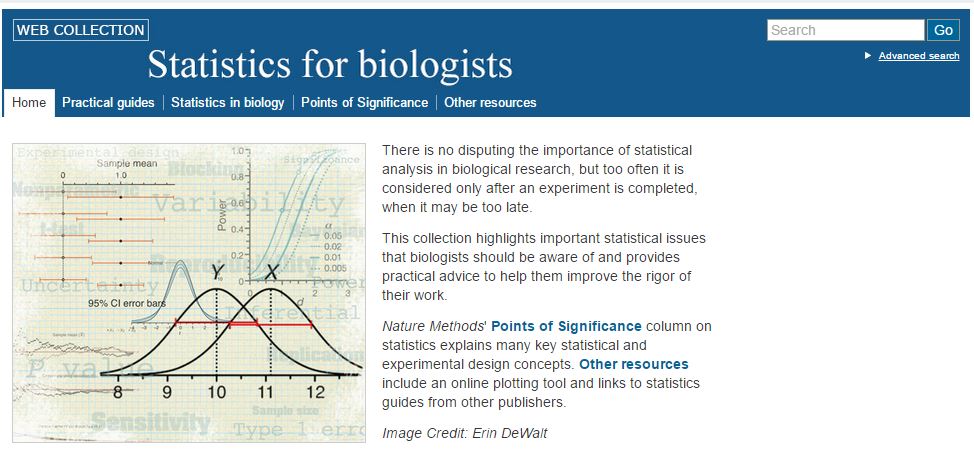
While delving into reproducibility issues, the Nature journals have also commissioned and published a variety of content dealing with the use of statistics in basic biology. We have now brought together the most popular of these pieces into a collection.
The pieces range from comments, to advice on very specific experimental approaches, to the entire collection of the Points of Significance columns that address basic concepts in statistics in an experimental biology context. These columns, originally published in Nature Methods thanks to Martin Krzywinski and guest editor Naomi Altman, have already proven very popular with readers and teachers. Finally, the collection presents a web tool to create box plots among other resources.
We hope this collection, freely available to all readers, will be a resource for many biologists—students, teachers and experimentalists who just want a refresher or a quick reference.