Editor’s note: Further to its original publication, this post has been edited to reflect more accurately the content of the Nature Masterclass that was delivered at the 2015 Naturejobs Career Expo in Boston.
Papers are accepted based on novelty, importance and scientific merit. But once published, a well-crafted title and abstract can help your work be found.
Contributor Anthea Lacchia
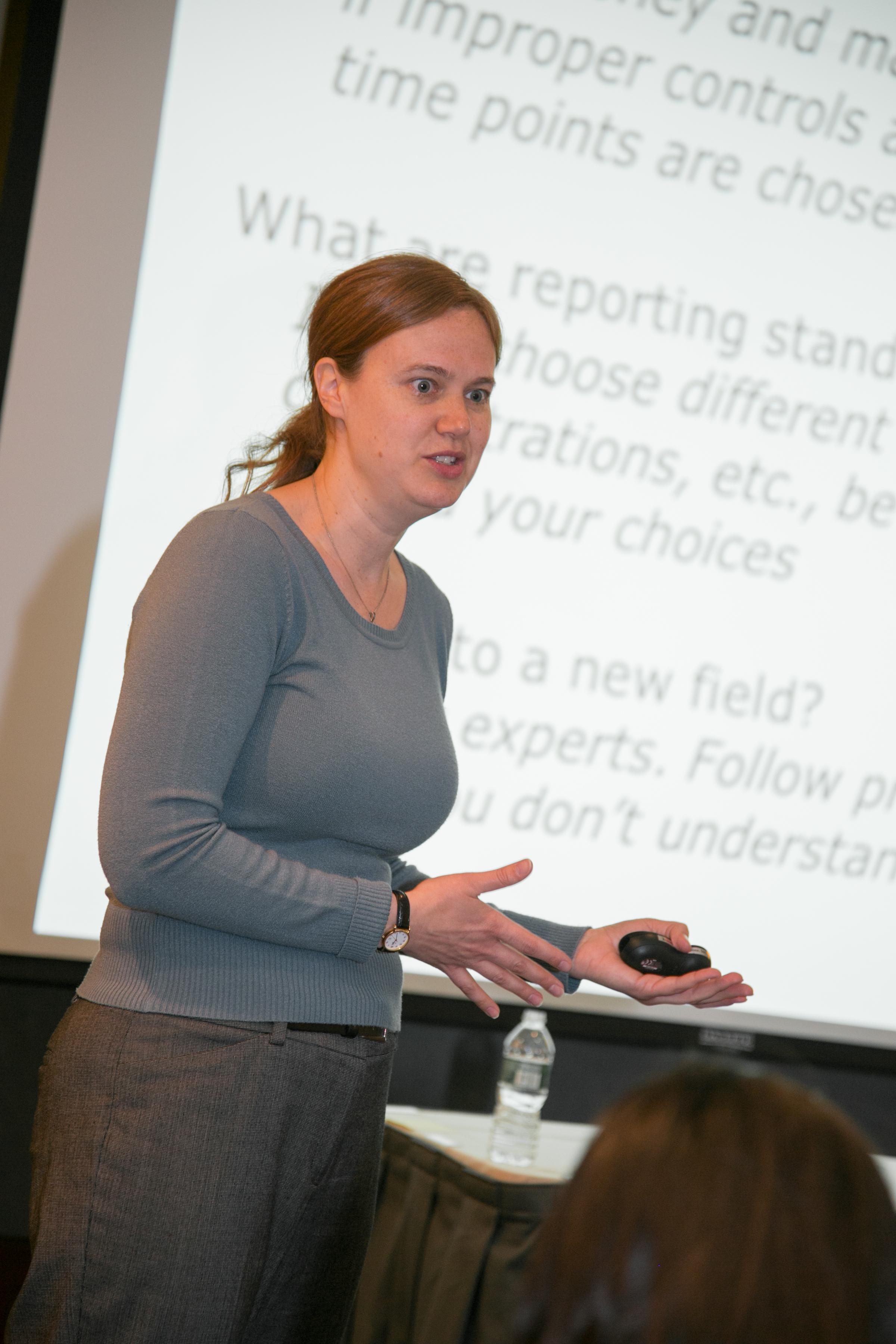
Understanding what editors in top-tier journals are looking for in a paper is not always easy, especially for early-stage career researchers. Speaking to a packed room as part of a Nature Masterclass held at the Boston NatureJobs Career Expo 2015, Kyle Vogan, Senior Editor at Nature Genetics, shared some insights into his role before offering some practical advice to those in the process of writing up.
The talk was divided into two halves. The first explored what Nature editors are looking for and was focused on content. To increase chances of acceptance, scientists need to address important questions, design good experiments, generate solid data, analyse the data using appropriate statistical frameworks and interpret the findings correctly. No surprises here. And no substitutes for hard work.
The second half of the talk described how to write an effective title and abstract. With the volume of scientific literature growing rapidly, carefully crafted titles and abstracts can help published papers get noticed by readers amid the noise. Therefore it is important to make sure these signposts contain information on study design, sample size, experimental evidence and main conclusions. “Focusing just on the conclusions may not give the reader enough confidence to know whether to believe that the data actually support the claims,” Vogan said.
Titles: be simple and specific
The title should encapsulate the novelty of your paper and be understandable on first reading. Vogan recommended that titles follow the acronym DEF: they should be declarative, which means they should make a statement about something (e.g. with a subject, action verb and object); engaging, (which usually translates into not being overly technical; and focused (so, short).
Vogan offered a number of tips for drafting a title, including:
- Use active rather than passive verbs.
- Avoid words that don’t add to the story such as: “on this”, “study”, and “investigation”.
- Be specific in delivering your message: the title of a Nature Medicine article published in 2012 was changed from “The effect of insulin on liver cells in the absence of 2 key signalling components” to “Insulin regulates liver metabolism in vivo in the absence of hepatic Akt and Foxo1” (title change by the Nature Masterclass team, not the journal). Not every reader may know what Akt and Foxo1 are, but the title is declarative and specific.
- “But don’t be too specific” said Vogan. When possible, avoid acronyms and other jargon, which renders the title opaque to readers not already conversant in the field. However, Vogan noted that this should not be viewed as an absolute prohibition and that sometimes it is not possible to adequately convey the essence of the research without acronyms.
- Be careful of being overly assertive in titles (e.g. by claiming a cause-and-effect relationship when the data only show a correlation).
- Avoid question marks: titles should present outcomes, without teasing the reader. Furthermore, articles with interrogative titles tend to be rejected.
- Focus on what is novel in the work.
- Avoid complex, compound nouns. For example, the term “excess water-weight remover” would probably be removed from a title during the editorial process at a Nature journal, according Vogan.
- Genus and species names can be included, but should be accompanied by the common name of the organism.
- Avoid puns, since they are not usually very helpful, lead to fewer citations, and tend to make papers invisible to web searches. Besides, Vogan added, these attempts at humour tend to be funnier to the authors than to anyone else. As an example, he pointed to a paper published in the journal Bioinformatics with the title “Multiple alignment by aligning alignments“. “I don’t know what that actually means, except that they are trying to be cute,” Vogan said.
Although these are good rules to keep in mind, Vogan advised not obsessing too much over them. “Not every good title will strike every box,” he said. Usually it’s a trade-off between the main components of DEF. Some titles may be focused and engaging, but not very declarative; an example of this was drawn from a paper published in Nature Genetics this year titled “A Big Bang model of human colorectal tumor growth”.
Abstracts: Get to the point
Vogan presented what he called the “Nature summary template” for writing abstracts. They should start from a few general statements to give context, then they should describe the problem and main results, and they should end with a brief summary about what the results add to previous research.
Vogan offered some dos and don’ts for writing strong abstracts:
- Do include keywords in order to make it more searchable.
- Don’t try to include everything. Keep it focused.
- Don’t include too much detail about methods.
- Don’t use obscure abbreviations, acronyms and references to literature or to figures.
As the audience left the room they appeared excited to put what they had learned into practice: “I learned a lot,” said Ardeshir Kianercy, a mechanical engineer at Johns Hopkins.