Science Journalism Tracker: A virtual water cooler for sciwriters

In addition to training writers from across the globe, the Knight Science Journalism program at MIT keeps an eye on what we all produce. The KS Journalism Tracker web site notes that, for the past six years, its writers have “commented on the effectiveness and balance of thousands of news stories.” The program recently lauched a redesiged web site, but the Tracker’s mission remains the same. Today it counts 30,000 hits a month, including many from Spanish-speaking readers interested in posts on Latin Amerian science journalism. The site hopes to offer the same service to Chinese-speaking science writers.

 Earlier this week, Nature Boston talked Phil Hilts, the former New York Times reporter who runs the Knight Science Journalism program at MIT.

What is the thinking behind the Tracker? 

Knight Science Journalism Program director Phil Hilts

(Charlie Petit’s) original idea was just to do a little round up of a bunch of stories. What he noticed was — science writers, while they know each other and see each other at meetings, they don’t really see each other’s work very much.

… He started getting into the idea that you could pick out a couple of good stories and identify them and do a little critique – and once in a while do a critique when something went wrong. (The posts) are all supposed to be relatively short. They’re starting to get a little too long and I’ve started complaining to (the writers.)…I like a mixed length and not too much analysis.

What’s the difference between an analysis and a critique?

My sense of analysis is that it tends to go pretty deep and long.  I don’t really want deep and long.

Why not?

This is a blog and … (Readers) go to it because they’re interested in what is going on. … If you give them this large post, it’s going to quickly put them off.  Once in a while, a little longer that’s fine.  But mainly they want to jump on and see two or three or four items – here are some good stories or everybody is doing this story this way. Continue reading

Starting out in science: Boston researchers share lessons from their first jobs

Thursday 26th July saw the launch of SciLogs.com, a new English language science blog network. SciLogs.com, the brand-new home for Nature Network bloggers, forms part of the SciLogs international collection of blogs which already exist in GermanSpanish and Dutch. To celebrate this addition to the NPG science blogging family, some of the NPG blogs are publishing posts focusing on “Beginnings”.

Participating in this cross-network blogging festival is nature.com’s Soapbox Science blogScitable’s Student Voices blog and bloggers from SciLogs.com, SciLogs.deScitable and Scientific American’s Blog Network. Join us as we explore the diverse interpretations of beginnings – from scientific examples such as stem cells to first time experiences such as publishing your first paper. You can also follow and contribute to the conversations on social media by using the #BeginScights hashtag.   
 

Click for video of Jerry De Zutter and others

A scientist’s first job can be a thrill, a terror, a challenge, a source of inspiration or the inspiration to do something different.  So say some of the researchers whose career paths led them through Kendall Square this week. Conversations inside and outside neighborhood labs and offices explored the question – What lessons did you learn when first starting out?

Some researcher had mentors — or at least people who gave them memorable advice. Jerry De Zutter met his first boss — Gary Barsomian of Genzyme – while playing Ultimate Frisbee.  De Zutter interned at Genzyme as an undergrad, worked at the Cambridge-based pharma for a year, and got some advice from Barsomian before heading to graduate school :“The one thing you want to make sure you do when your rise to the level of a PHD science, is to become an expert in something. “

De Zutter focused on the signal transduction processes that underlie neurodegeneration. After several jobs in the pharmaceutical industry, he now runs a team of researchers working on discovery and the pre-clinical pipeline at ALS Therapy Development Institute. The company is one of a growing number of non-profit pharmaceutical development projects.

On a break at a Kendall coffee shop, Deepti Sharma also said she had a supportive boss. Working with LC-MS ( liquid chromatography-mass spectrometry] at Advion, a company in Ithaca, New York, she said her supervisor encouraged her to take on more responsibility: “That gave me a good opportunity to explore the product development platform with full enthusiasm and energy,” she said. Sharma also got the best of both worlds – academic and industry. While at the company, she was able to work with Cornell professor Jack Henion, whom she described as “the father of LC-MS…It was as if I was working as  a student but in an innovative, fast-paced environment,” she said.

Not everyone queried in the square remembered an inspiring boss. Chris, a pharma chemist who asked that his last name not be used, said he had a supervisor with “a very serious temper problem” at his first job, which was in an academic lab. But, that isn’t what drove him out of the university setting and into the world of corporate science. Without a PhD, he didn’t see any future in academia.
Kathryn Erat

 When Kathryn Erat started her career in the 1950’s, she quickly stepped into the future.  A degree in math and physics landed her a job with a combustion engineering company working on power systems for nuclear submarines. After struggling for days to solve complex math problems, she suggested to her boss that they might be able to work more efficiently with a new form of technology – the computer. Back then, that meant a mainframe and a trip to New Jersey.

Two chemical engineers lunching outside a local biotech – Tanya and Hong – both faced the same problem when finding their first jobs in the US. The two women – who asked that their last names not be used – had to convince employers that the skills they learned in Communist countries would apply to work in this country. When Tanya, who was trained in the former Soviet Union, got her first job, she was grateful for the chance to prove herself: “For those who are not born in the States and do not have an American education, to find a first job is extremely challenging because you don’t have the right experience in this country. Your experience anywhere else seems to be absolutely irrelevant.”

Hong, who arrived from mainland China 20 years ago, said she had the same problem, but ended up landing a job with a helpful boss. Her first realization was that the U.S. drug development industry worked under a different set of rules.

“Twenty years ago in China, (regulations) were a lot looser,” she said. Here, for example “the regulations about patient safety are very strict.”

Computational biologist Kevin Galinksy spent two years at the J. Craig Venter Institute in Maryland before coming to the Broad Institute.  As a young scientist, he’s only worked in a wired world. So, the advice to publish or perish had a different meaning for him – he can post some of the code he’s developed on the web.
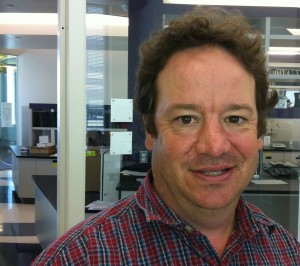
John Lincecum

Back at the ALS Therapy Development Institute, Director of Discovery John Lincecum, said he was interested in science and took premed course as an undergrad. But he decided to focus on the liberal arts and leave most of the science for grad school.

He fled the oil bust in his native Texas to look for work in then booming Massachusetts. Lincecum emphasized the science on his resume and was hired as a technician for a company now known as Charm Sciences, which was developing radioimmunoassays to test for penicillin levels in milk.

“I was absolutely terrified because my worry was that they would figure out I really wasn’t a scientist,” he said. “I was English major.”

His fears came true when he spent an entire week pressing the wrong button on a scintillation counter.  Instead of carefully measuring ionizing radiation, he was pushing the button for the timer.  He expected to get fired.  “But they were very patient,” he said. What he found was that the approach he had been counting on paid off:  “I felt all I had to do was — ask a lot of questions, be very, very enthusiastic and be willing to admit every mistake I made.”



For Media Lab applicants, “evidence of extreme creativity” trumps PhD

They say MIT puts a high values on credentials, but not at the Media Lab. Director Joi Ito, never graduated from college. His tech and Internet chops got him the job. (Ito is board chair of Creative Commons, an early investor in both Twitter and Flickr,  and according  Time Magazine, a member of the “cyber-elite.” )

So, no PhD required for the openings at the he Media Lab, where they are seeking twos professors  of “music, performance, arts, design, food, fashion, architecture, games, things we have not thought of, or any combination thereof.”

More from an ad for two tenure-track openings:

An anti-disciplinary research organization, the Media Lab focuses on the invention of new technologies that radically improve the way people live, learn, express, work, and play. Candidates should have a record of original thinking, action, and impact in the arts, design, and quality of life. Applicants should be willing to take risks commensurate with the Media Lab’s willingness to look beyond known boundaries and disciplines.

Successful candidates will establish and lead their own research group within the Media Lab; pursue creative work of highest international standard; engage in collaborative projects with corporate members and other Media Lab research groups; supervise master’s and doctoral students; and participate in the Media Arts and Sciences academic program.Appointments will be within the Media Arts and Sciences academic program, principally at the assistant professor level. A doctorate is not necessary, but evidence of extreme creativity is.

 APPLICATION DEADLINE: FEBRUARY 1, 2012

Listing the top science stories of 2011

MIT’s Science Journalism Tracker does it for you. Here’s a sample.

  • Scientific American: The Top 10 Science Stories of 2011 ; #1 is Fukushima reactors and the quake-tsunami in general. That’s good. Most interesting is #2 – Technology (eg Twitter) and the Arab Spring. Baffling is #7, the death of Steve Jobs. A top story for sure. …
  • Reuters – Kate Kelland: Whale sperm, orgasmic feet top 2011 bad science list ; Just dumb. Funny too.
  • Wired: Top Scientific Discoveries of 2011 ; …first one up is the maybe-faster-than-light neutrinos, and last is Higgs boson. Right in the middle are Neanderthal genes that are a small component of non-African genomes, and the rise of world population to 7 billion.
  • BBC: 2011 As Seen From Space ; Not science, strictly, but it includes the shot from the Int’l Space Station of the last reentry for the shuttle program, of the Atlantis and its crew.

Nature has an entire spread, including a round-up  of  “The 10 most important people of the year.“ MIT astronomer Sara Seager makes the list.

Seager wants to search for Earth-like planets no more than 30 parsecs away, close enough that their atmospheres could be studied. Her tool would be a 10 × 10 × 30-centimetre space telescope designed to watch a single star for a planetary transit. Such an ‘ExoplanetSat’ would not be able to analyse spectra by itself. For that, Seager will need an orbiting telescope such as the Terrestrial Planet Finder, an ambitious concept that NASA put on ice in 2006. But a fleet of ExoplanetSats could provide a resurrected planet finder with a map of where to look. Each ExoplanetSat would cost less than US$1 million. Rather than a telescope mirror, it would rely on a modified, $1,300 commercial lens. And dozens could be launched very cheaply, piggybacking on rockets carrying other missions.

She also worked on the inaugural show at the Museums of Science Boston’s rebuilt planetarium.

Listee John Rogers also has a Cambridge link. The MIT grad  work on “electronic devices that can be worn rather than held — woven into clothes, say, or moulded to the body…. He found that ultra-thin silicon circuits printed onto an elastic surface could be highly flexible — and retain the benefits of silicon’s low cost and high performance. One result of this work is a spin-off company based in Cambridge, Massachusetts, called mc10, that is working with the sporting-goods giant Reebok to roll out a product in 2012 that.