#SciData15: Get more out of your research data

Researchers shared their tools to help scientists use and share data more effectively at the 2015 Publishing Better Science Through Better Data conference.

Guest contributor Rehma Chandaria
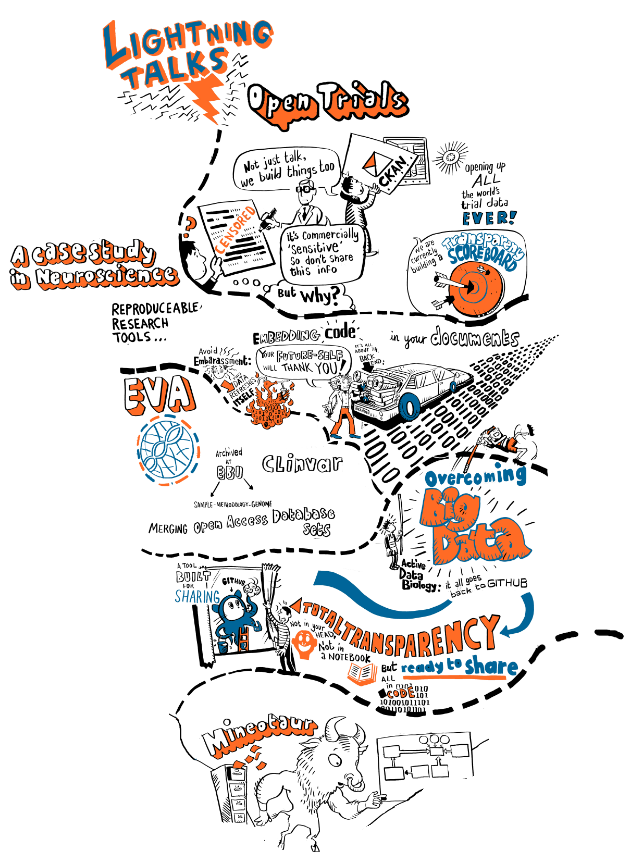
naturejobs-blog-Scidata15-Lightning-Talks

{credit}Image credit: SCIENTIFIC DATA/LUDIC GROUP{/credit}

The session of lightning talks at the 2015 Publishing Better Science Through Better Data conference was strategically scheduled to combat the post-lunch lull that often occurs. Five speakers had seven minutes each to tell the audience about their tools for helping scientists to use and share data more effectively.

Dr Sam Payne and Dr Balint Antal have both written programmes that allow researchers to collaboratively analyze and visualize large amounts of data. Payne of the Pacific Northwest National Laboratory in Washington State developed Active Data Biology, a tool for interactively exploring and analyzing ‘big data’. He demonstrated how the programme can be used to assess proteomics data in the form of a heatmap — you can click on various proteins, conduct real-time analytics, save the proteins you find interesting and look at what your collaborators have saved. Rather than having the information hidden away in your notebooks or in your head, everything is stored on GitHub so it’s transparent and available to everyone involved. Mineotaur, developed by Antal of the University of Cambridge, UK, is based on a similar idea. It is an open-source tool designed for biologists to explore high-throughput microscopy data. Mineotaur can also be used to share research findings and allow others to analyse them further. It can even be embedded in publications to allow readers to explore the data for themselves. Continue reading
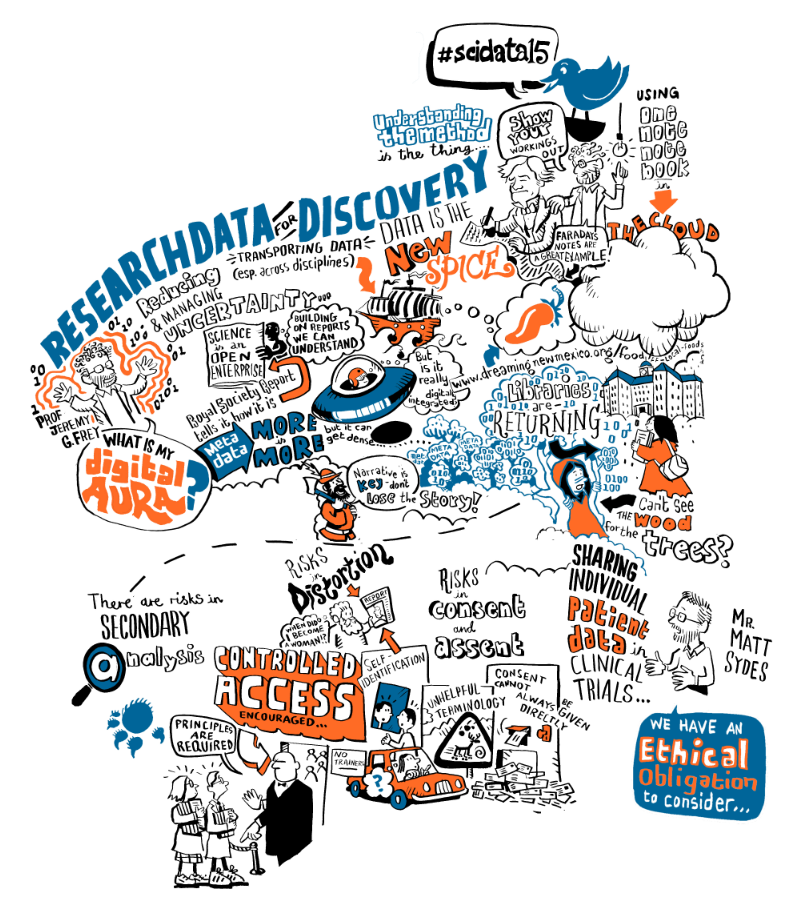

#SciData15: Research Data for Discovery: Prepare to Share

Speakers at #SciData15 advocated for a wider degree of awareness of the field of data science and the implementation of data sharing technologies.

Guest contributor Caroline Weight

naturejobs-blog-Scidata15-Research-Data-for-Discovery

{credit}Image credit: SCIENTIFIC DATA/LUDIC GROUP{/credit}

“We must engage in the idea of sharing,” said conference chair Iain Hrynaszkiewicz as the 2015 Publishing Better Science through Better Data meeting kicked off at the headquarters of Nature Publishing Group (NPG) in London on 23rd October.

Hrynaszkiewicz, who develops new areas of open research publishing and data policy within NPG/Macmillan, noted that 30 funding bodies — including the Engineering and Physical Sciences Research Council and The Royal Society — have written policies that outline requirements for data-sharing. Examples include detailed methods and protocols, microscopy images and mathematical workings, as well as meta-datasets of, for example, genotypes and microarrays.

The meeting’s aims were to increase awareness of ways to effectively share data and to discuss how to improve the efficiency, implementation and overall impact of sharing among the scientific community. A recurring issue throughout the day was how to enforce sharing, and get the concept to become part of standard, everyday scientific practice –one that seeps into the lives and habits of working researchers. Continue reading

Data sharing: Contribute to the community

Data sharing can make a significant contribution to the scientific community, but it comes with challenges, says Caroline Weight.

Guest contributor Caroline Weight

We have all heard of it. We are all worried about it. We hear whispers of it in the corridors. We are advised to be careful what we say to ‘others’. We constantly check the literature. It matters to us. After all, it is our careers on the line.

‘Scooped’.

The process of publication is vigorous, competitive and tricky. It’s not uncommon for five years to pass between writing the grant application and publishing the work. Big labs with state-of-the-art facilities stand a better chance of getting their work out there first, given the extra manpower and often more-established protocols. This race for ownership of the data makes it difficult to share information and present new findings at meetings or conferences. Even at manuscript submission, there is often a chance to actively inhibit particular referees in case of conflicts of interest or personal competitors, to retain the novel concepts and data until they have been made public. Not until the publication has been accepted and is in print can you heave a sigh of relief and move on to the next project. Yet, sharing of data is essential to the progression of science in the modern world. Continue reading

Data sharing: Why it’s all ‘mine’

Data sharing makes scientific sense, but the career-conscious nature of scientists may stand in the way.

Guest contributor Rachel Yoho

As with many aspects of society, human nature shapes interactions in science research. When we consider “data sharing,” the likely response is probably a shrug. We’ve all been there. Group work and competition at its finest. The increasingly competitive environment for grant funding, and the ‘publish or perish’ attitude promotes the “mine, mine, mine” attitude among scientists. To focus on the issue of overcoming career-protecting objections to data sharing however, we can focus on several trends.

Data ownership
With many factors, including budget cuts, sequestration and economic downturns, the current scarcity of grant funding creates financial stress in labs. ”Big grants” like the NIH R01, had lower success rates for new grants in 2014 as compared to the last four of five years. In turn, data ownership becomes possessive to the PI and lab, even beyond that of the funding agency or institution. Simply, it’s our grant money, it’s our data. By working for and finally achieving a grant, often after many attempts, a sense of accomplishment and pride in ownership develops. Continue reading

Announcing the Publishing Better Science Through Better Data writing competition

Enter a new writing competition for the chance to attend the Publishing Better Science Through Better Data 2015 event (#scidata15) in October, have your writing published on the Naturejobs blog and work with Nature Publishing Group editors.

SciData-logo-naturejobs-blogAfter a rapidly sold out first conference in 2014, we are looking for five budding science writers to help with news coverage of Publishing Better Science Through Better Data 2015. The day-long conference, held at Nature Publishing Group’s offices in Kings Cross on October 23rd 2015, will explore the practical implications, for early career researchers conducting and publishing their work, of data sharing policies and tools.

This year’s full-day conference will include advice on publishing, advancing careers and include discussion of emerging tools and resources available to researchers to help them, and society, derive maximum benefit from scientific research. The focus of the 2015 conference is on natural sciences and medicine, from academic and industry research perspectives.

Speakers will include representatives from leading journals, research organisations, funding agencies and technology providers. Also, lightning talks and demos will enable conference delegates – researchers and technologists – to present case studies of data sharing and analysis tools in action. Continue reading