
Disappearing hand trick
Julian De Freitas explains in the News Blog that Roger Newport of the University of Nottingham knows how to fool a person’s brain into thinking their hand has vanished. This sleight of mind is so compelling that it has officially been crowned the best illusion in the world:
“The illusions this year were particularly spectacular”, says Stephen Macknik, judge moderator for the 8thAnnual Best Illusion of the Year contest, which took place at the annual meeting of the Vision Sciences Society in Florida yesterday. The 10 best illusions from 59 entries were unveiled in a concert hall packed with vision scientists from across the globe, who voted for the final winners.
You can find out more information in the post.
Guppies lust after killer orange prawn
Alice Lighton reports in the News Blog that a murky-brown prawn which lives off the coast of Trinidad has evolved orange spots on its pincers to tempt local guppies. The fish mistake the markings for both food and a potential mate, and unwittingly become the prawn’s next meal:
Researchers placed a model of a Macrobrachium crenulatum prawn into a tank with female Trinidadian guppies, who were understandably wary of its head and claw areaa. But when the prawn’s pincers were decorated with orange spots, as they are in the wild, the fish couldn’t resist taking a closer look.

New-look naturejobs.com
Nature Job’s blogger, Rachel Bowden, announces that over the past 12 years their team have worked hard to craft the Naturejobs website into an eminent career resource for scientists. In that time, with your help, they’ve become the largest dedicated jobs board for the scientific community worldwide. That’s why they’re excited to share the new naturejobs.com with you.
The re-launched site offers a fresh new look and improved functionality which lets you search, save and apply for jobs even more quickly and easily. Here’s how the new site can help you with your job search and career development:
- Apply for jobs faster by uploading your CV and cover letter to your account
- Find exactly the right job using the advanced search option, now delivered via filters on the left-hand side of your search results
- Get jobs that match your search keywords sent to you by email using our improved job alert sign-up process
- Easily find useful science career news and features in our archive by filtering articles by date, discipline, career stage and more
- See the very latest updates on science careers and jobs news via the Naturejobs Twitter feed, which has been integrated into the site
This is just the first phase of the new naturejobs.com – watch out for further new features and improvements to the site over the coming weeks. Feel free to leave feedback in Rachel’s post.
Stephen Hawking
Graham Morehead reveals in his latest post that in an interview, Stephen Hawking was asked, “What’s the most common misconception about your work?” He replied, “People think I’m a Simpsons character.” [Link]
 Graham points out that he was, in fact, in several Simpsons episodes and in one of them, while sharing a beer with Homer, he is seen discussing the shape of the universe. Hawking tells Homer, “Your theory of a doughnut-shaped universe is intriguing… I may have to steal it.” We all know Homer has a doughnut fixation, but this is a reference to a real theory. Graham explains this theory in his post, including the background.
Paralyzed fish
Noah Gray explicates in the Action Potential Blog that over the last few years there have been several experiments involving different creatures navigating in virtual environments while neural activity was monitored. Most of these subjects would have their heads fixed for the stability of recordings in the brain. Noah reveals that the same can’t be said for the subject in this latest example of a virtual reality navigator: a wriggling, swimming fish. A more creative solution had to be sought and in a paper published online yesterday, Ahrens, Engert and colleagues decided that paralysis was the way to go in order to follow the neural activity of this navigating fish. From the authors, here is the system set-up: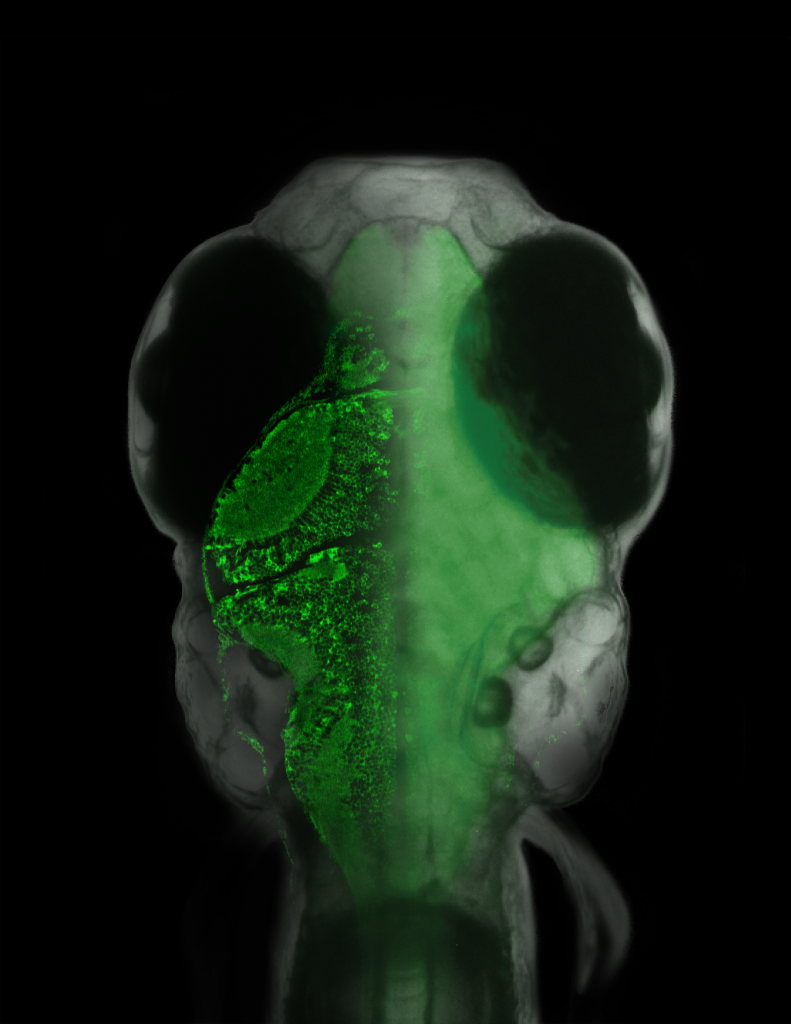
To examine neural dynamics across brain areas that drive sensorimotor recalibration, we developed a system to study neural activity at cellular resolution17, 18, using two-photon microscopy19, anywhere in the brain20 during closed-loop optomotor behaviour in larval zebrafish. These animals have a small and transparent brain that is readily accessible for optogenetic recording and stimulation21, 22, electrophysiology23 and single-cell ablation24. To remove motion artefacts25, 26, we developed a swim simulator for completely paralysed larvae (Fig. 1a). Motor commands, or ‘fictive swims’, are recorded at the motor neuron level8, 27, 28(Fig. 1c, d) and translated, in real time, into visual feedback that resembles the optic flow of freely swimming fish (Methods). This constitutes a fictively driven virtual-reality setup. Simultaneously, a two-photon microscope scanning over a transgenic fish expressing GCaMP2 (ref. 29) in almost all neurons20, 30 allows activity to be monitored throughout the brain at single-neuron resolution. As the experimenter is in complete control of the visual feedback, this allowed us to study neural dynamics during visually guided motor adaptation throughout the brain at the cellular level.
Continue to the post to allow Noah to translate this text and to find out more about this research.
 Get Ur Geek On
Pete Etchells acknowledges in his latest post that there was a time, in the (embarrassingly) not-too-distant past, when being called a geek was a slur. If you were a geek, you were socially inept. You spent all your time doing technology-, science-, or maths-based hobbies. You might have been shy and retiring. You were not cool. He continues:
Why am I pontificating about this? Well, Mark Henderson’s ‘The Geek Manifesto’ was published this week, and is a rallying cry for geeks everywhere to stand up and make themselves heard. Not just in science, but in politics, healthcare, the media, the justice system, the educational system, and anywhere where rational, evidence-based approaches can lead to sound and sensible policies. It’s a superb book, and if you haven’t already devoured it you really should. Better people than I have already written glowing reviews, but I wanted to provide my own thoughts and experiences, on the media section in particular.
You can read the rest of Pete’s thoughts, in particular why he feels science blogging is important, in his post.
Could there be life on Mars?
This week’s Soapbox Science guest post is by geologist and planetary scientist at the Open University, David Rothery. In his post, David asks, “Could there be life on Mars?” and, “How common is life in the Universe?”
The general “how does a planet function?” question is not all that drives planetary research. The more we learn more about microbial life on Earth, the more we have come to realise that there are bodies elsewhere in our Solar System were similar life could survive. Mars with its present-day water seeps and much wetter past is the most obvious, though not necessarily the best, candidate. Some of the icy moons of Jupiter and Saturn contain oceans of liquid water, where life could survive by feeding off chemical energy (all the time) or from sunlight (during brief episodes when cracks open). For example Enceladus, a 500 km diameter moon of Saturn is criss-crossed by fractures, some of which have been seen to vent ice-crystals to space providing evidence of warm, liquid water in its interior.


Join in the conversation by leaving your thoughts in the comment thread.
Science communications conference
This week saw the annual two-day Science Communication Conference in London, organised by the British Science Association in association with the Wellcome Trust. This year’s theme was ‘Impact’ with the conversations focusing on the various ways to measure public engagement activities, as well as how research scientists and engineers will consider the impact agenda of their research. Day 1 included a popular key note by Lisa Jardine, the Centenary Professor of Renaissance Studies and Director of the Centre for Editing Lives and Letters at Queen Mary University of London, as well as eight different panel sessions looking at everything from working with journals, to evaluating learning through play. Day 2 included an interesting plenary session on whether science communication can benefit from national initiatives like Olympics 2012, a controversial simulated heart attack on stage, as well as the singing delight, Helen Arney: Voice of an angle (spelling intended). The London Blog documented the online conversation and you can find short summaries and Storify boards from Day 1 here and Day 2 here.

Adding to this, Nature Network blogger, Suzi Gage, also reviewed the conference in her post, SciCom12 – Impact to Heart Attack.
Videoing Aids?
Scitable blogger and lecturer, Nick Morris, explains in his latest post that he has found an unforeseen benefit to videoing student presentations:
I have also found an unexpected benefit to videoing the presentations, and that is it makes marking a lot easier as I can go back and review the video after the session and adjust my marks if needed. What is surprising is the number of time I do end up adjusting the mark, either up or down, based on what I see on video. I think the reason that this happens is because when I’m in the room listening to the students, and trying to complete all the tasks that I need to do, I occasionally miss key things, and it is only after the presentation that I’m able to pick up on these things by watching the video. What is worrying is that on a number of occasions I have been surprised at how much my memory of the presentation, and the notes I made on the presentation, differ from what I am later watching on the screen in my office.
Alzheimer’s rage
This week the Indigenus Blog heard from Itender Singh, a Delhi University alumnus and a research assistant professor at the University of Rochester Medical Center, USA. His work with colleagues from the centre and elsewhere has resulted in development of a new compound which promises to work wonders for people with Alzheimer’s disease (AD). Subhra Priyadarshini elaborates:
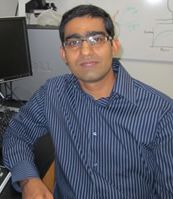 Their success story (and paper published in the Journal of Clinical Investigation) is already getting a lot of peer attention[1], [2], [3].
Singh and colleagues have created a new compound that acts to inhibit the functioning of another compound called RAGE, which is known to play a key role in the accumulation of beta amyloid levels in the brain of people with AD. Such accumulation of beta amyloids is known to be the main trigger for neuronal loss and dementia. So, in essence, the researchers have found a compound that cuts out the nuisance value of RAGE.
Earlier therapies to reduce the production or aggregation of beta amyloids have not worked out to be effective. Singh and colleagues have created a novel ‘small-molecule inhibitor’ which works in this manner — it blocks the functioning of RAGE (acronym for ‘Receptor for Advanced Glycation End products’) thus helping reverse the beta amyloid levels in the brain.
Their work on aged mice has shown that this small molecule inhibitor can normalize cognitive performance. This looks like one of the most promising anti-RAGE therapies till date.
More details can be found in the post.
Sexy primes
This week GrrlScientist asks, “What happens when a numberphile plays with prime numbers?” She links out to a video where mathematician James Grime goes through the explanation for why there is just one sexy prime quintuplet: