The medical school revolution will be digitized

meddummy.jpg

Today’s medical student can carry an astounding amount of reference material on their iPhone or laptop. And when they graduate they’ll be seeing patients who’ve had independent genetic testing done to determine disease risk. How do medical schools adjust their curricula to cope with these 21st century realities?

Medical educators gathered at the New York Academy of Sciences yesterday to hash out answers to this question at a forum titled “Innovating and Updating the Medical School Curriculum”. At the meeting Carol Storey-Johnson, a dean for education at Weill Cornell Medical College, talked about the need to integrate biomedical science and clinical experience throughout medical school. Charles Weiner, from the Johns Hopkins School of Medicine, echoed this in a presentation on his institution’s new curricular model, “Genes to Society”, which emphasizes a systemic view of disease tuned to individual variability.

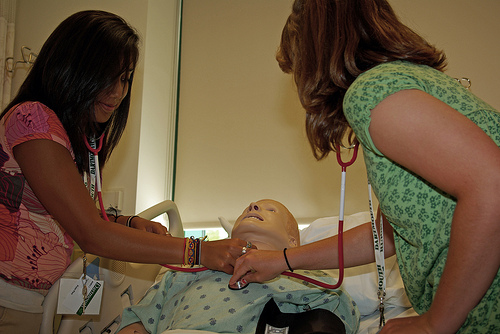
The use of simulations, it seems, will continue to grow exponentially, whether through the use of 3-D anatomical models or robotic patients. Hands-on cadaver dissections will soon no longer be a common staple of the first-year medical school experience. They’re being replaced by dissection demonstrations and fixed-tissue specimens. But this is more due to a lack of bodies than a conscious philosophical shift. Fewer people are donating their remains to medicine, and the number of anatomists is dwindling to an aging few. It’s hard to attract young people to the field, since there’s little research money in it, except perhaps if you’re going into neuroanatomy. “There’s no surprises below the neck,” I heard conference-goers say on more than one occasion.

There was a palpable sense of regret in the attendees that future generations of doctors wouldn’t go through the familiar rite of passage. Others take a matter-of-fact view of the disappearance of cadaver dissections. “I used to feel the same way about the light microscopes, when they got rid of those,” a Harvard gastroenterologist told me at lunch. “But the students are doing just fine without them.”

Image by anolobb via Flickr Creative Commons

Lindau 2010: The Culture Of The Nobel Prizes

The Nobel Prizes have long been a stimulus for light-hearted discussion on Nature Network, prompting quips, parodies and even cartoons. Of course, the IgNobel prizes are there to cock a snook at improbabe research, but here we focus on humorous accounts related to the actual Nobels.

Perhaps the most memorable example comes from the satirical pen of Stephen Curry. Around the time of the 2009 awards, he began planning his own acceptance speech for the trio of awards he expected to receive the following year.

Your royal Highness, members of the Academy, esteemed colleagues, ladies and gentlemen, it is a great and singular honour for me to accept the Nobel prizes for physics, chemistry and medicine.

In my speech this evening I would like to present a brief account of the thought processes that gave rise to my revolutionary (and prize-winning!) Theory of the Tangential Universe and to show how it finally solved one of the most enduring problems of modern science and medicine, the existence of the strange phenomenon known as the homeopath.

The whole missive can be read here, and might just scoop the Literature prize to boot.

Here’s a fun game that never really took off (yet) on Nature Network. How many degrees of separation are there between you and a Nobel Prize winner? As long as you have a publication and access to a collaborator database such as BioMedExperts it’s possible to compute your distance from any other published author. For example, you had that paper in Nature with co-author Dr Y, she published elsewhere with Dr Z, and he published with Sir Paul Nurse; hence, you are three degrees away from a Nobel winner. Try it with a laureate in your field and let us know in the comments how close you get.

Sometimes the laureates themselves take part in the fun. As first noted by Heather Etchevers, here’s a neat banner for Roger Tsien’s laboratory, reflecting his 2008 Nobel Prize for Chemistry for the development of green fluorescent protein and variants:

We’ve even seen Nobel laureates immerse themselves in virtual culture. Back in February 2009, Erwin Neher and Ramon Latorre gave a talk at Encuentros 2009, a gathering of Chilean scientists in Europe. Their lectures were streamed live into the virtual world Second Life, allowing those who couldn’t attend to hear and see the talk in a simulated lecture theatre.

Finally, Viktor Poór has provided a series of ‘stripped science’ cartoons on recent prize winners.

2009 prize for medicine: telomeres.

2008 prize for chemistry: GFP.

2008 prize for physics: broken symmetry.

2008 prize for medicine: shared three ways.

If you know of other good Nobel-themed games, cartoons, quips or anecdotes, on Nature Network or elsewhere, do let us know in the comments.

Part of a series to coincide with the Lindau Nobel Laureates Meeting 2010, celebrating the values of the Nobel Prize, as covered on Nature Network.

Whaling meetings fail to reach compromise

humpback whale.JPGPosted on behalf of Anjali Nayar

Talks on a compromise proposal to end the 25-year ban on commercial whaling while improving protection measures afforded to the marine mammals fell apart this week at the meetings of the International Whaling Commission (IWC) in Agadir, Morocco.

Although some groups went into the meetings hoping for a political compromise, others say it is no surprise that the talks – an attempt to resolve 10 years of disagreement over the management of whaling – failed.

“The Chairman’s proposal was developed within too narrow a circle of member nations and was released without sufficient time for input from the IWC Scientific Committee or concerned NGOs,” says C. Scott Baker, the associate director of the Marine Mammal Institute at Oregon State University.

Sidney Sydney Holt, a a consultant in fisheries management science whale specialist with the Mammal Society*, adds, “It was obvious it could not possibly attract a consensus – too many illogicalities and even illegalities, and that it could take weeks, not days, to amend it to a semblance of acceptability.”

Many non governmental organizations have been quick to point blame at Japan. “The lack of sufficient flexibility shown by Japan to phase out it’s whaling in the Southern Ocean Whale Sanctuary prevented a decision from being adopted,” says Susan Lieberman, director of international policy for the Pew Environment Group.

Others say the proposal fell apart because of the NGOs who “wield considerable influence on many governments on this issue”, in the words of Doug Butterworth, a professor in applied mathematics at the University of Cape Town, who uses mathematical models to develop management procedures for whales. “There is no scientific argument here, as the levels of take proposed do not represent any real threat to the populations involved.”

Continue reading

Deepwater Horizon: Robot blunder sends more oil gushing into Gulf

BP was forced to remove the cap collecting oil from its disastrous leaking well in the Gulf of Mexico yesterday, after an undersea robot collided with the collection equipment.

Although the ‘lower marine riser package cap containment system’ has now been reinstalled, the accident likely allowed thousands more barrels of oil to pollute the Gulf.

BP removed the cap at 0845 CDT and reinstalled it at 1830 CDT. The day before, BP reported collecting 8,195 barrels of oil over a 12 hour period, although this included oil collected through a ‘choke line’ as well as through the cap.

Coast Guard Admiral Thad Allen, National Incident Commander for the spill, told reporters that a remotely operated vehicle had bumped into and closed a vent that is supposed to carry warm water into the containment cap to prevent the formation of methane hydrates, which could block oil flow.

“Out of abundance of caution the Discover Enterprise [the collection ship] removed the containment cap with the riser pipe and moved away until they could assess the condition,” Allen said yesterday (transcript).

Climate change and Australia’s new prime minister

gillard.jpgAustralia has a new prime minister today, and climate change is a big part of the reason why. Julia Gillard replaced the once-incredibly-popular Kevin Rudd after the latter’s popularity took a dramatic tumble.

Rudd was hugely undermined by his failure to push through an emissions trading scheme after making huge political capital with his ‘tough on climate change’ stance. As a general election approaches later this year, his Labor party decided he had to go and voted in Gillard to take his place.

Australia’s first ever female prime minister affirmed her commitment to tackling climate change, but immediately came under fire from the main opposition party, who said she was going to continue Rudd’s delaying over an emissions trading scheme (Sydney Morning Herald).

“It’s my intention to lead a government that does more to harness the wind and the sun and the new emerging technologies. I will do this because I believe in climate change,” said Gillard in her first speech as PM (transcript, via The Age).

“I believe human beings contribute to climate change and it is most disappointing to me, as it is to millions of Australians, that we do not have a price on carbon, and in the future we will need one. If elected as Prime Minister [in the forthcoming election], I will re-prosecute the case for a carbon price at home and abroad. I will do that as global economic conditions improve and as our economy continues to strengthen.”

More views

Most damaging of all was the perception that Rudd, who once described climate change as one of the biggest “moral dilemmas of our time,” had abandoned his commitment to being green. Some of his most ardent supporters, particularly young voters, were horrified when he announced in April that he would shelve an emissions-trading scheme that had secured him many votes back in 2007.

Time

Rudd’s support began to slide in April after he shelved his carbon trading system, the centerpiece of his plan to tackle climate change, which he called the greatest “moral challenge” of our time. He then proposed the 40 percent tax on the “super profits” of resource projects in Australia, the world’s biggest shipper of coal and iron ore, and refused to back down even after members of his own party objected.

Bloomberg

Prime Minister Gillard may not have shown much interest in climate action yet, but she has demonstrated herself to be a good negotiator, is open to negotiating with the Greens, and is clearly interested in power. When climate failure has claimed the last four leaders – Prime Ministers Rudd and Howard and Opposition Leaders Turnbull and Nelson – Prime Minister Gillard would be well advised to come to talk to the Greens about real climate action.”

Green party politician Christine Milne (Reuters).

Image: wikipedia

BC Earthquake monitor explains the Canadian quake

Researchers at BC’s Weston Observatory in Weston, Mass. track and study earthquakes. NNB yesterday asked Director John Ebel to tell us what he knows about the Canadian earthquake.

NNB: Can you tell us a little about how earthquakes in the Northeast differ from west coast earthquakes, For example, the difference between the earthquake process in plate interiors and those at plate boundaries.

JE: In most ways, earthquakes in California and northeastern North America are very similar. They give the same kinds of seismic waves, and they look similar on our seismograms. One difference is in the frequency of earthquakes. For example, the rate of earthquakes in California is about 100 times greater than the rate of earthquakes in the northeastern U.S. Western Quebec is only slightly more seismically active than New England. Thus, while damaging earthquakes can happen in California and the northeast, they are more frequent in California.

Another major difference in the earthquakes is that earthquakes in eastern North America are felt over a much larger area than earthquakes of the same magnitude in California. For example, today’s earthquake was felt as far west at Milwaukee, which is a distance of several hundred miles from the epicenter in Quebec. A similar sized earthquake in California would not be felt much beyond 100 miles from the epicenter. The reason for this is that the rock beneath California is hotter than rock at the same depth beneath eastern North America. Hot rock tends to absorb seismic wave energy more than does cold rock.

NNB: The Weston observatory website says that "a commonly accepted explanation for the cause of earthquakes in the Northeast is that “ancient zones of weakness” are being reactivated in the present-day stress field." Could you give your thoughts on that theory?

JE: We believe this because when we do detailed analyses of the seismic waves generated by earthquakes in the eastern U.S., the direction of the maximum pressure in the rock that triggered the earthquake is aligned close to the direction that the tectonic plate is moving today. In fact, an hour ago I saw a first analysis of today’s earthquakes that was consistent with that theory. Thus, the present-day stress field is being caused by the movement of the tectonic plates.

What we also know is that most earthquakes in eastern North America tend to occur where we have many old faults preserved. Those old faults formed hundreds of millions of years ago when eastern North America was at a plate boundary, much as the West Coast of North America is today. While we cannot yet identify individual faults that are seismically active today, the greatest earthquake activity in eastern North America tends to occur where there are faults that are 250 million years old or younger. These are the “pre-existing zones of weakness” that is being referred to in the quote above.

NNB: The Globe reported that in one building "chairs were moving across the floor, and the building felt like it was moving and was not structurally sound. Would that be possible from this earthquake? If so, why were there so few reports of similar shaking?

JE:I am not an engineer, so I have only an informed but layman’s knowledge of earthquake engineering. However, I know from having studied many earthquakes that apparently some buildings shake more than other nearby buildings in an earthquake. For example, in a study done a number of years ago by a student and myself, we learned that when earthquakes are felt in Boston, the Customs House Tower seem to shake more strongly than other, nearby buildings. I assume this has to do with (1) the way the particular buildings are constructed and (2) the soils or rock upon which the buildings have their foundations. Buildings on soft soils like river bottom sediments or landfill tend to shake more strongly than buildings with foundations on rock.

NM: Why were there so few reports of similar shaking?

I don’t know, but I suspect it has to do with the peculiarities in the way the one building the Globe reported on is constructed.

NNB: The Globe also reported the largest quake ever recorded in the Northeast hit Quebec in 1663, shattering chimneys in Boston, nearly 400 miles away. Might today’s quake be related – on the same fault line for example?

JE: Ironically, just last week I submitted a paper to a scientific journal (Journal of Geophysical Research) on a study I carried out on the 1663 earthquake. The 1663 earthquake appears to be associated with movements on faults that border the St. Lawrence River. Those faults formed over 500 million years ago when an ancient piece of continent rifted away from when is today the Canadian part of North America. Today’s earthquake was not centered on the St. Lawrence rift, but rather it was centered in a seismic zone within the Canadian part of the North American continent. Thus, today’s event was associated with a different zone of weakness than was the 1663 earthquake.

BC tracks earthquakes in the northeast

They say some in Boston felt the Canadian earthquake this afternoon at about 1:40.

WQ_SeisMap.png

From Boston College’s Weston Observatory. Earthquakes in New England and surrounding areas. The data for 1924-1974 is from the U.S. Geological Survey, and the data for 1975-2006 is from the Weston Observatory archives of earthquakes recorded by the Northeastern United States Seismic Network.

Yes, it’s true. Earthquakes do occur on a regular basis in New England. Notable examples of earthquakes that caused damage in New England and adjacent areas are: the earthquake off the coast of Cape Ann, MA in 1755; two earthquakes near Ossipee, NH in 1940; and an earthquake near New York City in 1884. In spite of this regular occurrence of earthquakes in the northeastern United States, most people living in New England probably think of places like California or Japan when they hear the word “earthquake.” While Californians have learned to expect earthquakes, residents of New England typically consider the ground beneath their feet to be “solid as a rock.” Nonetheless, the record of earthquake activity in the United States shows that, while the highest level of activity is, of course, in the western part of the country, earthquakes are quite common in many areas of the eastern United States, including New England.

More on the Canadian government’s earthquake site.

Quotes of the Day

“I would estimate the number of dead sea cucumbers to be in the thousands and their cause of death is obviously related to the oil spill.”

Rainer Amon, a marine scientist from Texas A&M, comments on a disturbing discovery on a Deepwater Horizon cruise (Scientific American, hat tip: Deep Sea News).

“I would rather lose a toe, and gain a whole hand.”

Shannon Elliott explains why she has had her big toe transplanted to her hand, which was damaged in an accident (PIX 11 News, via Fox).

“It’s clear that this government doesn’t believe in research in general and they think research is not necessary. Maybe they think that Italy can stay in the G8 just by producing bags and shoes.”

Emilio Campana, head of research at Rome’s marine institute INSEAN, discusses a planed strike by scientists on 25 June in protest at government funding cuts that threaten his and other research institutions (Research Europe, not linkable).