
For “Super Agers,” Bodies Age As Brains Stay Young

The Shadow Puppeteer from Kalabhavan

Early research on the sharpest octogenarians reveals unusually youthful brain regions

This is a guest post in our #NPGsfn11 blog series and posted on behalf of Sandra Upson and is cross-posted at Scientific American’s Observations blog.

A nasty affliction sets into humans as they advance in years. The hair either disappears or thins into a fuzzy halo, the skin sags and bunches, while inside the brain, changes set in that slow our reaction times and cause our memories to fade. A steady, widespread thinning out of the brain’s cortex, the outermost layer of the brain, is thought to underlie some of this cognitive transformation.

But not everybody ages the same way—and not everyone, it turns out, suffers from memory decline and cortical thinning. The 48 octogenarians in the Northwestern University Super Aging Project were selected for having met or bested the average performance of a 50- or 60-year old on standard tests of recall. Magnetic resonance imaging scans of their brains corroborate their superior abilities: not only do super agers act the same as their younger counterparts, their brains look the same. “To see no change whatsoever was really surprising,” says Theresa Harrison, one of the researchers who presented preliminary findings from the project at a poster session at the 2011 Society for Neuroscience conference.

Continue reading

I Am Judging You While You Wait To Buy Coffee

This is a guest post in our #NPGsfn11 blog series and posted on behalf of Dr. Becca.

There may be no better spot for people watching in all of the convention center than the leather sofa that faces the Starbucks line, and that is exactly where I am sitting. It’s perfect—I’ve got a constant stream of people going by, but that stream is slow-moving enough that my not-fully caffeinated brain is actually able to make an observation or two. One thought that occurs to me: with a few highly-notable exceptions, SfN-goers appear to be better-dressed this year than last. But before you go patting yourselves on the back too long over your new-and-improved sartorial prowess, let’s think this through a little.

Continue reading

Big ‘O’ Studies

This is a guest post in our #NPGsfn11 blog series and posted on behalf of Gary Stix and is cross-posted at Scientific American’s Observations blog.

The pop psychology section of Barnes & Noble is filled with self-help books that dutifully explain how the brain is the body’s primary erogenous zone. Now researchers have spliced together a series of fMRI images to make a movie that shows the extent to which that clichéd adage rings true. A video, shown on an iPad this afternoon in a poster session at SfN 2011, indicates that more activity exists in the brains of women during “self-stimulation” to orgasm (this is a family blog so we’ll stick with geek speak) than anything short of an epileptic seizure. Barry Komisaruk, a Rutgers University psychology professor marvels “It seems to activate all of the major brain systems, which we didn’t know before. I don’t know of any other behavioral process that is so powerful.”

orgasm image.jpg

A still from the “Brain Symphony” movie, courtesy of Dr.Barry Komisaruk.

The movie, labeled by the researchers in Komisaruk’s laboratory as a “brain symphony” and presented to the press in a book called “hot topics,” shows the buildup to orgasm and the subsequent ebbing of activity during a five-minute period. A series of colored lines—each of which represents a two-second “snapshot”—descend down the screen, evolving from dark red (lowest activity) to (white, highest level) as a woman’s brain progresses toward the Big O. Each line is subdivided into 80 columns that represent the left, midline and right regions. (The poster presentation includes scans of six women, though only one was used for the movie.)

Continue reading

New Neurons Create Confusion, Intrigue

This is a guest post in our #NPGsfn11 blog series and posted on behalf of Jason Snyder. This is cross-posted at Functional Neurogenesis.

Science, and therefore the SFN meeting where much science is unveiled, can be a cycle of confusion and clarification. Currently, confusion may be prevailing in the adult hippocampal neurogenesis field, since new neurons have been implicated in everything mammals do – spatial and nonspatial memory, anxiety, depression, addiction, social behavior, stress regulation, blinking, etc. This should not be entirely surprising since the hippocampus itself, where these young neurons reside, has many different functions. But how can we reconcile these seemingly disparate functions?

Every time I get worked up about all these neurogenesis findings, I think about two words: Septal and Temporal. These words return me to a state of inner peace, calmness and….mental turmoil, since now all of my experiments will have to be performed twice. Neurogenesis aside, the septal and temporal ends of the hippocampus are connected to different brain structures that cause the septal hippocampus to be more involved in spatial processing/cognition and the temporal hippocampus to be more involved in regulating stress and emotion. Which has the potential to explain everything.

Continue reading

Where Do Your Fears Lie?

This is a guest post in our #NPGsfn11 blog series and posted on behalf of Tara LeGates.

It is something we have all experienced and the memories it produces are some of the strongest and longest-lasting we know. Fear is evolutionarily-conserved and significantly influences behavior in response to danger. However, chronic fear, or fear elicited by non-threatening cues, is maladaptive and the hallmark of several disorders such as anxiety, phobias, and posttramatic stress disorder. Knowledge of the circuitry underlying fear will hopefully assist in the understanding and treatment of these types of disorders.

Andreas Lüthi presented some of his eloquent work dissecting this circuitry in a Special Lecture entitled: Defining the Neuronal Circuitry of Fear. This was a fantastic talk that I’m afraid may be difficult to fully capture in a blog post.

Lüthi’s group used auditory fear conditioning to elicit fear behavior in mice. This is a form of classical conditioning where an auditory stimulus (tone) is paired with footshock, which will elicit fear behavior (freezing). Eventually, providing the tone alone will elicit this fear response. If the tone is continuously presenting with no shock, the fear behavior can be extinguished, considered a separate learning experience. Think about it this way: Let’s say your boss jingles his or her keys. Normally, that’s not very threatening right? Well, now s/he comes into the lab, jingling those keys and yelling indiscriminately. Perhaps this becomes a regular occurrence. Eventually, just the sound of those keys, as s/he approaches the lab, will have you running for the cold room for cover. Classical conditioning.

Continue reading

Flexible Brains Are Habit-Forming

This is a guest post in our #NPGsfn11 blog series and posted on behalf of Björn Brembs.

“Like riding a bike” is what we say when we want to convey how some skills are never forgotten. In this way, skills are like habits: they stick and are hard, if not impossible, to shake. Therefore, it may not be surprising that one of the models used in neuroscience research to mimic the process of skill learning is habit formation. Animals (mostly rats or mice) are trained in a specific task until it becomes so automated or stereotyped that the behavior becomes difficult to change. It is precisely because of this automation and lack of behavioral control that habit formation is also an important paradigm when modeling drug addiction. Drug addicts are thought to have developed a drug-taking habit that has become so automatic and rigid that they cannot help but execute it (especially when faced with drug-associated cues). Thus, skills and habits are motor memories that can last a lifetime.

Habit formation in animal models is usually induced by over-training them. For instance, in one poster from the first session of this year’s Society for Neuroscience conference, Smith and Graybiel trained rats in a T-Maze: following a given auditory cue, the animals had to go either left or right for a reward. Before a habit is formed, i.e., in the early phase of the experiment, the behavior is still flexible (termed ‘goal-directed.’) This is tested by devaluing the reward the animals receive for choosing the correct arm of the T-maze. For instance, if turning right after tone A is rewarded with water and turning left after tone B is rewarded with food, animals are more likely to make more mistakes when the ‘water cue’ is given, if they were sated with water immediately before testing in the maze. Presumably, this is because the animals were tested when they were no longer thirsty and had less incentive to follow the devalued ‘water cue.’ This goal-directed behavior is abolished by habit formation: over-training the animals will not lead to any reduction in response to the water cue, even if the animal had previously been sated. The behavior has become stereotyped, automatic, insensitive to devaluation.

Continue reading

SfN Is My Nerd Disneyland

This is a guest post in our #NPGsfn11 blog series and posted on behalf of Bradley Voytek.

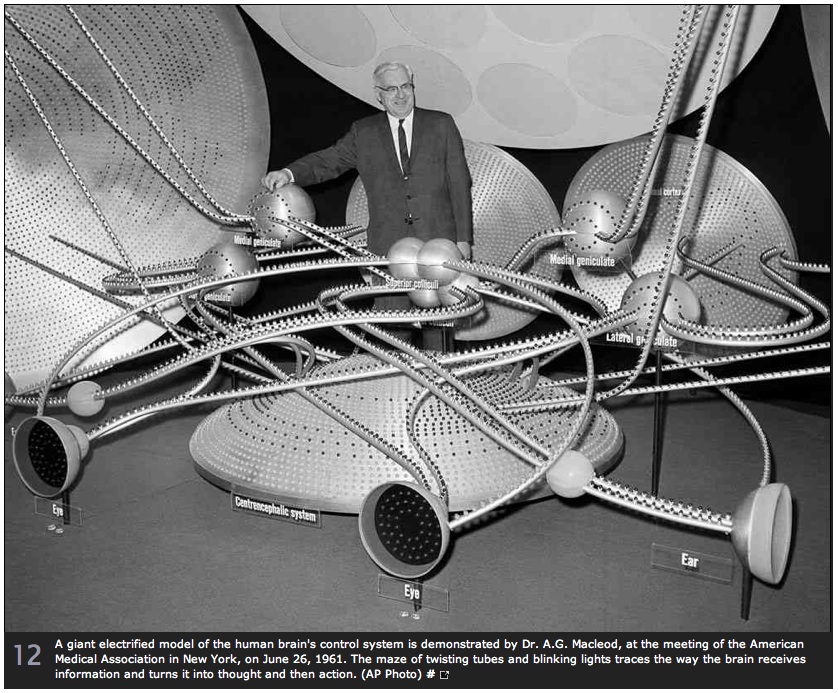
Meet the electric brain. A pinnacle of modern science! This marvel comes complete with a “centrencephalic system”, eyes, ears, medial and lateral geniculate, corpora quadrigemina, and visual cortex.

(click to enlarge)

The text reads:

A giant electrified model of the human brain’s control system is demonstrated by Dr. A.G. Macleod, at the meeting of the American Medical Association in New York, on June 26, 1961. The maze of twisting tubes and blinking lights traces the way the brain receives information and turns it into thought and then action.

It’s a cheap journalistic trick to pull out a single example of hubris from the past at which to laugh and to highlight our own “progress”. But where did the Electric Brain fail? Claims to understanding or modeling the brain have almost certainly been made countless times over the course of human thinking…

Continue reading