One fish, two fish and 400,000 zebrafish

Hundreds of translucent creatures that biomedical researchers rely on for genetic insights settled into new digs today as researchers opened a newly refurbished and expanded animal repository called the European Zebrafish Resource Center. Housed at the Karlsruhe Institute of Technology (KIT) in southwest Germany, the center can maintain 400,000 live fish at maximum capacity in more than 3,000 tanks, and will include lab space for on-site zebrafish in vitro fertilization. Uwe Strähle, a geneticist at KIT, told Nature Medicine by phone after the ribbon-cutting ceremony that European zebrafish researchers eager to preserve their hard-won transgenic and mutant lines may begin submitting eggs to the center. Currently the center houses 300 transgenic lines but Strähle expected the collection to expand to hold thousands of lines in the next five years.
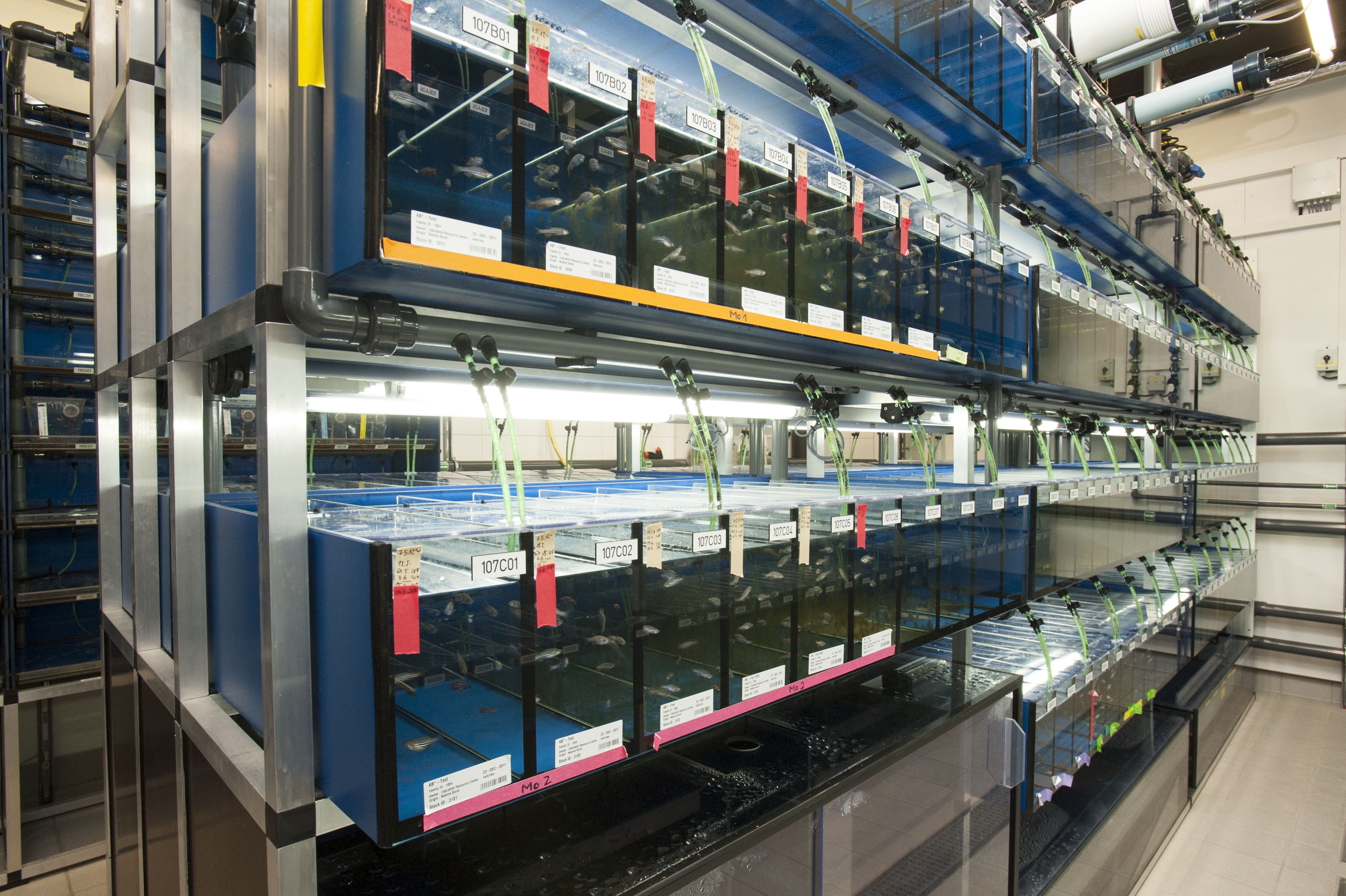
“Some mutant forms of zebrafish cannot be replicated so it is important to preserve those lines for future research,” Strähle explained. And as if capacity wasn’t enough, the center’s equipment might make any zebrafish investigator glassy-eyed with excitement. Located a few floors above the core aquarium room that will hold only frequently requested lines are brand-new PCR machines and freezers capable of storing 80,000 sperm samples in cryopreservation.

But Strähle thinks researchers will benefit most from the center’s screening lab, stocked with—among other neat toys—a single plane illumination microscopy machine that can be used to create 4-D images of the animals, including their traits. He envisions researchers visiting the screening lab to take advantage of the tools available to add or knock out genes and breed zebrafish lines needed for their future research.

In the past, European zebrafish researchers exchanged fish with US labs like the Zebrafish International Resource Center maintained by the University of Oregon, but the costs of sending little fish across the ocean kept going up. Zebrafish research in Europe can now make a big splash on its home turf.

Photo courtesy of Martin Lober, Karlsruhe Institute of Technology


Build a new biosafety lab, but possibly build it smaller, says report

Less than one month after a US National Resource Council (NRC) panel criticized the government for underestimating the risks of a proposed new biosecurity lab, a new ten-person committee issued a second report today advising that construction should go ahead, although possibly on a reduced scale from the original design.

The report comes at the request of the US Department of Homeland Security (DHS), which asked the NRC to weigh the pros and cons of three possible options: build the estimated $1.14 billion  National Bio- and Agro-Defense Facility (NBAF) in Manhattan, Kansas according to the original plans; build a scaled-back version of the facility with a distributed network of smaller affiliated laboratories; or continue using the half-century-old Plum Island Animal Disease Center in New York State.

The NRC committee was not tasked with choosing a best option, but it did come out with strong recommendations. For one thing, it basically nixed the possibility of keeping Plum Island open.

In a news conference this afternoon, committee chair Terry McElwain, director of Washington State University’s animal diagnostic lab in Pullman, described the ageing facility as “very outdated, inefficient,” and even with modifications, it “could not meet maximum level containment standards.”

Yet, even with the recommendation to begin construction on the Kansas facility, the report was mixed on what size and scope the lab should take. “The new lab as planned does meet the nation’s animal research needs, but it has a big drawback: the high cost,” McElwain said.

In this time of fiscal austerity, a scaled-back version of the facility could make a lot of sense, the report noted. And it would still be able to handle most research into emerging pathogens and diseases, although a planned vaccination research program would likely have to be dropped and possibly assigned to another high-level containment lab.

Still, stressed McElwain about the possibility of a smaller NBAF, “I want to make it clear this would not compromise the ability of cutting-edge research.”

Report image courtesy of the National Research Council

23andMe’s face in the crowdsourced health research industry gets bigger

The burgeoning field of do-it-yourself biomedical research got a major endorsement this week when the genetic testing heavyweight 23andMe announced it had bought the community health site CureTogether for an undisclosed sum.

With CureTogether, a social networking site that enables users to conduct their own research studies by sharing and aggregating health information, California-based 23andMe appears to be getting serious about expanding its efforts in the Web-based, participant-driven research arena.

Already, peer-reviewed studies involving 23andMe’s 150,000 customers have yielded novel genetic insights into Parkinson’s diseasehypothyroidism and common traits such as freckling. CureTogether’s infrastructure and user base—which span some 500 medical conditions—should only make such patient-driven research easier.

“There are tremendous opportunities for our members and for future research by integrating the 23andMe and the CureTogether platforms and phenotypic data,” CureTogether cofounder Daniel Reda, who will now serve as 23andMe’s senior product manager, said in a statement.

23andMe will face competition, though. PatientsLikeMeQuantified Self and DIYgenomics are just a few of the community portals that now facilitate crowdsourced biomedical research. “Participatory health initiatives are becoming part of the public health ecosystem,” Melanie Swan, the founder of DIYgenomics, wrote in a study published earlier this year the Journal of Medical Internet Research.

Two years ago, Nature Medicine profiled one such participatory health startup called Genomera (see ‘Personalized investigation’ from our September 2010 issue). At the time, chief executive Greg Biggers was just developing the Palo Alto, California-based company’s platforms. But in the intervening years, Biggers has been busy tweaking the cloud-based software, testifying before the Presidential Commission for the Study of Bioethical Issues about amateurs participating in research and helping academics, as well as lay users, run analyses on his website.

Now, Biggers says his goal of a prospective, longitudinal study that can yield scientifically valid results has almost been achieved. Currently, the site hosts an ongoing study that is examining the effects of whole-fat butter on human cognition. (Biggers declined to share more details from the study on his beta site.)

“Since the first study we helped orchestrate [on vitamin B metabolism], we have proven two important items,” he says. “That participant-driven research is credible and productive, and that Internet study operations bring efficiency and scale to the world of health research.”

That’s a message that still has some skeptics in the ivory towers of most universities, but it doesn’t seem to have escaped 23andMe.

Photo courtesy of  Bruce Rolff via Shutterstock

Vaccine stabilization technique proves as smooth as silk

Vaccines and other biologic drugs quickly degenerate and lose their effectiveness if left out of the fridge for very long, creating a huge problem for healthcare delivery in less developed parts of the world. Fortunately, a new preservation technique could offer longer shelf lives. Reporting today in the Proceedings of the National Academy of Sciences (PNAS), researchers have discovered a silk protein capable of stabilizing heat-sensitive biologics for months at a time at room temperatures or even hotter.

“This work shows the high stability of silk and increases the chances of our ability to stabilize other drugs and bioactive molecules that are sensitive to heat,” says SU Kundu, who studies silk biomaterials at the Indian Institute of Technology in Kharapur and was not involved in the study.

A team led by David Kaplan, a chemical bioengineer at Tufts University in Medford, Massachusetts, purified the silk protein from silkworm cocoons and added the freeze-dried product to a commercial measles, mumps and rubella vaccine. They then exposed the silk-stabilized vaccine to the scorching temperatures common to many parts of the developing world — not to mention the US Northeast this past week — and showed the product retained the majority of its potency up to six months later. “This is the first study to successfully show how silk can be used in a commercially available vaccine,” he says.

According to Randy Lewis, a spider silk researcher at Utah State University in Logan, Utah, the secret to silk’s action as a vaccine preservative lies in its ability to encapsulate the attenuated viruses in the preparation and protect them from heat and moisture. “The silk is physically trapping the virus and preventing it from changing its structure,” he says.

Kaplan says the data are strong enough to merit testing of the silk-stabilized vaccine in the near future. “I would hope to see a clinical trial start within one year,” he says.

Image courtesy of Naypong via Shutterstock

US experts demand compensation for injured trial participants

Before Karen Maschke boarded a plane for Haiti several years ago, she received several routine vaccinations for whooping cough, tetanus and hepatitis B from a local medical school clinic. Maschke, a bioethicist at the Hastings Center in Garrison, New York, who edits the journal IRB: Ethics & Human Research, obtained the shots with the comfort of knowing that if something went wrong she would be eligible for compensation under the US National Vaccine Injury Compensation Program. But she worried about the estimated 2 million Americans participating in clinical trials each year who receive much riskier, experimental treatments. For these people, Maschke notes, anyone “who feels she has been harmed has few recourses.”

Currently, US research sponsors have no obligations to pay for patients’ medical care if they are harmed during a clinical trial (although a handful of organizations have voluntarily agreed to provide free, short term care for injured subjects). Carl Elliott, a bioethicist at the University of Minnesota in Minneapolis, wants such compensation schemes to become mandatory. “There are powerful economic interests in the status quo, and injured research subjects have few advocates,” Elliott told Nature Medicine in an email. “The fact that an injured subject in an exploitative research study can be required to pay for his or her own medical bills is, quite frankly, a disgrace.”

Elliott’s criticisms are just the latest in a long line of attacks on the US’s policy for not compensating injured research subjects. Several government-commissioned panels, beginning with the Tuskegee syphilis panel in 1973, have convened and recommended possible reimbursement protocols. Last year, for example, the US Presidential Commission for the Study of Bioethical Issues released a scathing report of the federal government’s treatment of Guatemalan patients in the 1940s. The report suggested implementing a system modeled after the National Vaccine Injury Compensation Program for all trial participants. To date, however, no actions have been taken.

Continue reading

Let the (medical) games begin: A Q&A with Olympics health director Brian McCloskey

With just three weeks to go before the Olympic flame is officially lit in London, the UK’s Health Protection Agency (HPA) announced this week that it is “Games ready”, with a rapid-response system in place to keep spectators and athletes healthy. Over the course of the 16-day event, the public health body will pinpoint and respond to any emerging health hazards or infectious disease outbreaks that may occur among the 11 million ticketholders and 15,000 athletes expected to descend upon the British capital.

Leading the effort will be the Olympics lead health director Brian McCloskey, who is also the HPA’s regional director for London. A family doctor by training, McCloskey played a major role in the agency’s emergency response to the London tube bombings in 2005 and helped craft the public health preparedness guidelines for the 2004 Olympics in Athens. Ahead of this year’s Summer Games, McCloskey spoke with Nature Medicine about the HPA’s key preparations and overarching public health challenges for the 30th Olympiad.

Which infectious diseases will you be tracking during the Games?

We will monitor all infectious diseases, but the main ones that will likely be an issue for us will be gastrointestinal diseases such as food poisoning and infectious diseases such as measles. There have been measles outbreaks in Europe and in UK in the past couple of years and those haven’t gone away.

Continue reading

NIH working group changes tune, recommends more training grants

Graduate students and post-docs in the biomedical field compete for limited research money from the US National Institutes of Health (NIH) and, after spending years in training, face uncertain career paths. A working group charged with studying these problems presented a report to NIH Director Francis Collins and his advisory committee yesterday—and offered some new solutions.

Back in March, the group said it was considering suggestions to reduce post-doc training grants and shifting the focus to programs that support work outside tenure-track academic research, where jobs are scarce. But it has shifted its tune about the means to achieving this goal. In their final report, they recommend increasing training grants, which require principal investigators to submit detailed research and mentoring plans as part of the application for funding. The NIH’s ‘R01’ research grants, however, make no such requirements.

At yesterday’s meeting, Shirley Tilghman, who co-chaired the working group and is also president of Princeton University in New Jersey, pointed to the current NIH budget crunch as forcing the rethink about its granting schemes. Ultimately, they hope that institutions will use more training and research grant money to support staff scientists, who are experienced researchers with graduate or doctoral degrees. “These trained scientists are sometimes treated like second-class citizens and they are the glue of our labs,” Tilghman told Collins and his advisors.

One way to shorten training time and free up individuals to kick-start their careers is for the NIH to cap funded projects at five years for institutions and six years for individuals, according to the report. It says that a faster track to the workplace would help the 45% of US-trained PhDs who pursue careers outside of academia. The committee also had ideas for helping graduate students get a head start on career development should they want to later leave the ivory tower. They recommended the creation of a program allowing academic institutions to apply for NIH money to develop programs that provide project management, business and entrepreneurial skills for graduate students only. The most successful programs could then be used as models at universities around the country. “What we’ve heard from industry is, ‘We get your graduates [from NIH] and we have to retrain them,’” says Tilghman.

But more than training, the best ideas come from a diverse group and a separate working group on diversity reported yesterday that the biomedical field still measured up short. With all other factors controlled for, African-Americans are still 10% less likely to be awarded NIH grants, said Reed Tuckson, co-chair of the working group and vice president of UnitedHealth Group headquartered in Minneapolis. Among other recommendations, the group suggested adding a chief diversity position to the NIH’s advisory committee to the director and encouraged Collins to use his “social capital” to encourage minorities to join the biomedical workforce. For his part, Collins promised both groups that today’s recommendations, unlike others in the past, would not be relegated to a shelf to collect dust. “A career in biomedicine is one of the most exciting things possible,” Collins told the group. “We want to make the field as attractive as possible for our young people.”


First vein grown from human stem cells successfully transplanted into a young girl

First came bladders. Then pulmonary arteries. Followed by urethras, arteriovenous shunts and tracheas. Now, in another first for the world of tissue-engineered body parts, Swedish surgeons have successfully transplanted a bioengineered vein into a 10-year-old girl suffering from portal vein obstruction.

“This is a very good start for demonstrating what impact regenerative medicine can have on patients by using a biological matrix and seeding it with a patient’s own cells,” says Juliana Blum, cofounder and senior director of business operations at Humacyte, a North Carolina–based company developing bioengineered blood vessels for dialysis patients.

A team led by Suchitra Sumitran-Holgersson at the University of Gothenburg took a 9 centimeter-long snippet of vein from the groin of a deceased donor, stripped it of all cells and then reseeded the resulting hollow tube with stem cells taken from the recipient’s own bone marrow. Two weeks later, the surgeons transplanted the engineered conduit into the young girl. She remained healthy for close to a year, although a second procedure was then needed to lengthen the first graft after the vein started to constrict. Ever since the second transplant, in February of this year, the girl’s energy levels have improved and the blood flow to her kidneys are back to normal.

“The girl is somersaulting now,” says Sumitran-Holgersson, who reported the findings today in The Lancet. “Her parents told me, ‘We have a completely different child.’”

Ordinarily, when adults suffer the same problem as the girl who received the tissue-engineered blood vessel—a condition in which the vein that carries blood from the spleen and intestines to the liver is blocked—surgeons opt to transplant a patient’s own vein from the leg.  But this option is not feasible for young children because of the potential growth problems that can result from grafting in a still maturing body.

Christopher Breuer, a pediatric surgeon at the Yale University School of Medicine in New Haven, Connecticut, says the study represents an important next step for tissue-engineered technology. “This is a new application,” he notes. “This is the first time a bioengineered vein has been used in the portal circulation.”

As researchers try to make these procedures more routine, however, the use of stem cells on bioengineered grafts could face regulatory delays. “Whether real or not, regulatory agencies consider the risk of tumorogenesis or alterations in DNA a serious problem,” says Todd McAllister, cofounder and chief executive of Cytograft Tissue Engineering, a Novato, California company developing tissue-engineered blood vessels for people on dialysis for end-stage kidney disease.

Breuer, for one, is trying to overcome those obstacles. He is leading the first clinical trial in the US testing a tissue-engineered vascular product: a bioengineered blood vessel for children with a congenital heart defect. For more on his approach, see our 2011 news feature, ‘Taking tissue engineering to heart’.

Image courtesy of  Lightspring via Shutterstock

Microfluidic chips offer a SMART-er way to detect flu

Tracking influenza outbreaks quickly and cheaply could get a whole lot easier thanks to a number of experimental devices that can accurately detect viral strains in an hour or so. Using microfluidic techniques, these ‘flu chips’ could lead to better disease surveillance and treatment

“We want to see better tests in the outpatient setting so physicians can get the best information available,” says CDC epidemiologist Dan Jernigan. “Within the last year we a have seen a number of these tests being developed.”

In March, Catherine Klapperich and her colleagues at Boston University described a miniaturized device embedded with tiny tubes that could extract flu RNA from a sample and amplify it using reverse-transcriptase polymerase chain reactions (RT-PCR) with 96% sensitivity. To her knowledge, no other assay previously used one chip for both tasks using a cohort of human samples.

In another first, Anubhav Tripathi and his colleagues at Brown University in Providence, Rhode Island, have developed a technique that relies on a DNA probe that binds and amplifies target viral RNA without relying on RT-PCR — a system the authors call a ‘Simple Method for Amplifying RNA Targets,’ or SMART. Reporting today in the Journal of Molecular Diagnostics, the researchers found that the SMART assay accurately detected flu in the lab, with studies involving clinical specimens underway to confirm the results. “They have done that through creative engineering of the primer and probes, and reengineering the assay development from the beginning,” says Klapperich, who was not involved in the Brown University study.

Importantly, unlike most laboratory-based assays currently approved for influenza testing by the US Centers for Disease Control and Prevention (CDC), these new point-of-care devices can be run under field conditions, thereby reducing the time from isolate sampling to diagnosis that can delay the pace of pandemic monitoring.

Beyond influenza, many groups are working on similar point-of-care diagnostics for a slew of other infectious diseases, too. Click below for a video about a new rapid and affordable way to detect HIV and syphilis in a developing world setting (as reported last year in Nature Medicine).

You are currently viewing a placeholder content from YouTube. To access the actual content, click the button below. Please note that doing so will share data with third-party providers.

More Information

Image courtesy of anyaivanova via Shutterstock

Turning down the heat revs up brown fat

This past winter, vests were a hot button issue thanks to then US presidential hopeful Rick Santorum. But a vest that cools—rather than warms—could fire up studies of brown fat as researchers seek drugs that turn on this calorie-burning tissue.

Compared with white fat, which mostly acts as an energy repository, brown fat serves to generate heat. In the past, researchers believed only babies made use of brown adipose tissue. Now we know adults have small deposits of brown fat throughout the body that burn energy only in chilly environments. With roughly two-thirds of the US classified as overweight, researchers are keen on pinpointing how brown fat is activated and how to convert white fat to its healthier cousin to help people slim down.

In February, Canadian researchers published a study in the Journal of Clinical Investigation that looked beyond brown fat’s heat-producing capabilities to how, once activated, it affects our metabolism. With a sample size of six healthy men, they reduced average skin temperature by about 4 degrees to roughly 30°C by fitting them in a cooling suit. Positron-emission tomography (PET) allowed scientists to see for the first time that cold exposure increased the amount of nonesterified fatty acids (NEFA)—the primary source of energy for tissues in fasting conditions—in the blood stream by one-third. Despite the small sample size, researchers expressed confidence in their results due to consistent measurements across the participants.

But it would be more convenient for overweight individuals to take a drug that causes brown fat to burn calories. A study published this week in the Proceedings of the National Academy of Sciences (PNAS) set out to test a possible drug therapy. Aaron Cypess of the Joslin Diabetes Center in Boston and his team wanted to determine if an ingredient found in over-the-counter decongestant drugs, called ephedrine, might activate brown fat without any cold exposure. A meta-analysis in 2003 had previously suggested that ephedrine may produce modest weight loss in humans. Ephedrine seems to cause weight loss by stimulating a release of the messenger molecule norepinephrine, thereby increasing heart rate. Brown adipose tissue has receptors for norepinephrine, so researchers reasoned the drug would activate this type of fat.

Continue reading