Fermilab names Nigel Lockyer as new director

Nigel Lockyer

Nigel Lockyer{credit}Fermilab{/credit}

Physicist Nigel Lockyer has been appointed the new director of the Fermi National Accelerator Laboratory in Batavia, Illinois. In September he will move from his post as director of TRIUMF, Canada’s national laboratory for particle and nuclear physics in Vancouver, British Columbia. Lockyer spent many years working on Fermilab’s Tevatron, and earned renown for measuring the lifetime of the bottom quark. Under his lead, TRIUMF built new experiments and international agreements, worked to produce better medical isotope supplies and developed a commercialization arm, Advanced Applied Physics Solutions. Nature spoke to him about Fermilab’s future focus on a large neutrino experiment.

Fermilab’s major project, the Tevatron, shut down in 2011. Is the lab past its glory days?

Absolutely not. There’s half a dozen really interesting questions where Fermilab can play a really interesting role. We’re looking to have a flagship programme where we can ‘own the podium’, as they said in Canada during the Olympics.

What will that flagship be?

This is determined by the international landscape. Europe is really focusing on the Large Hadron Collider (LHC). They say if you want to study neutrinos, talk to the United States or Japan. So what Fermilab is pursuing is the Long Baseline Neutrino Experiment (LBNE). I personally find the science there very inviting. One issue is charge parity violation, looking to see if neutrinos are different from antineutrinos. This could broach completely new ground. The second goal is to look at proton decay, which gets into Grand Unified Theory questions. The third thing is people are very interested in detecting neutrinos from supernovae.

What the US government has given a bit of a green light to is a detector on the surface that I would argue is too small.  I’d like to make it twice as big and put it a kilometre underground. The challenge is to work with European and Japanese colleagues to see if we can do that.

The budget for particle physics in the United States is seriously constrained thanks to the financial crunch. How much money do you have to play with? Is it enough?

Nobody has told me how much I have to play with yet, and I’m sure it’s not enough.

You have been described as having “an unapologetic eye for commercial opportunity”, and are renowned for your abilities as a communicator and salesman as well as a physicist. You’re moving from a facility with a strong interest in making isotopes for medical procedures, to one with a far more esoteric goal of understanding the Universe. Will that be a harder sell?

That’s where I started, so I’m just returning to my roots. What you call ‘esoteric’ is really what I enjoy — that’s my favourite. That said, I’m a believer that the public, who pays for what we do, should get more. These labs should always have economic or social impacts. You have to remember we provide both knowledge and training. These students can go out into the world and do great things.

TRIUMF is known for its work on medical isotopes; CERN for the world wide web; and Fermilab for superconducting magnets from which magnetic resonance imaging is derived. I’m going to keep my eyes open for these opportunities. Though in my lifetime, that won’t be the main thrust of Fermilab, which is the only US national lab dedicated to particle physics.

What are the biggest differences between doing particle physics in Canada and in the United States?

In Canada, about 90% of our particle physicists have to go elsewhere to actually do it; the other say 10% work at TRIUMF, SNOLAB or the Perimeter Institute. I don’t know the number for the United States. I’d guess a majority also go overseas now, but at least you’ve got a lot of people at Fermilab actually doing the work.

What is the atmosphere like at Fermilab? Are people excited about future opportunities, or feeling squashed by budget constraints?

I haven’t been yet! The selection committees met off site. I go there this coming Friday. But I guess it’s a mixture of both.

What do you see as your main job as director?

My focus is going to be ensuring that Fermilab has a readily identified flagship experiment, in an area that everyone agrees is important. That means getting involvement from the international community on LBNE.

The other half of my time will be working towards making the Linear Collider happen, whether that’s in the United States or Japan. It will probably be hosted in Japan; there’s a lot of momentum on that. As director I’ll be a leader in the US community, so I need to add my own two cents to where the interesting physics is and where we should put our effort. We have to build a Higgs factory. It has to happen.

The community is meeting in Minneapolis, Minnesota, this August to set an agenda for particle physics. Fermilab will have to see how we can contribute to that, given budget constraints.

How will Fermilab’s neutrino work stand out above the international competition?

Europe has helped: they have decided not to go ahead with a European version of LBNE, which was on the table, from CERN to Finland. And can the Japanese do both a Linear Collider and neutrinos? That’s not clear.

What’s going to happen at TRIUMF after you leave?

An interim director will be found. They should get someone good — the lab’s in great shape.
Canadian accelerator produces a city’s-worth of medical isotopes overnight

{credit}ACSI{/credit}

The looming problem of a global medical isotope shortage is one step closer to a solution. A Canadian team has developed an upgrade that allows hospital cyclotrons to make a much-needed diagnostic tracer, and has proven it can pump out enough overnight to fulfil a city’s needs the next day.

Most of today’s medical-imaging procedures, such as those used to trace cancer or monitor heart function, employ a radioactive element called technetium-99m (99mTc). But this isotope is hard to produce and has a half-life of just 6 hours, making it impossible to store long-term. Global supplies come mostly from two nuclear reactor facilities: one in Canada, and one in the Netherlands. Both are reaching the ends of their useful lives, and isotope production is scheduled to stop in 2016 and 2015, respectively.

The demand for 99mTc will eventually dry up as a more advanced form of scanning, called Positron Emission Tomography (PET), takes over. This uses different isotopes that can already be manufactured by advanced hospital cyclotrons, but it is more expensive and today used for only a small fraction of scans. In the meantime, governments and researchers are keen to create an alternate supply chain for 99mTc , perhaps using the same cyclotrons that will be needed for PET scans.

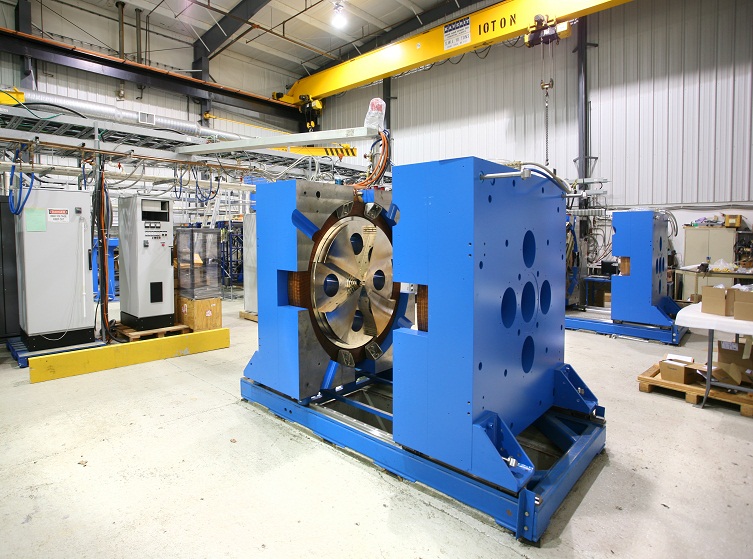
In February 2012, a team based at the TRIUMF particle accelerator near Vancouver demonstrated that they could retrofit hospital cyclotrons, such as the one pictured, to do the job. “It’s basically an after-factory add-on,” says Tim Meyer, spokesperson for TRIUMF. Now they have done further work on the needed metal target, making it strong enough to not melt under the heat of the beam, but porous enough to dissolve rapidly in solution so the 99mTc  can be extracted for use. On 9 June they announced that tests at the BC Cancer Agency in Vancouver show they can make 10 Curies-worth of the isotope overnight: enough to treat at least 250 patients and satisfy the needs of a city like Vancouver.

TRIUMF says the upgrade kit and cost of the targets will be price-competitive with the current supply of 99mTc . They hope to get regulatory approval within a year or two; clinical trials have already been done in Edmonton.

Others are also working on the medical isotope problem. There is a similar project for a cyclotron upgrade kit based at the University of Alberta; the Prairie Isotope Production Enterprise is pursuing using electron accelerators that could do the job; Europe is working on a replacement research reactor; and there is an effort to build a new, centralized facility in Wisconsin that could produce enough 99mTc  for half of the United States. “If it works, it’ll be pretty cool,” says Meyer of the US effort. “We think we’ll be to market faster.”

Seismic fault’s temperature implies deadly earthquake involved low friction

Researchers have come a step closer to understanding how and why the earthquake and tsunami that devastated Japan in 2011 were so surprisingly big. Temperature sensors installed in the fault last year now show that friction between the rocks during the quake was an order of magnitude smaller than previously assumed.

The magnitude-9 Tohoku earthquake shocked the research community by setting a record for the greatest amount of slip ever seen in a fault: some 40–80 metres. No one could explain how or why this happened. In late 2011, a group of researchers mounted a ‘rapid response’ effort to investigate (see ‘Drilling ship to probe Japanese quake zone’).

In the spring of 2012, they managed to install a suite of 55 temperature sensors more than 850 metres into the fault, which itself lies under 6,900 metres of water. Creating an observatory at those depths was in itself a record-breaking achievement. The project faced many challenges: bad weather delayed the installation, shifts in the fault could have crushed the instruments and an earthquake in December could have buried the observatory with landslides. But the team managed to retrieve their sensors on 26 April.

“Amazingly, it seems like the experiment might have actually worked,” says team member Emily Brodsky of the University of California, Santa Cruz. She and a colleague presented their preliminary results at the Japan Geoscience Union Meeting on 19 May.

The temperature measures show how heat dissipated from the fault over time, enabling the researchers to extrapolate back to the moment of the earthquake and to see how much frictional heat was generated during the shift. From this they calculated the coefficient of friction for the fault, and found it to be an order of magnitude lower than the conventional value that has been used since the 1970s. That lower number means less friction.

The result supports the theory that the friction during an earthquake can be dramatically different from the friction during quiet times, perhaps because water in clays is heated by a quake’s shaking, then expands and jacks open the fault. Brodsky says that there are hints that this finding could be generalized to other faults.

The result is consistent with experiments being conducted by Brodsky’s collaborator Kohtaro Ujiie of the University of Tsukuba, who has been trying to recreate the pressure and temperature conditions of this fault in the lab. Both groups hope to publish their results soon.

Quantum computer passes speed test

The world’s only commercially-available quantum computer has faced much controversy about whether it is actually faster or better than a conventional computer. A new independent speed test helps to answer that question.

In short: the D-Wave quantum computer is thousands of times faster than other commercial computers at the very specific problem it was designed to solve. The computer is  about average on other types of problems, and, importantly, it is still not clear whether the speed advantage will scale up as the computer gets bigger. That would be necessary to fulfil one of the big promises of quantum computing: making otherwise-intractable problems solvable.

Catherine McGeoch, a computer-science professor and algorithm-speed tester at Amherst College in Massachusetts, was asked by D-Wave, a quantum-computer company based near Vancouver, Canada, to put the company’s latest quantum computer through its paces. This was not an easy thing to do. The D-Wave device operates differently from other computers, not just because it uses quantum bits that exploit fuzzy quantum behaviour to speed up calculations, but also because it doesn’t use logic gates to perform operations. Instead it does something called ‘annealing’, where an answer is arrived at by looking for the lowest energy state of the bits in the computer chip. “It’s like comparing apples and oranges, or apples and fish,” says McGeoch.

The D-Wave Two computer, which has 512 quantum bits, is designed to tackle classification-type problems that are useful in machine learning and image recognition. Essentially it is good at determining the best ways to sort things into different categories, such as X-ray scans that contain an image of a bomb and ones that don’t.

McGeoch compared a 439-qubit version of D-Wave to a commercial product from IBM designed to solve the same sorts of problems. The IBM product is designed to deliver a confident answer to a given problem after 30 minutes. McGeoch found that D-Wave did just as well at finding the right answers, but in a half-second run time. That’s 3,600 times faster. “It was really amazing,” she says.

On other sorts of problems, the D-Wave computer was slowed down by having to ‘translate’ the question for their quantum chip, using a conventional front-end computer. In these cases it was about the same speed as conventional computers; overall McGeoch gave it an “above average” grade.

This doesn’t necessarily mean that D-Wave is the fastest approach even for the problems it is designed to tackle. Another test, performed by a different group, previously showed that a quantum annealer like D-Wave could be beaten in speed tests by a non-quantum, conventional annealer (see this previous blog post). “That didn’t surprise me. They’re comparing two highly specialized solvers in ideal laboratory conditions,” says McGeoch.

It is unclear whether D-Wave’s speed advantages will stick as the computer gets more qubits: it’s possible that it will keep producing correct answers to larger and larger problems in half a second, while conventional computers take longer and longer to crack them. “Right now it’s hard to say. I have a bunch of data sitting around for me to try and answer that this summer,” says McGeoch.

McGeoch will present her peer-reviewed paper at the International Conference on Computing Machinery in Ischia, Italy, on 15 May.

Further proof for controversial quantum computer

Is the world’s only commercial quantum computer really a quantum device, or a just regular computer in disguise? Controversy has long swirled around the computer produced by D-Wave, a company based near Vancouver, Canada. Now a paper published on the arXiv preprint server takes a step forward in showing that it really does operate on a quantum level.

D-Wave’s computer is a special type of quantum device: its quantum bits (or qubits) seek out a low-energy state that represents the answer to a given problem. Unlike a universal computer, this kind of computer, called an annealer, cannot answer any question thrown at it. Instead, it can only answer ‘discrete optimization’ problems. This is a type of problem where a set of criteria are all fighting to be simultaneously met, and there is one best solution that meets the most of them — one example being the simulation of protein folding, in which the system seeks a state of minimal free energy. The hope is that a quantum annealer should be able to solve these problems much more quickly than a classical one.

The company’s current top-line computer has 512 qubits. In some ways, this is miles ahead of work in universal quantum computers, where academics struggle to get just a handful of qubits to operate usefully. But even D-Wave admits that it doesn’t know exactly how its computer works, and critics have complained that it might not be quantum at all. Instead, it could be using classical physics to crunch calculations.

In 2011, a group led by scientists working with D-Wave published a paper in Nature with evidence that their 8-qubit system was working on a quantum level: it responded to temperature changes as expected for a quantum device. Now, a group of independent scientists follows that up by showing that the 128-qubit version of the D-Wave computer (or at least the 108 functioning qubits in the specific computer that they analysed) also seems to be behaving quantumly.

Simulations of quantum versus classical annealers show that a classical one has a fairly uniform probability of solving a problem correctly; a quantum device should instead have a low probability of success at solving hard problems, and a high probability of success solving easy ones. This is what they see with the D-Wave computer.

Scott Aaronson, a theoretical computer scientist at the Massachusetts Institute of Technology in Cambridge who has historically been sceptical of D-Wave’s claims, says that he is fairly convinced by the data, but that there are plenty of important questions remaining — including whether the current or future versions of the D-Wave computer will actually be any faster than classical machines.

The new paper, Aaronson notes, shows that a quantum annealer is actually expected to be slower than a classical one in many circumstances. “It may be that they really have built a quantum annealing device, which is academically very interesting, but that it provides no [speed] advantage. That may be the case,” says Aaronson.

The paper’s authors include several researchers from the University of Southern California in Los Angeles, which has a deal to use and experiment with the D-Wave computer recently purchased by aerospace company Lockheed Martin. The co-author contacted by this reporter declined to comment on the work until it appears in a peer-reviewed publication. As of March, that group now has a 512-qubit version of the D-Wave to play with, which could start to show a speed advantage over classical annealers.

Canada to investigate muzzling of scientists

Canada’s information commissioner has launched an investigation into the ‘muzzling’ of scientists in seven federal agencies, including the departments of the environment, fisheries and oceans and of natural resources, and the National Research Council of Canada.

The University of Victoria’s Environmental Law Centre  and the non-profit group Democracy Watch filed a complaint in February arguing that government policies restricting federal scientists’ communication with reporters violate Canada’s Access to Information Act. The document, called ‘Muzzling civil servants: a threat to democracy’, says: “the federal government is preventing the media and the Canadian public from speaking to government scientists for news stories — especially when the scientists’ research or point of view runs counter to current Government policies on matters such as environmental protection, oil sands development, and climate change.”

The investigation follows long-running complaints that Canada’s conservative federal government is anti-science. Last summer, scientists staged a mock funeral protest for ‘the death of evidence’, complaining about serious budget cuts and a tendency of the government to sideline scientific evidence when making policy. Just this March, stories emerged of scientists being barred from a freshwater research site in northern Ontario after the federal government decided to abandon ownership of the renowned Experimental Lakes Area facility starting in September.

Complaints of ‘muzzling’ have been ongoing for several years. Federal scientists are required to get approval from public-relations officers before granting interviews; this process can take minutes or days, and has sometimes left journalists without access to timely information. In 2010, an internal investigation of media policies within the department of environment (Environment Canada), disclosed through the Access to Information Act, said: “our scientists are very frustrated with the new process. They feel the intent of the policy is to prevent them from speaking to media”. Kathryn O’Hara, president of the Canadian Science Writers’ Association, complained about these practices in a Nature column in 2010.

A good timeline of the events leading to this investigation is presented in the Vancouver Sun.

And a good analysis of the government’s policies, and whether they deserve to be called anti-science, is in Macleans.

Earthquake triggers tsunami warning in Hawaii

The location of the 7.7 quake{credit}Natural Resources Canada{/credit}

A 7.7 earthquake off the west coast of Canada on Saturday evening triggered a series of tsunami alerts for the Pacific and some coastal evacuations in Hawaii. Although the quake was fairly large — the biggest Canada has seen in some 60 years — it produced waves of only about a metre in Hilo, Hawaii, and less than about 0.3 metres in California and British Columbia.

The quake originated on the Queen Charlotte fault, which lies a few hundred kilometres west of the mainland, and was also responsible for an 8.1 quake in 1949. This fault mostly produces horizontal movement of tectonic plates, rather than the large vertical movements that typically shift ocean waters and generate large tsunamis. But a 2010 Geological Survey of Canada review of the fault suggests that it is capable of producing large waves.

The Pacific Tsunami Warning Center issued a bulletin less than ten minutes after the quake, reassuring that “a widespread destructive tsunami threat does not exist based on historical earthquake and tsunami data”.  Nevertheless, the dangers of more active seas and coastal flooding triggered sirens in Hawaii, where some beaches and ports were closed, and traffic jams were generated as people fled inland.

No major damage was reported from the earthquake. The Queen Charlotte area is not heavily developed or populated.

Smaller quakes have caused larger waves for Hawaii in the past. In 1946, a magnitude-7.1 earthquake from the Aleutian Islands flooded downtown Hilo, killing more than 150 people and causing US$26 million in damages.

Huge phytoplankton bloom found under Arctic ice

{credit}Photo by Sam Laney, Woods Hole Oceanographic Institution{/credit}

Researchers have been shocked to find a record-breaking phytoplankton bloom hidden under Arctic ice. “It’s much bigger [in concentration] than any natural open water bloom in the most productive ecosystems in the world,” says Kevin Arrigo of Stanford University in California. “The growth rates were astonishingly high — these cells were doubling more than once every day.”

“I would have told you a year ago that this couldn’t happen in the Arctic,” says Arrigo. Now, he notes that some 25% of the Arctic Ocean has conditions conducive to such blooms. The finding implies that the Arctic is much more productive than previously thought, and might help to explain why Arctic waters have proven such a good carbon dioxide sink, the researchers say.

As Arctic ice melts earlier in the summer thanks to climate change, these blooms could grow in extent or happen earlier in the year. The implications of that are unknown, but it could be bad news for fish that feed on open-water phytoplankton, or animals that time their summer trips to the Arctic to match what has traditionally been the peak of phytoplankton blooms. “There’s going to be winners and losers,” says Arrigo.

Researchers have long assumed that phytoplankton blooms in the Arctic start in summer, in open waters after the ice melts. In charting this, as part of a mission to help ‘ground-truth’ NASA satellite measures of such blooms, a team of researchers was making measures in the Chukchi Sea as part of the ICESCAPE mission of summer 2011. But when they looked under the thin ice, they were shocked to find a ‘pea soup’ of phytoplankton about 100 km on a side, extending up to 70 metres deep in places, they report today in the journal Science. The natural concentration of phytoplankton there is greater than anywhere else Arrigo is aware of — not including blooms caused by fertilizer runoff in places like the Gulf of Mexico or the Baltic Sea.

In hindsight the finding makes sense. Shallow Arctic waters are known to be rich in nutrients such as nitrogen. And sea ice is known to be getting thinner — in the mid-1980s, about 75% of Arctic spring ice was thick ‘multi-year’, which is often about 3 metres thick; but by 2001 that had plummeted to 45%. Ice that forms and melts in a single year is often just a metre thick. That thinner ice, and the melt ponds that form on top of it in spring, act like a skylight to let light into the waters below, while still blocking out harmful ultraviolet rays. The result is perfect growing conditions for phytoplankton. “If I were a phytoplankton that’s where I would want to grow,” says Arrigo.

The researchers guess that the blooms seen previously in open Arctic waters were not the beginnings of phytoplankton season, as previously thought, but the tail, dying end of it.

All eyes on Venus

Will you be able to see the transit?

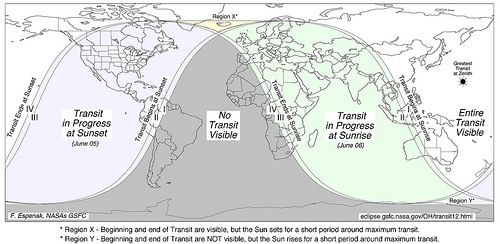
Telescopes around the world — and in space — will be aimed at the Sun today to catch the rare astronomical event of a transit of Venus. Our planetary neighbour crosses in front of the Sun (from the viewpoint of Earth, that is) only twice every 120 years or so.  The last time this happened was in 2004; it won’t happen again until 2117.

This has professional and amateur astronomers alike jumping up and down with excitement, getting out their welding goggles and pinhole cameras to watch the event from their back yards. For tips on when and how you might be able to spot the transit, see TransitofVenus.org.

If you are trapped beneath clouds or in a part of the world that won’t be able to see it, there are live webcam streams being hosted by NASA starting at about 2:45 p.m. Pacific time (5:45 Eastern time), and by the Slooh telescope network, with ‘pre-game’ commentary starting at 2:30 p.m. Pacific time (5:30 p.m. Eastern time). The entire transit will take about seven hours.

Although much of the excitement around this transit is aimed at public-outreach efforts aiming to get the public interested in astronomy, there is also some real science to be done. Astronomer and transit enthusiast Jay Pasachoff of Williams College in Williamstown, Massachusetts, wrote in Nature a few weeks ago about the science goals. These include trying to ‘ground truth’ detections of exoplanets circling far-off stars, and getting a once-in-a-lifetime measure of the climate of Venus. Although there’s a probe in orbit around Venus, this gets a very limited view of the planet’s climate: it can basically see the atmosphere in only one spot at a time, making it impossible to know whether the changes it sees are due to changes in space or changes in time. A simultaneous measure of the climate along an entire pole-to-pole line is measurable only today.

Check back here for updates.

UPDATE 1 (4:30pm Pacific time)

Venus approaches the Sun from on the upper left hand side{credit}NASA SDO{/credit}

As predicted, Venus started its path across the Sun at around 3 p.m. Pacific time. Some fantastic photos have been released already, including this spectacular one from the space-bound Solar Dynamic Observatory (SDO) of Venus approaching the Sun.

SDO’s observations are going to be used to calibrate a couple of instruments on the observatory, including confirming where exactly the ‘north pole’ of the Sun lies in its view, and measuring the ‘point spread function’ of its telescope — how much light leaks from one pixel into others around it. SDO should also be able to take its own measure of how much oxygen is in Venus’s atmosphere.

The weather is looking perfect for observations from Hawaii — one of the best spots for viewing this transit and the source of NASA’s main webcast.

UPDATE 2: 6 June

Hawaii didn’t just have clear skies for the transit — it had the perfect conditions, known as ‘coronal skies’. “I held my thumb up to block out the Sun, in the traditional test carried out by solar astronomers, and the sky was the same blue right up to the edge of my finger.  That shows how low the scattering in the sky was,” says Pasachoff. It was, however, very windy, he adds, so they took short exposures to lock in details before pictures were blurred by motion, and they will have a lot of post-processing to do.

A photo snapped from the International Space Station{credit}Don Pettit / NASA{/credit}

Positive reports of good measurements have already come in from Arizona, Udaipur, Japan and, for the last half of the transit, from Australia.  The site in the Marquesas in the South Seas had instrument problems, says Pasachoff. He has had no report yet from New Mexico, where astronomers were using a new carbon dioxide filter to study Venus’s atmosphere.

Perhaps one of the most novel observations comes from the International Space Station, where astronaut Don Pettit snapped a photo of the transit from the window (see picture).

The Hubble space telescope, which, like our own eyes was too sensitive to be pointed directly at the Sun, was aiming to gather information about Venus from the sunlight reflected from Tycho crater on the Moon. Likewise, the European Space Agency’s Very Large Telescope in Chile was aimed at the Moon to catch these reflections. There are no reports from either as yet. David Ehrenreich of French National Centre for Scientific Research in Grenoble says that they will get the Hubble data by the end of the week, though analysis will take months.

All in all, “we had a wonderful day, even better than expected or hoped for,” says Pasachoff. “At this point, it is not possible to say if anything surprising turned up.”

“We are exhausted after spending almost seven hours outside, but we feel great, and we can’t wait to look at our observations in detail.”

Star science-education researcher leaves the White House

Carl Wieman served with the Office of Science and Technology Policy from 2010-2012{credit}OSTP{/credit}

Nobel Prize-winning physicist Carl Wieman, who has been a leading light in the Obama administration’s push to improve science education, is leaving his post as associate director for science at the White House Office of Science and Technology Policy (OSTP). Wieman is stepping down on 2 June for “personal reasons”, confirmed OSTP communications director Rick Weiss in an e-mail to Nature today.

Wieman, who won his Nobel in 2001 for the creation of the first Bose–Einstein condensate, made a dramatic career shift to a quantitative study of undergraduate education methods soon after receiving his prize. He spearheaded the Carl Wieman Science Education Initiative at the University of British Columbia (UBC) in Vancouver in 2007, while maintaining a position at the University of Colorado at Boulder in another teaching initiative. He went on leave from both posts on taking up his position with OSTP in 2010; it is unclear whether he plans to return to them now. “His future plans are uncertain at this time,” says Weiss. A UBC website lists Wieman as being on leave until July 2012.

Wieman has made waves with his scientifically rigorous approach to assessing what university students ought to be learning and how they would best learn it. He has been an outspoken advocate for participatory technologies in the classroom, such as ‘clickers’ that let students answer multiple-choice questions and reveal their answers to the teacher on the fly (see this UBC page about clickers). He has tackled many conventional beliefs about ‘good’ teaching, showing that even the most dynamic teachers with the smallest classes fail to get students to retain information using traditional lectures (see ‘Improved learning in a large-enrollment physics class‘). Many of his views are discussed on his blog.