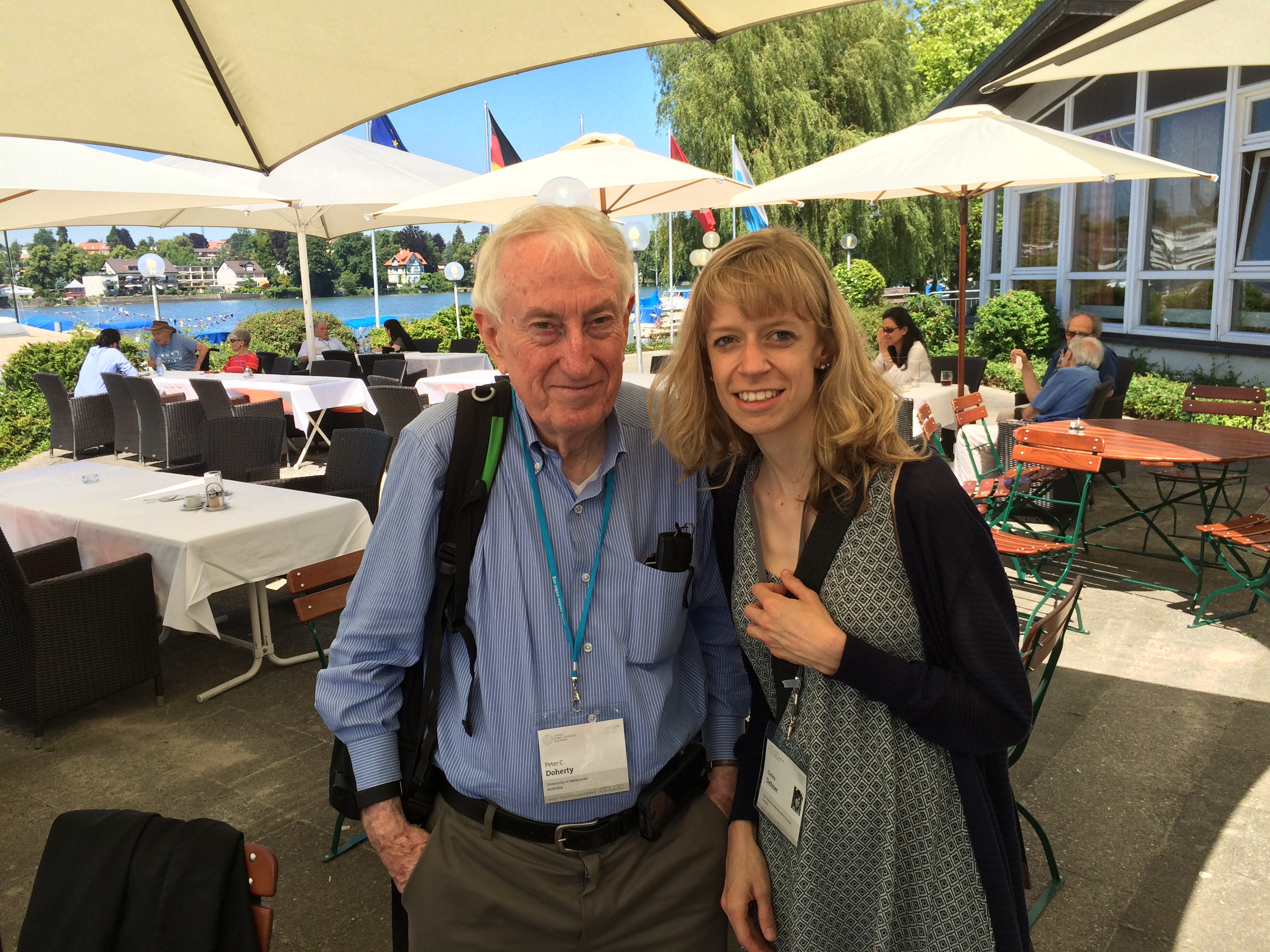
Carina Dehner shares what she learnt at the 2015 Lindau Nobel meeting from Professor Peter Doherty, winner of the Medicine or Physiology Nobel in 1996.
Guest contributor Carina Dehner
Peter Doherty and Carina Dehner{credit}Image credit Carina Dehner{/credit}
The Nobel Prize is a highly coveted and uniformly respected accolade. Receiving this honor opens almost every single door in the world; seemingly every country will welcome you with open arms. For example, the American immigration system will immediately provide you with a green card–. Furthermore, it conveys life-long prestige which many use to influence policy.
But, what is so special about these laureates? What happened in their lives and education that primed them for their seminal achievements? At the 2015 Lindau Nobel meeting I had the opportunity to interact with Professor Peter C. Doherty, winner of the 1996 Medicine or Physiology Nobel for his research on the immune system. He and Rolf Zinkernagl discovered how the immune system recognizes cells infected by a virus, deepening the understanding of how the immune system distinguishes self from foreign molecules. I was interested in his work as it closely relates to my own research on autoimmune diseases. What I was most excited about, however, was what I could learn from someone who has reached what many consider to be the pinnacle of a scientific career.
Nonlinear paths
Doherty began in Australia as a veterinary doctor, then switched to pathology, where he made his novel findings in immunology research. This meandering path is not unique to Doherty – many scientists often switch research fields, following research questions they find interesting. This type of career path is worth considering because it might stop you from developing tunnel vision and be open for other aspects.
Mentors
Today young scientists are advised to seek a mentor, but it struck me as interesting that Doherty’s never had one. Although he did mention annual meetings with a supervisor in pathology, he never gleaned constructive feedback that helped guide and formulate his thinking. He often left meetings with a simple “good idea” and nothing more. But this obviously did not discourage him.
He doesn’t believe mentors are the be-all-and-end-all. Many senior scientists are extremely busy, and might not be able to focus much attention on your needs as a young researcher. Instead, he suggests speaking to those who are just one or two steps ahead of you in your chosen career path to find out what they’ve experienced. Not only that, but if you want the best learning experience, “it helps to have a mentor who will continue to be enthusiastic about you after you’ve left “the fold”.
Yet he does his best to help his current students. Now, Doherty spends more time away from the bench, reviewing his staff’s papers and working with them to improve their communication skills. “Being able to express him- or herself is one of the most important things in a scientist,” he says.
Science communication
As part of my experience at Lindau, I was given the opportunity to present my research in Doherty’s master class on immunology research. I learned how difficult it can be to convey one’s research to an audience, particularly those not in your field. In asking essential word definitions and mechanisms in immunology – addressed to the audience, he made it obvious how important it is to make one’s own work understandable for any audience. Instead of skipping the details he recommended focusing on the message of the project.
Doherty enjoys communicating ideas that are important to him and encourages young scientists to express their opinions, thoughts and most importantly their work to others. One way he recommends is by submitting written articles to publications like The Conversation. “[It] is a great option for spreading your work – it’s openly accessible and it saves you from wrong journalism – you yourself can set your point of view there,” he says. He believes that the problem lies with well-qualified science journalists losing their jobs, “and the fact that media organizations push a particular (and at times toxic) line.”
So instead he suggests scientists reach out to the public themselves. “The lack of awareness of science and how it works is dangerous, especially when ignorance is a license to deny realities that may be dangerous to us,” he says. “We need everyone to speak up, and younger people are more likely to be adept in the ‘new media’.”
His advice on how to learn to do this is to just get writing. “If you can find someone who is good and will read your stuff, listen to what they tell you,” he says. He had a short list of tips that would be useful for any scientists, whatever their career stage:
Less is more. You don’t have to cover everything. Instead, focus on getting a key message across.
Tell a story, whatever format you use.
Avoid jargon where you can.
Don’t reproduce anything you don’t understand. “If you read an impressive argument or statement that you don’t understand, don’t reproduce it. The originator probably doesn’t understand it either!”
The end goal
When reflecting on the Nobel itself, Doherty believes that “this prize is much more recognition than what you deserve – suddenly things come up you never thought about before.” But there are also advantages of a prize like this. He now has the ability to provide yearly financial support for the training of young scientists, which brings him much joy.