Science communication: How to get a job

Start writing and presenting in your spare time whilst in academia, say panelists at the 2015 London Naturejobs Career Expo.

Developing extra skills in your spare time will help demonstrate your passion for science communication in an interview.

You are currently viewing a placeholder content from YouTube. To access the actual content, click the button below. Please note that doing so will share data with third-party providers.

More Information

Top tips:

  1. Look for opportunities within departments/universities to present your work. this is a safe environment in which you can trial out different techniques, whether for academic conferences or a chat down the pub.
  2. Look for, or start, other forums where you can explain your science to a lay audience. One of the most challenging things is explaining science to consumers. Speak to friends and family about your research and see if you can get them to understand what you do.
  3. Reflect on how to improve your communication; ask for feedback from the people you speak to.
  4. Joining writing groups to develop your writing skills. Having an external, objective input on your writing will help improve it.
  5. Ask your supervisor if they have any writing projects that they need help with, whether it’s writing a book chapter or website copy.
  6. Join a learned society and write for their blogs. They also have public engagement teams that are always looking for volunteers to help at events
  7. Build a network of people from within the science communication field that you can turn to.
  8. Although you might feel that you have no time to do any of the above, if you have a passion for it, you’ll make time. One way to manage your time is to use those brief moments of freedom in a productive way. When an experiment is running, read your favourite popular science books, write a blog, pursue an interview.

Further reading:

Science communication: Whose responsibility is it?

Science communication: Sculpting your role

Science communication: How to deal with misrepresented science in the media
Science communication: Do you need a PhD?

Science communication: Making the transition

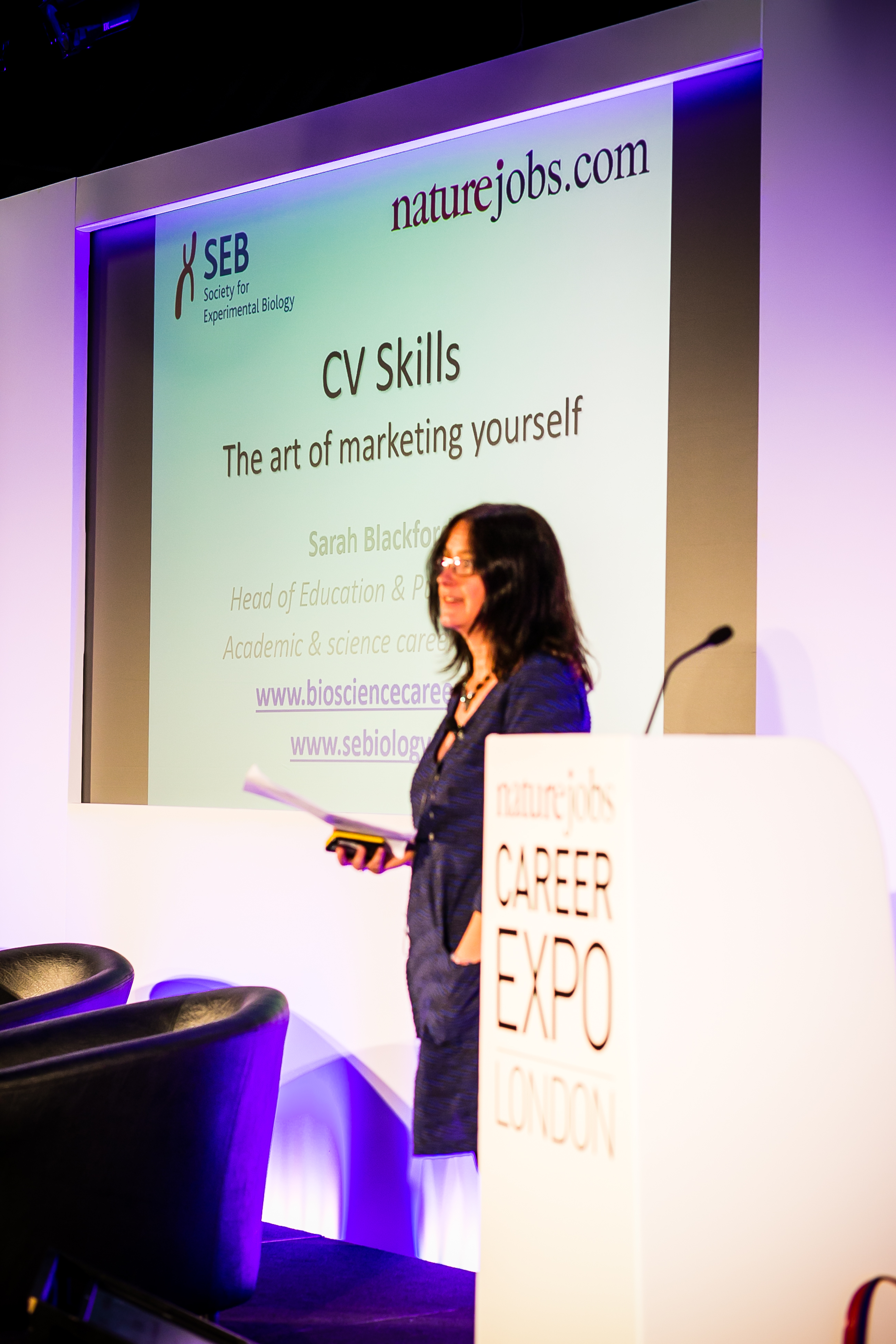
CV skills with Sarah Blackford

Simon Hazelwood-Smith reports on Sarah Blackford’s Top Tips for a job winning CV at the 2014 Naturejobs Career Expo in London.

Contributor Simon Hazelwood-Smith

Sarah-blackford-CV-NaturejobsWhat is the purpose of a curriculum vitae, or CV? One obvious answer that it is a document that helps a job applicant to get through the initial candidate-selection process and into an interview. But how do you make sure that your CV gives you the highest chance of selection by an employer? And should you change your CV when applying for different types of science-related positions?

Answering these and other questions in the final talk of the day at Naturejobs Career Expo on 19 September in London, UK, was Sarah Blackford, a careers adviser at the Society for Experimental Biology in the UK. With 15 years of experience in scientific-careers advice, Blackford is an indubitable expert in the field. She says that you can employ some simple and straightforward tactics to improve your CV.

Almost all employers look for evidence in a CV of certain candidate attributes. Communication skills are essential for effective teamwork, and enthusiasm and a good attitude are important for showing that you would easily fit in to the organization where you are applying.

Applicants must be careful to target their CV to the job advert. An excellent way to do this is to go through job adverts and highlight the skills that the employer is seeking. But it is not enough to just state that you have the skills and attributes listed in the job description. Your CV should provide evidence that your skills match the position’s requirements. Continue reading

How to identify and leverage experiential opportunities to bolster your credentials

Jim Gould, a Naturejobs Expert, answers the question: How do I identify and leverage experiential opportunities to bolster my credentials?

Contributor Jim Gould

No matter what you ultimately do in your career, you have to gain and master many skills not directly related to your scientific training. However, if you are focused and efficient, there are ways to build your professional credentials with relevant experiences. Once I had decided that one day run a postdoc office, I realized I would need more experience in four areas: leadership, teaching and service, programme management and writing. I was determined to systematically gain these experiences and take time to reflect on past achievements.

This blog post, for example, is a calculated move. I combined my expertise and experience with my interest for online writing to ask the editor if there was anything I could contribute to Naturejobs Blog.

Through trial and error I developed a process that allowed me to identify and leverage many of the experiences that helped land my current job and position me well for the future. Based on these personal experiences, I want to share a practical approach to identifying and leveraging your own experiential opportunities to bolster your credentials. Continue reading

How to make the most of transferable skills

iStockphoto/Thinkstock

Transferable skills are perhaps the job-seekers biggest asset. They can certainly help you get a job – making your CV stand out and impressing an interviewer – and can also help you to succeed in pretty much any new undertaking. The problem is, much of the time transferable skills remain elusive – we know we must have some, but we often aren’t really sure what they look like and so can’t recognise them when we need to.

On top of which, it’s easy not to think about transferrable skills until it’s time to apply for a job, which can sometimes be too late.

Instead, it’s important to think about the kinds of transferable skills you have, and how they might be useful for any future career aspirations whilst still working away in your current role, or as a student.

 Spotting transferrable skills

Some transferrable skills may be obvious – scientists are especially good at problem solving and analysis, for instance. But there are other skills, often known as ‘soft skills’, which form part of your work or home life activities that might not come to mind immediately, but could be usefully applied in a different role or context.

“The 2011 Careers in Research Online Survey results reveal that university researchers are engaged in a wide range of activities beyond pure research,” Anna Price, Researcher Development Advisor at Kings College London, told the Naturejobs Career Expo last month. These activities include presentations at conferences, teaching, organising events such as a conference or workshop, and organizational and project management skills. What you do outside of work can also count. “You might be on the Parent-Teacher Association, or running a book club. These can be really useful when applying for jobs that require skills that aren’t part of your key role,” Price said. Continue reading