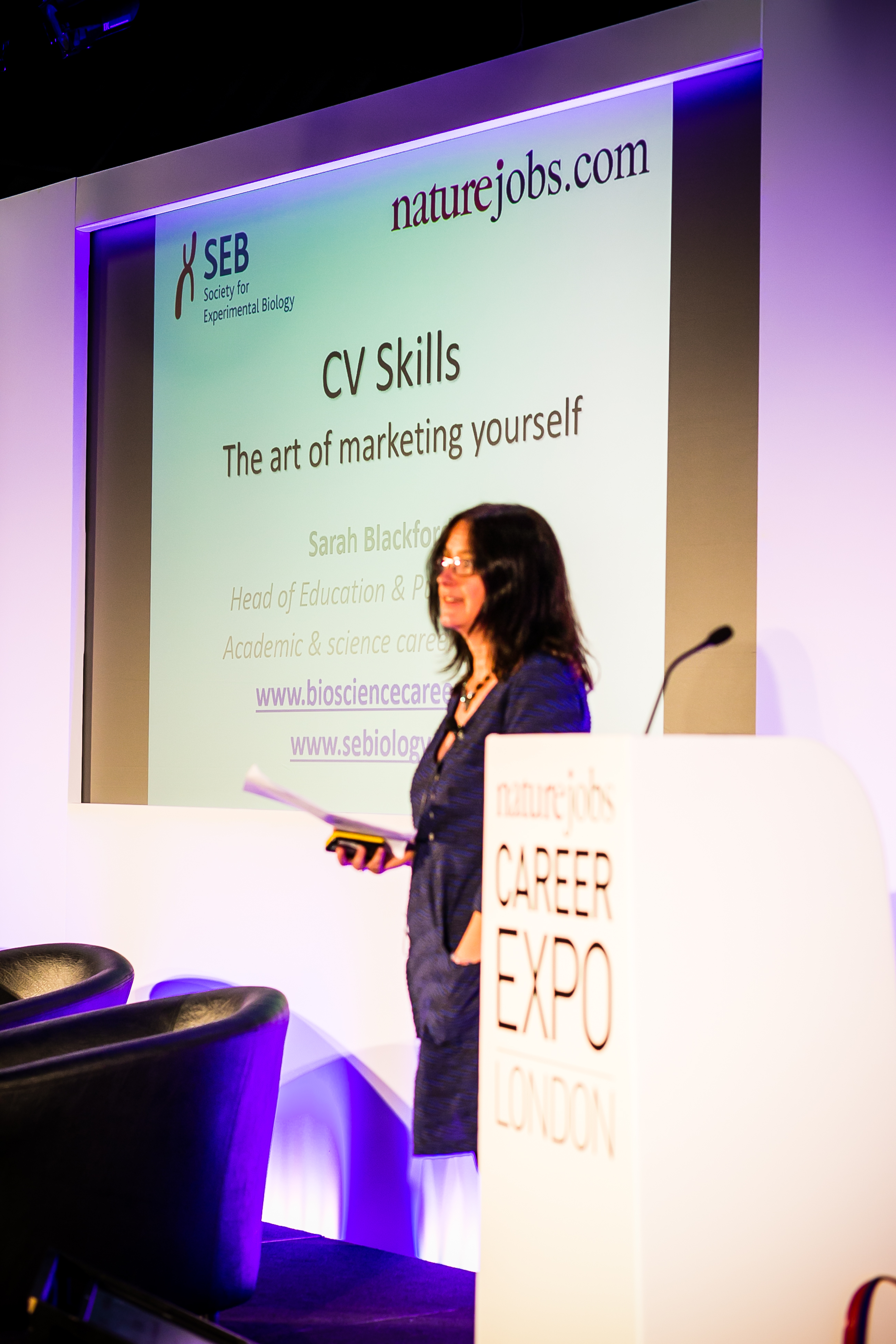
This new series on the Naturejobs blog, called Ask the expert, is an opportunity for you, our readers, to chose what questions our experts answer. We’re still easing them in slowly, so this time they’ll still be given some questions.

{credit}Image courtesy: Sarah Blackford{/credit}
Meet our expert for this month: Sarah Blackford, Head of Education & Public Affairs at the Society for Experimental Biology.
What is your scientific background?
My scientific background is way back in the past, when I worked for three years at York University investigating calcium uptake in plants. Practical lab work was not for me; my specialities were more aligned with presenting data, designing posters, negotiating for equipment from other research groups and organising departmental socials. My communication and creative skills led me on to a 5-year career in scientific publishing as assistant editor at the Journal of Experimental Botany.
Why did you decide to take on the role you have now?
Whist working as assistant editor, I was based at Southampton University, where I took the opportunity to spend some of my spare time volunteering at the Careers Service. I enjoyed helping students and researching employers and careers information. When my job relocated to Lancaster University, I was offered a post as a Careers Adviser there and, subsequently, at Leeds University. After three years, I returned to Lancaster to set up the Society for Experimental Biology’s Education & Public Affairs office. My current role involves doing a variety of tasks such as science communication, management and supporting the career development of early career researchers and PhD students.
How do you want to help scientists in their careers?
I have had over 10 years’ experience in my role as academic and science career specialist, and have formalised this with a master’s in career education and guidance (Warwick University), as well as publishing a book entitled Career planning for research bioscientists. Therefore, I hope to be able to offer a breadth of support for scientists, encompassing most aspects of their career development and management, from personal and professional through to practical and transitional.
Tell us something interesting about yourself.
Working for the Society for Experimental Biology means I’m not restricted to supporting researchers in only one institution, so mobility is a big part of my work. This year I’ve delivered workshops and one-to-one career guidance in 20 different institutions and at three international conferences in 8 countries. Being a tea lover, I always take time out to try out one or two local cafés and tea shops when I’m in town. So far, top of my list are Gottingen, Germany and Portland, Oregon!
Sarah’s got such a vast experience in bioscience careers, so here are some bioscience questions for her. Vote in the poll to decide which one she will answer in November!
You are currently viewing a placeholder content from Default. To access the actual content, click the button below. Please note that doing so will share data with third-party providers.
More Information