Films on environment and wildlife have come a long way in India in the last decade. Celluloid seems to be quite a medium of choice to take the message across. The film making format has also seen a change with many film makers changing over to new ways of storytelling.
However, documentary films screened at environment and wildlife film festivals, viewed by select audiences most of whom are already aware of the issues, do not somehow seem to go beyond that mandate. Yes, the challenges to cross over to the other side, the mainstream, and be seen by the masses are many — no one goes to a movie theatre to be preached, they go there for entertainment.
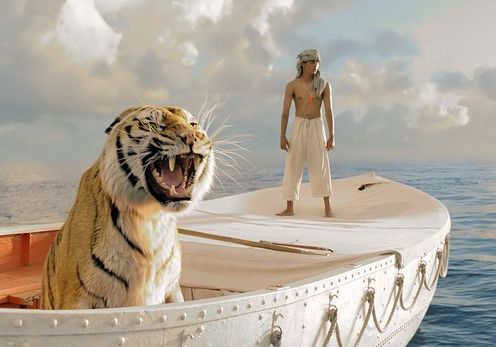
Is there a middle path for environment & wildlife film makers? A still from 'Life of Pi'.{credit}Life of Pi movie/Flickr{/credit}
At the other end of the spectrum are big budget movies such as ‘Life of Pi’, which every middle class and upper class household in India worth its salt went to check out last weekend. The movie taught children a thing or two about animal behaviour and survival strategies (though many could scientifically challenge some of the films contents, specially the dream-like carnivorous island). Agreed that it takes one Ang Lee and truckloads of money to make such movies but the take home message here is the art of storytelling.
Is their a way of telling a story, beyond the documentary mode, that could perhaps make a movie much more ‘mainstream’? Why don’t more environment and wildlife film makers use innovative ways of telling stories? That, in no way, is intended to belittle the classic documentary format, which will forever continue to charm the more intellectually-oriented — the classes, as cinema lingo labels them. As for the masses, these festivals will perhaps need to reinvent themselves in form and tenor for people to sit up and take note.
The organisers of environment and wildlife film festivals seem to realise this and are struggling hard to reach their message across to more people every year.
One of the biggest film festivals in this genre in India — the multi-city traveling festival CMS Vatavaran that began in 2002 — boasted of 300 entries from 27 countries last year. It is still travelling this year with the theme ‘biodiversity conservation’ and is scheduled to screen films in the West Bengal capital Kolkata next week (December 3-8, 2012). Their theme was a good fit for Hyderabad’s COP-11 to the Convention on Biological Diversity, where they hosted the ‘International Biodiversity Film Festival’ with more than 50 Indian and international films on biodiversity issues.
The organisers say,”Ideals are abstract, but they are necessary, too. They can be transformed into a felt experience, but can get only as febrile as the passion that pushes it. The questions that provoked us a decade ago remain.”
Being screened in New Delhi next week is ‘Quotes from the Earth‘ (December 6-7, 2012), an environment film festival organised by advocacy group Toxics Link and India International Centre, Delhi. It will have about 25 films from across the world, some of which are currently on show at the more mainstream film event ‘International Film Festival of India (IFFI 2012) in Goa (November 20-30, 2012).
That brings us to films with overt or covert environment/wildlife themes being screened at the more talked about and attended IFFI, 2012. Of these films, just about a couple adopt the documentary-style story telling technique. While the Greek film ‘Boy eating Bird’s Food’ is the story of a boy and a canary bird with insights into the bird’s life, the Hebrew-Russian ‘Igor and the Crane’s Journey’ is the story of a father and son tracing the journey of migratory birds from Russia to Africa. English film ‘Salmon Fishing in the Yemen’ is a visionary sheikh’s passion for a peaceful pastime of salmon fishing and the ‘Last dogs of Winter’ tells the story of wild bears peacefully sharing a barren strip of coastal land with a large number of chained dogs during polar bear season in Manitoba, Canada. ‘Fogo’, featuring a small community in the Fogo island that is forced to leave as the tundras take over their habitats and ‘More than Honey’, a personal perspective of a beekeeper’s grandson in Switzerland, are a couple of others to mention.
Adopting the documentary style are Elemental (by Gayatri Roshan and Emmanuel Voughan-Lee) which narrates the journey of three people connected by their deep bond with nature and driven to confront some of the most pressing ecological challenges of our times, the Vidarbha farmer suicides story ‘Cotton for my Shroud’, and the self explanatory ‘Himachal’s Avian Paradise: Pong Dam Wildlife Sanctuary’ and ‘Mangroves: Guardian of the Coast’.
‘Tiger Dynasty’, a popular film in wildlife film circuit by director-producer-cinematographer S. Nallamuthu shows the life of a young tigress taken from her home in Ranthambore National Park and released in Sariska with the hope that she will raise a new dynasty there. The film maker has been filming the tigress ever since she was a cub and he reveals what challenges such displaced animals feel in their new environments. ‘Char: the No Man’s Land’, is an account of environment refugees from India and Bangladesh.
Girish Kasaravalli’s national award winning film from 2002 ‘Dweepa’ is also a refreshing entry — it deals with the issues of building dams and displacement of natives — with some master storytelling and camera.
I’m sure the issue has been debated in umpteen panel discussions, perhaps in these very film festivals, but it would be good to know what film makers in this genre think about marrying entertainment with hard-core information-packed story telling techniques? Is there a middle path for environment and wildlife messages? Infotainment, without dumbing down the message? What are the cult movies in this genre, according to you?