Big ‘O’ Studies

This is a guest post in our #NPGsfn11 blog series and posted on behalf of Gary Stix and is cross-posted at Scientific American’s Observations blog.

The pop psychology section of Barnes & Noble is filled with self-help books that dutifully explain how the brain is the body’s primary erogenous zone. Now researchers have spliced together a series of fMRI images to make a movie that shows the extent to which that clichéd adage rings true. A video, shown on an iPad this afternoon in a poster session at SfN 2011, indicates that more activity exists in the brains of women during “self-stimulation” to orgasm (this is a family blog so we’ll stick with geek speak) than anything short of an epileptic seizure. Barry Komisaruk, a Rutgers University psychology professor marvels “It seems to activate all of the major brain systems, which we didn’t know before. I don’t know of any other behavioral process that is so powerful.”

orgasm image.jpg

A still from the “Brain Symphony” movie, courtesy of Dr.Barry Komisaruk.

The movie, labeled by the researchers in Komisaruk’s laboratory as a “brain symphony” and presented to the press in a book called “hot topics,” shows the buildup to orgasm and the subsequent ebbing of activity during a five-minute period. A series of colored lines—each of which represents a two-second “snapshot”—descend down the screen, evolving from dark red (lowest activity) to (white, highest level) as a woman’s brain progresses toward the Big O. Each line is subdivided into 80 columns that represent the left, midline and right regions. (The poster presentation includes scans of six women, though only one was used for the movie.)
Continue reading →

New Neurons Create Confusion, Intrigue

This is a guest post in our #NPGsfn11 blog series and posted on behalf of Jason Snyder. This is cross-posted at Functional Neurogenesis.

Science, and therefore the SFN meeting where much science is unveiled, can be a cycle of confusion and clarification. Currently, confusion may be prevailing in the adult hippocampal neurogenesis field, since new neurons have been implicated in everything mammals do – spatial and nonspatial memory, anxiety, depression, addiction, social behavior, stress regulation, blinking, etc. This should not be entirely surprising since the hippocampus itself, where these young neurons reside, has many different functions. But how can we reconcile these seemingly disparate functions?

Every time I get worked up about all these neurogenesis findings, I think about two words: Septal and Temporal. These words return me to a state of inner peace, calmness and….mental turmoil, since now all of my experiments will have to be performed twice. Neurogenesis aside, the septal and temporal ends of the hippocampus are connected to different brain structures that cause the septal hippocampus to be more involved in spatial processing/cognition and the temporal hippocampus to be more involved in regulating stress and emotion. Which has the potential to explain everything.

Continue reading →

Where Do Your Fears Lie?

This is a guest post in our #NPGsfn11 blog series and posted on behalf of Tara LeGates.

It is something we have all experienced and the memories it produces are some of the strongest and longest-lasting we know. Fear is evolutionarily-conserved and significantly influences behavior in response to danger. However, chronic fear, or fear elicited by non-threatening cues, is maladaptive and the hallmark of several disorders such as anxiety, phobias, and posttramatic stress disorder. Knowledge of the circuitry underlying fear will hopefully assist in the understanding and treatment of these types of disorders.

Andreas Lüthi presented some of his eloquent work dissecting this circuitry in a Special Lecture entitled: Defining the Neuronal Circuitry of Fear. This was a fantastic talk that I’m afraid may be difficult to fully capture in a blog post.

Lüthi’s group used auditory fear conditioning to elicit fear behavior in mice. This is a form of classical conditioning where an auditory stimulus (tone) is paired with footshock, which will elicit fear behavior (freezing). Eventually, providing the tone alone will elicit this fear response. If the tone is continuously presenting with no shock, the fear behavior can be extinguished, considered a separate learning experience. Think about it this way: Let’s say your boss jingles his or her keys. Normally, that’s not very threatening right? Well, now s/he comes into the lab, jingling those keys and yelling indiscriminately. Perhaps this becomes a regular occurrence. Eventually, just the sound of those keys, as s/he approaches the lab, will have you running for the cold room for cover. Classical conditioning.

Continue reading →

Flexible Brains Are Habit-Forming

This is a guest post in our #NPGsfn11 blog series and posted on behalf of Björn Brembs.

“Like riding a bike” is what we say when we want to convey how some skills are never forgotten. In this way, skills are like habits: they stick and are hard, if not impossible, to shake. Therefore, it may not be surprising that one of the models used in neuroscience research to mimic the process of skill learning is habit formation. Animals (mostly rats or mice) are trained in a specific task until it becomes so automated or stereotyped that the behavior becomes difficult to change. It is precisely because of this automation and lack of behavioral control that habit formation is also an important paradigm when modeling drug addiction. Drug addicts are thought to have developed a drug-taking habit that has become so automatic and rigid that they cannot help but execute it (especially when faced with drug-associated cues). Thus, skills and habits are motor memories that can last a lifetime.

Habit formation in animal models is usually induced by over-training them. For instance, in one poster from the first session of this year’s Society for Neuroscience conference, Smith and Graybiel trained rats in a T-Maze: following a given auditory cue, the animals had to go either left or right for a reward. Before a habit is formed, i.e., in the early phase of the experiment, the behavior is still flexible (termed ‘goal-directed.’) This is tested by devaluing the reward the animals receive for choosing the correct arm of the T-maze. For instance, if turning right after tone A is rewarded with water and turning left after tone B is rewarded with food, animals are more likely to make more mistakes when the ‘water cue’ is given, if they were sated with water immediately before testing in the maze. Presumably, this is because the animals were tested when they were no longer thirsty and had less incentive to follow the devalued ‘water cue.’ This goal-directed behavior is abolished by habit formation: over-training the animals will not lead to any reduction in response to the water cue, even if the animal had previously been sated. The behavior has become stereotyped, automatic, insensitive to devaluation.

Continue reading →

SfN Is My Nerd Disneyland

This is a guest post in our #NPGsfn11 blog series and posted on behalf of Bradley Voytek.

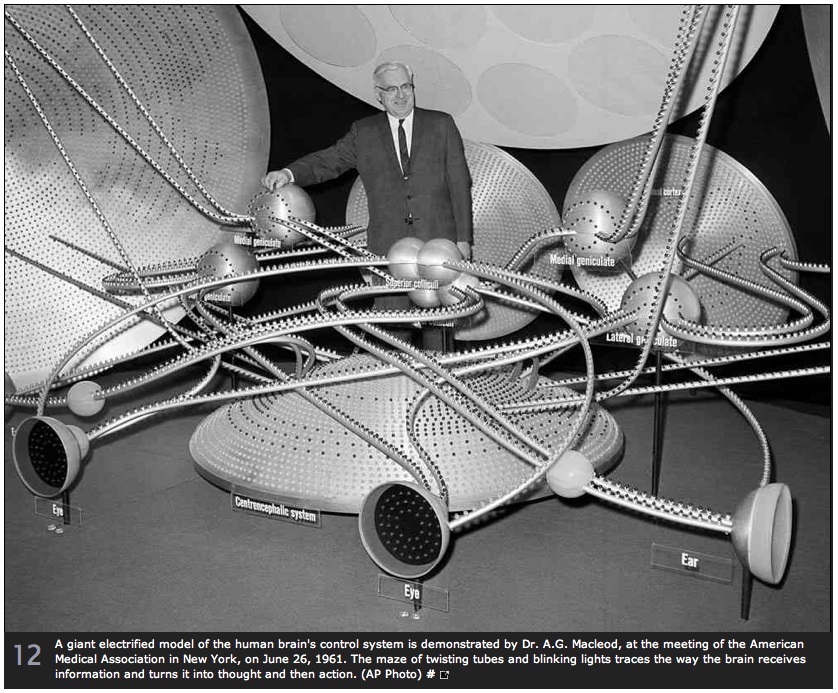
Meet the electric brain. A pinnacle of modern science! This marvel comes complete with a “centrencephalic system”, eyes, ears, medial and lateral geniculate, corpora quadrigemina, and visual cortex.

(click to enlarge)

The text reads:

A giant electrified model of the human brain’s control system is demonstrated by Dr. A.G. Macleod, at the meeting of the American Medical Association in New York, on June 26, 1961. The maze of twisting tubes and blinking lights traces the way the brain receives information and turns it into thought and then action.

It’s a cheap journalistic trick to pull out a single example of hubris from the past at which to laugh and to highlight our own “progress”. But where did the Electric Brain fail? Claims to understanding or modeling the brain have almost certainly been made countless times over the course of human thinking…

Continue reading →

The business of universities

Universities are strange two-headed beasts: they are places where much of the research we publish is conducted, but they are also educational institutes, whose job is to train students (not all of whom go on to become scientists, or necessarily contribute to the research side of the enterprise). Added to the mix now is that many universities are now effectively businesses, having to provide their own operating revenues in the face of tighter funding.

In the UK, there is increasing grumbling that this is Not A Good Thing, with many university staff members warning that some of the tactics involved in raising these revenues will dilute the value of the degrees that are being doled out.

Continue reading →

NN Joins Neuroscience Peer Review Consortium

When the community is overburdened by peer review, it’s everybody’s problem. As of today, Nature Neuroscience has become part of the solution by joining the Neuroscience Peer Review Consortium, a flexible system that allows voluntary participation by authors, referees and editors. Here are more details, from our April editorial:

Continue reading →

Job opening at the journal…

If anyone has happened to check the “About the Editors” section on our webpage, you may have noticed that I am in the midst of my second stint at the journal. I worked here back in 2001 in between completing a master’s degree in the UK and a PhD at MIT, and then returned this year while I looked into postdoc options. I will be leaving at the end of January to start a postdoc in Andrew Oxenham’s lab at the University of Minnesota, and so the journal is looking for someone to take my place.

I would encourage anyone considering alternatives to the standard academic career in science to think about applying. I have enjoyed my time here tremendously and highly recommend the position.

I get asked all the time what it’s like to be an editor. The primary duties involve reading and evaluating manuscripts. Over 70% of submitted papers are rejected without review, and reading the submissions and then making those calls is one of the main responsibilities. Once a decision is made to send a paper out for review, you have to choose appropriate reviewers, and once the reviews are in, you have to come to a decision on what to do with the paper. Other responsibilities include commissioning and editing News and Views pieces and review articles, writing press releases, and attending scientific meetings. So there is not that much editing in the traditional sense of the word, although it is a component of the job. The job mostly involves thinking critically about science.

I really enjoy the work, so much so that I came back to work for the journal a second time. One of my favorite aspects of the job is that you get to be very broad, reading papers from quite a large expanse of the field. It’s quite different from scientific research, where typically we focus on very particular problems for long periods of time. You stay up to date on the entire field and continually learn new things. It’s also very different from research in that the rewards are more immediate. Every decision you make has tangible short-term consequences, and matters to a lot of people. Because the editorial decisions are so important to the people involved, and to the community at large, it’s easy to get excited about the day to day activities on the job. You are also constantly exposed to cutting edge work, sometimes being the first to hear about it. And you spend a lot of time talking with scientists, so you stay close to the research world even though you are not doing primary research.

The main official requirement is a PhD in neuroscience. My background is in the higher end of the field, but someone with molecular or cellular training would be equally welcome.

If you think you might be interested, you should submit a CV and cover letter to admin@natureny.com, and cc the editor in chief, Sandra Aamodt, at s.aamodt@natureny.com. If you have any questions about what is involved feel free to email me as well.

Tuesday thoughts

Today was the fourth day of SFN 2006, and I find myself seriously frustrated with the setup of the meeting this year – there seems to have been little to no thought put into where to schedule the various concurrent sessions. Usually there are multiple slide sessions each morning or afternoon that are of interest. The natural thing to do is to skip back and forth between sessions to catch the most interesting talks, but here in Atlanta this is all but impossible given the distance separating even closely related sessions. The Atlanta convention center consists of three connected buildings, each of which has multiple levels connected with escalators. It takes a good 10 minutes to walk from Building B to Building C, and yet sessions that are fairly similar in focus are routinely allocated to different buildings. On Sunday the session on objects and faces (mostly fMRI of the ventral pathway) was in B and one on extrastriate visual cortex was in C, as was a session on attention. No doubt most of the people interested in one of these sessions would have been interested in the others, and yet it was all but impossible to go back and forth. This has happened to me every day thusfar. Many of the scientists here have expressed a similar frustration. The problem would be easy to remedy – someone just needs to put related sessions in nearby rooms. The room assignments, as far as I can tell, are totally random, which has detracted from the meeting.

This afternoon featured a well attended talk on the current funding woes, given by the heads of the various agencies of the NIH (the NIH director was supposed to give it, but his flight was delayed). The talk focused on explaining why we are currently experiencing a funding crunch in the US, and attempted to highlight what the NIH folks say are widespread misconceptions about NIH funding. The increased competition for funds has apparently been mostly driven by an increase in grant applications (rather than a funneling of resources to more clinically oriented research), fuled in part by a boom investments in the biomedical sciences by universities. New facilities have brought with them new jobs, and there are now many more people applying for grants. NIH funding doubled between 1998 and 2002, but has leveled off since then, so supply has not kept pace with demand. Tom Insel stressed that they are still committed to basic research; apparently the proportion of directly translational research they fund has not increased. He did not address the issue that most of the scientists I know are interested in – whether basic research grants need to explain how the research might ultimately benefit human health in some way. There was a Q&A session at the end that I had to skip out on, so perhaps someone queried him about this. They did offer some encouragement, citing previous periods when funding dried up and funding rates were as low as 10%, and explaining how grants that are ending now will free up uncommitted funds for new grants. They also concluded by stating the need to better explain the importance of the NIH to the public (apparently only 10% even know what the NIH is).

Redesigning scientific publishing

The most striking news for me at the®evolution in Scientific Publishing session yesterday was that fewer than 100 people showed up, even though prominent posters advertising the discussion greeted all attendees on their way into the meeting. I guess neuroscience journal editors are going to have to figure out how to navigate the brave new world of scientific publishing without much help from readers.

For those of you who haven’t been following the debate, there are a couple of linked hot-button issues that publishers have been dealing with over the last few years. One is whether journal content should be available to anyone (open access) or only to subscribers or site license users. Another is how journals should make the transition from print to web publication, which includes the question of who’s going to pay for our work once journals move away from print subscriptions as a major revenue source. (If you doubt that journal editors add value by publishing your work, ask yourself why you don’t just post a description of the experiment on your own website and skip all that pesky peer review hassle.) Like the rest of us, the editors of the Journal of Neuroscience are trying to figure out how to keep the community happy and the journal sustainable at the same time, and this session was their attempt to bring society members into the conversation.

The panel included people from the American Physical Society, the librarian organization SPARC, Science magazine, Highwire Press, Elsevier and PNAS. We heard some cautionary tales – when PNAS tried making their content freely available after one month in 2000, they had an 11% drop in subscriptions, and when the APS tried asking high-energy physicists to pay for publication in the early 1990s, many of them stopped submitting their work to the journal. But there were also some success stories, including several journals at which authors or third parties can pay to make articles free online at publication. At PNAS, about 20% of authors take this option. Donald Kennedy of Science emphasized that his journal is available to virtually all scientists through site licenses, though Andrew Watson, who edits the open-access Journal of Vision, challenged that view in the question period, calling the discussion “too nice”. He had a point: I’m not sure that someone unfamiliar with the debate would have been able to determine which panelists disagreed with each other on what issues.