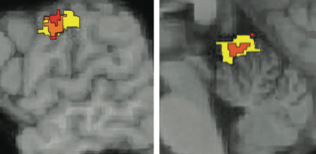
From Ramsden et al. addendum
The (highly abbreviated) life story of a paper appearing in Nature often goes something like this: ideas are birthed and experiments envisioned. Pilot experiments are run, yielding beautiful preliminary data. Replication and controls are then gathered over the course of months, if not years of hard labor. The paper is written, submitted, and reviewed. A few (two is typical) rounds of review and revision later, it is published (with highly variable degrees of reviewer and editorial unanimity). But this is by no means the end, rather, just a milestone in the evaluation process by the community. In journals, post-publication evaluation has traditionally occurred in the form of peer-reviewed follow-up papers or formal commentary. This may change someday as alternative forms of scientific publishing are explored, but for today we’ll talk about a formal addendum we’re publishing on a 2011 paper by Cathy Price and colleagues and invite you to add to the discussion.