
Over the coming month, the Nature Press Office will be reading and reviewing the books shortlisted for the 2014 Royal Society Winton Prize for Science Books, cramming in a book or two a week until the winner is announced on the 10th November 2014.
An initial look at a strong shortlist suggests that the competition for a recently-increased prize of £25,000 will be fierce. There’s a lot here with relevance to our everyday lives, with a vibrant exploration of the man-made materials around us and a moving personal account of experiences with cancer and the vast research world connected to it. Along the way there’s a huge helping of humour in the form of riotously entertaining science writer Mary Roach, who takes us on a trip down the gut in disgusting and glorious detail. However, the real hero of this shortlist seems to be history, with a celebration and exploration of the role of science in our past. Personally I can’t wait to get stuck into the beautiful prose of Phil Ball, pulling apart the ethical struggles and individual stories of scientists in Hitler’s Third Reich. Added to this, and completing the shortlist, are erudite accounts of the development and controversy around the theory of general relativity and the myriad of ways that seven key elements have changed, and continue to change, our lives.
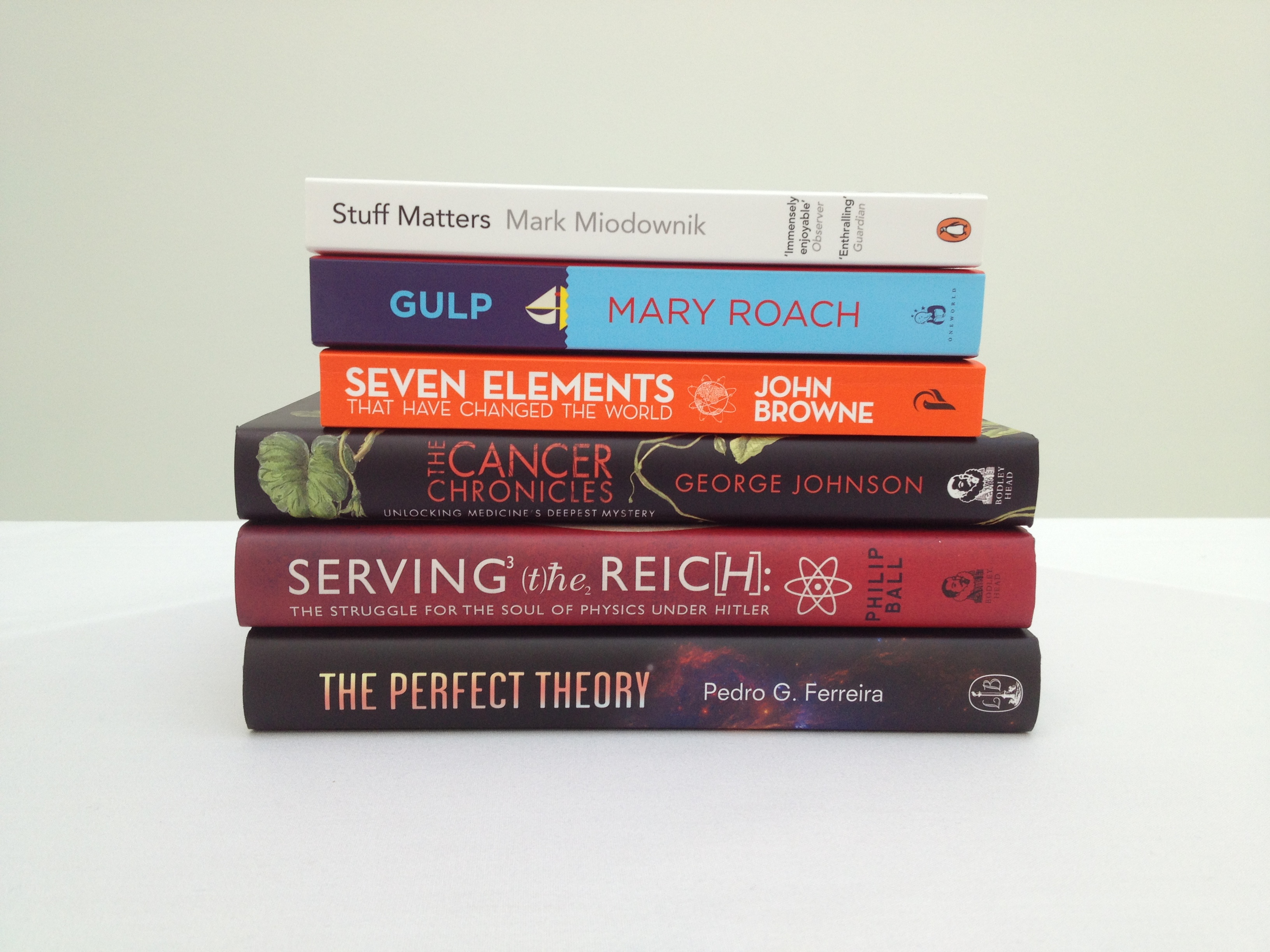
The complete shortlist comprises:
- Serving the Reich: The Struggle for the Soul of Physics under Hitler by Philip Ball (read the original Nature review here)
- Seven Elements That Have Changed the World: Iron, Carbon, Gold, Silver, Uranium, Titanium, Silicon by John Browne
- The Perfect Theory: A Century of Geniuses and the Battle over General Relativity by Pedro G. Ferreira (read the original Nature review here)
- The Cancer Chronicles: Unlocking Medicine’s Deepest Mystery by George Johnson
- Stuff Matters: The Strange Stories of the Marvellous Materials that Shape Our Man-made World by Mark Miodownik (read the original Nature review here)
- Gulp: Adventures on the Alimentary Canal by Mary Roach (read the original Nature review here)
All in all, it’s going to be a busy few weeks for the Nature Press Office, as we continue to promote the breadth of the research published by Nature Publishing Group whilst racing through the shortlist. Senior Press Officer Bex Walton kicks off the proceedings with a review of Stuff Matters: The Strange Stories of the Marvellous Materials that Shape Our Man-made World by Mark Miodownik.
 Alice Henchley has been Head of Press at Nature since the start of 2013. Prior to that, she worked at the Royal Society and the Zoological Society of London, communicating everything from population policy to conservation of the world’s most extraordinary animals.