Imaging exodus: a thermographic lens on refugees

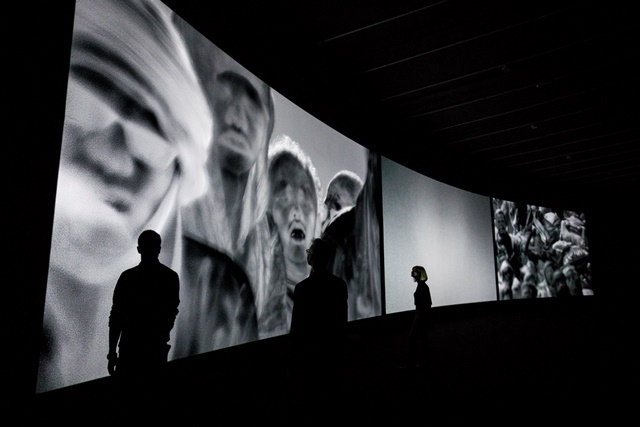
Incoming: installation view, by Richard Mosse in collaboration with Trevor Tweeten and Ben Frost, at The Curve, Barbican Centre, London.

Incoming: installation view, by Richard Mosse in collaboration with Trevor Tweeten and Ben Frost, at The Curve, Barbican Centre, London.{credit}Photo by Tristan Fewings/Getty images{/credit}

Posted on behalf of Philip Parker

Like war photography, images of the refugee crisis can elicit a disorienting mix of empathy and disbelief. Photographer Nilüfer Demir’s 2015 image of lifeless toddler Alan Kurdi, face down on a Turkish beach, is a case in point. Now film installation Incoming at London’s Barbican, by Irish photographer Richard Mosse, offers an original, unsettling perspective on the crisis.

To escape some of the tropes of documentary photography, Mosse has experimented with non-standard processes such as 16-millimetre infrared film, which colourises in pinks and purples. For Incoming, he used a ‘camera’ classified as a weapon — a military-grade device created by a drone and missile designer that uses thermographic technology to detect people at 30 kilometres. Controlled by the International Traffic in Arms Regulations, it was designed for use in ballistics targeting and surveillance. For the show (which finishes on 23 April, moving to Melbourne, Australia, in the autumn), the images of refugees on journeys from the Middle East to Europe are displayed across a triptych of three 8-metre-wide curving screens. Mosse has repurposed a technology of war for ostensibly humanitarian ends.
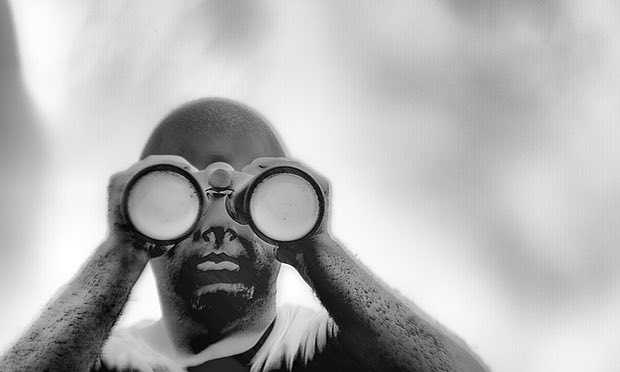
Still frame from Incoming, 2015–2016. Three-screen video installation by Richard Mosse in collaboration with Trevor Tweeten and Ben Frost.

Still frame from Incoming, 2015–2016. Three-screen video installation by Richard Mosse in collaboration with Trevor Tweeten and Ben Frost.{credit}Courtesy of the artist, Jack Shainman Gallery, New York and carlier|gebauer, Berlin.{/credit}

The device — capable of resolving fine detail in darkness and through fog and smoke — was ideal for capturing subjects in difficult conditions. It uses middle-wavelength infrared, with optics specially created from the rare earth germanium, and sensors made from cadmium telluride to detect heat contours. Mosse and his cinematographer had to devise a rig to carry the 23-kilogram camera, plus steadicam and computer.

They spent two years filming the routes trekked by refugees – from Syria, Iraq and Afghanistan across the Aegean, through North Africa into Europe, and inside camps in Greece and Germany. The 50-minute Incoming captures the gritty realities: a rescue at sea; a lorry lumbering, overloaded with human cargo. But the imaging renders these scenes uncanny. The people are negatives, variations in skin colour evened out and noses and lips whitened; every fold in their clothes is etched, but they are rendered in shades of grey. A man appears to be washing his face in oil (water appears black). A fire in a camp billows like grey liquid. One beautifully composed scene picks out kites being flown in front of a bare mountain range, but as the imaging gives no sense of scale, the black darts resemble a fleet of stealth bombers. Mosse has slowed the footage to less than half its usual 60 frames a second, giving it a balletic aesthetic at odds with the raw subject matter.
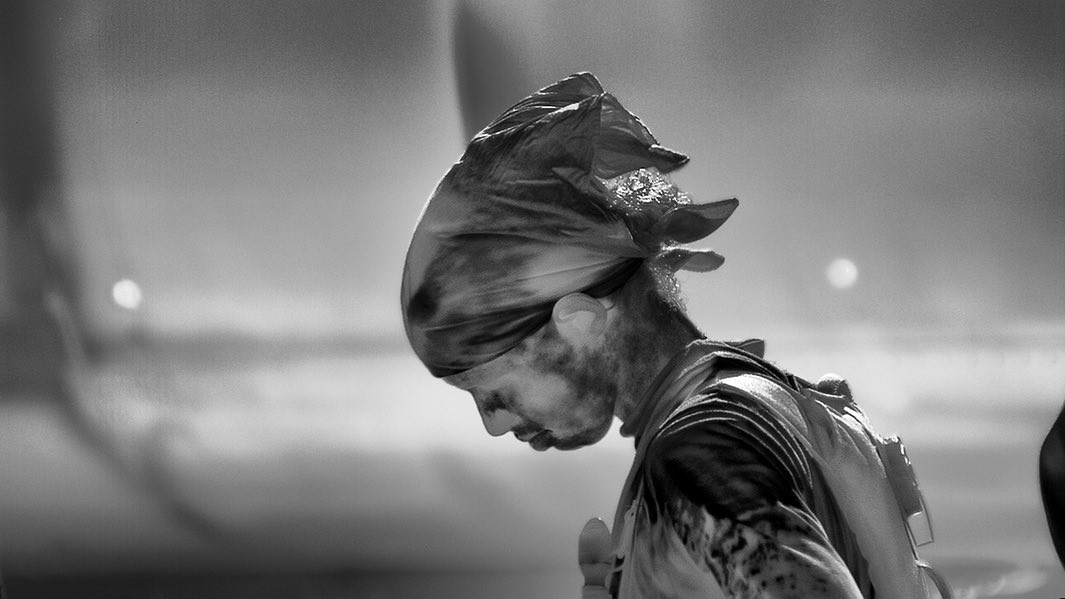
Still frame from Incoming, 2015–2016. Three-screen video installation by Richard Mosse in collaboration with Trevor Tweeten and Ben Frost.

Still frame from Incoming, 2015–2016. Three-screen video installation by Richard Mosse in collaboration with Trevor Tweeten and Ben Frost.{credit}Courtesy of the artist, Jack Shainman Gallery, New York and carlier|gebauer, Berlin.{/credit}

Mosse often lingers over his subjects — we spend a long time staring at hairs on the arm of a distant policeman. In more intimate scenes, the detail serves to distort. Ultra-closeups of the postmortem of a child who drowned at sea is clinical and disturbingly unemotional, even with the high-pitched wail of a saw carving a bone sample for DNA identification. Each person’s eyes are black apertures, any sense of the individual erased.

Mosse shot almost every scene without his subjects’ knowledge. In a British Journal of Photography article on Incoming, he was quoted as saying that this allowed authenticity and “portraiture of extraordinary tenderness”. In my view, the technology renders real people with real grief and hopes into an anonymous mass – of the other, the migrant, the stateless. For soldiers, this distancing is undoubtedly an advantage; as a viewer, I became alienated.
Richard Mosse in collaboration with Trevor Tweeten and Ben Frost, The Curve, Barbican Centre.

Richard Mosse in collaboration with Trevor Tweeten and Ben Frost,
The Curve, Barbican Centre.{credit}Photo by Tristan Fewings/Getty images{/credit}

The United Nations estimates that over 65 million people are displaced globally, more than at any time since the Second World War. With climate change and political instability ongoing, that figure looks likely to increase. In an accompanying book, Mosse claims that he wished to reconcile the camera’s capacities with the “harsh, disparate, unpredictable and frequently tragic narratives of migration and displacement”. But we know the name of Alan Kurdi, the subject of Demir’s unforgettable photograph; the unnamed, monochrome hordes in Mosse’s film ultimately become abstractions. For all the thermal imaging, Incoming left me cold.

Philip Parker trained as a scientist, worked in publishing and with campaigning organisations. He is currently Stamp Strategy Manager for Royal Mail. He tweets at @parkerpj01.

Incoming is at The Curve Gallery at the Barbican, London, until 23 April, and will travel to Melbourne, Australia, in autumn 2017. It is co-commissioned by the Barbican and the National Gallery of Victoria in Melbourne.


For Nature’s full coverage of science in culture, visit www.nature.com/news/booksandarts.
Fibonacci’s real mathematical legacy

Posted on behalf of Davide Castelvecchi

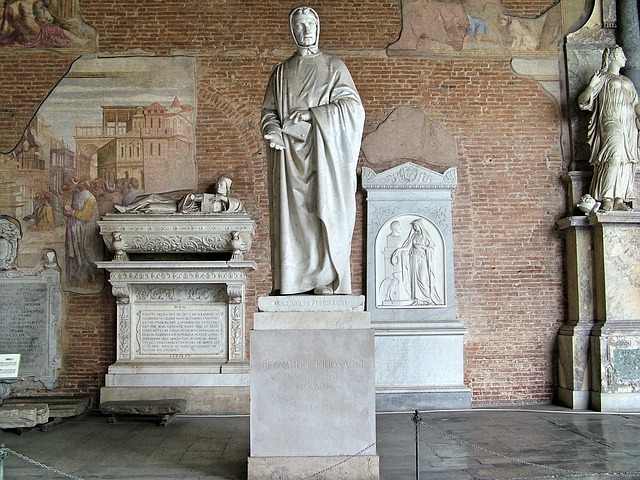
Statue of Leonardo Pisano (Fibonacci) in Pisa.

Monument of Leonardo Pisano (Fibonacci) by Giovanni Paganucci (1863) in the Camposanto di Pisa.{credit}Hans-Peter Postel, Wikimedia Commons{/credit}

For hundreds of years until the ebb of the Italian Renaissance, one name was synonymous with arithmetic. This was Leonardo — not the polymath from Vinci, but Leonardo Pisano (ca. 1170-1250), now popularly known as Fibonacci.

Yet we know little of Fibonacci’s life beyond the nickname and his Pisan roots: most details come from a 160-word autobiographical sketch written in 1202. He is often assumed to have discovered the so-called ‘Fibonacci sequence’, which starts with zero and 1 and is thereafter the sum of the two previous numbers (so 1, 2, 3, 5 and so on). The sequence shows up with astonishing frequency in natural spiral structures such as shells and plant tendrils.

Fibonacci did not, however, discover the sequence – it was recorded in Sanskrit at least as far back as 200 BC. Nor does the sequence explain anything about artistic beauty via the so-called ‘golden section’, as Keith Devlin reminds us in his new book Finding Fibonacci. The Pisan’s greatest legacy was to help Europe dump the ancient system of Roman numerals and switch to Hindu-Arabic numbers from 1 to 9 and, perhaps most importantly, 0, which Fibonacci called zephirum after the Arabic ṣifr. (Finding Fibonacci repeats some of Devlin’s arguments in his 2011 The Man of Numbers, and indeed is in large part a meta-narrative exploring the making of that earlier book.)

A page of Fibonacci's Liber Abaci from the Biblioteca Nazionale di Firenze showing (in box on right) the Fibonacci sequence with the position in the sequence labeled in Roman numerals and the value in Hindu-Arabic numerals.

A page of Fibonacci’s Liber Abaci from the Biblioteca Nazionale di Firenze showing (in box on right) the Fibonacci sequence with the position in the sequence labeled in Roman numerals and the value in Hindu-Arabic numerals.{credit}National Library of Florence, Wikimedia Commons.{/credit}

During Fibonacci’s lifetime, much of Italy was part of the Holy Roman Empire, yet many Italian cities were in practice independent city-states. Pisa, Genoa, Amalfi and Venice had been gaining prominence as maritime powers, establishing trade routes across the Mediterranean. As commerce boomed, Italian merchants needed to keep track of finances efficiently. Roman numerals made multiplication and division extremely cumbersome (try dividing MXCI by LIII); they were no match for the 10-digit positional system invented by the Hindus some time before 700 AD and common in the Arab world. And compared to using, say, an abacus, calculations in Hindu-Arabic numbers also allowed an “audit trail”, as Devlin points out: “An individual sitting in Pisa controlling a network of traders needed to be able to review the financial books on a regular basis.”

To fill that need, in 1202 Fibonacci (the son of a notary working for Pisan traders) published Liber Abaci, a compendium of Hindu-Arabic arithmetic and its practical applications to trade. The 600-page book introduces the numerals and explains how to use them for basic calculations. Like every good maths textbook, it also features many practical problems, such as how to convert currencies (Italy alone had 28 at the time, Devlin notes), or puzzles such as this:

It is proposed that 7 rolls of pepper are worth 4 bezants and 9
pounds of saffron are worth 11 bezants, and it is sought how
much saffron will be had for 23 rolls of pepper.

Such problems may seem trivial to someone trained in modern elementary-school algebra, but the symbolic notation for equations with x’s and y’s had not yet been invented at the time, so all solutions had to be spelled out in words. As mathematician John Hannah wrote in his 2011 review of The Man of Numbers,“It is awe-inspiring to see how far medieval mathematicians could progress using such primitive tools.”

Liber Abaci was published in Latin, as was the norm for learned texts. But soon, ‘popular arithmetic’ books in local vernacular, many citing Fibonacci as their source, began to appear. These ‘abacus books’ became standard in schools; at least 600 were written over the next few centuries. Through these texts Italy, and later Europe, learned to do maths.

In Finding Fibonacci Devlin tells us (22 times) that Liber Abaci “changed the world”, comparing the medieval mathematician to tech giant Steve Jobs. He even contends that the book made Western science and technology possible. But although Liber Abaci seems to predate the vernacular abacus books, did it actually inspire them?

Devlin points out that Fibonacci had also written a shorter, simpler abacus book in the vernacular, intended for merchants. That is now generally considered to be lost. If this book could be found, he argues, it might turn out to be the “missing link” between Liber Abaci and the spread of popularized arithmetic texts that came later.

Medieval whodunit

In 2003, historian of mathematics Raffaella Franci discovered such a vernacular text, Livero de l’abbecho, from the late 1200s. Devlin centres both his books on the assertion that Franci concluded that this text was a copy of Fibonacci’s lost book; Devlin avers that it is a “slavish” copy.  He states that thanks to Franci and subsequent studies by other researchers, “we can now say with historical certainty” that Livero de l’abbecho is indeed Fibonacci’s missing link.

But is this as certain as Devlin claims? Franci wrote to me: “I do not believe and I have never claimed that Livero de l’abbecho should be attributed to Leonardo Pisano.” She found evidence that Livero de l’abbecho was based on Fibonacci’s lost book — not that it was a word-for-word copy. Another historian of mathematics, Elisabetta Ulivi, adds that Livero cannot be an exact copy as it’s written in an Umbrian dialect, not Fibonacci’s Tuscan. And historian Jens Høyrup even disputes the importance of Livero and Fibonacci to the importation of Hindu-Arabic arithmetic.

Devlin emailed me that Livero “can be taken to be a fairly close copy” (in Finding Fibonacci he describes it as “a medieval equivalent of a photocopy”) of Leonardo’s lost book. “My duty as a writer of history is not to list the ‘facts’,” he added. “It is to present the best account I can.” Devlin did not respond to follow-up questions about why, in both his books, he describes his attribution of Livero to Fibonacci as “Franci’s conclusion”.

Still, Finding Fibonacci showcases Devlin’s writerly flair. My favourite passages are the incredible story of how Liber Abaci (or at least, the edition he wrote in 1228, the sole surviving one) became available in English for the first time – to this day the only modern-language translation. Mathematician Laurence Sigler had made it his mission to translate the book, rushing to complete the task right before he died of lymphocytic leukemia in 1997. But his editor moved on, and the manuscript languished on floppy disks for years. For a while Sigler’s widow Judith Sigler Fell, fearing the project would be killed, took the extraordinary step of impersonating her husband in communiqués.

By the time Fell found a new publisher, Springer Verlag (now part of the same publisher as Nature), floppy disks had been superseded and she had to hire a hacker to extract the files. Fell then discovered that Springer only accepted submissions in TEX format, the technical standard for physics and mathematics texts. She learned it and spent six months retyping the text. Fibonacci’s Liber Abaci was finally published in 2002 — the 800th anniversary of the book’s first appearance.

Davide Castelvecchi is senior physical sciences reporter at Nature. He tweets at @dcastelvecchi.


For Nature’s full coverage of science in culture, visit www.nature.com/news/booksandarts.

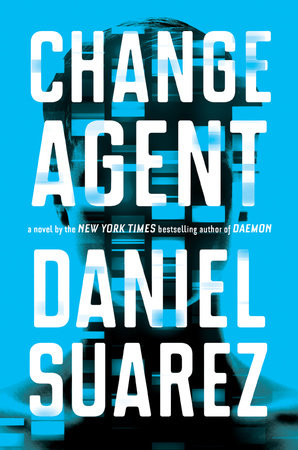
Change Agent: CRISPR-flavoured fiction

Posted on behalf of Sara Reardon

9781101984666It’s 2045, and the genetic editing system CRISPR has become a mainstay of society, producing everything from housecat-sized tigers to geopolitical intrigues. The United Nations has approved a sensible list of gene edits that can be legally used to eliminate specific genetic diseases from human embryos. This international concord works as well as one could expect from a sluggish bureaucracy trying to rein in a lucrative new enterprise. Before the treaty’s ink is dry, underground labs in Asia are offering “vanity edits” to parents willing to pay for smarter, healthier children. A single CRISPR snip to a gene that reduces the risk of heart disease might be routine and relatively cheap; altering the many genes that contribute to a complex feature like intelligence will cost much more. And that’s before you factor in the legal consequences if you get caught designing your perfect baby. As one illicit geneticist says, “all genetics is warfare”.

So begins Change Agent: a sci-fi thriller set in Southeast Asia with colourful and scientifically believable elements embellishing a fairly tired plot. Former software developer Daniel Suarez drew on still-cutting-edge research for his novel, one of the first to namecheck CRISPR as the catalyst for dystopia.

In Suarez’s imagined future, crime involving genetically modified humans has become so pervasive that international police organisation INTERPOL has devoted massive resources to dealing with it. But when detective Kenneth Durand finds himself hot on the heels of an organized crime ring in Singapore, he gets jabbed with a “change agent”. He awakens weeks later, shocked to find his body inexplicably transformed into that of the cartel’s ringleader, Marcus Demang Wyckes.

No one believes Durand’s explanation, least of all fellow INTERPOL agents who see him as the man whose face is on every wanted poster in Asia. After all, even the best scientists in 2045 believe it is impossible to genetically edit a living person. So Durand-as-Wyckes sets off alone to track down the real Wyckes and find a way to reverse-engineer his own body. That journey takes him through a landscape of sci-fi cliché – an underground nightclub of bio-enhancement enthusiasts, a shadowy Chinese trafficking ring with an invisible leader, intrusive augmented-reality ads.

Biotechnological flights of fancy

Yet Suarez has sprinkled the narrative with clever ideas inspired by current technologies. Singapore’s streets crawl with drug addicts, who tattoo molecular compounds onto their bodies so that dealers with 3-D printers can synthesize the drugs to deliver personalized highs. The Burmese government, which is waging genocide on its hill tribes, destroys their crops with gene drives — a controversial technology that can destroy populations by introducing genes that kill offspring. Nearly every other page is a glimpse into some biotechnological flight of fancy.

Suarez’s descriptions of the capacities and limitations of CRISPR, among other real-life technologies, are clear and mostly accurate, with minimal artistic licence. It’s the novel’s plot that — although fast-moving — fails to impress. As Durand flees his pursuers, he fights an unconvincing war with himself, as Wyckes’ grafted-on persona tries to drive him to violence. The enemies and allies that he picks up along the way are hackneyed and forgettable. This is especially true of the moustache-twirling Wyckes, whose denouement would be described as disappointing if we had cared about him in the first place. I won’t spoil everything, but suffice to say that Suarez wastes his most original idea in Wyckes’s bizarre engineered hitman, whose clever biochemical makeup repulses normal humans.

When we finally meet the CRISPRers, it’s in coastal Thailand (where else?). Potential parents sit through a parade of perfect children as if it’s a presentation for timeshare vacation condos. Predictably, the youngsters are a cover for the criminals’ more profitable product: children engineered with defective brains and enhanced muscles that make them disciplined workers and soldiers. Certainly people in 2045 must have read Brave New World. And meanwhile, readers will experience less shock than scepticism over how INTERPOL ever let crime get this bad right under their noses.

Perhaps that dulled reaction is what makes Change Agent most memorable. We have become so used to fictional explorations and academic treatises on engineering humans — from Mary Shelley’s Frankenstein to recent editorials in Nature — that the deranged possibilities presented by the technologies fail to thrill us any more. In an era stranger than fiction, sci-fi writers are increasingly hard-pressed to generate the requisite surprise, even as the scientific advances motor on.

Sara Reardon is a reporter for Nature working on biomedical research and policy, based in Washington DC. She tweets at @Sara_Reardon.


For Nature’s full coverage of science in culture, visit www.nature.com/news/booksandarts.
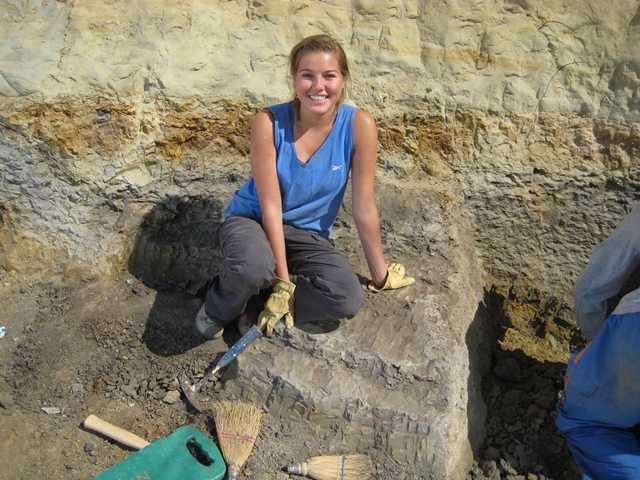
Ancient DNA and the rise of ‘celebrity science’

Elizabeth Jones.

Science historian Elizabeth Jones.

3Q: Elizabeth Jones

Whether it’s about Neanderthal-human interbreeding or the prospect of resurrecting woolly mammoths, the public cannot seem to hear enough about ancient-DNA research. For science historian Elizabeth Jones, ancient DNA offered an opportunity to study the development of a field in the crucible of intense public interest. She defines the phenomenon as “celebrity science”, in which scientists harness attention to generate interest in their work and capture future funding.

What led you to the definition of celebrity science?

As a historian, I used traditional research methods, like looking at professional and popular literature. I’ve gone back to conferences and archives. But one of the main reasons I’ve come up with the idea of celebrity science is from my conversations with scientists working in ancient DNA themselves. Many of them are alive so I can talk to them, but it’s also dangerous territory because their careers could be impacted by what I write. Meanwhile, if you go back to the 1970s and 80s, you see that the interest in ancient DNA was there from the very beginning. My speculation is that this comes from a long history of popularizing certain public-facing fields, such as palaeontology, archaeology and molecular biology. Our fascination with dinosaurs, human history and genetics and DNA as the code of life is documented. When you get these things together, the interest is just explosive.

Jurassic_Park_logo

The Jurassic Park franchise enabled a visual image of what using ancient DNA to bring back extinct species might mean.

How important do you think the Jurassic Park films are to the field?

Steven Spielberg’s 1993 film Jurassic Park had, for the first time, this visual image of what it would mean to use DNA to do something like bring back dinosaurs. That image was used by both researchers and reporters to talk to the public – ‘I’m doing this ancient-DNA research, and it’s kind of like this but not really’. It created a lot of momentum and it influenced press interest. There are some arguments that it influenced publication timing in journals like Nature. Did it influence research? One good example has to do with funding in the United States. Jack Horner, who is a palaeontologist but was also the scientific consultant to the Jurassic Park films, applied to the National Science Foundation in 1993 for money to try to extract DNA from dinosaur bones. Interviewees I talked to who were involved in the project feel the funding was awarded in part because of the public interest in the film at the time. Some researchers think this close connection between science and science fiction was damaging to press and publication expectations about what their research could really do. But a lot of the researchers who work in this field are very attuned to news value. They understand that you have to sell science. That means packaging it in such a way that the consumer wants to read it or learn more about it. They understand that Jurassic Park was an easy entry for communicating to the public what their research can and can’t do.

What changes have you seen in the field since?

Ancient-DNA researchers agree that they have achieved a great sense of credibility in the field of evolutionary biology. You can look at a lot of the work with ancient humans like the Neanderthal genome, for example, that’s really shown the power of ancient DNA. But even the Neanderthal genome was still very much a celebrity kind of study. Svante Pääbo was really active in designing it that way, by issuing press releases, putting a strict deadline on his lab and telling the rest of the world “we’ll sequence the genome in two years’ time”. It’s very much still science in the spotlight, but one that has demonstrated that they can do rigorous research. Next-generation sequencing has allowed researchers to get some high coverage genomes from extinct organisms. There are a few researchers in the ancient-DNA community who are not necessarily pursuing de-extinction, but they’re involved in these conversations. Because they’re respected scientists, they have lent a sense of credibility to the idea that de-extinction might happen. I think researchers in the ancient-DNA community are starting to pay attention to this pursuit in a way they wouldn’t have 15 years ago. As for my own work, I worry that scientists will think I’m saying celebrity science is a sell-out kind of science. Of course there are tensions between science and the spotlight. But ancient-DNA research is a great example of how really rigorous work can coincide with press and public interest.

Interview by Ewen Callaway, a senior reporter for Nature based in London. He tweets at @ewencallaway. 

This interview has been edited for length and clarity.


For Nature’s full coverage of science in culture, visit www.nature.com/news/booksandarts.
Imaging and imagining black holes

Posted on behalf of Davide Castelvecchi

You are currently viewing a placeholder content from YouTube. To access the actual content, click the button below. Please note that doing so will share data with third-party providers.

More Information

Until several years ago, most cinematic and artistic depictions of black holes — including many in the pages of Nature — failed to match the known facts. A black hole (the remnant of a runaway gravitational collapse) often looked like a space whirlpool, or perhaps a simple black sphere representing the event horizon — the surface that constitutes a point of no return for anything that falls inside. This would be pictured either against a background of stars, or surrounded by an ‘accretion disk’. (Think Saturn’s rings, but made of superheated plasma and spiralling in at close to the speed of light.)

Thanks in part to physicist Kip Thorne’s involvement,Christopher Nolan’s 2014 film Interstellar was the first one to show what you would actually see if you were to fly near a black hole (see image here). And as I wrote last week in Nature, an ambitious radio astronomy project now aims at taking the first snapshot of an actual black hole. In other words, a real-life picture of Interstellar’s black hole Gargantua, if a highly pixelated one.

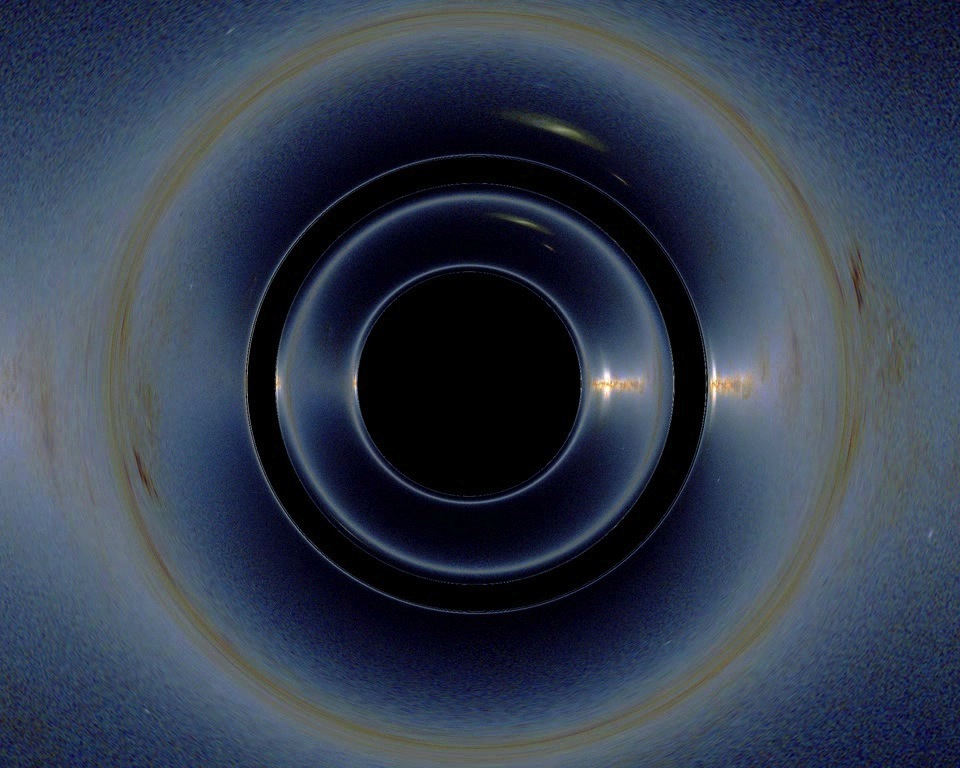
Between accurate art and actual observation, it might finally begin to sink into our collective imagination just how weird these objects must look. Gravitational lensing, a consequence of Albert Einstein’s theory of gravity, makes light rays curve around a black hole — some light rays do so multiple times. This means that ironically, even though a black hole forever hides what has fallen into it, it cannot hide anything that lies behind it. In particular, if there is an accretion disk, gravitational lensing produces multiple images of it, which appear to wrap around the black disk of the event horizon like a halo (see the infographic accompanying my article).

A black hole cannot hide another object (in this case another black hole) that passes directly behind it. Instead, the object in the background will appear like a ring surrounding the one in the foreground.

A black hole cannot hide another object (in this case another black hole) that passes directly behind it. Instead, the object in the background will appear like a ring surrounding the one in the foreground.{credit}Alain Riazuelo/Institut d’Astrophysique de Paris{/credit}

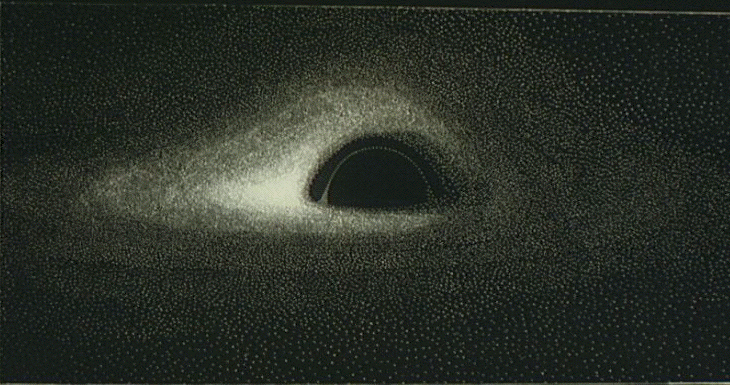
Theoretical physicist John Wheeler famously made the term ‘black hole’ official in 1967 to describe the phenomenon. Fewer realise that around a decade after that, an astrophysicist accurately portrayed a black hole, as Thorne relates in his splendid companion book to the film, The Science of Interstellar. In 1978 at the Paris Observatory, Jean-Pierre Luminet became the first to make a detailed computer calculation of a black hole’s appearance. He did so, he told me, by programming a (by then already obsolete) 1960s IBM 7040 computer, using punch cards.

Because Luminet had no way to print out the resulting image or visualize it on a screen, he used the data to draw an image by hand, putting individual dots of India ink onto a photographic negative. He published it that year in the French magazine La Recherche, and then with more detailed technical results in the journal Astronomy and Astrophysics in 1979. (On his blog, Luminet explains how calculating the appearances of black holes is technically similar to understanding the optics of glories, atmospheric phenomena similar to rainbows.)

Given that Gargantua is an accurate simulation using twenty-first-century knowledge and computing, it is uncanny to see how Luminet’s hand-drawn picture made from a punch-card computer’s data already had all the crucial ingredients. In fact, in one respect it was even more accurate. In Luminet’s image, one side of the accretion disk (the one rotating towards the observer) looks much brighter than the other — a consequence of its extreme speeds. As Thorne notes in his book, the Interstellar team considered including this effect in their renderings, but director Christopher Nolan decided it would be too confusing for viewers. This was possibly the only aspect in which the Gargantua sequence strayed from scientific accuracy.

The first accurate image of the appearance of a black hole (India ink on Canson negative paper).

The first accurate image of the appearance of a black hole (India ink on Canson negative paper).{credit}Jean-Pierre Luminet{/credit}

That realism was a long time coming. From the 1970s at least, most popular-science renderings of black holes lacked the effects of gravitational lensing. “I was a little bit upset to see that in many popular magazines, they more or less systematically used artistic views with no scientific accuracy at all,” Luminet recalls. Starting in the late 1960s, science-fiction had also battened onto black holes, but under an intriguing array of names. A 1967 Star Trek episode had a ‘black star’. A 1975 episode in another TV series, Space: 1999, involved a ‘black sun’. Films, too, began to feature black holes, including  Disney’s 1979 The Black Hole.

Meanwhile, the rise of powerful computers in the decades after Luminet’s efforts meant researchers made ever more realistic simulations, and began to craft colour animations. In the early 1990s, the late astrophysicist Jean-Alain Marck, also at the Paris Observatory, created the animation at the top of this piece, which Luminet later used in the documentary Infinitely Curved. Even more spectacular animations were created by Alain Riazuelo at the Paris Institute of Astrophysics and by Andrew Hamilton at the University of Colorado in Boulder. (Hamilton also rendered what happens when you fall inside a black hole.)

You are currently viewing a placeholder content from YouTube. To access the actual content, click the button below. Please note that doing so will share data with third-party providers.

More Information

However, none of these outreach efforts had the same impact as Interstellar. The film has begun to affect the way artists represent black holes, says Eugénie von Tunzelmann, who led the 200-strong team of computer-graphics experts at London-based company Double Negative, which created the special effects. Stylized icons now often look like a strip crossing a circle – suggestive of the accretion disk and its lensed image. “The first thing that comes to mind when people say ‘black hole’ might have changed.”

Even in relatively inaccurate sci-fi representations, black holes still provided inspiration for young minds – including for many kids who grew up to become researchers and perhaps work on projects such as the Event Horizon Telescope (EHT), the radio astronomy project that plans to image real black holes. “A lot of scientists, and maybe especially astronomers, always carry that little flame within them,” says Sheperd Doeleman, an astrophysicist at Harvard University in Cambridge, Massachusetts, who helms the EHT. “It really gets you thinking about what’s possible.”

Davide Castelvecchi is senior physical sciences reporter at Nature. He tweets at @dcastelvecchi.

Notes on the animations:

Colour Animation of a Black Hole with Accretion Disk (top): this shows the gravitational lensing around the event horizon (Jean-Alain Marck; from the documentary Infinitely Curved).

A Journey into a Black Hole (bottom): a simulation of what an observer would see while falling into a black hole (Andrew Hamilton).


For Nature’s full coverage of science in culture, visit www.nature.com/news/booksandarts.

A wily plotter and his pioneering atlas

Posted on behalf of Rosalind Cotter

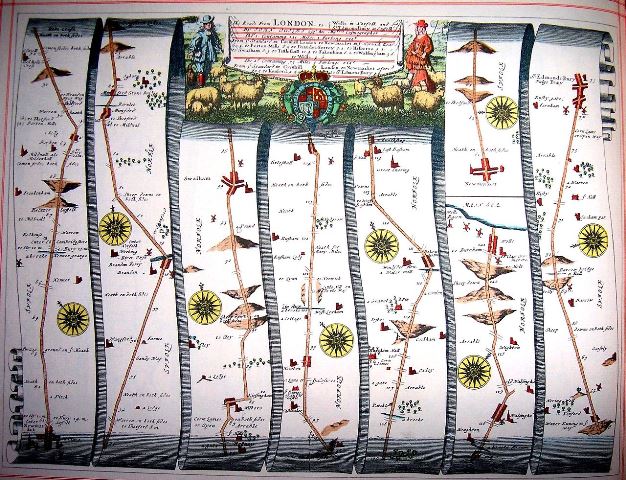
A colour version of the Britannia strip map showing the route from Newmarket, Suffolk to Wells-next-the-Sea, Norfolk.

Figure 1 One of the ‘Principal Roads of England and Wales’ displayed in John Ogilby’s Britannia atlas. It shows the route from Newmarket in Suffolk to Wells-next-the-Sea in Norfolk. As well as towns, villages, bridges and churches, these scaled strip maps record every wood, common, ford and metal mine along the way. {credit}Wikimedia Commons{/credit}

When it comes to unearthing facts and piecing them together into a bigger picture, scientists arguably have it easier than historians. The forensic scientist has recourse to DNA, soil and pollen analyses. The astrophysicist and molecular biologist have big data and an arsenal of technology to collect and unravel it. Even the palaeontologist has a formidable taxonomic lexicon to fall back on. Historians have to make do with piecemeal facts and shadowy context, guided by sources that are often incomplete, unreliable and open to misinterpretation. They cannot systematically test their hypotheses or devise controls to shore them up.

Remarkable, then, to take a little-known seventeenth-century cartographer, shake together a kaleidoscope of disparate facts from his long life, and apply them to tease out a sinister political strategy, all carefully concealed in Britain’s first road atlas.

In The Nine Lives of John Ogilby, Alan Ereira does just that. Ereira is a master story-teller, and his biography of Ogilby (1600-76) is a riveting ride never dulled by its meticulously referenced detail. The backdrop to Ogilby’s colourful life includes the Gunpowder Plot, the English Civil Wars, the execution of Charles I, the Restoration of Charles II, the Plague and the Great Fire of London. His career encompassed the eponymous “nine lives”, as entrepreneurial lottery founder, celebrated dance master to barristers, impresario, poet, soldier and sea captain, secret agent, publisher of deluxe editions of classics and – at the grand age of 70 – Cosmographer and Geographic Printer to Charles II.

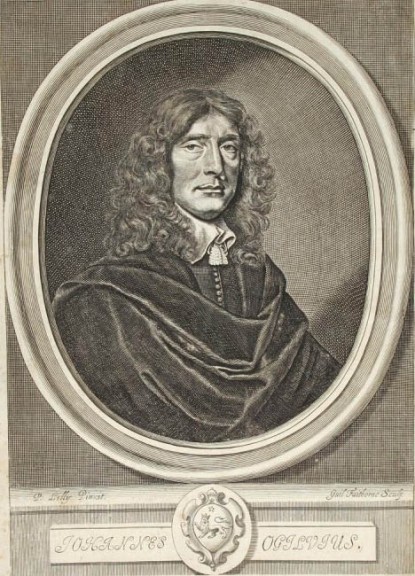
Portrait of John Ogilby (from a 1660 edition of Homer's Illiad).

Portrait of John Ogilby (from a 1660 edition of Homer’s Illiad).{credit}Wikimedia Commons{/credit}

Of these exploits, the most fascinating (and puzzling) to a scientist is the last. The king tasked Ogilby to draw up a road atlas of England and Wales as an aid to the fledgling postal service, but this was to be much more than a simple precursor of today’s motoring guides. Using a device he dubbed a “wheel dimensurator”, a push-along wheel 5 metres (16.5 feet) in circumference that incorporated a dial to record distance, Ogilby painstakingly compiled mile-by-mile strip maps of 73 roads (see Figure 1, above). Between them, these covered 12,070 kilometres (7,500 miles). He plotted details of natural and man-made landmarks along the way at a scale of 1 inch to the mile, a mapping standard later adopted by the British Ordnance Survey until the 1970s. The distances catalogued, allowing for land contours, accord to within roughly 5% of interpolations from Google Earth.

At that time, precision measurement was equated with scientific authority. Therefore the king commandeered physicist Robert Hooke  and architect Christopher Wren, both fellows of the Royal Society, to advise Ogilby. They devised questionnaires for the project’s surveyors to ask locals as they passed through villages:  strange questions, about possible landing sites and unusual tides, watercourses and locations of farms and metal mines. No expense was spared. The eye-watering production costs, equivalent to roughly half a billion pounds today (comparable with Google’s annual expenditure on Google Maps), were at odds with the impoverished state of the country after the English Civil Wars (1642-51) and the second Anglo-Dutch War (1664-67).

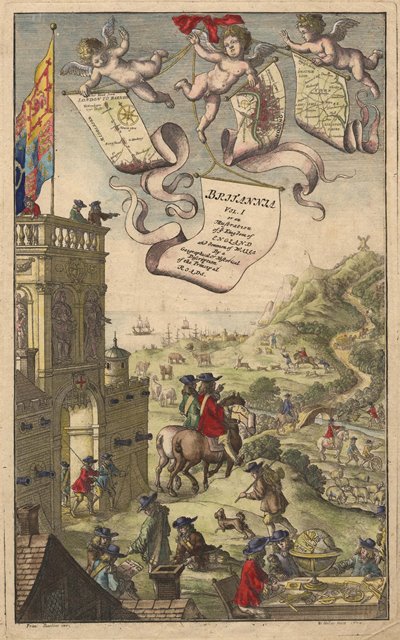
The stupendous efforts of Ogilby and his surveyors and engravers culminated in a magnificent volume comprising 100 plates, Britannia, published in 1675 (its resplendent frontispiece is shown in Figure 2, below). Weighing almost 8 kilograms, it was hardly handy for travellers. The routes depicted were surprising too. Why London to Aberystwyth, a small place today and a mere fishing hamlet in the seventeenth century? And why no mention of key commercial thoroughfares such as the road to Liverpool?

Figure 2 The frontispiece of John Ogilby’s Britannia. The gateway is flying the royal standard and bears the arms of the City of London. In the foreground, a map is being made by surveyors at a table of instruments. The three distant figures on the right are working with Ogilby’s measuring wheel: one is pushing it, one is cleaning the mud off, and the horseman behind is making notes and checking the direction of travel on a compass. Curiously, they are moving along a small track and not along the main highway. This and other mysteries, as well as secret codes hidden in the plate, are discussed in The Nine Lives of John Ogilby.

Figure 2 The frontispiece of Ogilby’s Britannia. The gateway is flying the royal standard and bears the arms of the City of London. In the foreground, a map is being made by surveyors at a table of instruments. The three distant figures on the right are working with Ogilby’s measuring wheel: one is pushing it, one is cleaning the mud off, and the horseman behind is making notes and checking the direction of travel on a compass. Curiously, they are moving along a small track and not along the main highway. This and other mysteries, as well as the secret codes hidden in the plate, are discussed in The Nine Lives of John Ogilby.{credit}Courtesy of Swansea University, Information Services & Systems (ISS){/credit}

Ereira picks up on all the signs that Britannia could be a military atlas rather than a postal one, as officially designated. The routes seem to have been selected for landing marching armies, punctuated with conveniently placed metal mines for producing armaments. There were Catholic shrines marked too — surprising in a Protestant nation. Ereira’s hunch is given credibility by the secret Treaty of Dover, drawn up in 1670 by Charles II with his cousin Louis XIV of France just before the start of the Britannia project. That secret lay hidden for almost 100 years.

The Treaty stemmed from Charles’ vulnerability to covert political and religious forces across the land, after nine years in exile during Oliver Cromwell’s interregnum. Charles’ solution was to seek direct power for himself. (His inspiration was Frederick III of Denmark, who set himself up as Europe’s first monarch to rule by absolute decree after a resounding victory over the Swedes in 1660 gained him immense popularity.) First, Charles needed a glorious military victory over the Dutch, preferably funded by France. But the price for French assistance would be to shift Britain back to Catholicism. The Treaty was duly signed. Ogilby, now turned spy, was commissioned by Charles to amass the information necessary for military back-up by French troops in the event of popular insurrection. They could land unobtrusively at any of the potential invasion points identified on the map as having a functioning roadway, such as Aberystwyth or Wells-next-the-Sea.

As it turned out, no such invasion was necessary. The victory over the Dutch was modest and contributed nothing to Charles’ popularity. There was no uprising. Instead, Charles achieved absolute power by dispensing with Parliament and using the information in Britannia to remove opposition town by town. Ogilby died the year after Britannia was published — but Ereira has given new life to this extraordinary man and his meticulously compiled roadmap.

Rosalind Cotter is Nature’s Correspondence editor.


For Nature’s full coverage of science in culture, visit www.nature.com/news/booksandarts.
Revisiting Feynman on physical law

Posted on behalf of Andrea Taroni

9780262533416

Physics, along with jurisprudence, is principally known for its laws. And physical laws are amazing: they can predict almost anything, from the effects of gravity to why the Sun shines. Explaining them is surprisingly hard, however. Anybody first encountering them in the classroom, typically as mathematical formulae applied to abstract problems, can attest to that. The result is countless hours spent by teachers, educators and popularisers of science devising ways to make physics (and its laws) ‘more interesting’.

Richard Feynman’s The Character of Physical Law – published in 1965 and now newly reissued by MIT with a foreword by Frank Wilczek – stands out as an early example of a successful attempt towards this end. The book is based on a series of lectures the iconic physicist had delivered the previous year at Cornell University. But it’s a layered work, and clearly shows Feynman also drawing from another set of lectures, delivered at the California Institute of Technology from 1961 and 1963. Those would go on to become his most famous work: The Feynman Lectures in Physics (reviewed here).

However, whereas The Feynman Lectures were an attempt to reinvigorate the pedagogical approach to ‘freshman’ physics, The Character of Physical Law is, in Wilczek’s words, far more than an exposition of facts and ideas. It is also a character study of Feynman himself.

By physical law, Feynman is quick to explain that he means “the rhythm and pattern of phenomena of nature which is not apparent to the eye, but only to the eye of analysis”. In other words, the very phenomena we uncover through painstaking empirical observation, and tend to ultimately write down as mathematical equations. But the topic of the lectures is broader still. They focus on the characteristics common to all the laws: “that is another level, if you will, a higher generality over the laws themselves”.

The big picture

What is really striking about The Character of Physical Law is Feynman’s ease in covering broad areas of physics — for instance, the law of gravitation, the relationship between physics and mathematics, the role of symmetry in physical laws. But crucially, he is equally adept at discussing the history of these topics and their relevance to everyday life, and lucidly articulating the reasons why one might be curious about them. It is this combination of skills that allows him to avoid excessive abstraction and philosophising, a common pitfall when looking at the big picture of things.

For instance, Feynman kicks off by discussing the law of gravitation. In plain words, this describes how a particle is attracted to every other particle through a force directly proportional to the product of their masses, and inversely proportional to their distance. Though acknowledging that it is a discovery of the Enlightenment, he argues that by “describing its history and methods, the character of its discovery, its quality”, he recontextualises it for the present.

In the space of a few pages, the reader learns the way mathematician and astronomer Johannes Kepler established how the planets orbit around the sun. And they are provided with a clear description of the Newtonian mechanics that explain what makes them go around — including, of course, a brief explanation that, eventually, even Newton’s laws are found wanting and Einstein’s relativity takes over. At the next level of generality, Feynman also considers other instances in which inverse-square laws appear in nature — for example, to describe the interaction between electrical charges. The reader is invited to think deeper as each layer of description is peeled away, while at the same time keeping in mind the common threads that bind them together. Yet Feynman isn’t afraid to admit when even the boundaries of his knowledge are reached: “instead of having the ability to tell you what the law of physics is, I have to talk about the things that are in common to the various laws; we do not understand the connection between them”.

This approach certainly demonstrates an unusual depth of physics understanding. It also reveals Feynman’s humanity. Feynman was of course famously charming and charismatic — and, arguably, flawed, perhaps propagating the myth of his stage persona a little too enthusiastically. But ultimately he was, in my view, a man driven by a playful, down-to-earth spirit of curiosity, not the dry and abstract reasoning of a detached academic.

Rules of the game

As Wilczek notes in the foreword, a lot has happened in physics since 1965; yet The Character of Physical Law holds up extremely well today. My favourite chapter is the one on symmetry in physics. Feynman starts off by noting that symmetry appears to fascinate the human mind, if only for aesthetic reasons. But he chooses to emphasise the symmetry within the laws of physics themselves. Certain laws can be symmetric with respect to time and space, for example, but not necessarily under changes of scale. The implications of these symmetries are more obvious in some cases than others. But the key point is that by focusing on these underlying rules of the game, one gains an appreciation for the character of the physical laws they apply to.

To underline that, he masterfully explicates the far-reaching implications of charge-parity violation in the weak nuclear force. In his own words, “it is as if 99.99% of nature is indistinguishable right from left, but that there is one little piece which is completely different”. This ultimately explains the preponderance of right-handed molecules, such as proteins, that play a central role in the biochemistry of life. Feynman’s genius as a communicator lies in his ability to explain this connection in a manner that is accessible, fascinating and accurate in equal part.

Ultimately, I wouldn’t go quite as far as Wilczek by describing The Character of the Physical Law as the single best introduction to modern physics. Somehow, I suspect there is a reason why the more incremental approach espoused in The Feynman Lectures in Physics has gained traction with a wider readership over the years. But for the interested reader looking for more, this book offers enlightenment to those exploring its facets.

Andrea Taroni is chief editor of Nature Physics. He tweets at @TaroniAndrea. 


For Nature’s full coverage of science in culture, visit www.nature.com/news/booksandarts.
Snapping Earth for more than seven decades

Posted on behalf of Elizabeth Gibney

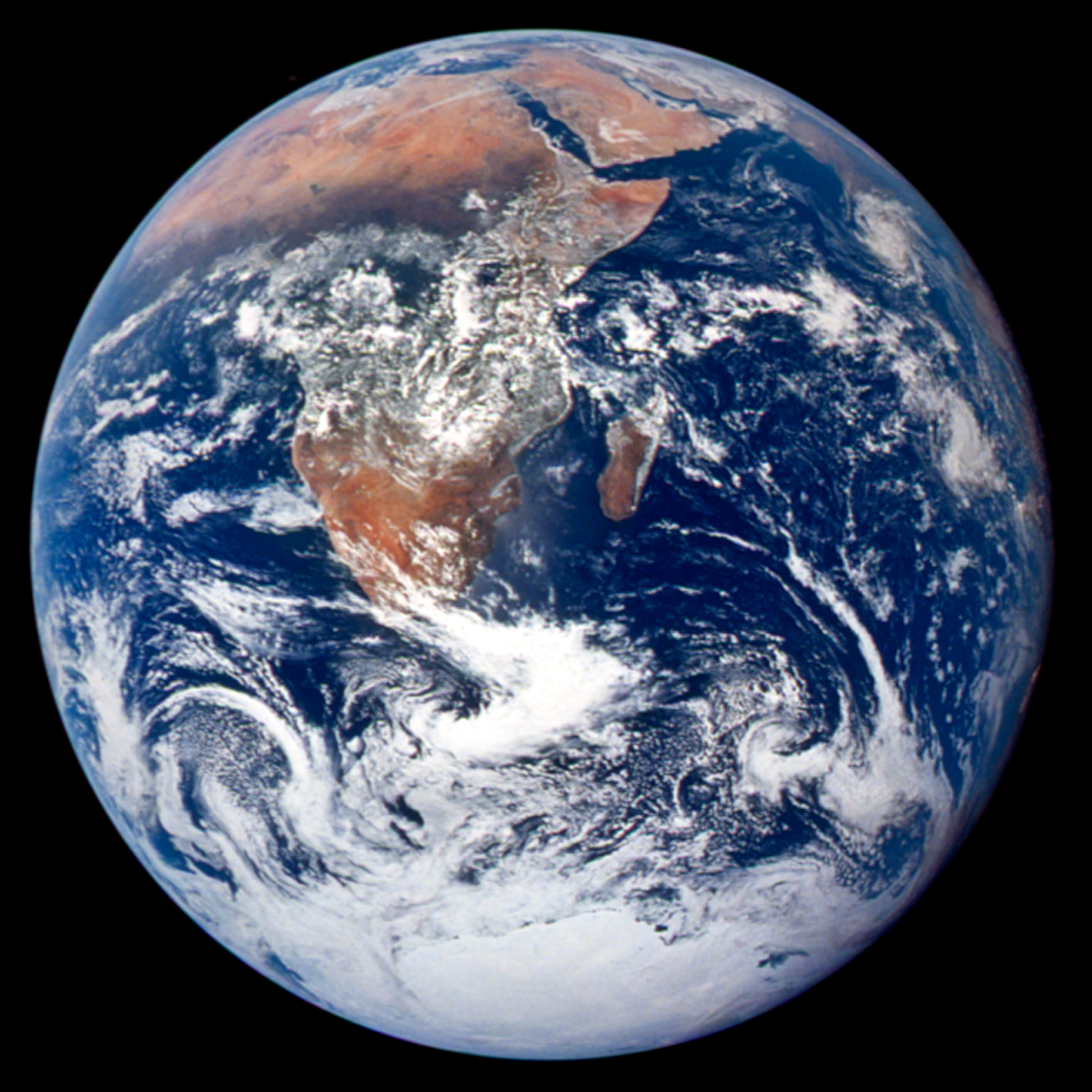
The 'Blue Marble' image of Earth by the Apollo 17 crew in 1972.

The ‘Blue Marble’ image of Earth captured by the Apollo 17 crew in 1972. {credit}NASA{/credit}

For centuries, the only way to ‘see’ Earth whole was through globes and maps; its grandeur was merely glimpsed in mountain vistas or across a stretch of ocean. That changed in the 1940s, when the first images of the planet were snapped from rockets probing the border of space, 100 kilometres up. The imaginable became the visible.

Since then, satellites and spacecraft have beamed down shots from ever greater distances and in growing detail. Now Nature Video has captured the most iconic of these in the film Portraits of a Planet: Earth from Space.

You are currently viewing a placeholder content from YouTube. To access the actual content, click the button below. Please note that doing so will share data with third-party providers.

More Information

These images have massively boosted science and technology – from weather forecasting to monitoring natural disasters, forest cover and climate change. And they have had a subtler psychological impact. Revealing this majestic, finite, vulnerable entity framed in blackness has elicited deep responses feeding into policy and culture.

Going ballistic

The first images of Earth from space — from 1946 and 1947 — were black-and-white, grainy and remarkable partly for the fact that they happened at all. Both were taken by cameras retrofitted into the empty nosecone of V-2 rockets, long-range ballistic missiles the United States captured from Germany at the end of the Second World War.

In 1946, all that protected the film during the rocket’s crash landing was a steel cassette. When the photos were first projected onto a screen, “the scientists just went nuts”, recalled Fred Rulli, a member of the rocket’s recovery team, in an interview with Air and Space magazine. The following year’s project nudged the rocket further into space to 160 kilometres, bringing more detailed images clearly revealing Earth’s curvature.

Taken in March 1947, these pioneering NASA images of Earth were the first taken from an altitude of more than 100 kilometres. Cameras retrofitted into the empty nosecone of V-2 rockets were deployed to take the shots.

Taken in March 1947, these pioneering NASA images of Earth were taken from an altitude of 160 kilometres – then a record high. Cameras retrofitted into the empty nosecone of V-2 rockets were deployed to take the shots.{credit}Johns Hopkins Applied Physics Laboratory{/credit}

The cold-war space race soon pushed cameras to greater heights. In 1957, the Soviet Union launched its first satellite, Sputnik; the US quickly followed suit. Three years later, the newly formed NASA put TIROS 1, its first weather satellite, into orbit, which sent video back to Earth using dual television cameras. TIROS 1 proved that such images could provide be used to monitor cloud formation, one of the first indications of the potential scientific power of satellites.

In 1960, cameras aboard NASA's first weather satellite TIROS-1 captured Earth.

In 1960, cameras aboard NASA’s first weather satellite TIROS 1 shot Earth.{credit}NASA{/credit}

Human-crewed efforts began with the orbital missions of Yuri Gagarin in 1961 and John Glenn in 1962. But it was not until 24 December 1968 that Apollo 8 astronaut Bill Anders captured arguably the most iconic image of Earth. Later dubbed ‘Earthrise’, it was the first to show the planet from the perspective of another celestial body, as a luminous blue hemisphere rising above the Moon’s horizon. Anders had had to fight to get the long-lens camera on board, and deviated from the craft’s flight plan to get the snap (as he wrote in his obituary of Glenn earlier this year).

That awe-inspiring image was a shot across the bows of the cold war. It was also transformational for earthbound observers: the moniker ‘Spaceship Earth’ gained traction as people fully grasped the planet’s limits. Ultimately, ‘Earthrise’ supercharged the nascent environmental movement in the United States particularly, pioneered by environmentalists, scientists and thinkers such as Buckminster Fuller; and it proved a trigger for the US Earth Day, which launched in 1970.

That grassroots clamour, bolstered by works such as biologist Rachel Carson’s 1962 Silent Spring, had an influence on policy shifts at the federal level. The period from 1970 to 1973 saw the Environmental Protection Agency established and the US Clean Air Act, Clean Water Act and Endangered Species Act passed. Anders notes, “I wouldn’t say [Earthrise] was the only reason, but it certainly was an important reason motivating folks to take better care of our planet.”

'Earthrise' - possibly the most iconic portrait of Earth - was captured by astronaut Bill Anders from Apollo 8, the first crewed lunar mission.

‘Earthrise’ – possibly the most iconic portrait of the planet – was captured by astronaut Bill Anders from Apollo 8, the first crewed lunar mission, in 1968.{credit}NASA{/credit}

The spectacular ’Blue Marble’ (see opening image), shot by the crew of Apollo 17 in 1972, fuelled further activism; it has been recreated by NASA many times over. The photograph captured Earth with the Sun behind the camera illuminating most of the globe, and from a distance (45,000 kilometres from the planet) no one has managed since.

Inspired by the potential of such astounding images, the US Geological Survey and NASA launched the first satellite in the Landsat programme in 1972, to chart Earth’s terrain in detail. Landsat satellites have documented burning oil wells in the first Gulf War, the impact of Hurricane Katrina and deforestation in the Amazon. Landsat’s false-colour rendering of Alaska’s Malaspina glacier, taken with a thermal imaging camera, is mesmerizingly beautiful.

In 1991, Landsat satellites captured lit oil wells in Kuwait , which burned for 10 months.

Landsat satellite images of lit oil wells in Kuwait during the Gulf War, in 1991. They burned for 10 months.{credit}NASA{/credit}


This Landsat image, shot in 200, captures the majestic flow of Alaska's Malaspina Glacier. This false-colour composite was created using infrared, near infrared and green wavelengths.

Shot in 2000, this false-colour composite showing the majestic flow of Alaska’s Malaspina Glacier was created using infrared, near infrared and green wavelengths.{credit}NASA/USGS{/credit}

In recent years, a parade of Earth monitoring and robotic exploration craft have added countless images to the file. In 2012, over 312 orbits, the Suomi National Polar-orbiting Partnership satellite built up a night-side image of Earth and its lit-up cities in ‘The Black Marble’. In 2013, NASA’s Cassini craft turned around in the outer Solar System to capture Earth — a pinprick of light — through the rings and moons of backlit Saturn.

Composite image 'The Black Marble' was taken by Suomi NPP, a joint National Oceanic and Atmospheric Administration and NASA satellite, in 2012

Composite image ‘The Black Marble’ was taken by Suomi NPP, a joint National Oceanic and Atmospheric Administration and NASA satellite, in 2012.{credit}NASA{/credit}

Called ‘The Day the Earth Smiled’, that shot was taken from more than 1.2 billion kilometres away, making it a far cry from the images of our planet revealed some 70 years ago. But while the photographs have become ever more impressive, rarely are they as powerful as those first images of the ‘ground beneath our feet’ in its sublime entirety.

'The Day the Earth Smiled', taken by NASA's Cassini craft in 2013, shows Earth through Saturn's rings. The image spans some 650,000 kilometres and is a mosaic crafted from photographs taken over four hours.

‘The Day the Earth Smiled’, taken by NASA’s Cassini craft in 2013, shows Earth through Saturn’s rings. The image spans some 650,000 kilometres and is a mosaic crafted from photographs taken over four hours.{credit}NASA{/credit}

Elizabeth Gibney is a reporter on physics for Nature based in London. She tweets at @LizzieGibney. 


For Nature’s full coverage of science in culture, visit www.nature.com/news/booksandarts.
Orchids: the success of beautiful cheats

Posted on behalf of Alison Abbott

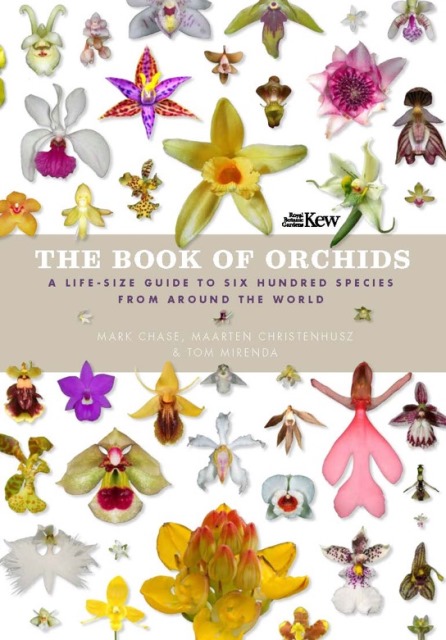
image001One in seven flowering plants on Earth is an orchid. The Orchidaceae, one of the oldest, as well as the most extensive, families of flowering plants, comprises 749 genera and around 26,000 species. Some have evolved to survive in the most inhospitable of environments, pushing their sweet blooms through the sands of arid deserts or the icy soils of Arctic tundra. All this I learned from The Book of Orchids, a luscious coffee-table tome from Ivy Press (and the University of Chicago Press in the United States), coauthored by Tom Mirenda, Mark Chase and Maarten Christenhusz.

Orchids didn’t achieve their success by being nice guys. They are “Masters of deception and manipulation…famous for lying and cheating,” writes Mirenda, the Smithsonian Institute’s orchid collection specialist, in his introduction.

The book describes 600 representative species, with each photograph reproduced at life size. The selection shows off the aesthetic range of the family, from the startling beauty of Australia’s extravagantly multi-coloured Queen of Sheba (Thelymitra variegata) to the dull arum-leaved spurlip orchid (Pachiplectron arifolium) from New Caledonia, whose puny brown petals make it appear dead.

Introductory essays summarise the unlikely biology of the family and the threats to some of its species.

Queen of Sheba orchid (Thelymitra variegata)

Queen of Sheba orchid (Thelymitra variegata){credit}Maarten Christenhusz{/credit}

All orchids begin as a structure called the protocorn, a small ball of cells without roots, stems or leaves. For the embryo to develop, the protocorn needs to be infected by a fungus which provides it with the necessary sugars and minerals.

Nearly all orchid species share two other physical characteristics. Almost without exception, the male and female structures — the stamen and the stigma — are fused into a single column, which makes for unusually efficient pollination. And most orchids have one very distinctive petal that is modified — thanks to an unusual mechanism of genetic control — into a sort of lip upon which pollinators like bees, wasps or moths may land.

The lip is a main site of the orchid family’s deception. Pollinators land in the belief that its patterns promise something attractive, like nectar or a mate. The repertoire of scams in the orchid family is as broad as its range of beautiful form and colour. And the tricks are mean. Flowering plants generally use traits like colour or scent to attract pollinators, and then reward them with nectar so that they return regularly. Most orchids don’t bother with the reward. The pollinators, unsurprisingly, quickly learn not to be fooled.

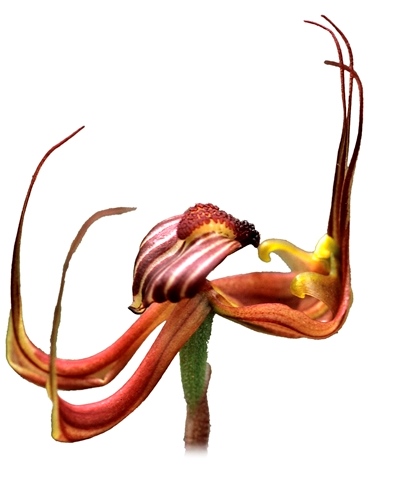
Lazy Spider orchid (Caladenia multiclavia){credit}SOF/K. Senghas{/credit}

But that doesn’t bother the orchids. Because of their unusual structure, orchid flowers load vast amounts of pollen onto the back of a naïve insect during its first visit. That load is readily scraped off onto the thousands of ovules in the next flower it visits while it is still working out that it is being cheated. Vast numbers of seeds result from a single encounter.

Orchids can fool by mimicking characteristics of other flowers which do give rewards — some produce look-alike nectar spurs that contain no nectar — or by aping the sexual hormones of insects. Many species have evolved multiple fake lures. The lazy spider orchid (Caladenia multiclavia) from south-western Australia, for example, attracts a local wasp both with sex pheromones and an insect-like silhouette.

Orchids’ sense of entitlement extends to their relationships with fungi, which get nothing in return for their efforts in supplying orchid embryos with vital nutrients. Though some orchids do provide sugars with fungi as they mature, others continue their unrewarding exploitation lifelong.

Lady Ackland's cattleya (Cattleya aclandiae)

Lady Ackland’s cattleya (Cattleya aclandiae){credit}Eric Hunt {/credit}

Meanwhile, humans are doing what they can to challenge orchids’ survival skills. Many species are under threat from collectors supplying them to manufacturers of faddy foods, drinks and therapies. Some of the most beautiful species, like the Queen of Sheba or the Malaysian slipper orchid (Paphiopedilum rothschildianum) are threatened by poachers supplying horticulture.

The Book of Orchids numbers 100,000 cultivars, mostly hybrids, in the horticultural trade. Few reach general retail outlets. For orchid-lovers like myself who select from the offerings of their local garden centre, the book offers (alas) no advice on how best to look after these beauties, but raised my respect for them to a yet higher level.


Alison Abbott is Nature’s senior European correspondent. She tweets at @alison_c_abbott.


For Nature’s full coverage of science in culture, visit www.nature.com/news/booksandarts.
Artist of the animatronic

3Q: Giles Walker

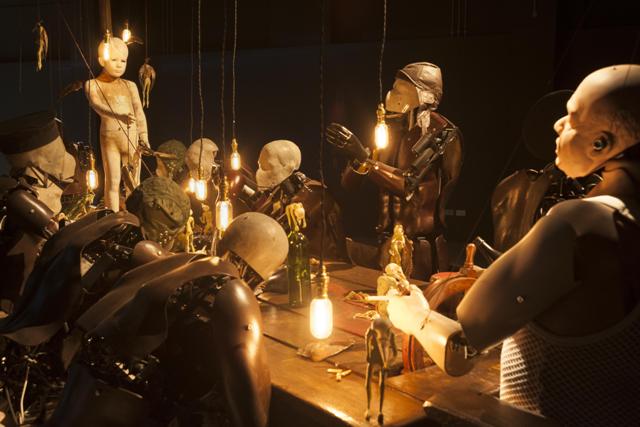
The Last Supper, Giles Walker's art installation at the London Science Museum's Robots show (multimedia).

The Last Supper, Giles Walker’s art installation at the London Science Museum’s Robots show (multimedia).{credit}Giles Walker © The Board of Trustees of the Science Museum{/credit}

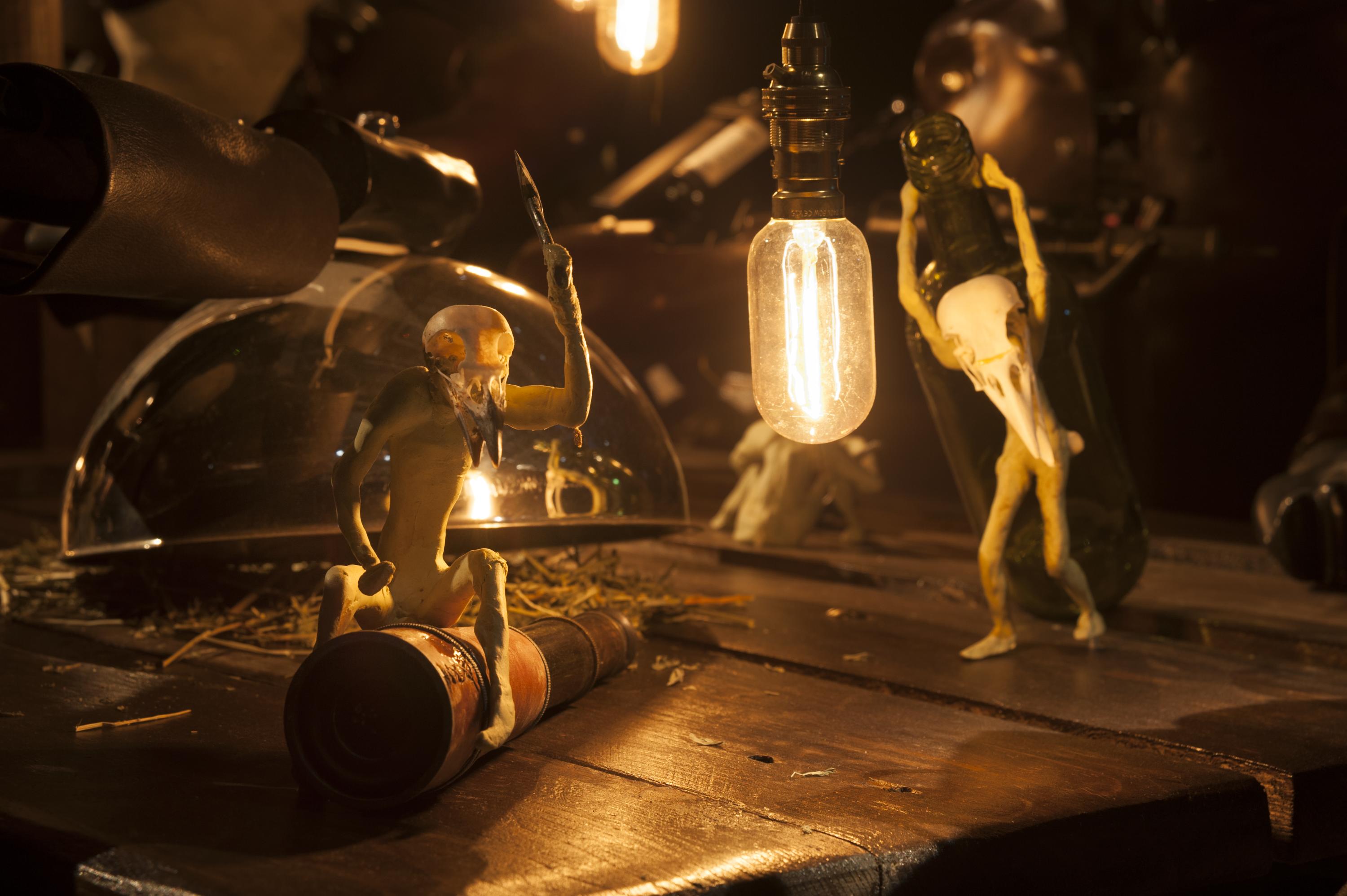
Not all roboticists are scientists or engineers. Giles Walker, an artist in Brixton, south London, specialises in turning scrap metal into animatronic sculptures — ‘art robots’ that do not involve AI. Walker uses low-tech, unashamedly cheap technologies to animate artbots: car windscreen wiper motors for big clumsy movements, radio-control servos for delicate ones, coordinated via a communications protocol used in theatre lighting. His replica of the 1928 talking tin man Eric is a star of the London Science Museum’s Robots exhibition (reviewed here). Another of Walker’s works on display there, The Last Supper, enters darker territory. This animatronic ‘ensemble piece’ involves 12 mechanical figures sitting around a table. The figures — many with faces that are humanoid, yet smoothly featureless — talk about sin and forgiveness. A doll-like sculpture of a naked child backed by a cross stands on the table. It’s a bizarre scene, packed with a sense of foreboding. Here, Walker explains what’s important when building a robot for art’s sake — and what makes it all worthwhile.

What sets animatronic figures apart?

Everyone immediately likes mechanical or kinetic art. People are drawn to moving things. If they see them as a robot, they are even more drawn. Robots appeal because they have such cult status already: old ones, because you see a relatively naive picture of the future held by people of the past; new ones, because they offer a glimpse into the future that may be just as naive. And I think attempts at replicating humans, whether in Frankenstein or a robot, have always fascinated people.

Detail, The Last Supper.

Detail, The Last Supper.{credit}Giles Walker © The Board of Trustees of the Science Museum{/credit}

What are your criteria for your mechanical figures?

You see these robots coming out of Japan. Mine, by comparison, are very low budget. You can only afford a certain number of motions, so you think about movements that say the most about the character you are trying to portray. They don’t look human, but they behave in a human way. It could be through just a telephone or handbag — I give them a human trait that is instantly recognisable. The characters I create always tend to have fallen through the safety net of society. I built a ‘homeless’ character (Outside the Box) a few weeks ago to make a point. Few pay attention to a homeless person; the irony is that everyone pays attention to a homeless robot. I crafted it so that when people walked past, it told its stories. I didn’t fashion it like a Hollywood cliché.

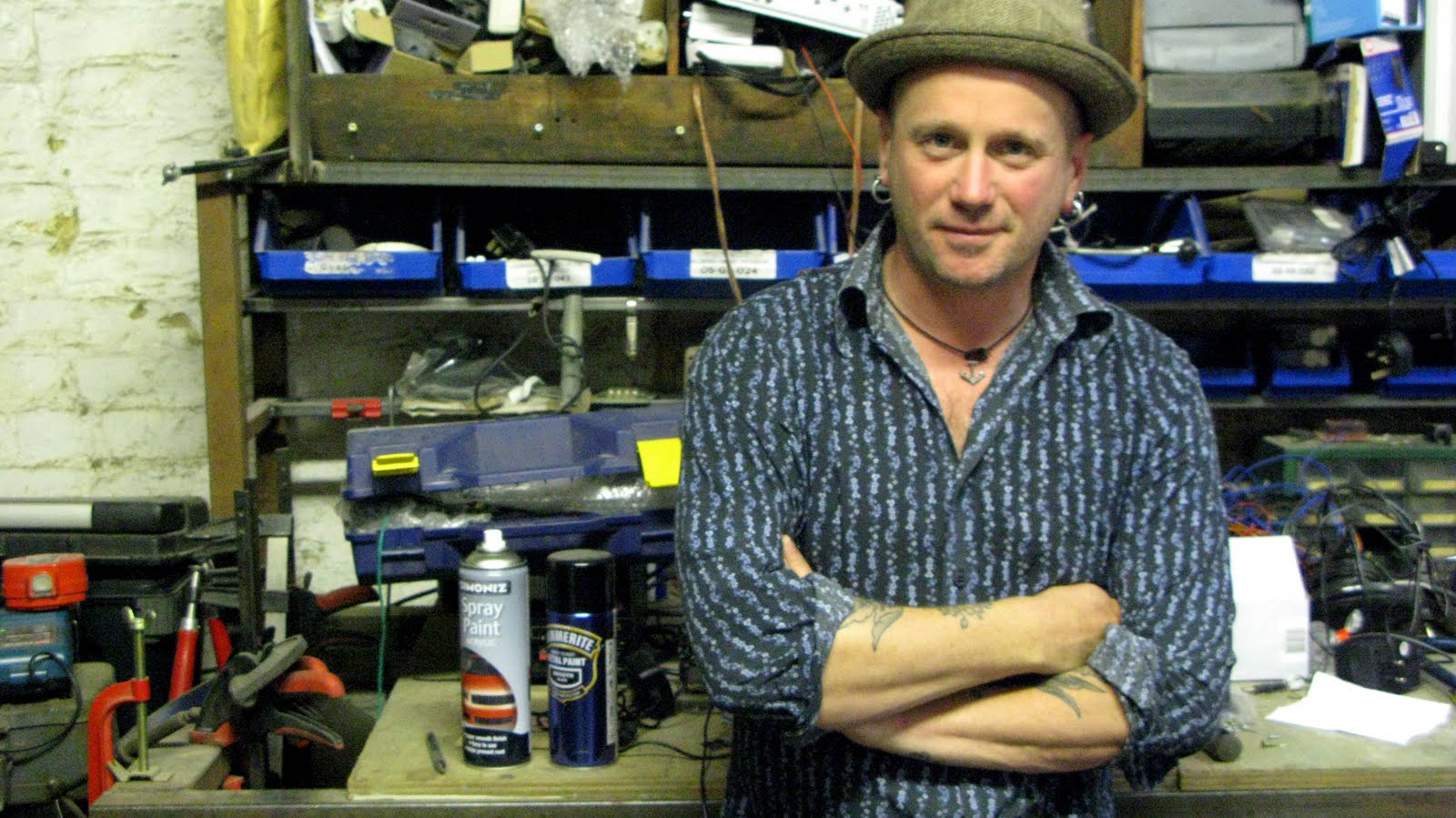
Giles Walker.

Giles Walker.

There is an idea of robots as utopian, but that is not quite true. Funding for robotic development mainly comes from the arms trade or medical science, either to make us kill each other more efficiently — drones, Big Dog — or to help make us live longer, using nanotechnology, robot-assisted da Vinci surgery or exoskeletons. Such advances make you wonder whether have we really developed as a species or are just cancelling ourselves out. My machines are not positive icons of the future. They will not improve our lives by being a more efficient workforce, freeing up more leisure time for the working man. They are lost ‘souls’, redundant, the technological remnants society has discarded on its accelerating trajectory. Most of my sculptures, including those in  The Last Supper, smoke. Robots aren’t supposed to smoke. The juxtaposition of having a mechanical figure show, perhaps, a human weakness creates an opportunity to hold a mirror up to our own species and play with its eccentricities.

Are there surprises when your creations ‘come to life’?

It’s the best moment. You build them to formula – one elbow move tends to be the same as any other. But when you first see all the joints moving at the same time, that’s the peak. If you make it do a certain move, it encapsulates everything that you have been trying to say with that character. That’s the buzz, that’s what you do it for. You fire it up for the first time, and it will have this nervous tic in its neck, and it’s like, yes! Then you can start fine-tuning it.

Interview by Celeste Biever, Nature’s chief news and features editor. She tweets at @celestebiever. Robots runs at London’s Science Museum until 3 September. The Last Supper shows there until 29 May. (View the installation in action here.)


For Nature’s full coverage of science in culture, visit www.nature.com/news/booksandarts.