Curiosity aims for a smooth runway

{credit}NASA/JPL{/credit}

I’ve been focusing a lot on the probabilistic assessment that Curiosity has a 98.3% chance of landing successfully (if its hardware works). About 1% of that risk is in the parachute, which is why scientists working the Mars Reconnaissance Orbiter are so keen to catch Curiosity during its descent. But what about the remaining 0.7% terrain-hazard risk?

This risk is the combination of boulders and slopes that could threaten to tip the rover, and craters and mesas with walls too steep for Curiosity to escape. According to Devin Kipp, an engineer on the entry, descent and landing (EDL) team at the Jet Propulsion Laboratory in Pasadena, California, slopes greater than 20% give the rover trouble. “Above that and it gets shaky,” he says.

Allen Chen, the EDL operations lead, was kind enough to share the above image, which shows the areas (in red) that contribute to the 0.7% risk associated with terrain hazards. You can see that the ellipse was purposefully positioned between the steep walls of Gale crater in the upper left corner, and, in the lower right, the steep slopes of Mount Sharp (oops, I mean Aeolis Mons).

But look carefully within the ellipse and, halfway between the centre and the western edge, you can see an angry red pimple: an unnamed 250-metre-wide crater with walls that would probably trap the rover. It’s a hole-in-one that Curiosity certainly wants to avoid. After the jump is a map that shows how that crater’s walls can slope as much as 25 degrees. Chen says that it’s possible that the rover could escape through a slightly less steep section of the crater’s southern wall, but it’s a predicament he doesn’t want to deal with.

So why didn’t the team move the landing ellipse to the north a little, where the landing terrain is all blue? That certainly was considered, Chen says. But there are trade-offs. The team would have eliminated a tiny amount of dangerous terrain, but then the rover would have much further from the base of Aeolis Mons — where the most important mission science awaits.
Continue reading

Mars orbiter plans for a Curiosity close-up

{credit}NASA/JPL/Univ. Arizona{/credit}

Remember this picture? NASA is quietly planning to have an even better one of the Curiosity landing — perhaps even in colour — by Monday morning.

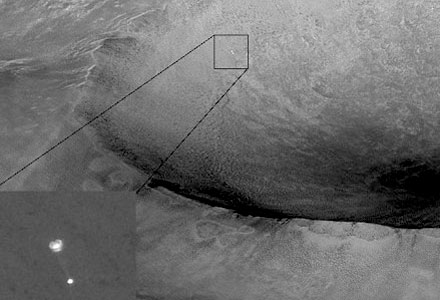
This snap, taken on 25 May 2008, is the parachute of the Mars Phoenix lander caught in the act 3 minutes before landing by the HiRISE camera on the Mars Reconnaissance Orbiter (MRO). Not only did the MRO give NASA a stunning image for the public, but it also provided crucial engineering information about one of the riskiest aspects of any Mars landing: whether the parachute opened completely.

And NASA is trying again. The MRO will slew into position and take a snap of Curiosity’s parachutes 60 seconds before landing, just before the rover is released from the back shell. It could even be possible to discern the heat shield on the ground. “We get one shot,” says Alfred McEwen, principal investigator of HiRISE (High Resolution Imaging Science Experiment) at the University of Arizona in Tucson.

This time, the chance of catching Curiosity on camera is only 60%, says McEwen. With Phoenix, there was about an 80% chance. The difference is because of the relative paths of the spacecraft. For the Phoenix landing, HiRISE’s long and narrow field of view was closely aligned with the path of the lander. For the Curiosity landing, the MRO will be much closer and looking almost directly down at Curiosity. But the paths are nearly perpendicular, which means that HiRISE’s field of view — a narrow north–south track about 6 kilometres wide on the ground — might not contain Curiosity, which will be barreling east along its 20-kilometre-long landing ellipse (see map after the jump).

There is a silver lining, however. Not only will the MRO be closer, but Curiosity’s parachute is about twice the size of Phoenix’s. In the Phoenix snap, the parachutes were just 10 pixels across. McEwen says that Curiosity’s parachutes could cover 50 pixels, making for a black-and-white image as detailed as 35 centimetres per pixel. And McEwen estimates that there’s a 20% chance Curiosity will fall along the central swath of HiRISE’s field of view, where there are colour detectors. “If we’re really, really lucky we’ll catch it in our colour strip,” he says.

McEwen expects to get the data back to Earth by 1 a.m. Pacific daylight time on 6 August. His team will spend a frantic few hours trying to spot Curiosity and process the image before delivering it to the Jet Propulsion Laboratory (JPL) in Pasadena, California, by 3 a.m. So forget the fish-eyed, fuzzy thumbnails that Curiosity’s hazcams are supposed to return first. By the time of the 9-a.m. press briefing on Monday morning, the JPL could have a beautiful surprise waiting for the public: a memento (hopefully not mori) of the most complicated landing ever attempted in the Solar System.

Continue reading

Don’t be terrified: Curiosity landing less risky than Spirit, Opportunity and Viking

By now everyone is familiar with the Curiosity rover’s system for entry, descent and landing, the preposterously complicated Rube Goldberg sequence that a Los Angeles Times reporter said is like “something Wile E. Coyote devised to catch the Road Runner”. It’s crazy to believe that it will get the rover to the surface of Mars in one piece, right? Wrong. Curiosity is the least-risky landing that NASA has ever attempted.

NASA doesn’t like to publicize internal estimates of failure and success rates. At a press briefing on Saturday at the Jet Propulsion Laboratory (JPL) in Pasadena, California, Doug McCuistion, director of the Mars Exploration Program,  said: “I don’t think there’s a single number that we can put on this.” And it’s true. there are so many complicating factors — some well known and quantified and others not even known — that any attempt at quantifying risk is a bit reductive. But the Curiosity team still tries. Earlier, mission-team members told me that the risk of a landing failure, according to millions of simulations, was 1.7% — with 1% of the risks wrapped up in parachute problems and the remaining 0.7% owing to terrain hazards (see ‘7 minutes of terror‘). Those numbers depend on a key assumption: that rover hardware functions perfectly to specifications. But that’s not a bad assumption, given that the JPL has been scrupulously testing much of this landing system since 2005.

And a success rate of 98.3% is much better than the calculated rates for the Mars Exploration Rovers (MER) Spirit and Opportunity. Allen Chen, the JPL operations lead for entry, descent and landing, told me that Spirit, which landed at Gusev Crater, had a success rate in the “high 80s”, and that Opportunity, which landed at the slightly more benign Meridiani Planum, was in the “mid-90s”.

What about the Viking landers? For that, you’d have to talk to the guy who, on Thursday, was lurking in the back of the briefing room wearing one of his trademark Los Angeles Dodgers baseball caps: Gentry Lee. Now JPL chief engineer for Solar System exploration, Lee has had his hand in just about every one of NASA’s planetary missions. At the time of the Viking landings in 1976, Lee was director of science analysis and mission planning.

Back then, he says, computer simulations were crude, the ability to test hardware was less robust and knowledge about Mars — and its atmosphere in particular — was thin. Now, he says, “the computational ability to analyse the bejeezus out of everything is absolutely staggering.” And so, when Lee told Viking project manager Jim Martin that the probability of landing success for at least one of the two landers was 90%, it really was a bit of a guess. Engineers working on Curiosity have every right to be more confident in their landing, he says. Asked whether he was more confident in Curiosity than he was in the Viking landings, Lee says, “Goodness, yes. And I’m breathing easier now than I was for MER.”

Image: NASA/JPL

Eyes on Curiosity’s descent

This is just way cool. NASA has created a visualization application, ‘Eyes on the Solar System‘, that allows you to use your home computer to see where all of its spacecraft are in the Solar System. Not only that, but programmers have created a module within the software to follow the Curiosity mission as the rover approaches Mars. You can follow the entry, descent and landing in real time, and you can also take the driver’s seat to fast-forward (and backward) in time. Doug Ellison, the content lead for the application at the Jet Propulsion Laboratory in Pasadena, California, says that everything is modelled as precisely as possible — even the trajectories for the ballast weights that are shed as the spacecraft descends. Here’s a shot of Curiosity against the backdrop of the mysterious Mount Sharp, just after it is released from the parachute and back shell.

{credit}NASA/JPL-Caltech{/credit}

Mars rover on track for 5 August landing

{credit}Eric Hand{/credit}

It’s so far so good for Curiosity, the car-sized rover that at 10:24 p.m. PDT on Sunday is expected to slam into the atmosphere of Mars en route to landing at the bottom of Gale Crater. Mission scientists are monitoring a dust storm that’s roiling in the southern hemisphere, but it is unlikely to linger around long enough to affect the spacecraft’s descent. “It’s very, very quiet in my office, which is good,” says Peter Theisinger, project manager for the mission at the Jet Propulsion Laboratory (JPL) in Pasadena, California.

At a media briefing on Thursday, mission engineers at the JPL said that after the latest corrective manoeuvre, the spacecraft hauling the rover is offset by just under a kilometre from its intended entry point into the atmosphere. That’s well within the tens of kilometres of offset that can be cleaned up during the guided entry phase of its descent, the first stage of the ‘7 minutes of terror‘ for the spacecraft, says Adam Steltzner, who is leading the entry, descent and landing phase. He says that the team may decide not to perform a final corrective manoeuvre on Friday. Steltzner is pictured at right describing the final stage of the descent, when the sky crane releases the rover from bridle cords. “I promise you it’s the least crazy of the methods that we could use,” he says. “We’ve become quite fond of it.”


American astronaut Sally Ride dies at 61

Sally Ride aboard the Space Shuttle Challenger. {credit}NASA{/credit}

Cross posted from Scientific American’s Observations blog on behalf of John Matson.

Sally Ride, the first U.S. woman in space, died today at age 61, according to the Web site of her science-education company, Sally Ride Science. The cause was pancreatic cancer.

Ride was born May 26, 1951, in Los Angeles and attended Stanford University, where she received bachelor’s degrees in physics and English, as well as master’s and doctoral degrees in physics, according to her NASA bio. In 1978, the same year she earned her Ph.D., Ride was selected to join NASA’s astronaut corps.

She first flew on space shuttle Challenger for the STS-7 mission, which launched on June 18, 1983. At that time, the U.S. had yet to send a female astronaut into orbit, but two female cosmonauts had gone to space as part of the Soviet space program. Ride flew another mission the following year and had been scheduled to make a third trip to space when the 1986 Challenger disaster forced NASA to suspend the shuttle program. Instead, she served on the commission convened to investigate the accident, as she did again in 2003 after the loss of space shuttle Columbia.

Following her retirement from NASA in 1987 Ride returned to academia. According to her company bio, she became a science fellow at Stanford University and then moved to the University of California, San Diego, as a professor of physics and director of the California Space Institute. (During that time she also wrote a 1989 cover story for Scientific American about the Soviet space program.) She founded Sally Ride Science in 2001 to encourage young students to pursue studies, and ultimately careers, in math and science.

Throughout her post-astronaut years, Ride remained closely involved with NASA. In addition to the two shuttle accident investigation boards, Ride also served on the Augustine commission, a blue-ribbon panel of spaceflight experts convened by President Obama in 2009 to review NASA’s plans for human spaceflight. More recently her company partnered with NASA to administer an outreach and education program called MoonKAM during the GRAIL moon mission. Each of the two GRAIL spacecraft, now in lunar orbit, carries a MoonKAM, a digital camera dedicated for use by middle-school students.

In 1982 Ride married fellow astronaut Steven Hawley, now a professor of astronomy and astrophysics at the University of Kansas. They divorced in 1987. According to her company’s Web site, Ride is survived by her partner of 27 years, Tam O’Shaughnessy, the chief operating officer of Sally Ride Science. Together, Ride and O’Shaughnessy wrote several books for school-age children about space exploration and climate change.

Read more on Scientific American.

Chinese astronauts board home-built space station

Posted on behalf of Jane Qiu.

It’s another milestone day for China’s space programme. At 2:07pm Beijing time, China’s manned Shenzhou 9 spacecraft (‘Divine Vessel’) successfully docked with Tiangong 1 space module (‘Heavenly Palace’) at an altitude of 340 kilometres.

Three hours later, after a series of safety checks, Jing Haipeng, commander of the spacecraft, entered Tiangong-1, followed shortly by the other two astronauts onboard Shenzhou 9, Liu Wang and Liu Yang. The entire process was broadcast live on CCTV, China’s state television.

Shenzhou 9 was launched last Friday from the Jiuquan spaceport in Gansu province. It’s the fourth time China sent astronauts to space but its first manned mission in a series of efforts to build a space station by 2020.

“This is a magnificent achievement,” Zhang Qiang, a chief engineer at the Beijing-based China Aerospace Science and Technology Corporation, told CCTV. “We are moving one step closer towards building the space station.”

Today’s docking followed last November’s success when the unmanned Shenzhou 8 spacecraft docked with Tiangong 1 (see China forges ahead in space). Similar to the earlier attempt, it took place via an automatic control system. On Saturday the astronauts are scheduled to go back to the spacecraft and detach the vessel from the lab module and try to dock with Tiangong 1 through manual control.

In the next few days, Liu Yang, China’s first female astronaut, will lead a range of scientific experiments in Tiangong 1. These include the effects of weightlessness on brain and heart functions and bone metabolism, as well as analysing the air quality and trace-gas levels in the space module.

Rocket slot reserved for Earth-monitoring satellite

{credit}ESA–P. Carril{/credit}

Researchers reliant on Earth-observation satellites for vital data were given reason to smile this week, as the European Space Agency (ESA) took a step towards launching its next generation of monitoring technology.

The Sentinel 1A environmental satellite now has a launch window in the final three months of next year, despite the fact that long-term operational funding has not been settled for the multiple planned Sentinels and the €5.8-billion (US$7.3-billion) Global Monitoring for Environment and Security (GMES) programme of which they are a part.

Since the loss of Europe’s Envisat was confirmed on 9 May, researchers have been increasingly afraid of ‘going blind’ and missing crucial data (see Europe loses sight of Earth). Confirmation that the future of the GMES and the Sentinels is secure would go a long way to assuaging these fears.

However the launches had been in doubt as European politicians wrangled over how to pay for them. At one point it looked like funding would be taken away from the European Union’s budget and run through an intergovernmental agency. This, feared ESA and scientists, could delay funding for years until all 27 member-state governments agreed to pay.

Last week the Danish EU Presidency set out a proposal to fund the GMES within the EU’s 2014–20 budget. Although this is by no means guaranteed to happen, the proposal is described by ESA as “an important step forward”.

Now ESA has confirmed that it has agreed a three month launch window for Sentinel 1A — from 1 October to 31 December, 2013. To some extent the space-agency’s hand was forced, as this narrowing down of the window from a year to three months had to be done now under the contract previously agreed with Arianespace, the French launch company based in Evry-Courcouronnes.

“What we should read into it is that despite some uncertainty the member states and the European commission are very keen on moving ahead with launching Sentinel 1A because they do not want to risk an interruption of data services especially after the loss of Envisat,” says Josef Aschbacher, head of the ESA GMES space office.

ESA also signed a contract with Eurockot in February to launch Sentinel 2A and Sentinel 3A at some point in early 2014.

Europe keeps hopes of Mars missions alive

Posted on behalf of Edwin Cartlidge.

{credit}ESA, Ted Stryk{/credit}

Member states of the European Space Agency (ESA) meeting in Paris yesterday decided to continue funding the development of the ExoMars missions until a final decision is taken on the project around the end of the year.

ExoMars envisages launching two missions to the Red Planet. The first, scheduled for 2016, would feature an orbiter making measurements of trace gases in the Martian atmosphere, while the second, which it is hoped will take off in 2018, would see a rover landed on the surface of the planet to search for signs of life.

ExoMars was to have been a joint undertaking between ESA and NASA but the US agency pulled out last year following budgetary problems. The Europeans are now working on a new partnership with the Russian space agency Roscosmos, who are expected to provide Proton rockets to launch both missions. ESA, however, will nevertheless have to stump up more money for the project, up from its original contribution that was capped at €1 billion (US$1.25 billion) to around €1.2 billion. With member states having so far promised €850 million, the missions face a shortfall of around €350 million.

A spokesman for ESA’s director general Jean-Jacques Dordain says that the agency is currently working on securing several lines of funding to fill the gap. One of these is to ask member states to up their existing commitments as well as using the joining fees from two new members, Poland and Romania. ESA is also hoping that Russia can provide a Proton rocket for its recently approved JUICE mission to Jupiter, scheduled to take off in 2022 , so freeing up additional funds for ExoMars. In addition, says the spokesman, ESA may transfer €50 million from its science programme (ExoMars being part of the exploration programme), although he stresses that this would not lead to any other missions being cancelled. Continue reading

‘Free’ spy telescopes come to NASA with a cost

And then there were three?

Ever since it was revealed on Monday that a US spy agency would be bequeathing to NASA not one but two telescopes at least as good as the Hubble space telescope (pictured), astronomers have been licking their chops. Here was a chance to resurrect WFIRST, a mission that would seek a better handle on dark energy, which is speeding up the expansion of the Universe. The 2.4-metre-wide telescopes have a field of view much wider than Hubble’s and would be better suited to the survey approach called for in WFIRST. “It’s a tremendous opportunity,” says David Spergel, an astronomer at Princeton University in New Jersey and co-chair of a National Academies committee that was meeting this week when the news was revealed.

But on Tuesday, NASA was still keeping relatively quiet about the apparent windfall. “We’re not pushing this information like we normally do,” said Michael Moore, NASA’s acting deputy director for astrophysics.

Why wouldn’t NASA be trumpeting this news from a mountaintop? One answer is that the telescopes, each valued by NASA at around US$250 million, might actually make a WFIRST mission more expensive. After all its troubles with the James Webb Space Telescope — which ballooned in costs to $8.8 billion and is the main reason a WFIRST mission has been put off — the agency doesn’t want to make a similar mistake. Spergel acknowledges that, paradoxically, the gift might in fact make WFIRST more expensive. “It enables you to do WFIRST faster, it enables you to do it better,” he says. “But I don’t think we know yet if it lets you do it cheaper.”

‘Faster’ and ‘better’ are easy to explain. Construction of the mirror of any space telescope is work that often has to begin the soonest — a so-called “long-lead” item. As it stands right now, NASA would not be able to launch WFIRST until 2024. Moore says that, with an infusion of money to repurpose one of the spy telescopes, a WFIRST launch could happen as early as 2020.

‘Better’ is also relatively obvious. WFIRST, as evaluated by the decadal survey in 2010, was designed around a 1.5-metre mirror. Bumping that up to 2.4 metres means that the mission can peer deeper into the Universe. It also means that it can survey the sky much more quickly. Furthermore, a 2.4-metre telescope is big enough to capture the attention of exoplanet hunters. Some are already calling for a star-blocker to be added to the guts of telescope, so that the faint light of planets might be seen.

But WFIRST was already estimated to cost $1.6 billion when it was going to be squeezed onto the 1.5-metre telescope.  Reconfiguring the mission for the larger 2.4-metre telescope will come with added expenses. The spy telescopes currently contain only the mirrors, optics and other structural supports; they lack solar panels, instruments and electronics — which are apt to be more expensive than for a 1.5-metre telescope. A heavier telescope would also require a more expensive rocket to lift it into orbit.

On the other hand, Spergel points out that doing something faster — launching in 2020 rather than 2024 — means lowering the cost of telescope’s human overhead. The “standing army” associated with any project is often one of the biggest costs. Moore says that a new WFIRST based on one of the spy telescopes could cost between $1 billion and $2 billion. Whether the $250 million “gift” makes the true cost more or less than $1.6 billion remains to be seen. “I think we need a serious evaluation of the cost,” Spergel says.

Image credit: NASA