Curiosity gets rolling on Mars

{credit}NASA/JPL-Caltech{/credit}

NASA’s Curiosity Mars rover has made tracks, literally. The $2.5 billion probe, which researchers hope will answer questions about whether Mars could have supported life, sent back this picture showing its first movement from the Red Planet yesterday. After taking 16 minutes to perform what NASA calls “combined forward, turn and reverse segments” the laser-armed rover ended up 6 metres from where it landed. You can see a video simulation of its test drive here. The rover’s first proper drive in a few days will see it head for a spot some 400 metres east.

“We have a fully functioning mobility system with lots of amazing exploration ahead,” says Matt Heverly, NASA’s head driver for Curiosity.

Still possessed by Curiosity? Check out Nature’s special page on the vehicle and the video below.

You are currently viewing a placeholder content from YouTube. To access the actual content, click the button below. Please note that doing so will share data with third-party providers.

More Information


NASA Curiosity rover fires its laser

It wasn’t a drive-by shooting, because the rover hasn’t moved an inch yet. But that’s about to change. On 19 August, the Mars Curiosity rover tested out the laser on its ChemCam instrument for the first time. The laser fired 30 pulses within 10 seconds at a fist-sized rock nicknamed Coronation (pictured), and a camera recorded the spectra of the induced sparks.

“Eep,” said the rock, according to its Twitter feed.

Testing out the ChemCam was one of the final instrument checks before Curiosity warms up its motors and makes way for an intriguing triple point about 400 metres away. On 17 August, project scientist John Grotzinger announced that the rover would head to this spot, called Glenelg.

Below, check out a new Nature video, which describes the rover’s landing and first two weeks in Gale crater and includes interviews with Grotzinger and deputy project scientist Joy Crisp.

You are currently viewing a placeholder content from YouTube. To access the actual content, click the button below. Please note that doing so will share data with third-party providers.

More Information

NASA selects mission to explore interior of Mars

NASA will be landing on Mars again. Just weeks after the successful landing of the Mars rover Curiosity, NASA on Monday announced that it had selected a mission that in 2016 would land near the equator of Mars in order to listen to the tremors rumbling through the planet’s interior. The US$425-million mission, called InSight (Interior Exploration using Seismic Investigations, Geodesy and Heat Transport) could expect to hear quakes as large as magnitude 4.5 or 5 in its two-year mission.

InSight beat out a mission to float on a hydrocarbon sea of Saturn’s moon Titan, and a mission that would have hopped on the surface of a comet. All three were “very compelling”, says NASA science chief John Grunsfeld. “The only disappointing thing is we can’t select them all to go on,” he says.

A month ago, Nature profiled each of the three finalists in NASA’s low-cost Discovery competition, as well as explored the consequences of a slowing cadence of mission launches.

At the time, the principal investigator, Bruce Banerdt, of the Jet Propulsion Laboratory in Pasadena, California, told me that in spite of the long history of Mars exploration, only the surface had been scratched. There are multiple National Academies studies that point to the need to get below the surface, he says. “There’s been a consistent drumbeat for 35 years that we need to study the interior of Mars,” he says. The mission should greatly reduce the uncertainty bounds on the thickness of the Martian crust  — potentially illuminating how Mars, in its early history, differentiated into a core, mantle and crust. It could also set limits on the size and density of the Martian core  — which in turn could help to explain the history of the planet’s magnetic dynamo.

Banerdt pointed out the misconception that you needed an array of two or more seismometers to study tremors. With new seismological techniques, he says, a single lander is enough. The mission relies on the same basic spacecraft design used by the Phoenix lander mission in 2008.

Image: NASA/JPL


Astronomy panel puts six ageing observatories on the block

{credit}Harry Morton / NRAO{/credit}

Wanted: a responsible operator for a radio telescope, 110 metres wide. Rebuilt in 2000. Nestled in the scenic woods of West Virginia. Capable of measuring the pulsing heartbeat of collapsed stars with incredible precision.

The Green Bank Telescope (pictured) — the largest fully steerable radio telescope in the world — is one of six facilities that the US National Science Foundation (NSF) will try to divest itself of, after a panel of astronomers on Thursday released its grim recommendations for how the NSF’s astronomy division should navigate gloomy budget scenarios.

The review panel found that, in order to pay for coveted future facilities like the Large Synoptic Survey Telescope, some of the agency’s older hardware should find new operators by 2017. The other telescopes are: the Mayall, the Wisconsin-Indian-Yale-NOAO (WIYN), the Kitt Peak 2.1-Metre, the Very Long Baseline Array and the McMath-Pierce Solar Telescope.

“Something has to be displaced,” says Daniel Eisenstein, an astronomer at Harvard University in Cambridge, Massachusetts, and chair of the 17-person panel.

NSF astronomy division director Jim Ulvestad points out that divestiture does not mean closure; he will try to find new operators for the facilities in the next 18 months. If no one steps up, only then would the NSF begin planning to close the telescopes.

Eisenstein says that the pain will also be felt by grant-seeking astronomers. Under the most pessimistic budget scenario, Ulvestad says that the panel’s recommendations would probably result in grant success rates dropping from an already historically low rate of 14% to between 10% and 12%.

Heliophysics survey: small is beautiful

{credit}NASA/Goddard/SDO AIA Team{/credit}

The last decade of heliophysics research helped in understanding how the Sun’s flaring, magnetically tumultuous behavior drives space weather. The next decade should focus on the near-Earth responses to those drivers, says Dan Baker, chair of the heliophysics decadal survey, which was released on Wednesday by the National Academies.

“I think we’re now bringing this a lot closer to home, with a lot more focus on the near-Earth end,” says Baker, who heads the Laboratory for Atmospheric and Space Physics at the University of Colorado at Boulder. The survey emphasizes the tangible effects that space weather has on Earth activities — everything from the power grid to satellite communications — even as, programmatically, it makes recommendations for smaller-scale research efforts and competitive mission lines.

Sponsored by NASA and the National Science Foundation, the survey involved more than 100 scientists and took nearly two years to make. Its release comes just as the Sun is set to reach its 11-year ‘solar maximum’ of magnetic activity next year. Like other decadal surveys in astrophysics and planetary science, agencies will use the report to secure backing in Congress for the listed priorities.

Top priority was a new multi-agency initiative called DRIVE (Diversify, Realize, Integrate, Venture, Educate), a hodge-podge of small-scale efforts that would include support for cubesats, instrumentation for large projects, and augmentations to strategic lines of research. Baker says the effort, which calls for a $33 million boost to existing funding lines, will help knit together the different agencies pursuing heliophysics research, and prepare the field for the missions coming later in the decade. “We have to make progress on the small end of the specturm in order to make progress on the big.”

The second recommendation is to expand and accelerate NASA’s competitive Explorer programme line by $70 million a year so that a mission could be launched every two or three years — and so that a mid-scale Explorer with a higher budget envelope could be launched alternately.

Coming in at #3 is a recommendation to change the Solar Terrestrial Probes programme into a competitive, principal-investigator-led mission line that would work like a larger version of the Explorer programme, with a $520 million mission launching every 4 years. The first recommended mission within this line would be IMAP, the Interstellar Mapping and Acceleration Probe, which would act as a high resolution follow-on to the Voyager and IBEX missions.

The last recommendation is to keep the large flagship Living With a Star programme, and that the next mission within the programme, the Geospace Dynamics Constellation, should explore the effects of the Sun and space weather on the ionosphere, thermosphere and mesosphere.

But in order to begin such a flagship mission, NASA first has to finish its current flagship, the $1.25 billion Solar Probe Plus, which is scheduled for a 2018 launch and is about to enter its expensive implementation phase. Thomas Zurbuchen, the survey’s vice chair and an associate dean for entrepreneurship at the University of Michigan at Ann Arbor, says interviews with that project’s team assured the survey that the price tag was “robust”. Still, Baker says, the survey includes “decision trees” in case Solar Probe Plus goes over budget. The survey does not want to repeat what happened with the 2010 astrophysics survey, where massive cost overruns with the James Webb Space Telescope have precluded most of that report’s recommendations. “It’s dangerous to be a blade of grass when the elephants are dancing,” says Baker.

Cemented fractures in Curiosity’s foreground?

{credit}NASA/JPL/Eric Hand{/credit}

It took 8 years and 34 kilometres of driving for the Opportunity rover to discover a vein of gypsum, deposited when hot, mineral-rich water coursed through rock fractures. Might the Curiosity rover have discovered something similar in the very act of landing?

A panorama of navigation camera images, retrieved on the rover’s third day on the surface, reveal that the retrorockets on the descent stage scoured out a shallow trench just a few metres from the rover. Clearly visible are two parallel, light-coloured, linear features. Could these be something like Opportunity’s veins? Project scientist John Grotzinger says that they could be fractures filled with some cementing material. “Sure, why not?” he said on Wednesday in a press briefing at the Jet Propulsion Laboratory in Pasadena, California.

The team will get a closer look as the main mast cameras are turned on and calibrated. The feature might even be close enough for the Chemistry and Camera (ChemCam) instrument to zap. And it is also a contender for a first short drive that is expected around the thirteenth Martian day — although some might want to avoid an area that was blasted with oxidized hydrazine propellant.

A few hundred metres further away lies a target that seems to be most exciting to the Mars scientists — a triple point between three different-looking deposits with scarps, or cuts, separating the units. The outcrops there might explain intriguing light-coloured deposits with high thermal inertia, which might be a clue that these deposits, too, have been cemented together in some way. Matt Golombek, project scientist for the Mars Pathfinder mission, says it’s a no-brainer: he would head to the triple point. “Why wouldn’t you go there? Those are outcrops. Why dink around with a little trench?”

After the fall, Curiosity plans its first move

The post-mortem of the Curiosity rover’s picture-perfect landing is nearly complete. After catching the rover in the act of falling, the HiRISE camera on the Mars Reconnaissance Orbiter (MRO) has, in its latest pass overhead, spotted the rover and all of its accoutrements in a sort of family portrait, shown here. “It looks like a crime scene,” said HiRISE scientist Sarah Milkovich in a press briefing at the Jet Propulsion Laboratory (JPL) in Pasadena, California, on Tuesday.

What’s next? As I describe in the magazine this week, Curiosity’s ultimate destination is Aeolis Mons, (informally dubbed Mount Sharp), to the southeast — but that is many months, if not a year, away. It might be tempting to go look at the wreckage of the sky crane, which is directly behind the rover. Some have even speculated that the very first image returned, from the rear hazard cameras, caught a puff of dust caused by the sky crane crashing. It would be an amazing coincidence of time and orientation. “I don’t think we can rule it out,” said mission manager Mike Watkins. But the rover team is unlikely to drive to that wreckage, partly because scientists with finicky geochemical instruments want to keep their distance from the confounding effects of 140 leftover kilograms of hydrazine propellant that may have polluted that terrain. So where will the rover drive?  Continue reading

Radio astronomer Bernard Lovell dies

{credit}The University of Manchester{/credit}

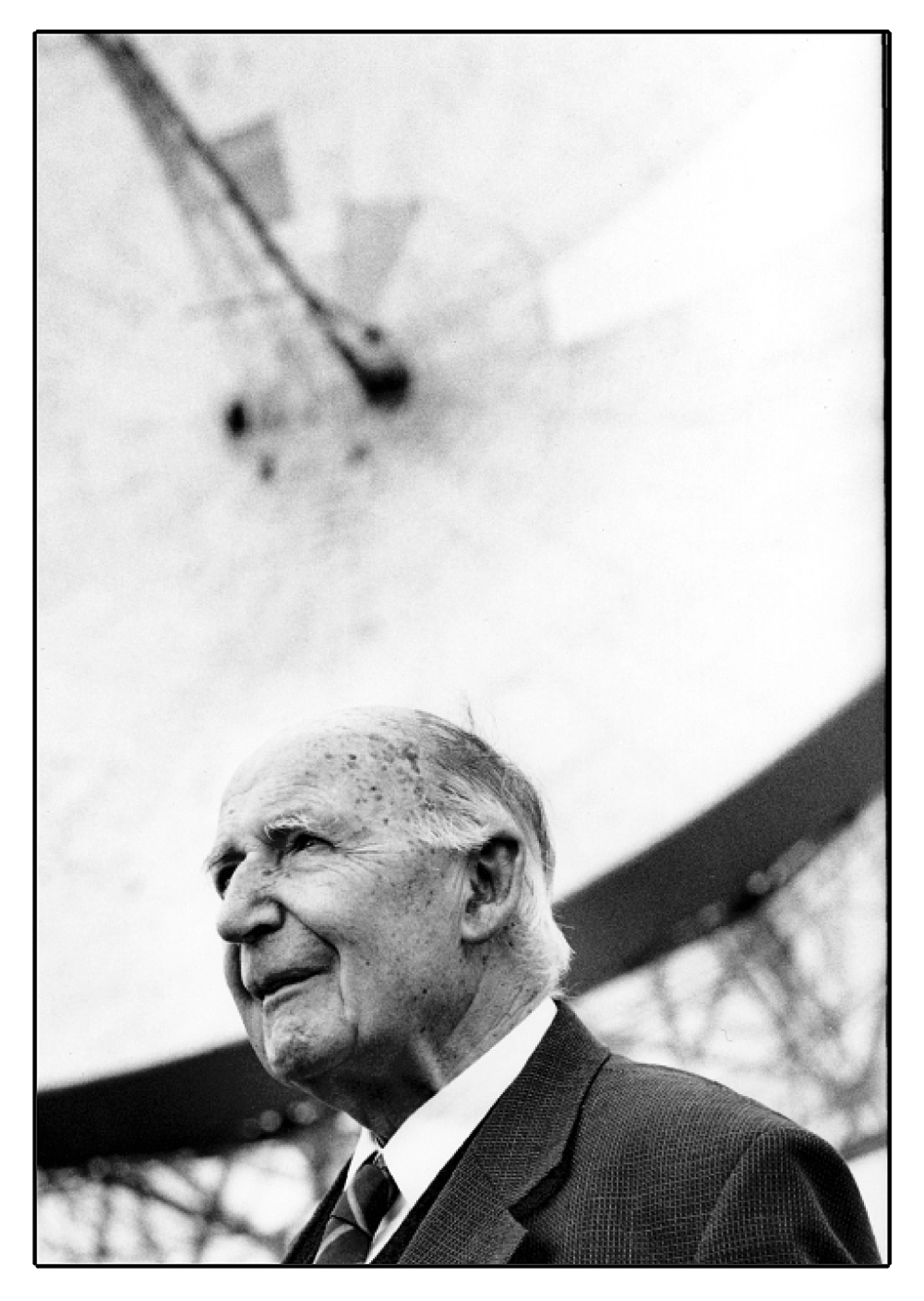
British physicist and radio astronomer Bernard Lovell, who founded the Jodrell Bank Observatory of the University of Manchester, UK, died on 6 August aged 98.

Lovell directed the observatory from 1945 to 1980, and in 1957 oversaw the construction of its iconic telescope — then the world’s largest fully steerable radio telescope — which opened in time to track the launch of the first artificial satellite, Sputnik 1. He also worked on radar and cosmic rays, and was knighted in 1961 for his contributions to radio astronomy.

In the short story “The Moon Match” (from Summer Days: Writers on Cricket), Lovell writes how cricket punctuated his memories of Russia’s Luna 2, the first satellite to reach the surface of the Moon.  Just after Saturday lunchtime on 12 September 1959, he had set off for a cricket match when — according to the story — a child signalled that he stop his car: “You must come back, you’re urgently wanted on the phone.”

It was a reporter asking what Jodrell Bank was doing about the launch that Moscow had just announced. “I am going to play cricket,” Lovell replied — and he did. At the tea break, he arranged to check back at the observatory that evening. He unlocked his office to find a message from Moscow on the telex machine, the paper “streaming out on the floor”, giving him all the details to track Luna 2 ‘s Moon impact the next day.

More details about Lovell’s life and career in the Jodrell Bank Centre for Astrophysics announcement of his death.

NASA releases rover’s eye view of Mars landing

Curiosity's heat shield drops away as the rover images its own descent to Mars{credit}NASA/JPL-Caltech{/credit}

What’s better than landing on Mars?  If you’re Michael Malin, head of the Mars Decent Imager (MARDI) on board NASA’s Curiosity rover, the answer is shooting video as you take the plunge.

At an 6 August press briefing at the Jet Propulsion Laboratory in Pasadena, California, Malin proudly unveiled this preliminary look at what it’s like to be in the driver’s seat when touching down on another planet. Malin first imagined the camera that could do the job more than a decade ago, and he has been waiting to try it ever since.

MARDI is attached to the underside of Curiosity. As the rover drifted down on its parachute during yesterday’s landing, the camera switched on automatically just 6 seconds before heat-shield separation.

After a few frames of darkness, the video shows the protective shield falling away. Down below, the rover’s landing site looms ever closer, erupting in a cloud of disturbed dust when the rover is close enough to blast the surface with its descent stage rockets.

The rover is then enveloped by the maelstrom of swirling dust, which settles out to reveal the pebbled surface of Gale Crater, just inches below the now-stationary camera.

“I never though there would be so much dust,” says Malin, “but otherwise it was pretty much as expected.”

The video is not just a visual record of the rover’s descent. The detailed view it offers of the area immediately around the landing site will serve as a guide during Curiosity’s first month or so of exploration, when it will confine itself to short traverses within a fairly small area around its landing spot.

The individual frames of the video taken just before the dust started to billow “are much higher resolution than we could get from orbit,” says Malin, “so they’ll be useful during the early stage of the mission.”

Today’s first glimpse of the video is just a teaser made up of a few low-resolution stills strung together like stop-action animation. Over the coming days and weeks, all the higher-resolution frames that MARDI captured will be relayed back to Earth and assembled into a less jerky and far sharper video of the descent.


Mars orbiter catches Curiosity by the tail

Curiosity has been caught in the act. Just a minute before landing, the HiRise camera aboard the Mars Reconnaissance Orbiter did what everyone was hoping for, and repeated the amazing feat of four years ago, when it snapped a picture of the parachute of the Phoenix lander. Alfred McEwen, principal investigator for the HiRise camera, had estimated that there was only a 60% chance of getting this image, which leaked on Twitter. The snap of Curiosity’s parachute is expected to be 5 times richer than the one for Phoenix, both because MRO was closer and Curiosity’s parachute was bigger.

Over the past few days, people here at the Jet Propulsion Laboratory in Pasadena, California have been fixated by an XBox video game that allows users to pilot in the rover themselves. And last night, it was the rich simulations of the landing sequence that held everyone’s attention. But it’s images like this, lonely and frail and beautiful, that get me. This is the real thing.

More details to come after the 9 am PDT press briefing.