All eyes on Venus

Will you be able to see the transit?

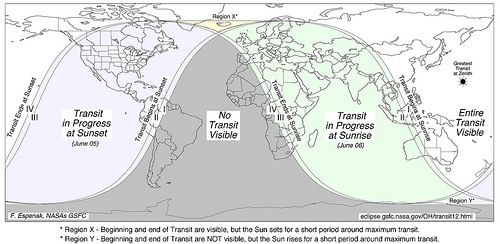
Telescopes around the world — and in space — will be aimed at the Sun today to catch the rare astronomical event of a transit of Venus. Our planetary neighbour crosses in front of the Sun (from the viewpoint of Earth, that is) only twice every 120 years or so.  The last time this happened was in 2004; it won’t happen again until 2117.

This has professional and amateur astronomers alike jumping up and down with excitement, getting out their welding goggles and pinhole cameras to watch the event from their back yards. For tips on when and how you might be able to spot the transit, see TransitofVenus.org.

If you are trapped beneath clouds or in a part of the world that won’t be able to see it, there are live webcam streams being hosted by NASA starting at about 2:45 p.m. Pacific time (5:45 Eastern time), and by the Slooh telescope network, with ‘pre-game’ commentary starting at 2:30 p.m. Pacific time (5:30 p.m. Eastern time). The entire transit will take about seven hours.

Although much of the excitement around this transit is aimed at public-outreach efforts aiming to get the public interested in astronomy, there is also some real science to be done. Astronomer and transit enthusiast Jay Pasachoff of Williams College in Williamstown, Massachusetts, wrote in Nature a few weeks ago about the science goals. These include trying to ‘ground truth’ detections of exoplanets circling far-off stars, and getting a once-in-a-lifetime measure of the climate of Venus. Although there’s a probe in orbit around Venus, this gets a very limited view of the planet’s climate: it can basically see the atmosphere in only one spot at a time, making it impossible to know whether the changes it sees are due to changes in space or changes in time. A simultaneous measure of the climate along an entire pole-to-pole line is measurable only today.

Check back here for updates.

UPDATE 1 (4:30pm Pacific time)
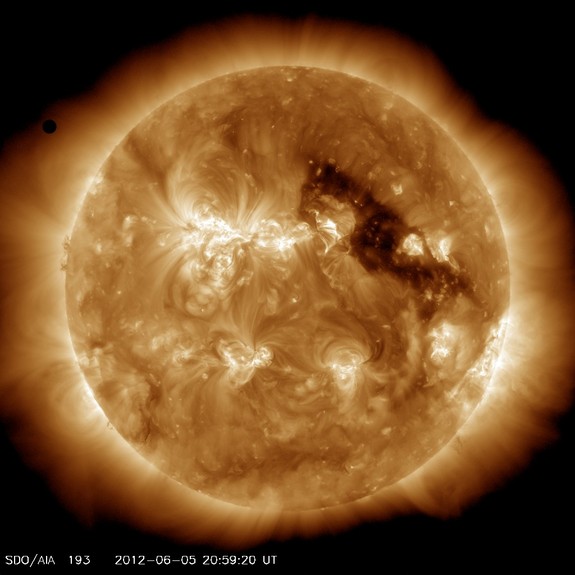
Venus approaches the Sun from on the upper left hand side{credit}NASA SDO{/credit}

As predicted, Venus started its path across the Sun at around 3 p.m. Pacific time. Some fantastic photos have been released already, including this spectacular one from the space-bound Solar Dynamic Observatory (SDO) of Venus approaching the Sun.

SDO’s observations are going to be used to calibrate a couple of instruments on the observatory, including confirming where exactly the ‘north pole’ of the Sun lies in its view, and measuring the ‘point spread function’ of its telescope — how much light leaks from one pixel into others around it. SDO should also be able to take its own measure of how much oxygen is in Venus’s atmosphere.

The weather is looking perfect for observations from Hawaii — one of the best spots for viewing this transit and the source of NASA’s main webcast.

UPDATE 2: 6 June

Hawaii didn’t just have clear skies for the transit — it had the perfect conditions, known as ‘coronal skies’. “I held my thumb up to block out the Sun, in the traditional test carried out by solar astronomers, and the sky was the same blue right up to the edge of my finger.  That shows how low the scattering in the sky was,” says Pasachoff. It was, however, very windy, he adds, so they took short exposures to lock in details before pictures were blurred by motion, and they will have a lot of post-processing to do.

A photo snapped from the International Space Station{credit}Don Pettit / NASA{/credit}

Positive reports of good measurements have already come in from Arizona, Udaipur, Japan and, for the last half of the transit, from Australia.  The site in the Marquesas in the South Seas had instrument problems, says Pasachoff. He has had no report yet from New Mexico, where astronomers were using a new carbon dioxide filter to study Venus’s atmosphere.

Perhaps one of the most novel observations comes from the International Space Station, where astronaut Don Pettit snapped a photo of the transit from the window (see picture).

The Hubble space telescope, which, like our own eyes was too sensitive to be pointed directly at the Sun, was aiming to gather information about Venus from the sunlight reflected from Tycho crater on the Moon. Likewise, the European Space Agency’s Very Large Telescope in Chile was aimed at the Moon to catch these reflections. There are no reports from either as yet. David Ehrenreich of French National Centre for Scientific Research in Grenoble says that they will get the Hubble data by the end of the week, though analysis will take months.

All in all, “we had a wonderful day, even better than expected or hoped for,” says Pasachoff. “At this point, it is not possible to say if anything surprising turned up.”

“We are exhausted after spending almost seven hours outside, but we feel great, and we can’t wait to look at our observations in detail.”

Dragon gets wet

The Dragon capsule splashed down to a successful landing in the Pacific Ocean just before noon Eastern time today, completing an up-and-down journey to the International Space Station. While this was done many times with the US space shuttle — and is still being done with Russian Soyuz capsules — the success of Dragon is significant because it is the first private, commercially owned vehicle to make that trip. The capsule, built by SpaceX, was launched on one of the company’s Falcon 9 rockets on 22 May, and docked with the space station last week.

SpaceX should begin in earnest now on 12 station resupply missions under terms of a $1.6 billion commercial cargo contract with NASA. The company has plans to certify the capsule for use by astronauts in the next several years.

At over $100 million per launch, Dragon is still not a cheap ride to the station. But it is a bargain basement price compared to the space shuttle, which according to a life-time analysis cost a whopping $1.5 billion per launch. The key difference is the way the rides are bought. The United States “owned” the space shuttle, but paid through the nose for commercial contractors such as Boeing to build it — under a procurement strategy called “cost-plus” that offered few incentives for contractors to find efficiencies.  SpaceX and other upstart companies want to sell rides into space not just to NASA but to anyone that wants one — and they want to sell those rides as the commercial airline industry does.

Image credit: Michael Altenhofen

Kavli Prizes for researchers who probed Kuiper Belt, phonons and human perception

The 2012 Kavli Prizes have been awarded to researchers who discovered the Kuiper Belt, probed the phonon and shaped our knowledge of the processes underpinning human perception.

Michael Brown, David Jewitt and Jane Luu have been awarded the 2012 astrophysics prize for their work on the Kuiper Belt. The prize committee says that their research on discovering and characterizing the belt “led to a major advance in the understanding of the history of our planetary system”.

Jewitt, of the University of California, Los Angeles, and Luu, of the Massachusetts Institute of Technology (MIT) Lincoln Laboratory in Lexington, were just yesterday awarded the Shaw Prize for this work, which included detecting the first object in what is now called the Kuiper Belt and then adding many more. Brown, of the California Institute of Technology in Pasadena, built on this to detect Eris, a planet-sized body in the belt.

The neuroscience prize was also split three ways, between Cornelia Bargmann, Winfried Denk, and Ann Graybiel, for their work on the neuronal mechanisms underpinning perception and decision making. Bargmann, of the Rockefeller University in New York, is cited for her work with nematodes; Denk, of the Max Planck Institute for Medical Research in Heidelberg, Germany, for his research on how information is transmitted from eye to brain; and Graybiel, of MIT, for work on habitual behaviours.

The Kavli nanoscience prize goes to Mildred Dresselhaus of MIT in Cambridge, who worked on synchronized vibrations at the atomic level known as phonons, and their interaction with electrons. “Over more than five decades, Dresselhaus has made multiple advances in helping to explain why the properties of materials structured at the nanoscale can vary so much from those of the same materials at larger dimensions,” says a statement from the prize team.

The Kavli prizes are awarded every two years by the Norwegian Academy of Science and Letters, the Kavli Foundation and the Norwegian Ministry of Education and Research. Winners receive a gold medal, a scroll and a share of US$1,000,000 in each category.

CORRECTED 1/6 – This blog originally listed Luu as being at MIT in Cambridge. In fact she is at MIT’s Lincoln Laboratory in Lexington.

Primitive space objects and protein folding take Shaw prizes

The Shaw Prize Medal{credit}Wikimedia Commons{/credit}

Two European and three US-based scientists have shared this year’s three Shaw prizes, each worth US$1 million. The prizes were established in 2004 by Hong Kong media mogul Run Run Shaw (who turns 105 in November) and are given for astronomy, life sciences and medicine, and mathematics, in recognition of those whose breakthroughs have “resulted in a positive and profound impact on mankind”.

David Jewitt, at the University of California, Los Angeles, and Jane Luu, at the Massachusetts Institute of Technology Lincoln Laboratory in Lexington, Massachusetts, share the astronomy prize for their “discovery and characterization of trans-Neptunian bodies” — objects in the outer reaches of the Solar System, such as the chilly and mysterious Quaoar.

The life sciences and medicine award was shared by Franz-Ulrich Hartl at the Max Planck Institute of Biochemistry in Martinsried, Germany, and Arthur Horwich at Yale University in New Haven, Connecticut, for their work on the understanding of protein folding. For that same work, the pair also won the 2011 Lasker award for basic medical research; surely a Nobel cannot be far away.

Russian-born Maxim Kontsevich, at the Institute of Advanced Scientific Studies near Paris, France, took the mathematics prize for his “pioneering works in algebra, geometry and mathematical physics and in particular deformation quantization, motivic integration and mirror symmetry”. He has already won the Fields Medal and the Crafoord prize for his work.

The prizes will be awarded on 17 September 2012.

CORRECTED 1/6 – This blog originally listed Luu as being at MIT in Cambridge. In fact she is at MIT’s Lincoln Laboratory in Lexington.

Extraterrestrial-intelligence pioneer Jill Tarter retires

After 35 years, astronomer Jill Tarter (pictured) is retiring from the Search for Extraterrestrial Intelligence (SETI) — a field she helped to pioneer and popularize, most recently at the SETI Institute in Mountain View, California. Tarter, who inspired the late Carl Sagan to create Ellie Arroway, the fictional heroine of the novel and movie Contact, says that she will instead focus her efforts on what she calls “the search for intelligent funding”.

“Last year’s hibernation was a real wake-up call,” she explains, referring to the seven-month shutdown of the institute’s Allen Telescope Array in northern California, triggered when its partners at the University of California, Berkeley, withdrew from the project (see Nature 475, 442–444; 2011). The array was reopened in December after the institute put together a ‘crowdsourcing’ website, SETIStars, and raised more than US$200,000 from individual donors. But that was a best a stopgap, says Tarter: “If we don’t get funding under control,” she says, “we’ll be a SETI Institute that doesn’t do SETI.”

The institute’s research programme costs about $3 million a year, says Tarter. “So our first priority is to establish an endowment that can provide that kind of funding today, tomorrow and a century from now.” (Federal funding has been out of the question since 1993, when Congress slashed SETI from the NASA budget with extreme prejudice; politicians simply cannot resist the temptation to ridicule the search as a quest for ‘little green men.’) Using the standard 5% rule-of-thumb for interest, that means raising at least $60 million. “But what’s interesting to me,” says Tarter, “is that, at any given time, there are more than a hundred campaigns underway in the United States to raise that much for a lab building, or a concert hall. So it’s clearly not an impossible amount to raise.”

It’s not a job for amateurs, though: Tarter plans to assemble a group of experienced fund-raisers for her campaign — “people with the equivalent of large Rolodexes,” she says, “who figure that SETI is too important to fail.”

Fortunately, adds Tarter, when her hoped-for donors ask what their money is buying, she will be able to point to a substantial upgrade in the Allen Array’s search capabilities being spearheaded by Gerald Harp, her successor as head of the SETI Institute’s search programme. In the months since the restart, that programme has mostly been listening for artificial signals in the same patch of sky being scanned by NASA’s Kepler satellite, which has already found more than 60 confirmed planets there, plus thousands more candidate planets. Right now, the array can listen to only three stars at once. But this summer, Harp is planning to test a signal-analysis method that would allow it to do simultaneous, low-resolution scans of many more stars — which means that the array could efficiently carry out targeted searches and wide-field surveys at the same time.

“We always reserve the right to get smarter, and do new things,” notes Tarter, who will be feted in June at the SETI Institute’s SETIcon II festival.

Image courtesy of Seth Shostak


European Mars missions still alive

The first stage of a European mission to Mars is still limping towards a 2016 launch, even though the European Space Agency (ESA) has not yet raised full funding for the mission, Jean-Jacques Dordain, ESA’s director general, told Nature today at a global space-exploration conference.

The suite of Mars missions — which is to include an orbiter as well as landed elements following launches in 2016 and 2018 — was originally a joint plan with NASA. In that formulation, a rover, launched in 2018, would have marked the beginning of a Mars sample-return mission architecture.

But NASA pulled out after the administration of US President Barack Obama deemed the plan too costly a commitment. Picking up the pieces after the divorce, Dordain was able to keep the mission alive in part by bringing Russia into the fold. Russia will contribute Proton rockets for the launches in 2016 and 2018. But Dordain says he is still €350 million (US$440 million) short of the estimated €1.2-billion cost of the mission.

He is trying to raise those funds in multiple ways, including asking existing member states to pay more, and also through the recruitment of new ESA member-states. Although he is not yet confident enough to say the mission will go ahead, he also is unwilling to give up. He hopes to have more funding commitments lined up before an ESA meeting next month.  “I cannot in three months re-plan everything we had built up in three years with NASA,” he says. “I need time.”

Image credit: ESA

Russia and Japan aim for the Moon

It was a rare confluence — the heads of the space agencies for Europe, Canada and Russia, along with senior representatives from the space agencies of India and Japan — all up on the dais together at a hotel in Washington DC, where they were on hand on 22 May to talk about the benefits of international collaboration at the Global Space Exploration Conference.

Interestingly, the leader of the space agency whose headquarters is just a few blocks away was not on the stage. That’s because NASA administrator Charles Bolden was in Florida, watching the attempt by SpaceX to send its Dragon capsule to the International Space Station.

But perhaps it was somewhat appropriate for NASA to be absent. Increasingly, the agency has had a hard time consummating its joint ventures, and Europe in particular has had to turn elsewhere for partners.

NASA has also shifted its exploration goals relative to other nations. While NASA now intends to pursue manned missions to asteroids, representatives of several other space agencies reiterated that the Moon was still squarely in their sights.

Vladimir Popovkin, the head of Roscosmos, the Russian space agency, said that Russia will pursue extensive, long-lived operations at the Moon’s surface. “We’re not talking about repeating what mankind achieved 40 years ago,” Popovkin said, through a translator.  “We’re talking about establishing permanent bases.” Similarly, JAXA, the Japanese Space Agency, issued a clear pronouncement about targeting the Moon.  “We are looking at the Moon as our next target for human exploration,” said Yuichi Yamaura, an associate executive director at JAXA.

China was another conspicuously absent member of the aerospace club as represented on stage. Those present were asked whether they should be doing more to collaborate with China.  “We’re all for it,” says Popovkin. “We have to talk to China.” Steve MacLean, the president of the Canadian Space Agency, described how impressed he was by China’s space operations after a recent visit. He says it would be “prudent” to explore more collaboration.

Space X launches Falcon 9

This morning, the first commercial space launch to the International Space Station (ISS) lifted off from Cape Canaveral in Florida. It was launched by SpaceX, and will carry the company’s Dragon capsule, containing some 460 kilos of supplies, to the space station crew.

The Falcon 9 rocket runs on a mixture of liquid oxygen and kerosene. It is essentially a larger version of the company’s Falcon 1 rocket, which first reached orbit in 2008.

The launch is a huge success for SpaceX, which hopes to eventually play a major role in supporting the ISS. It is also a vindication for NASA, which has invested millions in commercial companies in recent years.

This is just the start of the mission, however. Over the next few days, the Dragon capsule will perform a number of maneuvering tests. It will then move near enough to the ISS to be snagged by the station’s robotic arm and guided in for docking. The supplies will be unloaded, and the capsule will be filled with a variety of cargo for transport back to earth, including several experiments that have languished on the station.

After 18 days at the space station, the capsule will undock and return to earth, splashing down in the Pacific Ocean. Only when the capsule is bobbing in the waves will the Dragon’s flight be considered a complete success.

 Image: NASA TV

Tally of most hazardous asteroids doubles

A snapshot of the population of near-Earth objects and PHAs that scientists think are likely to exist. {credit}NASA{/credit}

NASA’s efforts to scan the skies for asteroids that could pose a danger to Earth have found twice as many sizeable chunks of space rubble making close approaches to the planet than previously predicted.

The US space agency announced on Wednesday that its asteroid-hunting mission, NEOWISE, performed by the Wide-Field Infrared Survey Explorer satellite telescope, had made its “best assessment yet” of the Solar System’s population of potentially hazardous asteroids, or PHAs.

PHAs are the subset of  near-Earth objects that have the closest orbits to that of our planet — coming within 8 million kilometres — and are also large enough to survive hurtling through the atmosphere to cause damage on a regional or greater scale. An earlier analysis by NEOWISE pegged the number of near-Earth objects at 20,500, fewer than had been predicted.

NEOWISE looked at 107 PHAs to make predictions about the wider population. The new estimates indicate the existence of some 4,700 PHAs, plus or minus 1,500, with a diameter wider than 100 metres. An asteroid of that size could destroy a metropolitan area or cause a major tsunami.

Roughly 20–30% of the PHAs out there have been found. A total of 843 planet-killers have been discovered, but just 152 are classed as PHAs. Similar estimates have been made in the past, but NASA describes them as just “rough approximations”. “Neowise has generated a more credible estimate of the objects’ total numbers and sizes,” the agency says. “The results reveal new information about their total numbers, origins and the possible dangers they may pose.” The data behind the analysis were collected before WISE was put into hibernation last year.

Although there are fewer near-Earth objects than earlier believed, the projections also indicate that there are about twice as many PHAs as previously thought that have “lower-inclination” orbits, which are more aligned with the plane of Earth’s orbit and so are more likely to hit the planet. According to NASA, this may mean that this subgroup of near-Earth objects is slightly more hazardous than had been thought.

It’s not all bad news for planetary defence, however. The results also mean it may be easier to access these asteroids in future robotic or human missions. “The NEOWISE analysis shows us we’ve made a good start at finding those objects that truly represent an impact hazard to Earth,” says Lindley Johnson, programme executive for the Near-Earth Object Observation Program at NASA headquarters in Washington DC

“But we’ve many more to find, and it will take a concerted effort during the next couple of decades to find all of them that could do serious damage or be a mission destination in the future.”

Canadian satellite system under budget cloud

Posted on behalf of Hannah Hoag.

Missed deadlines and an underfunded Canada Space Agency (CSA) may scuttle plans to build the next generation of earth observing satellites, according to the Canadian satellite company pegged to build them.

In 2010, the CSA selected MacDonald, Detwillier and Associates Ltd. to design the successor to Radarsat-2, the agency’s current earth observing satellite. The company came up with a three-satellite system that would provide information for maritime surveillance, disaster management and ecosystem monitoring. But Dan Friedman, the company’s president and chief executive officer, says the federal government missed a target deadline for awarding the building contract in January, according to a story in the Globe and Mail and the CSA may not have enough money for the project.

The Radarsat Constellation calls for three satellites (scalable to six) to maintain a polar orbit and provide radar images of nearly all of Canada’s land and waters. The Constellation would monitor ice and icebergs, winds and oil pollution in shipping lanes and coastal zones on a daily basis. It would also provide information on the state of Canada’s forests, changes to vegetation in protected areas and important wildlife habitat, and monitor wetlands and coastal change.  Unlike Radarsat-2, which is owned by MDA, the Canadian government would own Constellation.

Canada’s Earth observing satellites, Radarsat-1 and -2, have been important in mapping natural disasters, such as the 2011 flooding in Queensland, Australia, as well as the Antarctic’s glaciers and ice sheets. including a subsurface view of the ice-covered Lake Vostok.

Continue reading