Want to find investors for your research idea? Change the way you pitch

A fundraising pitch involves vastly different style and substance than a scientific talk. Entrepreneurial scientists and engineers need to understand and manage the differences.

In a funding pitch, complexity is your enemy — no matter how significant the science

By David Rubenson, Wendie Johnston and Ned Perkins.

Many scientists hope to translate their discoveries into something useful and financially profitable. A biologist, for example, might hope to create a new line of health care products. Many use special grants or family resources to establish small companies. However, given the enormous challenges in the healthcare market, virtually every nascent enterprise needs outside funding; whether from wealthy “angel investors,” venture capital, or investment from large pharmaceutical and device developers. Continue reading

Selling yourself: 7 sales techniques to advance your career

In an increasingly competitive job market, knowing how to properly sell yourself as a candidate may give you the edge, says Kristopher James Kent.

In certain circles, ‘sales’ has become taboo; the word summons memories of double glazing, cleaning supplies, or accidents that weren’t your fault. Despite this, a great salesperson simply believes in their product, and knows how to portray its finer points in an effective way.

Similar knowledge could give you the edge in applying for your next job or promotion. Sure; having the requisite qualifications and soft skills (being personable, confident, organised) is essential, but understanding your own value, and knowing some of the finer skills that salespeople use in their pitch, may help you to better present yourself to an employer.

FullSizeRender-small

Continue reading

Careers in industry: How to make a good elevator pitch

Preparing a key message, and demonstrating enthusiasm and passion will certainly get you noticed, say speakers at the 2015 London Naturejobs Career Expo.

Top tips:

  1. Use your network to find out about different jobs that you think you would be interested in or good at.
  2. Think about the key points and skills that you have that will catch someone’s attention.
  3. Provide examples of how the skills have been demonstrated.
  4. Rehearse your pitch before interviews/conferences to non-scientists, family and friends and ask for feedback.
  5. Break the conversation if there is no interest. Say thank you very much, and move on.
  6. Tailor your pitch to who you speak to.
  7. Get across your passion for what it is that they are interested in.
  8. Make sure that you make it clear what you want from the conversation, whether it’s information or another interview.

Further reading:

Careers in industry: The options.

Careers in industry: How to transition into a new field

Public speaking: The elevator pitch

Understand your audience and tailor your message accordingly when planning a 2-minute speech.

Every Thursday morning my alarm goes off at 6am. I get up, shower and dress in a sleepy daze before cycling over to Covent Garden in central London, UK. Instead of a cup much-needed coffee to wake me up, I do some public speaking. It’s the best morning wake up you’ll ever get.

A few years ago I joined Toastmasters, an international group of public speakers that help each other develop their speaking skills. It’s a group that feeds on evaluations; every Thursday morning all speakers at our club (Early Bird Speakers) are evaluated so that everyone can learn from someone else’s performance. In April I was tasked with a two-minute elevator pitch, addressing and inspiring the UK’s brightest A-level students. Here’s what I told them:

https://youtu.be/Ib4No3zOMjg

I’m not sure whether this would have inspired the nation’s A-level students, but it inspired me to think about how to properly prepare an elevator pitch and how they benefit scientists. With some effort, scientists and researchers can compose an elevator speech to sell their science to a classroom full of 6 year olds, a neighbour, a potential employer or a politician. Continue reading

Speed Networking for early career researchers

Contributor Gary McDowell, Tufts University Postdoctoral Association President

Graduate students and postdocs tend to spend the majority of their time at the bench, believing that this is the only path towards getting a job. The reality is that in the current job climate, most jobs are found through the networks that we build and the people we meet; up to 80% of the jobs people get are not publicly advertised. Many institutions and science organizations now regularly include networking events as part of meeting and conference schedules.

If this is something you might like to do, please let me know.

{credit}Image courtesy: Gary McDowell{/credit}

At Tufts University, our Postdoctoral Association recently tried a variation on this which is becoming more common in the business world: “Speed Networking”.

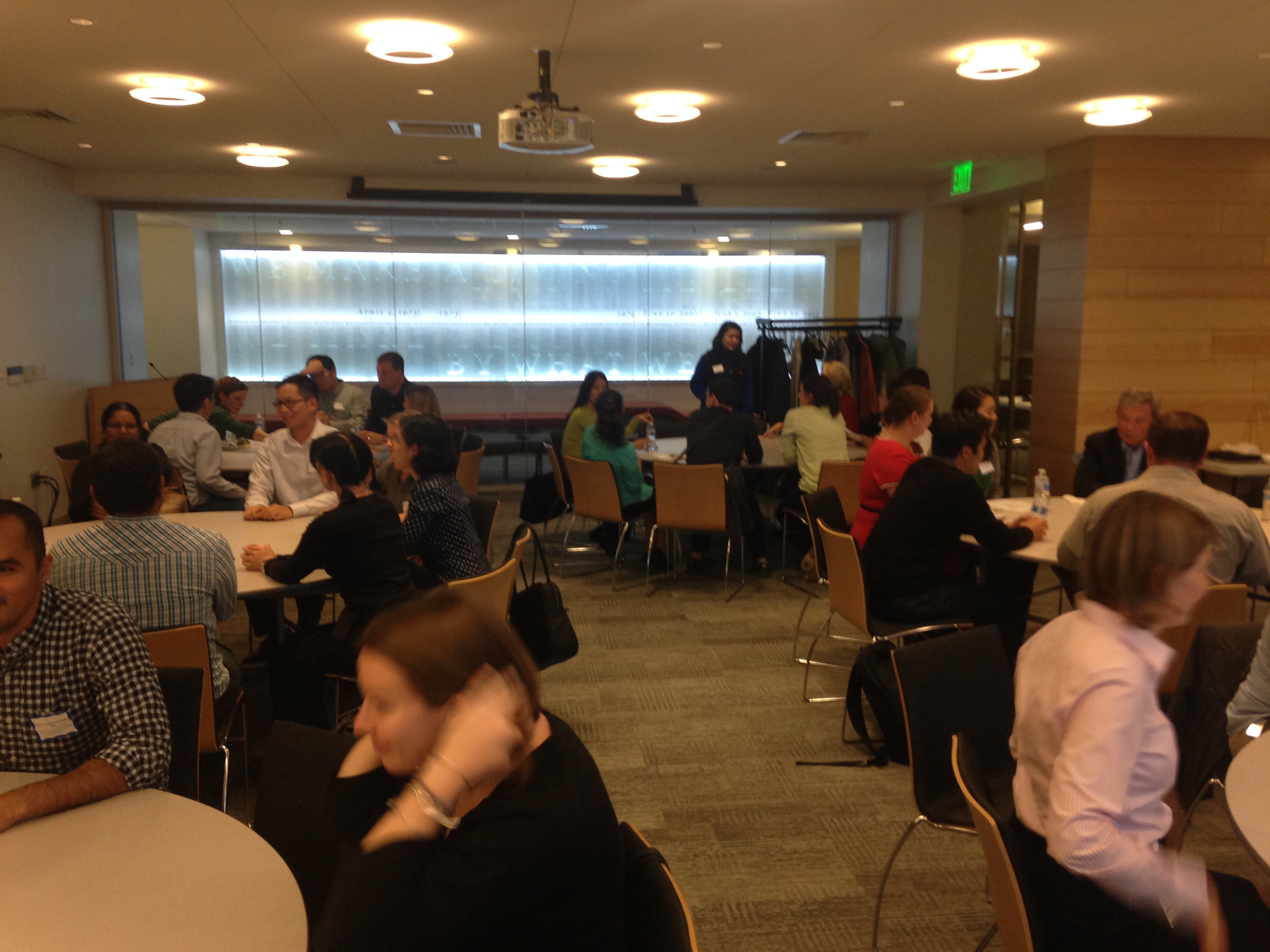
For those with experience of the cultural phenomenon of “speed dating”, the premise will be familiar.  35 postdocs and grad students were divided up into groups “dating” 15 professionals at themed tables: academia; industry; patent law; journal editing; regulatory affairs; business development; and administration. For 10 minutes, questions and conversations were exchanged to give students and postdocs an idea of some of the work involved in different careers and areas where they could build relevant experience for a particular role. Then, appropriately, a lab timer would beep and each group of postdocs and grad students would get up and rotate to another table. After everyone had met, there was time and space for more one-on-one networking. Contact details were made freely available afterwards to attendees, to get in touch and connect with professionals who most engaged them in discussing career aspirations. Continue reading