Scientific presentations: A cheat sheet

Scientific culture and insufficient training in public speaking leads to dull, text-heavy talks. Put more effort into presentations, say Andrew Gaudet and Laura Fonken

As postdocs with a combined 20 years of experience in neuroscience research, we’ve attended hundreds of talks and delivered dozens of presentations. We’ve realized it is imperative to perform your best every time you present — whether at a weekly meeting or at a job interview.

Your preparation and organization will help the audience understand your main points, and this professionalism will boost your reputation, which could lead to further opportunities. Ultimately, a presentation is one of the ways of influencing how others perceive your science and your competence. Here, we’ve put together some ideas for creating polished presentations.

presentation-1559937_1280

Continue reading

Finding job satisfaction as a science communicator

Yuko Ueno planned to work in science communication…

…But a supervisor suggested that gaining first-hand research experience might make her a better communicator. Today, she sells workshops to companies, schools and universities and teaches science to Sunday-school students at a private academy in Tokyo.

Smriti Mallapaty catches up with her to learn more.

yuko-smaller

Yuko Ueno

Continue reading

Public speaking: The elevator pitch

Understand your audience and tailor your message accordingly when planning a 2-minute speech.

Every Thursday morning my alarm goes off at 6am. I get up, shower and dress in a sleepy daze before cycling over to Covent Garden in central London, UK. Instead of a cup much-needed coffee to wake me up, I do some public speaking. It’s the best morning wake up you’ll ever get.

A few years ago I joined Toastmasters, an international group of public speakers that help each other develop their speaking skills. It’s a group that feeds on evaluations; every Thursday morning all speakers at our club (Early Bird Speakers) are evaluated so that everyone can learn from someone else’s performance. In April I was tasked with a two-minute elevator pitch, addressing and inspiring the UK’s brightest A-level students. Here’s what I told them:

https://youtu.be/Ib4No3zOMjg

I’m not sure whether this would have inspired the nation’s A-level students, but it inspired me to think about how to properly prepare an elevator pitch and how they benefit scientists. With some effort, scientists and researchers can compose an elevator speech to sell their science to a classroom full of 6 year olds, a neighbour, a potential employer or a politician. Continue reading

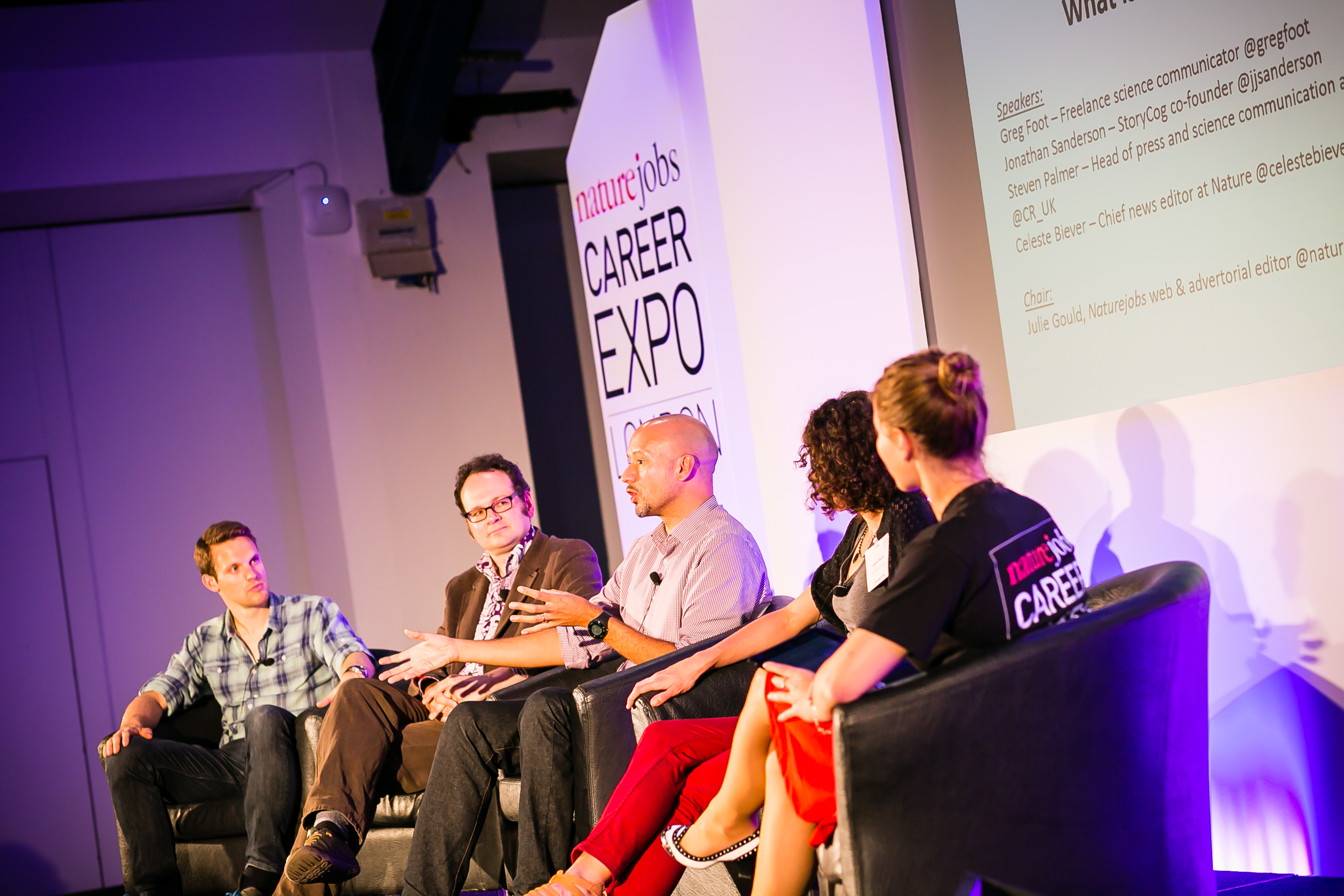
What isn’t science communication?

Naturejobs-science-communication

L-R: Greg Foot, Jonathan Sanderson, Steve Palmer, Celeste Biever, Julie Gould

Things to consider if you’re thinking about working in the field of science communication.

Contributor Samuel Brod

“A full house”, someone muttered as a besieged looking member of staff rushed out extra chairs for the hundreds of researchers filtering their way into the auditorium. Sci-comm, as it’s often termed, seemed a hot topic this year. A panel at the London Naturejobs Career Expo on September 19th, 2014 asked the question: What is science communication?  The panelists were Steve Palmer, Cancer Research UK; Jonathan Sanderson, StoryCog; Greg Foot, BBC; Celeste Biever, Chief news editor for Nature. Chair: Julie Gould, Naturejobs.

The talk began with the panelists describing their current jobs and how they’d found them, followed by a more general discussion around pursuing a career in science communication. On stage, the panel was at ease and their comments often induced laughter from the crowd, not out of politeness but genuine amusement. Within the audience, there was a definite sense of expectation–it seemed that they were waiting for answers. Continue reading