
Enterprising early career researchers get some high-level mentoring to handle the rough and tumble of the boardroom. David Payne meets finalists in the 21st annual Young Entrepreneurs Scheme (YES)
Epitome is a Singapore biotech start-up whose product pipeline is based on engineered tail proteins to tackle bacterial diseases. It wants a slice of the US’s $6bn acne market. Epitome’s founders are seeking raise $10m to build a factory where its cosmetic products can be manufactured. Investors will be rewarded with a seat on its board.
The launch team describe the company at a presentation attended by other young entrepreneurs. They brace themselves for some tough questions from a judging panel. One judge asks how a factory can be built for $10m Another challenges the team’s plan to launch an acne treatment as a cosmetic product, which means they won’t mention acne on the label (the team adopted this approach to make the US regulatory process more straightforward).
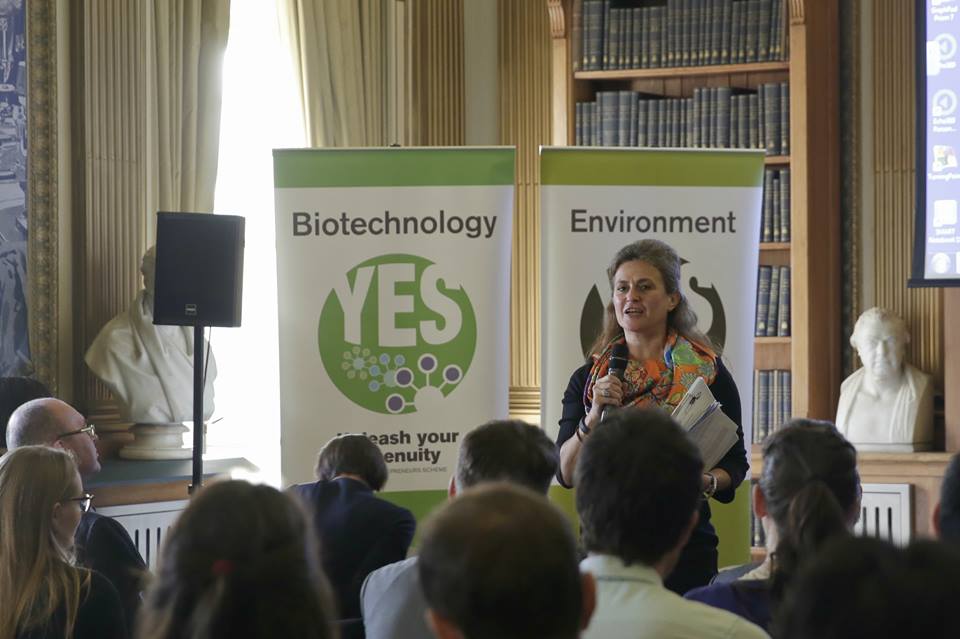
Elena Lurieluke, Head of Global Life Sciences Open Innovation, Corporate R&D at P&G, addresses fellow YES judges and finalists.
The Epitome team are ready for these and other questions. The same goes for Cutico, a company which plans to manufacture waterproofed paper cups that can be recycled in light of a UK government proposal to levy a 5p tax on cups that end up going to landfill. The French have already legislated to ban the sale of non-recyclable cups by 2020. It plans to trial its product at branches of Starbucks in London. Sounds good, but will it make Starbucks coffee taste any better?, one judge asks.
Epitome and Cutico were just two of 15 “hypothetical” or fictional businesses that reached the finals of the 2016 Young Entrepreneur Scheme (YES), which took place at the Royal Society in London this week. The competition gives early career researchers practical insights into how to commercialise research and collaborate with industry, and encourages them to think on their feet (as they would have to if faced by potential investors or shareholders) by presenting in front of an audience and a panel of judges. Launched by the University of Nottingham and the UK Research Council 21 years ago, YES now has more than 5000 alumni, many of them occupying senior positions across industry and academia.
Alicia Greated is one of them. She recently joined Heriot-Watt University, Edinburgh, as director of research and enterprise. A 1997 YES participant, her international career has included programme delivery of the UK’s £275m Newton Fund for science and innovation partnerships. “YES definitely raised my awareness of enterprise and entrepreneurship and provided one of my first chances to practise presentation skills,” she says.
In 2008 Kev Dhaliwal and his team took the concept of an optical light-detecting cancer path to YES. The idea led to him founding Edinburgh Molecular Imaging. He says of the experience: “I’d never had business training before, so doing YES, learning about the spin-out process and simulating being part of a company were all good practice.”
Ranmali Nawaratne, a senior technology transfer business manager at The Francis Crick Institute in London, now mentors YES teams. Her team, which entered in 2002, proposed genetically modifying cut flowers using arctic jellyfish proteins so they could grow in colder temperatures.
Mentorship is an important component of YES, as it is in science generally. Since 2005, Nature has recognized model mentors around the world with the Nature Awards for Mentoring in Science. The awards focus on a different country or countries each year. Editor-in-chief Phil Campbell describes this year’s winners.
But what does it take to be a mentor? Nirmala Hariharan, adjunct assistant professor at UC Davis’ School of Medicine, provided some clues in a Naturejobs blog post published in February 2016. Paul Smaglik argued in an article published in the same month that principal investigators serve as bosses, role models, teachers and technical advisers, but those tasks often prevent them from filling the role of mentor .
Perhaps they should access Nature’s guide for mentors, published in 2007, or at least some top tips, which this toolkit article aims to do. Lucy Godley, an assistant professor of medicine at the University of Chicago, found the mentoring process daunting when she first started out, but who knows – one of your mentees might become a Nobel Laureate. Three of them describe their experience of being mentored in a Naturejobs blog post published in July 2015.
David Payne is Nature‘s chief careers editor
Suggested posts
Why building a start-up is probably your most sensible career path
Jobs of the Future: What will a science career look like in 2030?