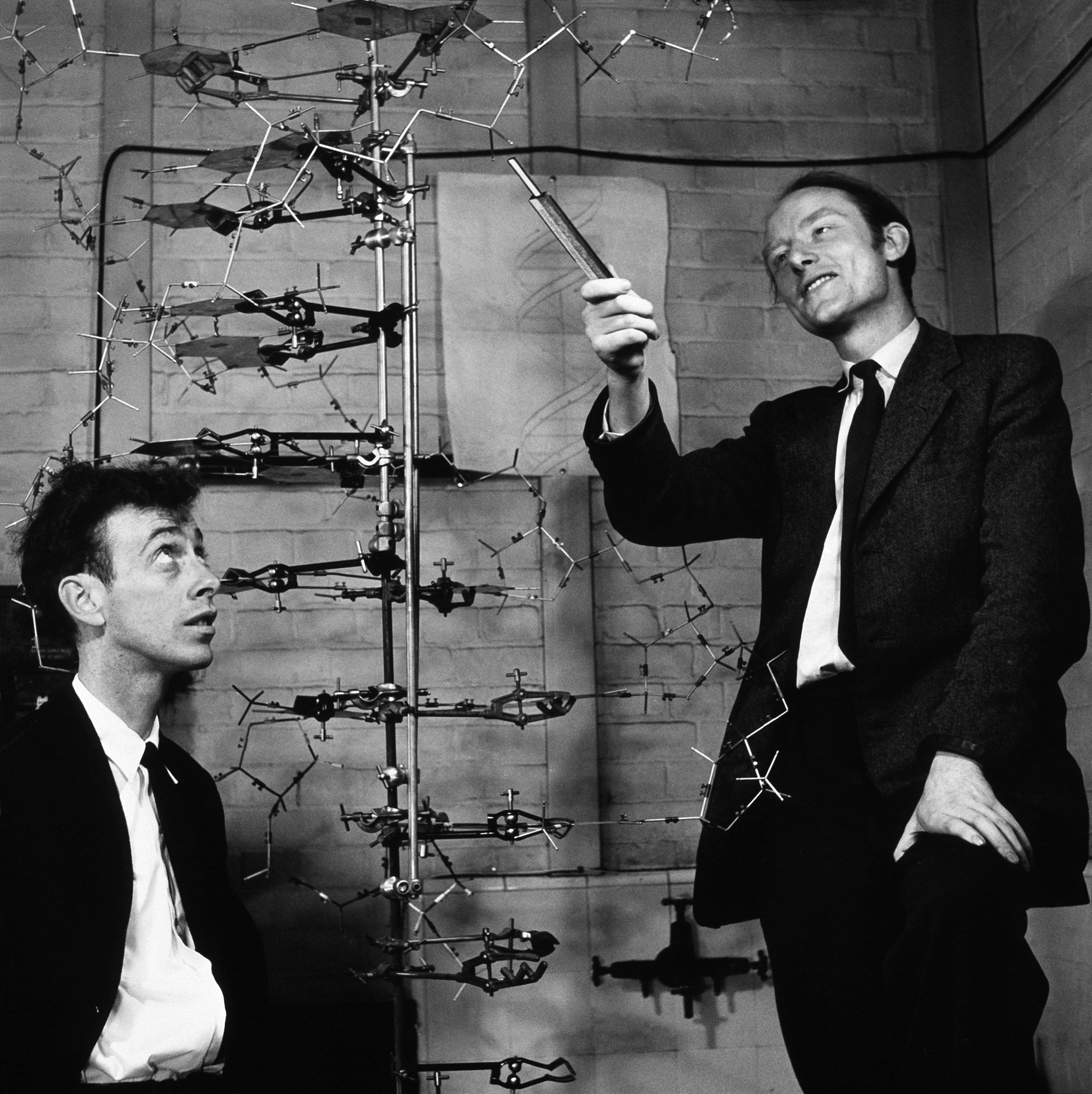
Happy DNA Day!

Watson-Crick-DNA-model

“It has not escaped our notice that the specific pairing we have postulated immediately suggests a possible copying mechanism for the genetic material”

Today is the 61st anniversary of the publication of the structure of DNA in Nature by James Watson and Francis Crick. Even though there are no traditional activities for this day, we hope you celebrate it doing something fitting (sequencing your genome, perhaps?).

The U.S. National Human Genome Research Institute has a National DNA Day website geared toward teachers and students, with a host of educational materials and activities centered around DNA Day.

For a little bit of history, you can also read a letter Francis Crick wrote to his son about the discovery of the structure of DNA here. In New York City, students celebrated the occasion by submitting their DNA to the National Genographic project, revealing the diversity of genetic origins amongst New Yorkers.

And finally, if you want to celebrate how far we’ve come since 1953 (and you have a ton of time to waste), you can try your hand at 2048-exome. Sure, maybe you can sequence a whole exome, but can you get to the Nature Genetics tile?


Follow me on Twitter @Brooke_LaFlamme

Cancer: what’s Down syndrome got to do with it?

A Wright's stained bone marrow aspirate smear of patient with precursor B-cell acute lymphoblastic leukemia.

A Wright’s stained bone marrow aspirate smear of patient with precursor B-cell acute lymphoblastic leukemia. {credit}VashiDonsk via Wikipedia{/credit}

Trisomy 21 (having 3 copies of chromosome 21) is most well known as the cause of Down syndrome. But as you can imagine, having an entire extra copy of a chromosome has other negative consequences as well. For one, people with Down syndrome are 20 times more  likely than the average person to develop a severe form of leukemia, B cell acute lymphoblastic leukemia (B-ALL). Two recent studies have helped further our understanding of the molecular disturbances that take place in trisomy 21.

In Nature, Audrey Letourneau et al. took advantage of a rare situation to identify the genes that are misregulated in Down syndrome. The researchers profiled the transcriptomes of identical twins that differed in one crucial aspect: one twin had 3 copies of chromosome 21, while the other had a normal complement of chromosomes. (The samples were collected post-mortem from the fetuses, with the permission of the parents). This approach allowed the researchers to avoid any noise from irrelevant differences, since the genes of both twins would be identical. (Read the article in The Scientist about this study here).

Not surprisingly, they found that trisomy 21 causes gene regulation problems on all chromosomes. Misregulated genes are organized along the chromosomes in domains, and these domains were defined by changes to the chromatin methylation patterns. Importantly for future research efforts, they also showed that the corresponding genomic regions in the mouse model for trisomy 21 were similarly modified compared to control mice.

In a second paper published online this week by Andrew Lane et al. in Nature Genetics looked specifically at the relationship between Down syndrome and B-ALL.  The authors identified two genomic events as the drivers behind Down syndrome-related B cell acute lymphoblastic leukemia (B-ALL): overexpression of the nucleosome remodeling protein HMGN1 and changes in histone methylation marks. (You can read the Dana-Farber Cancer Institute’s press release about the study here).

Through a very meticulous set of experiments, they first show that just having an extra copy of a small region of chromosome 21 (or in this case, the corresponding mouse chromosome, 16) with 31 genes is sufficient for giving B cell precursors the ability to self renew indefinitely—the first step to cancer formation. From there, they identify and confirm a single driver gene on chromosome 21, HMGN1, as being expressed at unusually high levels. This high expression of HMGN1 causes a decrease in one type of methylation (H3K27me3), leading to overexpression of genes usually carrying both H3K27me3 and another histone mark, H3K4me3.

Trisomy 21 karyotype. All the normal chromosomes + 1.

Trisomy 21 karyotype. All the normal chromosomes + 1. {credit}Wikipedia{/credit}

Interestingly, the authors of Letourneau et al. mention HMGN1 as a good candidate for regulating the genome-wide chromatin modifications they found. The accompanying News & Views article by Benjamin Pope and David Gilbert note that HMNG1 should be a target of future study in Down syndrome. Looks like the authors of Lane et al. got the message far in advance!

So a pattern emerges: changes in chromatin methylation patterns are a key event in trisomy 21 overall and in Down syndrome-associated B-ALL specifically. Dr. Lane, lead author of the paper in Nature Genetics  wonders “Could this [chromatin modifications] be a unifying theme for phenotypes (not only cancer) associated with DS?” As I mentioned earlier, having 3 copies of this chromosome is bad for a number of reasons: higher risk of B-ALL and testicular cancer, vision and hearing problems, thyroid issues, higher risk of type I diabetes, gastrointestinal issues, low or no fertility and the more widely known neurocognitive isssues. Future studies on epigenetic changes in Down syndrome, and the regualtion of HMNG1, should be able to unravel the mechanisms underlying these different aspects of Down syndrome.

Outside of Down syndrome, these 2 studies may also lead to a better understanding of (and hopefully new treatments for) cancers caused by epigenetic changes. As the article by Lane et al. showed, changes to the chromatin landscape allowed B cell precursors to make that first step toward leukemia. By understanding how this happens, we can start to find ways to prevent it.

Highlights from the Keystone Symposium on Stem Cells & Reprogramming

View from the Resort at Squaw Creek. Not a bad place for a conference!

View from the Resort at Squaw Creek. Not a bad place for a conference!{credit}Brooke LaFlamme{/credit}

I recently attended the joint Keystone Symposium “Stem Cells & Reprogramming” and “Engineering Cell Fate & Function” at the beautiful Resort at Squaw Creek. In addition to gorgeous weather, there was an amazing lineup of talks demonstrating the power and promise of stem cells and cell/tissue engineering. Here are just a few of the highlights from the meetings:

Keynote: Optogenetics

Karl Deisseroth from Stanford University kicked off the joint meeting with an overview of his lab’s research in optogenetics and how they’ve used the technology both to control and map neuronal networks in live animals or intact tissues. The Deisseroth lab has used optogenetics to better understand the neuronal architecture and genetic structure underlying complex behaviors, such as those associated with anxiety. In his talk, Prof. Deisseroth outlined how they are using optogenetic tools to target neuronal wiring using Boolean-like genetic systems to identify neurons expressing specific combinations of markers.

The second part of his talk focused on CLARITY, a method developed in the Deisseroth lab to allow for 3D imaging of neurons in intact tissues or whole brains. You can see some of the amazing videos generated with this technique here.

To learn more, you can find a list of Deisseroth lab publications here.

Stem cells and reprogramming in human disease modeling and treatment

There were a ton of talks (and posters) demonstrating the utility of stem cells and directed differentiation for human disease modeling and treatment development. I’ll only mention a few here, but all the talks were excellent. Continue reading

A re-SMARCable finding

Paper cranes are the symbol for the Small Cell Ovarian Cancer center

Paper cranes are the symbol for the Small Cell Ovarian Cancer Foundation {credit}Brooke LaFlamme{/credit}

On March 23, Nature Genetics published 3 related papers reporting the finding that SMARCA4 is frequently mutated in a rare ovarian cancer type, small cell carcinoma of the ovary, hypercalcemic type (SCCOHT) [Jelinic et al 2014, Ramos et al 2014, Witkowski et al 2014]

The fact that 3 independent research efforts made virtually the same discovery is, in a sense, remarkable, but it is also a reflection of just how critical this mutation is to the development of SCCOHT.

SCCOHT is a bit of a misnomer. Despite the fact that it is called a “carcinoma,” the World Health Organization classifies it as a “miscellaneous tumor.” As Dr. William Foulkes, senior author of one of the papers [Witkowski et al 2014], says:

“Like the Holy Roman Empire (not Holy, not Roman and not an Empire) not all cases of SCCOHT contained small cells, the term carcinoma was somewhat arbitrary and a third of patients never developed hypercalcaemia.”

SCCOHT is an extremely rare, very aggressive ovarian tumor that is most common in young women and girls. Regardless of the fact that most patients present at an early disease stage, the majority die within 2 years of diagnosis. You can find more about this tumor type at the Small Cell Ovarian Cancer Foundation’s website. Because SCCOHT is so rare, each of the three studies relied on archival samples (formalin-fixed paraffin-embedded tissue) and used different strategies to identify the genetic landscape of the tumor.

Douglas Levine’s group at Memorial Sloan-Kettering Cancer Center in New York used a candidate gene approach, sequencing the coding regions of 279 cancer-related genes in 12 pairs of tumor/normal tissue. They found biallelic inactivating mutations in SMARCA4 in each of the 12 tumor samples. Even more interesting, there were virtually no other recurrent mutations in any cancer-related gene in the tumors. Where suitable tissue was available, they were also able to show that the protein product of SMARCA4 was absent in the tumors. To test the functional consequences of SMARCA4 loss, the group introduced the protein into a lung cancer cell line that lacks it. By reintroducing SMARCA4, they were able to suppress cell growth. Depleting SMARCA4 transcript from another cell line had the opposite effect. (Read more about this study here and here)

William Foulkes’ group at McGill University started with familial cases of SCCOHT and used whole-exome sequencing to identify mutations. Although they suspected SMARCA4 already from previous work, they used the whole-exome approach to, paradoxically, obtain higher quality tumor sequence data for SMARCA4 than they were able to by traditional Sanger sequencing. This had the effect of not only identifying mutations in SMARCA4 in all 4 affected families, but also allowed the researchers to conclude, as with Dr. Levine’s group, that there were no other strong candidate genes that could be drivers of SCCOHT. Luckily, whole-exome sequencing turned out to be possible with these archival samples. They extended their sequencing efforts to additional non-familial samples and looked for protein loss as well. In all, 38/40 tumors showed loss of SMARCA4 protein. Similar to the other studies, they found mutations throughout the entire length of the gene and found that nearly all samples carried SMARCA4 mutations. 

An interesting aspect of the paper by Witkowski et al. is that the authors propose a re-classification of SCCOHT to extra-cranial rhabdoid tumors instead of carcinomas based on both histology and the finding that SMARCA4 is the driving mutation. Dr. Foulkes characterized the findings as both a “game changer” for SCCOHT and a “name changer.” (read more about this study here and here)

Finally, a collaborative group led by David Huntsman and Jeffry Trent at TGen in Phoenix, AZ also identified germline and somatic mutations (as in Witkowski) in 75% (9/12) of their tumor samples and loss of SMARCA4 protein in 14/17 samples. The group used whole-genome sequencing of both tumor and blood to identify mutations causing SCCOHT. Even with extensive genome sequence data, they found that SMARCA4 is the only significantly mutated gene in this tumor type. They also demonstrate that SMARCA4 mutation is very specific to SCCOHT–only 0.4% of other tumor types carry this mutation (a similar discovery was also reported by Witkowski et al). (Read more about this study here)

The significance of these studies is two-fold. First, they pinpoint the driving mutation behind this extremely aggressive tumor type and give clinicians a new tool to diagnose them. Second, they open the door for development of specific therapies targeted to SCCOHT, of which there currently are none.

In the end, these types of studies have a single goal in mind: to give people with terminal illnesses a chance at survival. To close, I’d like to share this story from Dr. Foulkes related to the SCCOHT study:

“One of the most satisfying parts of the project was working directly with women and their families from all around the world. When we found the familial mutation in family 3, the aunt of the proband decided to have a preventive oophorectomy, as her identical twin sisters both died of SCCOHT. While this might not be sensible for all women at risk, you can appreciate her concern. Now we have to try to find better treatments. If you talk to Maren Petersen, from the small cell ovarian carcinoma foundation, she will tell you how far things have moved on since her daughter was diagnosed. Unfortunately, she did not survive. We have to hope this work will in the future help other women to escape her fate.”

Author: Brooke LaFlamme, assistant editor Nature Genetics

Follow me on Twitter: @Brooke_LaFlamme