Spreadsheets have misprints – it is known

by Myles Axton

Normally we do not re-examine supplementary information in this detail, but there is a common minor problem that systematically affects a small number of gene IDs within long lists of gene names copied into spreadsheets in the supplementary tables of many articles. We suggest checking for this problem before submitting tables to journals. It is easy to see the altered gene names by sorting the column in a separate version of the file and then searching for the misspelled name to correct it in the replacement version intended for publication.
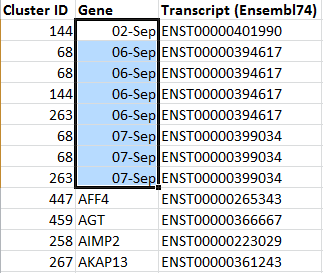
Example of the Excel formatting issue

Example of the Excel formatting issue

The authors of this paper claim that gene names in a large proportion of papers reporting gene expression data have this problem. Here we list the supplementary tables they identified in the journal prior to 2015 and from the first nine months of 2016 that we found to contain one or more misprints. We think that these mistakes do not prevent reuse of the datasets provided and as stated in the accompanying editorial Legible ledgers we do not propose to publish formal Corrigenda for the supplementary tables of these articles.


Double-blind peer review

Apaga_La_Luz_Y_Verás

{credit} “Apaga La Luz Y Verás” by Blofeldcine – Own work. Licensed under CC BY-SA 3.0 via Wikimedia Commons{/credit}

In this month’s editorialNature Genetics announces a new option available to authors at all monthly Nature Research Journals. Authors will now be able to opt in to double-blind peer review, so that anonymous reviewers will not have access to the authors’ identities. It will be the authors’ responsibility to make sure that their identities are removed from the manuscript. The decision to implement this option was made based on surveys of the scientific community and researcher feedback. What do you think of double-blind peer review? Will you choose this option for your own manuscripts? Why or why not? Let us know in the comments section below.

Love for Nature Genetics

In a previous blog post, I asked “what makes a Nature Genetics paper?” I have been slow to follow up on the post with my own answers to that question, but in the meantime I would like to share this email that brightened my day (edited for clarity): 

“I work on the field of genome-wide association studies (GWAS) in complex diseases and I note that of recent months, the criteria and standard of Nature Genetics (NG) for accepting GWAS papers is getting higher and higher.

 Looking back at this editorial from 3 years back:  https://www.nature.com/ng/journal/v43/n7/full/ng.881.html

Vol43_7

Cover art from Vol 43, Issue 7 {credit}John Arabolos{/credit}

It appears that NG remains truly interested in strong, novel biological insights arising from the genetic work, and this is really wonderful. Consistent with this, NG published a beautiful and conclusive GWAS on visceral leishmaniasis in 2013, even though very small studies in the past have hinted at the same gene, but without any power to be at all definitive. I could go on and on, as there are many such great examples.

Despite a ton of [rejections without review], my collective experience with the journal has been very good due to the consistency of the editorial decisions handed down, and the very helpful tone of the editors. It may seem subtle and not all that obvious, but I note that ‘secondary, strongly genome-wide significant, ethnic specific signals’ within a broadly known locus is usually not of sufficient novelty for NG, and it is really consistent throughout. The journal is to be saluted for the consistent, increase in standards throughout the years.”

We of course try to be as consistent as possible in our editorial decisions and to constantly raise the bar…though this doesn’t always make everyone happy, for sure. We’d love to hear from more of you (whether positive or negative feedback…though please keep it civil!). You can email me or directly leave a note in the comments if you prefer.

What makes a Nature Genetics paper?

largecoverIn the editorial published in the current issue of Nature Genetics, we draw attention to the development and implementation of community standards for biomedical publications. We also note that we will be discussing our own standards—interactively with the community, we hope—on this blog.

The goal is two-fold. First, we’d like to better communicate to researchers what we’re looking for in specific sub-fields (eg: genomic associations, cancer studies, epigenetics, evolutionary genetics, data analysis, etc) to more clearly answer the question “what makes a Nature Genetics paper?” Second, we want you to help us update what a Nature Genetics paper should be. Are there criteria we should be applying that we’re not? Don’t be shy. Obviously, we love to hear what we’re doing right, but it’s much more helpful to learn what we’re doing wrong.

So, to start off, I’m asking you: What makes a Nature Genetics paper? What should make a Nature Genetics paper? Send me your questions about our editorial processes or your comments/suggestions either in the comments to this post, by email (brooke.laflamme [at] us.nature.com) or on Twitter (@Brooke_LaFlamme). We will post contributions without name attribution unless you specify that you want to be named. For reasons of editorial responsibility we will need to record your name and affiliation offline. Questions and comments will be answered by staff on our editorial team in future posts.