Post by Igor I. Smolyaninov, Department of Electrical and Computer Engineering, University of Maryland.
How to build a ‘multiverse’ in a lab
Many physical properties of our universe, such as the relative strength of the fundamental interactions and the value of the cosmological constant appear to be fine-tuned for the existence of human life. One possible explanation of this fine tuning assumes the existence of a multiverse, which consists of a very large number of individual universes with different physical properties. Intelligent observers populate only a small subset of these universes, which are fine-tuned for life.
While this point of view may not be falsifiable based on astrophysical observations, one possible way to ascertain its viability may rely on macroscopic electrodynamics and condensed matter physics. In particular, the ‘optical spacetime’ in electromagnetic metamaterials (artificial structures patterned on a subwavelength scale to achieve unusual materials parameters) may be engineered to mimic the landscape of a multiverse that has regions with different topology and effective dimensionality. Nonlinear optics in metamaterials in these regions mimics Kaluza-Klein theories with one or more kinds of effective charges [1].
Another closely related model of a cosmological multiverse may be based on the electromagnetic properties of ferrofluids [2]. When a ferrofluid is subjected to a modest magnetic field, the nanoparticles inside the ferrofluid form small hyperbolic metamaterial domains, which from the electromagnetic standpoint behave as individual ‘Minkowski universes’. Microscopic spacetime defects and inflation-like behaviour appear to be generic within these individual Minkowski domains. It is remarkable that these non-trivial effects are accessible to direct experimental visualization using optical microscopy. Here I summarize several metamaterial systems that capture many features of cosmological models and offer insights into the hypothesized physics of the multiverse.
Electromagnetic metamaterials and transformation optics
The unconventional functional behaviors of the electric permittivity ε and magnetic permeability μ in metamaterials in the physical space lead to the creation of unusual ‘optical spaces’ that can be designed and engineered at will, opening the possibility of controlling the flow of light with nanometer spatial precision. Moreover, in a special class of hyperbolic metamaterials the optical space behaves like an ‘optical spacetime’, in which one of the spatial dimensions assumes a time-like character [3]. Hyperbolic metamaterials are extremely anisotropic electromagnetic materials, which behave like a metal in one direction and like a dielectric in the orthogonal direction. Hyperbolic metamaterials are typically composed of multilayer metal-dielectric or metal wire array structures. While in ordinary media all components of the ε tensor are positive, in hyperbolic metamaterials they have opposite signs in the orthogonal directions across quite broad hyperbolic frequency bands. Light can still propagate in such materials, but the direction of negative ε becomes time-like, so that the normally Euclidean optical space behaves more like a Minkowski spacetime at these frequencies. Light rays in this situation start to behave like evolving ‘world lines’.
Modeling time with metamaterials: metamaterial models of the Big Bang
The nature of time has been a major subject of science, philosophy and religion. Our everyday experiences tell us that time has a direction. On the other hand, most laws of physics appear to be symmetric with respect to time reversal. A few exceptions include the second law of thermodynamics, which states that entropy must increase over time, and the cosmological arrow of time, which points away from the Big Bang. While it is generally believed that the statistical and the cosmological arrows of time are connected, we cannot replay the Big Bang and prove this relationship experimentally. However, it appears that electromagnetic metamaterials may provide us with interesting tools to better understand this relationship and, maybe, the physical origins of time itself. For example, an experimental demonstration of the behavior of a world line near a toy Big Bang in an expanding metamaterial universe as a function of a timelike radial r coordinate can be seen in Figure 1.
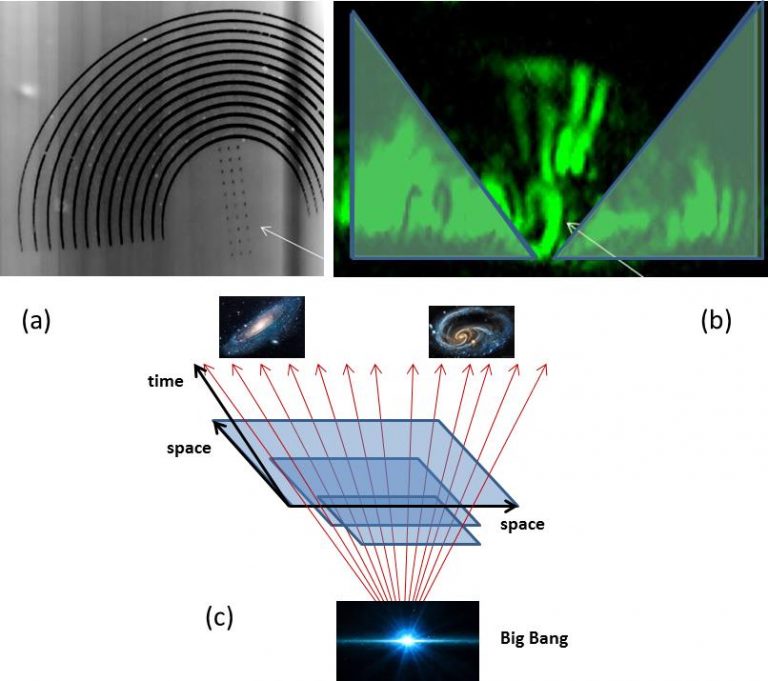
Figure 1 : (a) Atomic force microscopy image of a hyperbolic metamaterial structure. (b) Light rays increase their separation as a function of a timelike radial coordinate. Light scattering at the edges of the structure is partially blocked by semi-transparent triangles. (c) Schematic view of world lines behavior near the cosmological Big Bang.
Light rays are launched into the hyperbolic metamaterial near the r=0 point via the central phase matching structure (marked with an arrow in the figure). Similar to the world line behavior near the Big Bang (Fig. 1c), light rays or ‘world lines’ indeed increase their spatial separation as a function of a ‘timelike’ radial coordinate. This experimental model may illustrate the relationship between the statistical and the cosmological arrows of time if disorder is introduced in this metamaterial structure [3].
Metamaterial multiverse experiments in ferrofluids
Let us now turn our attention to self-assembled hyperbolic metamaterials made of ferrofluids, which share some common features with the class of cosmological models of the multiverse based on the loop quantum gravity [4]. This analogy relies on the fact that a modest external magnetic field aligns most of the individual magnetic nanoparticles in the ferrofluid into long parallel chains, so that the ferrofluid becomes a self-assembled hyperbolic metamaterial [5]. It appears that both loop quantum gravity models and the hyperbolic metamaterials may exhibit metric signature phase transitions [4], during which the spacetime metric used to describe the system changes its signature. Moreover, the metric signature transition in a ferrofluid leads to separation of the optical spacetime into a multitude of intermingled Minkowski and Euclidean domains, giving rise to a ‘metamaterial multiverse’ [2]. Inflation-like behaviour appears to be generic within the individual Minkowski domains (Fig. 2). Thus, studies of the optical spacetime in ferrofluids may illustrate the potential existence of parallel universes and shed some light on the ‘measure problem’ in a multiverse, which has to do with making probabilistic predictions of some particular measurement outcomes in a multiverse setting. All these effects may be studied in ferrofluids via direct microscopic observations.
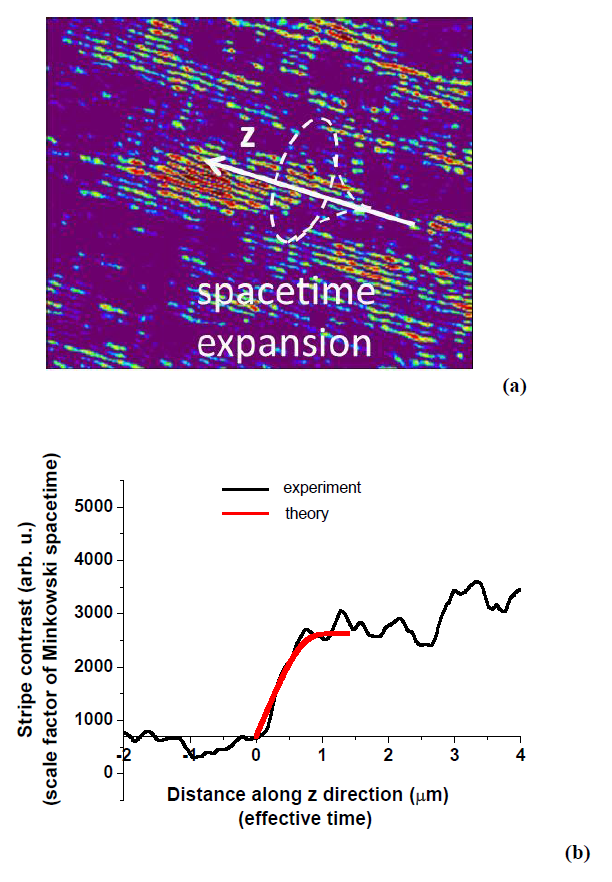
Figure 2: (a) This magnified image of the Minkowski domains in a ferrofluid illustrates inflation-like expansion of the optical spacetime near the domain wall. (b) Measured and calculated dependencies of the spacetime scale factor on the effective time.
Microscopic observation of spacetime melting in ferrofluids
Recent developments in gravitation theory provide numerous clues that strongly indicate that classic general relativity is an effective macroscopic theory, which will be eventually replaced with a more fundamental theory based on yet unknown microscopic degrees of freedom. Unfortunately, these true microscopic degrees of freedom cannot be probed directly. Our ability to obtain experimental insights into the future microscopic theory is severely limited by the low energy scales available to terrestrial physics and even to astronomical observations. In order to circumvent this problem, it is instructive to look at various examples of emergent gravity and analogue spacetimes [6] that appear in solid state systems such as superfluid helium, electromagnetic metamaterials and cold atomic Bose-Einstein condensates.
As discussed above, ferrofluids subjected to an external magnetic field have emerged as an interesting example of an electromagnetic metamaterial, which exhibits gravity-like nonlinear optical interactions, and which may be described by an emergent effective Minkowski spacetime. Unlike other more typical metamaterial systems, such a macroscopic self-assembled 3D metamaterial, they may also exhibit physics associated with topological defects and phase transitions. In particular, effective Minkowski spacetime melting may be observed and visualized in these metamaterials. If the magnetic field is not strong enough to hold nanoparticle chains together, the optical Minkowski spacetime gradually melts under the influence of thermal fluctuations. It may also restore itself, if the magnetic field is increased back to its original value. Such a direct microscopic visualization of Minkowski spacetime melting is depicted in Figure 3.
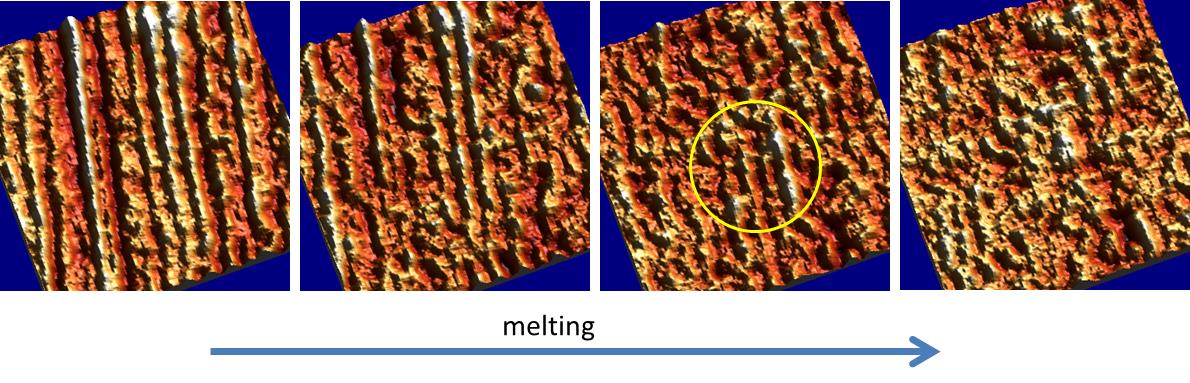
Figure 3: Magnified quasi-3D images taken from a movie of the effective Minkowski spacetime melting in a ferrofluid. A small region in the third frame, which remains in a microscopic Minkowski spacetime state (while the rest of the original spacetime has already melted) is highlighted by the yellow circle.
Outlook
The mutually related fields of electromagnetic metamaterials and transformation optics are experiencing extremely fast progress. While most of the experimental and theoretical work in these fields is devoted to revolutionary practical devices, such as super-resolution microscopes and electromagnetic invisibility cloaks, I have tried to show that they also have enormous potential in helping to shed light on some of the most fundamental problems of philosophy and science, such as the nature of time or potential existence of alternative universes. While the metamaterial systems considered here may or may not have anything in common with the real physical universe, they may still teach us a lot about the fundamental physics governing it.
References
- I. I. Smolyaninov, Journal of Optics 13, 024004 (2011)
- I. I. Smolyaninov, B. Yost, E. Bates, V. N. Smolyaninova, Optics Express 21, 14918 (2013).
- I. I. Smolyaninov, Y. J. Hung, JOSA B 28, 1591 (2011).
- M. Bojowald, J. Mielczarek. J. of Cosmology and Astroparticle Phys. 08, 052 (2015).
- V.N. Smolyaninova, et al. Scientific Reports 4, 5706 (2014).
- C. Barcelo, S. Liberati, M. Visser, Living Rev. Relativity 8, 12 (2005).