Interactions: Marco Martini

Marco Martini is in  the Materials Science Department of the University of Milano-Bicocca.

What did you train in?
Nuclear physics, environmental radioactivity.

What are you working on now?
Experimental condensed matter, interaction of ionizing radiation with materials, dosimetry and its applications to archaeological dating.

What motivated you to move to this field of research?
I found it very appealing to apply my knowledge in radiation physics both on the side of the interaction of radiation with matter and of the properties of insulating materials. The application has been either on new materials, fiber optics and microelectronics, or on ancient materials, mainly ceramics. This latter application introduced me to a very different field, i.e. science for archaeology and history of art, which has been named “archaeometry” since the 1960s.

What did you find more difficult when you started working in an area out of your comfort zone?
The approach to works of art is completely different for a physicist and an archaeologist, at least a traditional one, in the sense that particularly in the Mediterranean area, and mostly in Italy, the study of archaeological pieces is mainly based on the individual experience of the archaeologist and the scientific approach has been almost neglected up to a few years ago. Nowadays things are changing and archaeometry is expanding, making scholars in the humanities and in hard sciences meet and contribute to common researches.

And what did you find most helpful to familiarize yourself with new concepts and jargon?
For many years is has been very difficult to find a common jargon with archaeologists and art historians. The interest in understanding ancient civilizations has always been the driving force in applying the scientific method and in explaining how helpful scientific data can be, provided that they are always compared with the experience of the archaeological team.

Tell us about your experience the first time you went to a conference outside the field you trained in.
I must say that it was not so challenging, because I was so eager to let my colleagues know the power of scientific data in contributing to archaeological research that I tried to make all the scientific data accessible to them.

What are the main challenges and the main advantages of working in an interdisciplinary team?
It is extremely interesting, also because you always see how physics can be useful in fields apparently very far removed from it. At the same time it must be considered that building a career is much more complicated than when remaining inside an orthodox physics field, mainly due to the difficulties in finding appropriate journals: only very few results are so important to be published in international journals of high impact. Most results are very useful in the field, but no as highly considered as traditional physics experiments. Furthermore the community is not so wide and the citation numbers increase very slowly.

What would be your advice to a PI leading an interdisciplinary group?
In my opinion it is essential that before contributing to an interdisciplinary field, a researcher has a consolidated knowledge of his own discipline. A physicist can be a good archaeometer if he is a good physicist first.

Do you find it particularly difficult to obtain funding? Or to get your research published?
Nowadays, particularly in Italy, but also at the international level, the attention for cultural heritage is increasing and experienced laboratories are supported by public and private institutions.

Is there any anecdote you would like to share?
The archaeometry community is very composite, and you can be invited to contribute to local workshops and national meetings. Long ago I was invited to present our results on the Valdivia South American culture, which turned out to be one of the most ancient ones in the American subcontinent. I prepared my talk in English, but after a while I was invited to talk in Spanish, because almost half of the audience, mainly archaeologists, was not familiar with English. I spent in the past a few short periods in Spain due to a scientific collaboration: even if the Spanish and Italian languages are related, my Spanish is very poor. Nonetheless, my Italian-Spanish talk was understood and appreciated!

Interactions: Maria Vozmediano

Maria Vozmediano is in  the Instituto de Ciencia de Materiales de Madrid and works on field theories in condensed matter physics.

What did you train in?
Particle physics and cosmology. String theory.

What are you working on now?
Condensed matter physics.

Do you think of yourself as a quantum field theorist or as a condensed matter theorist?
I consider myself a physicist.

What motivated you to move to this field of research?
As many string physicists, from the string worldsheet I moved to 2D quantum gravity, membranes, anyon physics and anyon  superconductivity. Also, fullerenes appeared to me through a solid-state friend, as Dirac physics at the surface of a sphere.

What did you find more difficult when you started working in an area out of your comfort zone?
The phenomenological assumptions of the new field. The Landau-Fermi liquid theory was a great mystery to me till I read an article from J. Polchinski showing it as a fixed point of a renormalization group. It is very hard not to understand what seems obvious to everybody.

And what did you find most helpful to familiarize yourself with new concepts and jargon?
The collaboration with a very good condensed matter practitioner was essential to identify the problems of interest and the approximations used in the field.

Tell us about your experience the first time you went to a conference outside the field you trained in.
I felt horrible. The “impostor syndrome” to a high power. Besides, no friends or well known people to help.

What are the main challenges and the main advantages of working in an interdisciplinary team?
The best is to recognize same problems in disguise. To see the appreciation of simple things when they are seen with different eyes.  It is a lot of fun when there is mutual respect and appreciation between people in the complementary field. The problems come from  average or mediocre physicists that feel challenged by a different point of view. I have been lucky as the quantum field theory techniques have become a necessity in condensed matter. It is not easy at the beginning when you are seen as an outsider from an “rival field”.

What would be your advice to a PI leading an interdisciplinary group?
To any PI: choose the best people, intelligent and imaginative  no matter their expertise.

Do you find it particularly difficult to obtain funding? Or to get your research published?
Publishing has never been a problem. Been accepted by the condensed matter community has been harder. As a theoretician, funding has also not been a problem.

Is there any anecdote you would like to share?
This is not really due to changing fields. Once I was introduced as Dr. Vozmediano to a colleague who told me it was not possible because Vozmediano was a man.

10 things to remember for when you have graduate students

Guest post by Charlie Ebersole, a social psychology graduate student at the University of Virginia.

Graduate school has been both a wonderful experience and incredibly challenging. When I will later look back on this period in my life, I’m sure that my memory will fail to accurately capture what it was like to be a graduate student. I’ll remember the highs, and more lows than I care to admit, but will likely lose some of what the day-to-day experience was like. If I have graduate students of my own someday, I want to have a more complete picture of what graduate school was like so that I can give them a better experience. With that goal in mind (and with some great suggestions from Twitter folks), I compiled the following list for my future self.   

Things to remember for when you have graduate students
Gentle reminders from past you to help current you give your students a better experience 

    1. There are a lot of little ways that you can make their lives easier. For instance, if you suggest a literature for them to search, try to give them some citations as a starting point. That way, they don’t have to guess which articles you were thinking about. Little things like this can really add up in the long run.
    2. Although class grades might not matter as much in grad school, your students got into grad school, in part, because they were good at getting good grades. That drive won’t go away immediately. Same goes for deadlines. Be patient while they figure out priorities.
    3. Tell your students: Wanting to look competent is natural and useful in some settings. However, it’s also important to admit when you don’t know things. Acting like you know more than you do stifles opportunities for others to teach you new things. This is probably going to be an ongoing struggle; that’s ok. Let me know how I can make it easier for you to say when you don’t know things.
    4. Remind them that they have/will develop expertise that will surpass you. Take opportunities to learn from them so that they recognize this.
    5. Remember that shielding your students from their weaknesses will hurt their development. Also remember that hearing critiques from your advisor can be hard.
    6. It’s hard to know when you’re doing well as a grad student. Be sure to tell students when they’re doing well and point out what you see as their strengths. That can help balance when you need to do #5.
    7. Things from outside of work will affect work. Try to create an environment where students feel comfortable letting you know those things. As an example from your time in grad school: Brian regularly asking about your life outside of work (e.g., “how was your weekend?” at the start of each meeting) made it easier for you to bring up struggles when they were affecting your progress.
    8. Sometimes fighting for your students is as important as the outcome. You’re not going to win everything (or, frankly, most things), but showing that you care enough to stick up for them goes a long way.
    9. Grad students don’t make a lot of money. They might not have a lot saved either. Keep that in mind. Things that might not seem like much to you (like being a few hundred dollars in debt while waiting to get reimbursed for conference travel) might be a serious strain for them.
    10. Finally, you were really bad at writing when you started grad school. It’s probably just good to keep that in mind when looking at your students’ writing.

Interactions: William Hamlyn

William was awarded a Nature Reviews Physics poster prize at ICAP 2018.

Please introduce yourself 

I am a 3rd year PhD student at Durham University, UK, I collaborate with the Max Planck Institute for the Science of Light, Germany, and I work with atoms. A single atom is cool because it is a ‘quantum’ object and studying it can teach us about fundamental physics. A single atom is also cool because it can interact with a single photon. Systems built of single atoms communicating via single photons offer some interesting and mysterious uses; one Holy Grail of this community being a universal quantum computer. The challenge currently is how do we acquire a single atom? And how can we manipulate it? This is what my experiment focusses on (pun intended). I use thermal vapours of rubidium confined within nanometre-scale glass cavities (e.g. a fancy double-glazed window). This offers a novel and relatively simple method to approach the limit of having a single atom, on demand.

1.  Can you briefly explain the results for which you got the award?

My award was mainly for the creation and characterization of the ‘nanocells’ that we make. We are able to confine atomic vapour in structures ~500 nm in size. As was mentioned, it is really the novel approach that we are taking and the methodology itself that is the most interesting to the atomic physics community. To give some context: A typical cold-atom experiment might use ~200 BNC connectors to control the experiment, I currently use just 6. This is the beauty and ‘simplicity’ of thermal vapour experiments.

2.  What do you hope will be the impact of your research?

This depends on scale. Within our field we hope to produce a robust platform for single atom – single photon experiments. In research physics as a whole I hope to prove that one can ‘dare to dream’ if that isn’t too cliché. That there may exist some radically different approaches to achieving a goal, and that we can learn a lot by looking at methods used by other fields. For example, my microscopy setup is also used commonly in bio-physics experiments. In a wider context, it is possible that the understanding of fundamental physics can later lead to the exploitation and harnessing of these effects. One parallel could be to look at Faraday. Faraday was a researcher and in his lab he experimented with the effects of electromagnetism (later formalised by Maxwell). He was studying fundamental physics, he was not an inventor. Yet, 150 years later we have electric motors, lights, kettles, and the national grid. All things made possible by first understanding nature, and then harnessing these effects.

3.  What made you want to be a physicist in the first place?

To be honest not much. We choose our GCSEs, A-levels and degree at quite a young age. Certainly without the experience of knowing different fields in depth. I was good at science and I enjoyed being able to get satisfying answers on how things worked, and so I pursued it. Moreover, I cannot say if I will always be in the field and so, despite the fact that I am a PhD student in physics, I would argue that I never really ‘chose’ to be a physicist. I had no particular goal in mind, I simply chose the local most interesting decision at the time, and this path has lead me to where I am now. Perhaps that is how a passion manifests itself. In short: there was no single event of inspiration, but instead an ongoing process of learning and following the course of making rather short-term decisions that has steered me to where I am now.

4.   If you weren’t a physicist, what would you like to be (and why)?

I think I would try to be a professional athlete. Another great joy in my life is sport, and I do as much as I can currently. I would be curious to see how far I could get if I were to give it my full attention.

5.   Which is the development that you would really like to see in the next 10 years?

In the past century or so we have seen a continuous improvement in the understanding of the natural world that has come about by major international collaboration. Gone are the days where a single person can witness a natural phenomenon by candle light (well you still can, but it is nothing new). Today the world is more connected, and we study physics with greater precision and reliability than ever before. Experiments often take years of setup, controlled lab environments, and this all takes funding and the sharing of expertise. Science is also more accessible too with social revolution driving equality and allowing all people to pursue a career in science. I would simply like to see this continue. No one can predict the events of the future, and aiming for what you cannot see is impossible. However, what we can do is build the most productive and healthy work environment that we can, and to allow people and ideas to flourish.

6.    What is your non-scientifically accurate guilty pleasure (could be film/series/book)?

Guilty pleasure? Definitely farming simulator. I’d say it’s non-scientifically accurate by the extraordinary plant yields that seem to defy any conservation law. The physics engine is quite primitive too.

Interactions: Jeanne Colbois

Jeanne is a first year PhD student in the chair of condensed matter theory lead by Professor Frédéric Mila at École polytechnique fédérale de Lausanne, in Switzerland. The general aim of the group is to explore new phases of matter induced by strong correlations in electronic systems, which is done by investigating analytically and numerically the role of frustration or competing interactions in lattice models of low-dimensional quantum magnetism. She is the recipient of one of the poster prizes sponsored by Nature Reviews Physics at the Machine Learning for Quantum Many-body Physics workshop that happen last June in Dresden.


1.    Can you briefly explain the results for which you got the award?

I have been mainly focusing on the Ising model with antiferromagnetic further-neighbour couplings on the kagomé lattice. I am doing Monte Carlo simulations to try and understand how the physics of this model changes depending on the range of the interactions taken into account. It was a nice surprise to get an award for my poster, given that the main focus of the conference was Machine Learning for quantum many-body physics, and I have not been doing machine learning so far.

2.    What do you hope will be the impact of your research?

I am looking at a very specific problem, so I think the dream would be that new, more general questions would arise from studying this system.

3.    What made you want to be a physicist in the first place?

For me, it is a good balance between trying to understand our surroundings, trying to solve interesting and challenging problems, and meeting dedicated people whom I have a lot to learn from.

4.    If you weren’t a physicist, what would you like to be (and why)?

I think, as long as I would be trying to solve some problems and would feel useful in some way, I would be happy.

5.    What would be your physics superpower?

Asking the right question right away.

6.    What is your non-scientifically accurate guilty pleasure?

Maybe I don’t feel guilty enough about it, but I spend a lot of time playing and listening to music.

Interactions: Max McGinley

Max is a first year PhD student at Cambridge University. He works in the Theory of Condensed Matter group, supervised by Professor Nigel Cooper, and studies the theory behind certain interesting phases of matter which are known as ‘topological’. Max was awarded a poster prize sponsored by Nature Reviews Physics at the Quantum Dynamics of Disordered Interacting Systems conference in Trieste last June.

 1.    Can you briefly explain the results for which you got the award?

Topological phases of matter, unlike the familiar solid, liquid, and gas phases, are unconventional because they are inherently quantum mechanical. Their name refers to some `twist’ in the wavefunction that cannot be undone even if the system is deformed – much like how the hole in a torus (doughnut shape) can’t be removed continuously. In our work, we considered what happens to these topological wavefunctions when they are far from equilibrium and undergo some dynamics, for example if the environment suddenly changes. We found that whilst some topological phases stay topological after time evolution, others will ‘untwist’ as time goes on. We also proposed some ways in which this untwisting could be measured in experiments.

2.    What do you hope will be the impact of your research?

As well as being interesting for fundamental physics, researchers are currently discussing how these topological phases can be used to engineer quantum computers, which is an ambitious but exciting prospect. Although our work is more on the theoretical side, I hope that it can aid future work on topological quantum computers, especially since non-equilibrium dynamics will be unavoidable if such a computer is actually operated.

3.    What made you want to be a physicist in the first place?

I think what I most enjoyed about physics to start with was the idea that nature could be understood with a few neat mathematical ideas, even if I didn’t understand exactly what those ideas meant at the time. I find it extremely gratifying to see these elegant concepts show up not just in fundamental physics, but also in the study of real materials and (hopefully!) future technologies.

4.    If you weren’t a physicist, what would you like to be (and why)?

At school I was always torn between studying science and music, and in the end physics won, but a career in the music industry would be really exciting. I think there’s a mathematical side to music that I find quite appealing, so maybe they’re not quite as different as they seem.

5.    What’s your favourite (quasi-)particle?

Seeing as it mediates sound, I’d have to go for the phonon (see above).

6.    If you could have an effect or equation named after you, what would it be?

Every time I visit home, my parents always ask me if I’ve discovered a new element `McGinley-um’ yet, so it would have to be that. Although I think `Maximili-um’ might sound better.

Interactions: Amanda Lewis

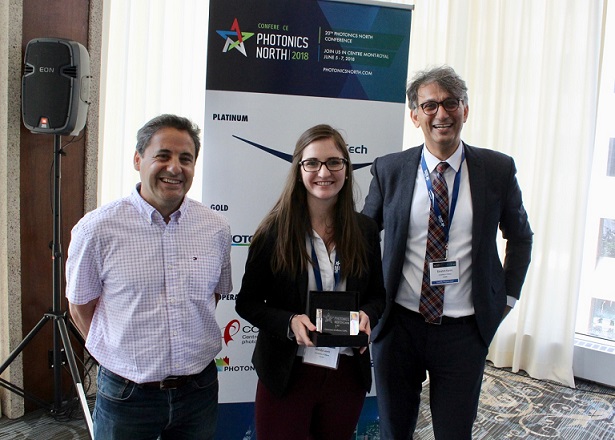
Mandy is a graduate student at the University of Ottawa working in the SUNLAB, a group focused on high-performance photovoltaic devices, photovoltaic systems, and electrical utility grid-edge applications. She recently won a poster prize sponsored by Nature Reviews Physics at Photonics North.

1.       Can you briefly explain the results for which you got the award?

Regular solar panels only absorb light that is incident on their front face. In contrast to those monofacial panels, bifacial solar panels can absorb light illuminating both the front and rear faces. Our group at the SUNLAB has developed modelling software to estimate the electrical energy yield of bifacial solar panels based on solar resource and environmental data,

with a focus on their potential impact in Canada’s North. We predicted an energy yield increase of over 24 percent using bifacial solar panels over monofacial panels for northern locations in Canada.

2.      What do you hope will be the impact of your research?

I hope to demonstrate that bifacial solar panels are a viable technology for Canada that performs in many environments – not only in hot, sunny locations. In fact, as these results show, the advantages of bifacial technology are even greater in Northern regions where solar power is conventionally assumed to be not as effective. This can allow remote communities to replace existing diesel-based power generation; many remote communities require diesel fuel to be flown in to generate power, which is inefficient, expensive, and polluting. Green alternatives like bifacial solar panels present a good opportunity to help achieve climate change objectives by reducing emissions.

3.      What made you want to be a physicist in the first place?

I chose to pursue research in order to make a positive impact, socially and environmentally. The work that the SUNLAB does with next-generation solar technology is really exciting, and I believe that breakthroughs in solar energy research will help to reduce our society’s reliance on fossil fuels. I also love an intellectual challenge, which is easily found in the work that we do.

4.       If you weren’t a physicist, what would you like to be (and why)?

It would be really interesting to work as a scientific educator or reporter, learning about new developments in a variety of fields and making them accessible to the public. I’m a big fan of podcasts, and I envy the work that the Stuff You Should Know hosts and the Economist’s Babbage get to do.

5.      What is your non-scientifically accurate guilty pleasure (could be film/series/book)?

I have a soft spot for Joss Whedon’s Firefly. It’s a really fun space/western story with lots of implausible technology, but the characters are charming.

6.    What would be your physics superpower?

I would love to have the power to teleport through time and space, like Hiro Nakamura or Doctor Who. I would want to visit all the most interesting times and places in history.